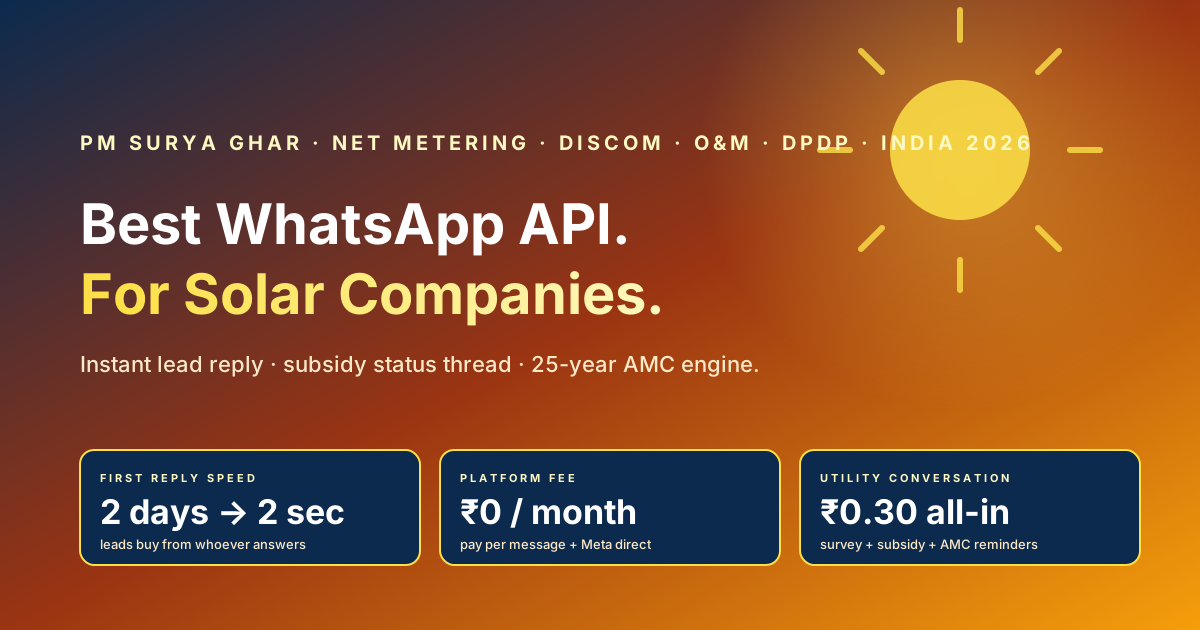
Few industries in India are growing as fast, or selling something as expensive and as slow-to-close, as rooftop solar in 2026. With the PM Surya Ghar Muft Bijli Yojana pushing residential rooftop adoption, falling panel prices, and a flood of EPC installers, solar EPCs, dealers and O&M (operations and maintenance) companies are drowning in leads they cannot follow up fast enough — and losing the ones they do reach to a long, paperwork-heavy buying journey. A solar sale is not an impulse buy: it is a ₹1.5 lakh to ₹15 lakh decision with a site survey, a subsidy application, a discom net-metering approval, a financing conversation and an installation that can take weeks. The single biggest leak in Indian solar is not lead generation — it is the lead that enquired, got a slow call-back two days later, and bought from the installer who replied in two minutes. This is the buyer's guide to choosing the best WhatsApp Business API for a solar company in India in 2026: what actually matters for this vertical, the lifecycle it has to carry, and how to pick a platform that does not bleed your margins on platform fees. Every regulator, scheme and pricing specific below is hedged — Indian solar policy, subsidy structures and discom rules move quickly, so treat each as "verify as of 2026," treat every figure as illustrative, and treat none of this as legal or financial advice.
Why solar selling is a WhatsApp problem. A rooftop solar lead is high-intent but high-friction: the customer wants to know the system size, the price after subsidy, the savings on their electricity bill, the financing EMI and the timeline — and they want it now, on the channel they already use. Email is ignored, a missed phone call kills the lead, and a busy sales team cannot personally chase every site survey, subsidy form and discom approval across a weeks-long pipeline. WhatsApp — opened within minutes, read far more than email — is where a solar company captures the click-to-WhatsApp ad lead, qualifies roof type and bill amount, books the site survey, walks the customer through the PM Surya Ghar subsidy and net-metering steps, shares the proposal and EMI options, and keeps the deal warm until installation, provided every send is consent-based and honest. Verify the operative scheme and discom rules as of 2026.
What "best" actually means for a solar company
The "best WhatsApp Business API" for a solar EPC is not the one with the most features or the loudest brand — it is the one that fits the specific shape of a solar sale: long, consultative, document-heavy and subsidy-dependent. Before comparing logos, get clear on the criteria that actually decide outcomes for this vertical. The table below is the buyer's checklist — weigh each against your own pipeline as of 2026.
| What to evaluate | Why it matters for solar | What good looks like |
|---|---|---|
| Speed-to-first-reply | Solar leads buy from whoever answers first; a 2-day call-back is a lost deal | Instant automated reply on a click-to-WhatsApp ad, 24x7 |
| Lead qualification flow | Roof type, monthly bill, ownership and pincode decide whether a lead is worth a survey | A chatbot that captures these before a salesperson spends time |
| Document & media handling | Proposals, subsidy forms, bill photos and panel datasheets travel in-thread | PDF, image and file send/receive with human handoff |
| Long-pipeline nurture | A solar deal takes weeks across survey, subsidy, finance and install | Scheduled follow-ups and stage reminders that keep the deal warm |
| Transparent, low pricing | Thin EPC margins cannot absorb a fat per-seat SaaS platform fee | ₹0 platform fee, pay only per message and Meta's conversation charge |
| O&M & service after install | The relationship continues for 25 years of generation and AMC | Service reminders, generation alerts and AMC renewal on the same line |
The reframe most solar founders eventually make: the platform is not the product — the lifecycle it lets you run is. A solar company that picks a WhatsApp platform on price-per-message alone, but cannot run a qualification flow or a weeks-long nurture, has bought a cheaper way to lose deals. Pick for the journey, then optimise the cost.
The end-to-end solar WhatsApp lifecycle
Here is the full rooftop-solar lifecycle a company can run over WhatsApp, from the first ad click to the 25-year O&M relationship, mapped to the automation at each stage and the guardrail that keeps it honest. Treat the automation column as a reference pattern and verify scheme and discom specifics as of 2026.
| Lifecycle stage | WhatsApp automation | Guardrail (verify 2026) |
|---|---|---|
| 1. Lead capture | Click-to-WhatsApp ad opens a chat; bot replies instantly and captures pincode, monthly bill, roof type and ownership | Capture consent at first contact; honour opt-out |
| 2. Qualification & sizing | Bot estimates indicative system size and bill savings from the inputs and routes hot leads to a salesperson | Estimates clearly marked indicative, subject to site survey; no guaranteed-savings claims |
| 3. Site survey booking | Booking flow offers survey slots with day-before and hour-before reminders to cut no-shows | Utility-style reminders; factual, not promotional |
| 4. Proposal & subsidy | Proposal PDF, system design and PM Surya Ghar subsidy and net-metering steps shared in-thread | Subsidy figures hedged to current scheme; no false eligibility promises |
| 5. Financing & close | EMI and loan options, payment links and order confirmation, with a human for negotiation | Financing terms accurate; route to a human for the commitment |
| 6. Installation & commissioning | Status updates across material dispatch, install date, discom inspection and meter installation | Honest timelines; set expectations on discom-dependent steps |
| 7. O&M, AMC & referrals | Generation check-ins, cleaning and service reminders, AMC renewal and referral asks for 25 years | Separate consent for service vs marketing; minimise data |
Notice the rhythm: WhatsApp carries a sale that is too long and too document-heavy for phone calls alone to sustain, then keeps the customer for the decades-long generation relationship where AMC and referrals live. For the deeper customer-lifecycle view across solar and EV charging, our solar rooftop and EV-charging customer lifecycle guide is a close companion, and for the agri-pump segment the PM-KUSUM solar pump playbook covers the subsidy-driven flow in depth.
The subsidy and discom thread: where most solar deals stall
The single most deal-killing part of a rooftop solar sale is not price — it is the bureaucracy between "yes" and "switched on": the PM Surya Ghar application, the discom net-metering approval, the inspection and the meter installation. Customers get anxious in this gap, lose trust, and sometimes cancel. WhatsApp is the highest-leverage place to manage it: a status thread that tells the customer exactly which step they are on, what document is needed next, and what to expect, removes the anxiety that kills deals at the finish line. Done well, the subsidy-and-discom thread turns the most frustrating part of a solar purchase into a reassuring, transparent experience — which protects the deal you already won and earns the referral that follows.
The subsidy thread, in one principle. Treat the subsidy and net-metering journey as a transparent, consent-based status sequence, not a black box. Tell the customer which stage they are on, what is pending, and a realistic timeline, and make it trivially easy to send a document or ask a question that routes to a human. Keep every subsidy and eligibility figure hedged to the current scheme rules, never promise an eligibility or a sanction you do not control, and route anything official to your team. The thread should feel like a company that has done this a hundred times, calmly guiding the customer through — never like silence. Verify the PM Surya Ghar scheme and discom net-metering rules as of 2026; this is not legal or financial advice.
Per-seat SaaS vs a ₹0-platform model: the margin question
Solar EPC margins are thin and getting thinner as competition rises. The WhatsApp platform you pick should not be a fixed monthly tax on every salesperson regardless of how many deals close. Most legacy BSPs charge a per-seat or tiered monthly platform fee on top of Meta's own per-conversation charge; a ₹0-platform model charges only for what you actually send. This comparison is directional — verify current pricing on each vendor as of 2026.
Get a 1-minute BSP audit on WhatsApp
Drop your WhatsApp number — we line-item your current invoice against Meta India rates in under 60 seconds. India-hosted, DPDP-compliant.
| Dimension | ₹0-platform model (RichAutomate) | Typical per-seat / tiered SaaS BSP |
|---|---|---|
| Platform / setup / monthly fee | ₹0 platform, ₹0 setup, ₹0 monthly | Monthly platform fee, often per seat or per tier |
| What you pay for | Only per message + Meta's conversation charge | Subscription + markup on conversations |
| Fit for seasonal solar demand | Costs scale with sends; quiet months cost little | You pay the subscription even in a slow month |
| Margin impact on a ₹2L system sale | Messaging cost is a rounding error | Fixed fee eats into thin EPC margin |
| Billing transparency | Client Pay: Meta bills you direct at Meta rates | Often a bundled markup you cannot see through |
The conclusion most solar founders reach: for a vertical with thin margins, seasonal demand and high deal values, a model where the messaging cost is a rounding error against the sale beats a fixed monthly tax that you pay whether you close one system or fifty. Run your own numbers on the WABA cost calculator and read the Client Pay vs SaaS Pay billing breakdown before committing.
Before you commit to a move, the BSP migration cost calculator gives you the all-in figure rather than the sticker price.
The automation stack that runs it
The good news for a solar company is that none of this needs custom engineering. The building blocks map onto a standard WhatsApp Business API automation stack: a click-to-WhatsApp lead-capture flow that qualifies pincode, bill and roof type instantly; a chatbot FAQ that answers the predictable questions — subsidy amount, system size, savings, financing, timeline — without a human; a site-survey booking engine with day-before and hour-before reminders; a proposal and document layer that sends PDFs, datasheets and subsidy forms in-thread; a long-pipeline nurture sequence that keeps a weeks-long deal warm across survey, subsidy, finance and install; payment links and UPI for booking amounts and EMIs; broadcast for opted-in scheme updates and seasonal offers; and a human handoff the moment a customer wants to negotiate or asks something official. For the relationship-management view across your whole pipeline, the best WhatsApp CRM for India guide is a useful companion. The discipline is to keep the chatbot scoped to qualification, logistics and honest scheme information, and route every commitment and official query to a human.
The economics: an illustrative solar cohort
Criteria and architecture are the floor; the reason to run WhatsApp across the solar lifecycle is faster first-reply, more surveys booked, fewer deals lost in the subsidy gap, and more O&M and referral revenue captured after install. Consider an illustrative rooftop-solar EPC running a mix of residential PM Surya Ghar, housing-society and small-commercial enquiries from click-to-WhatsApp ads. Every figure below is illustrative — model your own on the calculator.
| Metric (illustrative) | Without WhatsApp lifecycle | With WhatsApp lifecycle |
|---|---|---|
| Speed to first reply | Hours to days (manual call-back) | Seconds (instant automated reply) |
| Leads qualified before a salesperson spends time | Few; team chases cold leads | Most; bot filters roof, bill and ownership |
| Site-survey no-show rate | Higher (no reminders) | Lower (day-before + hour-before reminders) |
| Deals lost in the subsidy/discom gap | Higher (anxiety, silence) | Lower (transparent status thread) |
| WhatsApp messaging cost | ₹0 | Utility reminders at the cheapest tier |
The asymmetry is the argument: qualification, survey reminders, subsidy-status updates, proposals and AMC reminders are utility-category conversations — the cheapest tier — and they directly reduce the most expensive failures in a solar business, namely slow first-replies, wasted survey trips, deals abandoned in the paperwork gap, and a customer base that is never re-engaged for AMC or referrals. A handful of extra closed systems a month dwarf the messaging bill, which is a rounding error against a ₹2 lakh sale. Run your own figures on the WABA pricing and cost-optimisation guide before committing.
Build the solar lifecycle on RichAutomate
You can stand up the entire solar-sales-and-service layer — instant click-to-WhatsApp lead capture and qualification, indicative sizing and savings estimates with human routing, site-survey booking with reminders, proposal and subsidy-form delivery in-thread, a transparent PM Surya Ghar and discom status thread, financing and payment links, installation and commissioning updates, and a 25-year O&M, AMC-renewal and referral engine — without engineering lift, while your CRM and team stay the source of truth. RichAutomate charges ₹0 platform fee, ₹0 setup, ₹0 monthly. On Client Pay you pay only ₹0.10 per message plus Meta's own per-conversation charge billed to you directly by Meta at Meta's rates; on SaaS Pay it is an all-in ₹1.20 per marketing conversation and ₹0.30 per utility conversation — and survey reminders, subsidy-status updates, proposals and AMC reminders are utility conversations, the cheaper category. There is a 14-day free trial with 100 credits, so you can measure the first-reply speed, survey-booking and close-rate improvement before committing. Keep WhatsApp as the conversation layer, keep your CRM and team as the source of truth, and verify the PM Surya Ghar scheme, discom net-metering rules, financing terms and DPDP data rules as of 2026. See the full pricing page for details.
Stop losing solar deals to a slow call-back
A solar EPC, dealer or O&M company does not have to let high-intent rooftop leads leak away because the first reply took two days, the site survey was a no-show, or the customer got anxious in the subsidy gap and cancelled. From the instant click-to-WhatsApp capture and qualification, through the booked-and-reminded survey, the in-thread proposal, the transparent PM Surya Ghar and discom status updates, the financing and close, the installation milestones, and the 25-year O&M, AMC and referral relationship — WhatsApp can be the one continuous customer thread, while your CRM and team stay the source of truth. On illustrative numbers that means faster first-replies, more surveys booked, fewer deals lost in the paperwork gap and more AMC and referral revenue, for a messaging bill that is a rounding error against a ₹2 lakh sale. RichAutomate's pricing stays flat through all of it: ₹0 platform fee, ₹0 setup, ₹0 monthly — Client Pay at ₹0.10 per message with Meta conversation charges billed direct by Meta, or SaaS Pay at ₹1.20 marketing / ₹0.30 utility all-in. Start the 14-day free trial with 100 credits, WhatsApp us at 918160311319, or book a 30-minute walkthrough at https://calendly.com/inrichdaddy/30min. (All cohort, reply-time, survey and close figures here are illustrative — model your own on the calculator — and the PM Surya Ghar scheme, discom net-metering rules, financing terms and DPDP rules change; verify the current position as of 2026. This is operational guidance, not legal or financial advice.)
Start your 14-day free trial → · See full pricing · Read the solar lifecycle guide
Start your WhatsApp automation free
₹0 platform, setup & monthly — pay only per message. 14-day free trial + 100 credits. Get your free WhatsApp Business API setup in 24–48 hrs.
Chat with us on WhatsApp → Book a 30-min demoRelated: WhatsApp for rooftop solar EPC installers in India 2026 — enquiry capture, site-survey booking, DISCOM net-metering status and PM Surya Ghar subsidy tracking on one thread.