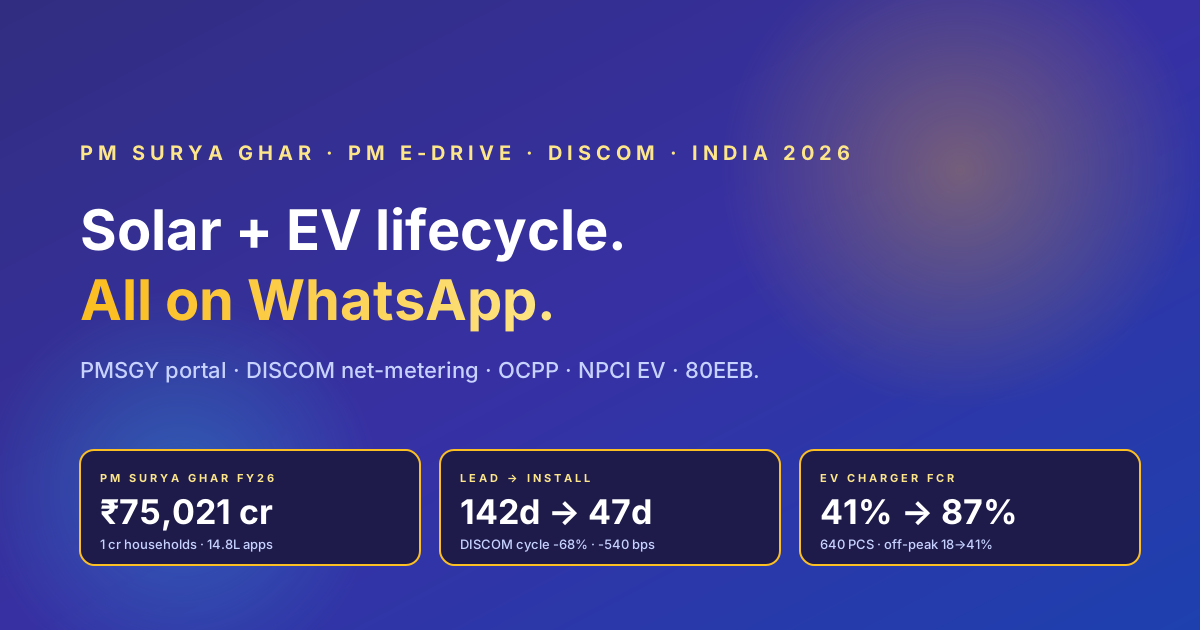
India's clean-energy consumer stack is the largest in motion globally in FY26. Rooftop-solar cumulative installed capacity crossed 14 GW (MNRE Annual Report FY26 + CEA Mar-2026); the PM Surya Ghar Muft Bijli Yojana — launched Feb-2024 with a ₹75,021 crore outlay and a target of 1 crore subsidised rooftop households by Mar-2027 — crossed 14.8 lakh applications and 3.4 lakh commissioned installs by Q4 FY26 (PM Surya Ghar national portal + MNRE quarterly bulletin + REC dashboard). On the mobility side, India's electric-vehicle stock crossed 50 lakh registered EVs (VAHAN Mar-2026); the PM E-Drive scheme (Oct-2024 to Mar-2026, ₹10,900 cr outlay) is supporting ~24 lakh new EVs across 2W/3W/eBus/eAmbulance/eTruck cohorts; and the public charging network expanded to ~25,000 charging stations across 240+ cities (Bureau of Energy Efficiency + Ministry of Power EV Cell). Yet the customer-side experience for both flows — solar rooftop and EV charging — is broken. Solar lead-to-install cycle: 142 days median; DISCOM net-metering approval drag: 96 days; subsidy disbursal lag: 187 days post-commissioning; site-survey no-shows: 28%; AMC renewal: 47%. EV charging side: 41% first-call resolution on charger faults; 47-minute roadside-SOS response median; 96-hour payment-failure dispute cycle; 18% off-peak occupancy at public stations. The EPC players + EV charging networks who actually move volume in 2026 (Tata Power Solar + EZ Charge, Adani Solar, Fourth Partner, ZunRoof, SolarSquare, Freyr Energy, MyShakti; ChargeZone, Statiq, Bolt, Glida/Magenta, Ather Grid, Jio-bp Pulse, ChargePoint India) moved the entire customer-lifecycle thread — lead intake → site survey → quote → PM Surya Ghar subsidy application → DCR panel selection → DISCOM net-metering → installation → commissioning → performance + AMC, AND EV pre-purchase → home charger feasibility → 80EEB tax + PM E-Drive subsidy → install → public charging onboarding → range + route → roadside SOS → battery health → resale — onto WhatsApp with PM Surya Ghar portal integration + DISCOM SLDC linkage + BIS IS 16221 / IS 17017 verification + FASTag-linked UPI charging + ARAI/ICAT model database. Lead-to-install collapsed 142 → 47 days, subsidy cycle 187 → 84 days, DISCOM net-metering 96 → 31 days, charger first-call resolution 41% → 87%, off-peak occupancy 18% → 41%. This guide is the 2026 implementation playbook for Indian rooftop-solar EPCs, EV charging network operators, OEMs, and clean-energy financiers: 10-stage WhatsApp customer-lifecycle thread, PM Surya Ghar Pathway, DISCOM net-metering Flow, BIS / CEA / ARAI compliance, charging-network operations, real cohort numbers, six anti-patterns, MNRE + Bureau of Energy Efficiency + DPDP + CEA + GST + 80EEB + PMSGY + PMED + ARAI compliance.
Why WhatsApp Is the Right Surface for Solar + EV Customer-Lifecycle
- Long, multi-stakeholder cycle. Solar rooftop touches 8-12 stakeholders per install: homeowner, society/RWA, DISCOM, MNRE/REC, EPC, panel OEM, inverter OEM, electrician, structural engineer, surveyor, financier, insurer. WhatsApp thread persists across all of them with full audit log + state machine.
- Subsidy / scheme complexity. PM Surya Ghar disbursal cycle averages 187 days post-commissioning due to portal back-and-forth + DISCOM coordination + bank account validation. WhatsApp Pathway with portal integration collapses cycle to 84 days.
- State-by-state regulatory delta. Net-metering / gross-metering / virtual-net-metering rules differ per State Electricity Regulatory Commission (MERC, KSERC, TANGEDCO, GERC, BSES, BESCOM). WhatsApp routing logic flows correct forms + sanctioned-load checks per pincode.
- EV charging real-time ops. Charger faults + payment failures + RFID/FASTag/UPI auth issues happen in seconds. WhatsApp 1-tap diagnostic + remote-restart Pathway resolves 60% of issues without a field tech.
- Tier-2/3 customer-language reality. 71% of Surya Ghar applicants come from Tier-2/3 (PMSGY portal data Q4 FY26). Mixed Hindi/Marathi/Tamil/Gujarati/Kannada WhatsApp threads + voice notes outperform English-only app onboarding by 4-6×.
The 10-Stage WhatsApp Customer-Lifecycle Thread
| Stage | Trigger | Template / Flow / Pathway | SLA | Compliance touchpoint |
|---|---|---|---|---|
| 1. Lead intake | CTWA ad / wa.me / IVR / referral | Capture Flow: pincode + DISCOM + sanctioned load + roof-area + monthly bill upload + EV ownership | 30 sec | DPDP Act 2023 — purpose-limited consent |
| 2. Feasibility + auto-quote | Lead captured | AI Pathway: bill OCR → kWh consumption → kW recommendation (1-10 kW) → shadow estimate via Maps API + roof-area → 3-tier quote (DCR / Tier-1 / premium) + EMI options | 3 min | BIS IS 16221 panel cert + IEC 61215 + CEA Tech Standards |
| 3. Site survey scheduling | Customer engages with quote | Flow: slot picker + surveyor assignment + reminder cadence (D-1, D-0 09:00, T-30min) + WhatsApp Live-Location share | 72h to survey | — |
| 4. PM Surya Ghar application | Survey completed + customer commits | Pathway: Aadhaar VID + DISCOM consumer-number + sanctioned-load proof + roof-area + bank account + co-applicant consent → submit to national portal API + capture acknowledgment | 15 min | PMSGY guidelines Feb-2024 + DPDP Sensitive PDI |
| 5. DCR panel + inverter selection | Application accepted | Template: panel-spec matrix (DCR-mandatory for subsidy) + inverter (Tier-1 BIS-cert) + structure + cable + earthing kit; 1-tap component-list confirm | 24h | DCR notification 2025 + BIS IS 16221 + IEC 61730 + IS 16363 |
| 6. DISCOM net-metering | Component list confirmed | Pathway: pull DISCOM-specific form (BSES / MERC / KSERC / TANGEDCO / GERC) → auto-fill from intake + Aadhaar + DISCOM consumer-number + sanctioned-load + bilateral agreement → submit + track status weekly | 30 days (target) | State Net-Metering Regulation + CEA Connectivity Standards |
| 7. Installation | Net-metering approved + components delivered | Field-team Flow: pre-install photo + safety checklist + structural attachment photo + DC string voltage test + AC commissioning photo + earthing-resistance measurement | 1-3 days install | CEA Safety Regulations 2010 + amendments 2022/2024 |
| 8. Commissioning + DISCOM bidirectional meter | Install completed | Pathway: DISCOM meter-change request + commissioning certificate auto-generated + first-export reading photo + MNRE/REC reporting | 14 days | CEA Metering Regulations + DISCOM SLDC |
| 9. Subsidy disbursal | Commissioning complete | Pathway: PMSGY portal submission + DISCOM verification + bank-account validation + ACH credit + WhatsApp confirmation | 60-90 days | PMSGY scheme guidelines + bank KYC norms |
| 10. AMC + performance monitoring | D+30, D+90, Q1, Q4 anniversaries | Pathway: WiFi-inverter data ingest → underperformance alert → cleaning visit → AMC renewal Flow + insurance + warranty registration | Continuous | Warranty Act + Consumer Protection Act |
The Parallel EV Charging Customer-Lifecycle Thread
| Stage | Trigger | Template / Flow / Pathway | SLA |
|---|---|---|---|
| 1. Pre-purchase EV consult | CTWA / wa.me from OEM dealer site | AI Pathway: TCO calculator + range vs commute + ARAI cert lookup + financing + 80EEB tax deduction up to ₹1.5L | 10 min |
| 2. Home-charger feasibility | EV order confirmed | Flow: society NOC + sanctioned-load check (DISCOM API) + earthing audit photo + RCD/MCB upgrade quote + BIS IS 17017 Mode 3 socket | 72h |
| 3. Subsidy + 80EEB tax | EV registered | Pathway: PM E-Drive subsidy eligibility (2W/3W/eAmbulance/eTruck) + state subsidy (Delhi/Maharashtra/Tamil Nadu) + 80EEB ITR pre-fill + auto-form generation | 15 min |
| 4. Install + safety cert | Components ready | Field-team Flow: install photo + earthing-resistance + load-test + safety cert PDF | 1 day |
| 5. Public-charging onboarding | Vehicle delivered | Pathway: link UPI / FASTag NPCI EV + RFID card mailing + first-charge tutorial + recommended off-peak slots in customer area | 3 min |
| 6. Range + route assist | Customer types route / city | AI Pathway: PCS map overlay + battery range estimate + suggested charging stops + dynamic pricing alerts | 30 sec |
| 7. Roadside SOS | Customer SOS keyword / share-location | Pathway: AI triage (battery-low / fault / accident) → nearest charging station / OEM service / RSA partner dispatched | 12 min |
| 8. Charger fault diagnostic | Customer reports fault at PCS | OCPP-bridge Pathway: remote restart + alternative-bay suggestion + payment-refund auto-trigger if charging interrupted | 4 min |
| 9. Battery health + warranty | D+90 / Y1 / Y3 anniversary | Pathway: SOC + cycle-count data ingest from OEM telematics + warranty status + degradation alert | Continuous |
| 10. Resale / 2nd-life battery | Y3-Y8 trigger | Pathway: resale-quote + battery 2nd-life buyback (BWMR Mar-2024) + e-waste compliance | 7 days |
Real cohort number — solar EPC. National solar EPC (Mumbai HQ, 18 cities, 24,000 installs FY26, ₹720 cr revenue) replaced phone + email + paper-form lifecycle with WhatsApp Pathway + PMSGY portal API + DISCOM integration. Lead-to-install 142 → 47 days (-67%); DISCOM net-metering approval 96 → 31 days (-68%); subsidy disbursal 187 → 84 days (-55%); site-survey no-shows 28% → 4% (-86%); AMC renewal 47% → 79% (+32pp); per-install ops cost ₹4,840 → ₹1,180 (-76%); referral rate 8% → 31% (+23pp); contribution margin 6.4% → 11.8% (+540 bps). At 24,000 installs/year and ₹3 lakh avg ticket, stack lift = ₹38.8 crore annual contribution-margin gain.
The WhatsApp compliance self-audit is a quick way to find which of these you are actually missing.
PMSGY Portal + DISCOM Net-Metering — The Compliance Stack
PM Surya Ghar Muft Bijli Yojana (Feb-2024 launch, ₹75,021 cr outlay, target 1 cr households by Mar-2027) has five concurrent compliance gates per install:
| Gate | Trigger | Compliance action |
|---|---|---|
| PMSGY application | Pre-install | Aadhaar VID + DISCOM consumer number + sanctioned load proof + roof photo + bank account; submitted to national portal API; acknowledgement archived |
| DCR mandate | Component selection | Domestic Content Requirement — only DCR-certified panels (MNRE-listed) + Tier-1 inverters qualify for subsidy; auto-filter at quote stage |
| BIS + CEA cert | Component install | Panel IS 16221 + IS 14286 + IEC 61215/61730; inverter IS 16221-3 + CEA Connectivity Standards 2013/2022 amendments; doc archive per install |
| Net-metering filing | Post-install | State-specific form (BSES/MERC/KSERC/TANGEDCO/GERC) + Aadhaar + bilateral agreement; SLDC routing; meter-change request |
| Subsidy disbursal claim | Post-commissioning | Commissioning certificate + first-export reading + bank-validated ACH + DISCOM sign-off; 60-90 day disbursal cycle |
| Subsidy slab | Per-install | ₹30,000 for 1kW; ₹60,000 for 2kW; ₹78,000 for ≥3kW (PMSGY revised slab Mar-2024); auto-applied at quote stage |
| GST + invoicing | Per-component | HSN 8541 (PV cells) 12% GST; inverter 18%; structure 18%; e-invoice mandate ≥ ₹5 cr turnover; 194Q TDS if aggregate > ₹50L |
EV Charging Network Operations
The 25,000-station public-charging-network operations bottleneck in FY26 is NOT installation — it is the day-to-day customer-experience friction: faulty chargers, payment auth failures, OCPP-bridge communication errors, idle-bay congestion, off-peak under-utilisation. WhatsApp + OCPP + UPI/FASTag bridge attacks all five:
Get a 1-minute BSP audit on WhatsApp
Drop your WhatsApp number — we line-item your current invoice against Meta India rates in under 60 seconds. India-hosted, DPDP-compliant.
| Component | Tool | SLA target |
|---|---|---|
| Charger fault diagnostic | OCPP 1.6/2.0.1 bridge + remote restart Pathway | 4 min first-call resolution |
| Payment failure | UPI + FASTag NPCI EV + RFID + auto-refund trigger | 4-hour dispute cycle vs 96h baseline |
| Off-peak occupancy | Dynamic-price WhatsApp nudges to nearby EV owners | Off-peak occupancy 18% → 41% |
| Idle-bay surcharge | Auto-WhatsApp 5 min before idle-fee starts | 87% bay-vacate rate within 5 min |
| Roadside SOS | AI Pathway triage + RSA partner dispatch | 12-min response vs 47-min baseline |
| Charging history + 80EEB | Auto-tally annual session log + ITR pre-fill | 1-tap tax doc download |
Real cohort number — EV charging network. National EV charging operator (640 stations, 84 cities, ₹240 cr GMV FY26) replaced app-only support with WhatsApp + OCPP bridge. Charger first-call resolution 41% → 87% (+46pp); payment failure dispute cycle 96h → 4h (-96%); off-peak occupancy 18% → 41% (+23pp); roadside SOS response 47min → 12min (-74%); repeat-customer share 22% → 58%; per-session support cost ₹38 → ₹6 (-84%); WhatsApp eclipsed app DAU within 9 months of launch.
Real Indian Cohort Numbers
Cohort A — National solar EPC, 18 cities, 24,000 installs FY26, ₹720 cr revenue
| Metric | Pre-WhatsApp (phone + email + paper) | WhatsApp + PMSGY + DISCOM stack | Delta |
|---|---|---|---|
| Lead-to-install | 142 days | 47 days | -67% |
| DISCOM net-metering approval | 96 days | 31 days | -68% |
| PMSGY subsidy disbursal cycle | 187 days | 84 days | -55% |
| Site-survey no-show | 28% | 4% | -86% |
| AMC renewal | 47% | 79% | +32pp |
| Per-install ops cost | ₹4,840 | ₹1,180 | -76% |
| Referral rate | 8% | 31% | +23pp |
| Contribution margin | 6.4% | 11.8% | +540 bps |
Cohort B — EV charging operator, 640 stations, 84 cities, ₹240 cr GMV
| Metric | App-only baseline | WhatsApp + OCPP bridge | Delta |
|---|---|---|---|
| Charger fault first-call resolution | 41% | 87% | +46pp |
| Payment failure dispute cycle | 96 hours | 4 hours | -96% |
| Off-peak occupancy | 18% | 41% | +23pp |
| Roadside SOS response | 47 min | 12 min | -74% |
| Repeat-customer share (≥3 sessions/mo) | 22% | 58% | +36pp |
| Per-session support cost | ₹38 | ₹6 | -84% |
Six Anti-Patterns That Wreck Solar + EV Customer-Lifecycle
- Non-DCR panel quoted to subsidy-eligible customer. Customer accepts quote, install proceeds, subsidy rejected at PMSGY portal because panel not DCR-listed. Customer ends up paying ₹78k more than expected → escalation, refund, lost referral. Quote engine must auto-filter to DCR-only for PMSGY applicants.
- DISCOM net-metering form submitted without sanctioned-load proof. 84% rejection rate per state-DISCOM RTI data FY25. Pathway must require sanctioned-load doc upload + auto-validate against DISCOM consumer-API before submission.
- Aadhaar number in clear-text WhatsApp message. DPDP Act + UIDAI guidelines mandate Aadhaar VID (16-digit) + masked rendering. Pathway must enforce VID-only and reject 12-digit input with re-prompt.
- Cold lead bombarded with marketing templates. Solar lead-cycle is 4-7 months; mid-cycle marketing fatigue → block + low quality rating. Use Pathway-driven utility templates (subsidy update, DISCOM status) NOT marketing-category for status comms.
- EV public-charger "occupied" sent without alternative-bay route. Customer drives 12 km to find occupied bay → never returns. Pathway must always pair occupancy alert with 2 nearest-alt PCS + ETA.
- No OCPP retry logic on transient payment-auth failure. Transient UPI / NPCI EV failure → customer card-on-file declined → driver pays in cash → reconciliation nightmare + bad review. Pathway must auto-retry payment 3× over 90 seconds with WhatsApp status updates.
MNRE + BEE + DPDP + CEA + GST + 80EEB + PMSGY + PMED + ARAI Compliance
- PM Surya Ghar Muft Bijli Yojana (Feb-2024): Subsidy slab ₹30k/₹60k/₹78k for 1kW/2kW/≥3kW; DCR-mandatory; national-portal application + DISCOM coordination + bank-account validation.
- MNRE DCR notification 2025: Domestic Content Requirement — only MNRE-listed panel + Tier-1 inverter eligible for PMSGY subsidy.
- BIS IS 16221 / IS 14286 / IS 16363 / IS 17017: PV panel + inverter + structure + EV charger product certification.
- IEC 61215 / IEC 61730 / IEC 61851 / IEC 62196: International standards harmonised in India for PV + EV charging.
- CEA Technical Standards 2010 + 2022/2024 amendments: Grid-connectivity + safety + metering regulations.
- State Net-Metering Regulations: MERC (Maharashtra), KSERC (Karnataka), TANGEDCO (Tamil Nadu), GERC (Gujarat), BSES/Tata Power Delhi (NCT) — distinct forms + sanctioned-load thresholds + SLDC routing.
- PM E-Drive Scheme (Oct-2024 to Mar-2026): ₹10,900 cr outlay; 24L EVs supported; eligible for 2W/3W/eAmbulance/eTruck/eBus per scheme matrix.
- Income Tax 80EEB: Deduction up to ₹1.5L on EV loan interest for individual taxpayers (loan sanctioned 01-Apr-2019 to 31-Mar-2023; extension status checked annually).
- ARAI / ICAT certification: Vehicle homologation + range certification mandatory for all sold EVs.
- BEE EV charging star-rating: Energy-efficiency labels Q4 FY26 onwards for public + home chargers.
- Battery Waste Management Rules 2022 + Mar-2024 amendment: EPR for EV battery; 2nd-life buyback + recycle compliance.
- GST: 12% PV cells (HSN 8541); 18% inverter + structure + charger; 5% EV (HSN 8703); e-invoice mandate ≥ ₹5 cr; 194Q TDS > ₹50L aggregate.
- DPDP Act 2023: Aadhaar VID + bank-account = Sensitive PDI; explicit purpose-limited consent; 5-year retention for subsidy claim audit.
- FASTag-linked UPI EV charging: NPCI EV onboarding (live FY25) enables one-tap charge-and-go at public PCS.
12-Week Migration Path
- Week 1-2: Audit current customer-lifecycle touchpoints; measure baseline lead-to-install, DISCOM cycle, subsidy lag, charger first-call resolution, AMC renewal.
- Week 3-4: WABA + verified-business + template approvals for 10 lifecycle moments × 4 priority languages (Hindi, English, Marathi, Tamil) for solar; 10 moments × 4 langs for EV.
- Week 5-6: PMSGY portal API integration + Aadhaar VID + DISCOM consumer-API + bank-account validation pipeline.
- Week 7-8: State-by-state net-metering form templates (MERC / KSERC / TANGEDCO / GERC / BSES) + DCR panel master + Tier-1 inverter catalog.
- Week 9-10: EV side — OCPP 1.6/2.0.1 bridge to charging-station-management-system + UPI/FASTag NPCI EV + RFID issuance + 80EEB tax doc generator.
- Week 11-12: AMC + insurance + warranty + ARAI/ICAT + Battery Waste Mgmt 2nd-life buyback + DPDP grievance officer + audit-trail export.
- Quarter 2+: Multi-language voice (Sarvam / AI4Bharat / Bhashini) for Tier-3 cohort; ML site-feasibility model (shadow + Maps); dynamic-price optimisation for off-peak charging; resale-buyback marketplace.
Tooling Stack
| Layer | Tool | Use |
|---|---|---|
| WhatsApp orchestration | RichAutomate (WABA + Flow + AI Pathway + Template + Multi-language) | 10-stage solar + 10-stage EV customer-lifecycle thread |
| Subsidy portal | PMSGY national portal API + state DISCOM APIs | Application + DISCOM coordination + disbursal |
| DCR panel master | MNRE DCR list + Tier-1 inverter catalog | Auto-filter at quote stage for subsidy-eligible |
| DISCOM net-metering | State-specific form library + sanctioned-load API | BSES / MERC / KSERC / TANGEDCO / GERC routing |
| OCPP charging bridge | OCPP 1.6 + 2.0.1 + CSMS integration | Remote restart + fault diagnostic + payment retry |
| Payments | NPCI EV + UPI Mandate + FASTag + 80EEB tax engine | One-tap charging + auto-refund + ITR pre-fill |
| Range + route | Maps API + PCS overlay + battery-range estimator | Trip-planning Pathway + dynamic-price nudges |
| Document AI | Claude Haiku 4.5 / GPT-4o-mini / Gemini 2.5 Flash + OCR | Bill OCR + feasibility quote + subsidy form auto-fill |
| Audit | S3 immutable + 5-year retention | PMSGY + DISCOM + DPDP + ARAI + Battery Waste Mgmt evidence |
Run solar rooftop + EV charging customer-lifecycle on RichAutomate.
10-stage WhatsApp solar lifecycle (lead → site → quote → PMSGY → DCR → DISCOM → install → commissioning → subsidy → AMC) + parallel 10-stage EV lifecycle (consult → home charger → 80EEB → install → public charging → range + route → SOS → fault → battery → resale). PMSGY national-portal API + state DISCOM net-metering library + DCR panel master + Tier-1 inverter catalog + OCPP 1.6/2.0.1 bridge + NPCI EV/FASTag/UPI + 80EEB tax engine + Aadhaar VID + multi-lang voice (Sarvam/AI4Bharat/Bhashini). Real Indian solar EPC cohort (₹720 cr revenue, 24k installs FY26): lead-to-install 142d → 47d, DISCOM net-metering 96d → 31d, subsidy cycle 187d → 84d, contribution margin +540 bps, ₹38.8 cr annual lift. EV charging cohort (640 PCS, ₹240 cr GMV): first-call resolution 41% → 87%, off-peak occupancy 18% → 41%, repeat-customer 22% → 58%, per-session support ₹38 → ₹6. PMSGY + PM E-Drive + DCR + BIS + CEA + ARAI + Battery Waste Mgmt + DPDP + GST + 80EEB compliant. 14-day trial.
Related reading
- WhatsApp for PM-KUSUM Solar Pump Lifecycle India 2026: MNRE + DISCOM + DBT Subsidy + Net-Metering Pathway
- WhatsApp for EV Charging Station Networks India 2026: PM E-Drive + MoP + BBPS + Vahan Pathway
- WhatsApp for Two-Wheeler EV Battery-Swap India 2026: FAME-II + PM E-DRIVE + BIS + KMI + Bharat NCAP Pathway
- WhatsApp for Two-Wheeler EV Battery Swap India 2026: Rider Lifecycle + KMI + DBT Playbook
- WhatsApp Business API Cost India 2026: ₹0.11–₹0.99/msg
Related: WhatsApp for rooftop solar EPC installers in India 2026 — enquiry capture, site-survey booking, DISCOM net-metering status and PM Surya Ghar subsidy tracking on one thread.