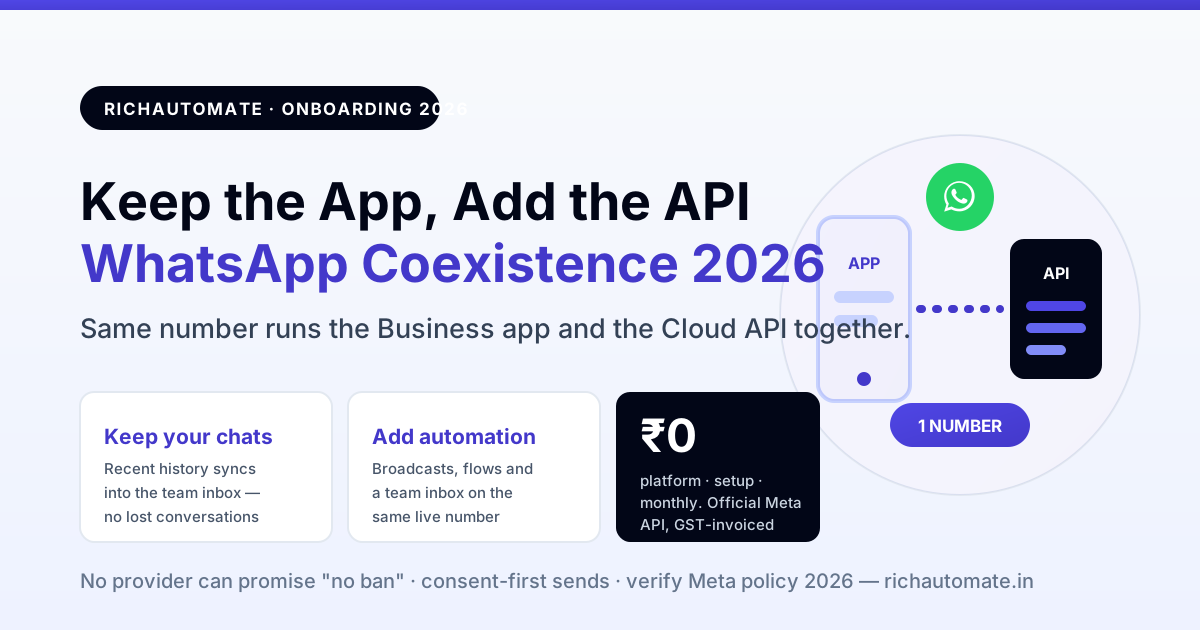
Yes — with WhatsApp coexistence you can keep using the WhatsApp Business app on your phone, with its existing chats, while a provider (BSP) also connects that same number to the Cloud API for automation, broadcasts and a team inbox. You do not have to abandon the app or lose your history to "go API" in 2026. This guide explains what coexistence actually is, exactly what you keep and what changes, how the setup runs, and the limits and India rules to verify before you switch it on.
What coexistence actually is
For years the choice was binary: run the free WhatsApp Business app on a phone, or migrate the number to the WhatsApp Business Platform (Cloud API) through a BSP and give up the app. Coexistence removes that wall. It lets one phone number run the Business app and be connected to the Cloud API at the same time — the owner keeps chatting from the app on their handset, while automations, campaign broadcasts and a shared team inbox run through the API on the same number.
This matters because the single biggest reason Indian small businesses stall on the official API is fear: "if I connect to the API, do I lose my WhatsApp Business app, my chat list, my green replies from my phone?" Coexistence is Meta's answer to exactly that objection. Treat every specific capability and limit below as "verify against the current Meta rule as of 2026" — coexistence is a comparatively new path and Meta changes what it supports, on which app versions, and in which regions, fairly often.
What you keep, and what changes
The point of coexistence is continuity. Here is the practical split — confirm each line against the current setup flow, since availability differs by account type and app version:
| Area | With coexistence |
|---|---|
| The Business app | Stays on the phone — you keep replying from it as before |
| Existing chats | Recent chat history syncs into the API inbox within a bounded window (verify the exact days supported), so the team sees ongoing conversations — not every message from years back |
| Contacts / labels | App contacts and labels largely carry over; check which sync live vs one-time |
| Automation + broadcasts | Now available via the API: template campaigns, chatbot flows, auto-replies, a team inbox |
| Who can reply | Both the phone owner (app) and the team (API inbox) — messages appear on one thread |
| Green tick / verified name | Handled through the API/Business Manager side once connected — coexistence does not itself grant a badge |
| Number | Same number throughout — no new number, no printing new cards |
The mental model: the app becomes the owner's personal reply surface, and the API adds a team inbox plus everything you cannot do from a phone — scheduled template broadcasts, flows, CRM tagging and reporting.
How the coexistence setup runs
The flow is designed to be low-risk because you are not "porting away" from the app. In broad strokes, verify the current steps as you go:
- Start from the Business app. The number must already be an active WhatsApp Business app account on the phone, on a supported app version.
- Connect through a BSP / Meta onboarding. You authorise the connection (Embedded Signup / Business Manager), which links the same number to the Cloud API without deactivating the app.
- Business verification + GST. Meta Business Verification is part of going fully live; in India, GST is effectively required to complete business verification and unlock higher messaging. See Meta Business Verification.
- History sync. A bounded window of recent chats syncs into the API inbox so the team has context. Do not expect a full multi-year export.
- Go live carefully. Once connected, register templates and start with utility messages before scaling broadcasts.
Limits and gotchas to verify first
Coexistence is genuinely useful but it is not "free API with no trade-offs." Confirm each of these against the current Meta documentation before you commit a workflow to it:
Get a 1-minute BSP audit on WhatsApp
Drop your WhatsApp number — we line-item your current invoice against Meta India rates in under 60 seconds. India-hosted, DPDP-compliant.
Not every API feature may be available in coexistence mode
Some Platform capabilities behave differently — or are restricted — when a number runs in coexistence versus a full API-only setup. Check whether the specific features you need (certain flows, catalog/commerce behaviours, payments) are fully supported in coexistence for your account before you build a process around them.
History sync is a window, not an archive
Only a bounded slice of recent conversation history moves into the API inbox. Older threads stay on the phone. If your team needs long-term records, keep your own CRM log rather than assuming the API inbox holds everything.
App-device rules still apply
The Business app's normal constraints — how many linked devices, one primary phone — do not disappear. Map who replies from where so the owner's phone and the team inbox do not talk over each other on the same customer.
Messaging limits and quality rating
Being on the API means Meta's messaging-limit tiers and per-number quality rating now govern your broadcasts. A poor-quality template or a spammy list drops the rating and caps volume regardless of coexistence. Keep sends consent-based and relevant.
You still register templates
Business-initiated messages outside the 24-hour service window must be pre-approved templates in the right category. This is the same discipline as any API setup — see template categories.
Coexistence vs full API migration — which fits you
Coexistence is not always the right answer. Use this to decide:
| Choose | When |
|---|---|
| Coexistence | The owner still wants to reply from the app on their phone, the number has valuable live chats you cannot lose, and you want to add automation + a team inbox alongside — a gradual, low-fear step up |
| Full API (no app) | A team handles all replies through a shared inbox, you send at real scale, and nobody needs the phone app — the cleaner setup for higher-volume operations |
| Stay app-only | Very low volume, one person replies, no broadcasts or automation needed yet |
For the full app-versus-API decision (features, cost math, when to switch), read WhatsApp Business API vs Business App. If you are moving the number between providers rather than adding the API, see what breaks in a BSP change.
Compliance you cannot automate away
Coexistence changes how you connect, not the rules you operate under:
- Consent first. Broadcast only to people who opted in. Scraping numbers and blasting is what restricts a number — coexistence does not shield you from that.
- GST for going live. Going fully live on the official API in India effectively requires GST for business verification — treat it as required, not optional.
- DPDP Act, 2023. Your customer contact list is personal data — keep proof of consent, send only what people signed up for, and offer an easy opt-out.
- No "no ban" guarantees. Being on the app and the API at once does not make a number un-bannable. Quality rating and policy still apply.
What it costs on RichAutomate
RichAutomate runs on the official WhatsApp Business API (Meta Cloud API) with ₹0 platform fee, ₹0 setup and ₹0 monthly minimum — and supports the coexistence path so you keep your Business app while adding automation. You pay per conversation on Meta's category rates: Client Pay at ₹0.10/message plus Meta's per-conversation rate, or SaaS Pay at ₹1.20/marketing and ₹0.30/utility conversation all-in. A 14-day trial with 100 free credits and no card lets you connect and run a real broadcast before committing. Verify current Meta rates, which change periodically. Full breakdown in the WhatsApp Business API cost guide and Client Pay vs SaaS Pay.
A realistic 30-day rollout
- Week 1: Confirm the number is a healthy Business app account on a supported version. Start business verification with GST ready. Connect via the BSP with coexistence enabled — app stays live.
- Week 2: Set up the team inbox, verify recent chats synced, assign who replies from the app vs the inbox. Register your first utility templates.
- Week 3: Turn on auto-replies and one utility broadcast to a small opted-in segment. Watch quality rating.
- Week 4: Scale broadcasts gradually, add a chatbot flow for common questions, and review what converted. Keep ramping volume, not spiking it.
Bottom line
Coexistence ends the false choice between keeping your WhatsApp Business app and going professional on the API. Keep the app and your live chats on the phone, add a team inbox, automation and broadcasts through the same number, and ramp volume on an opted-in list. Verify the exact feature and history-sync limits against the current 2026 Meta rules, keep GST and consent in order, and it becomes the lowest-fear way for an Indian SMB to step up to the official WhatsApp Business Platform. See the platform in full on features and pricing.