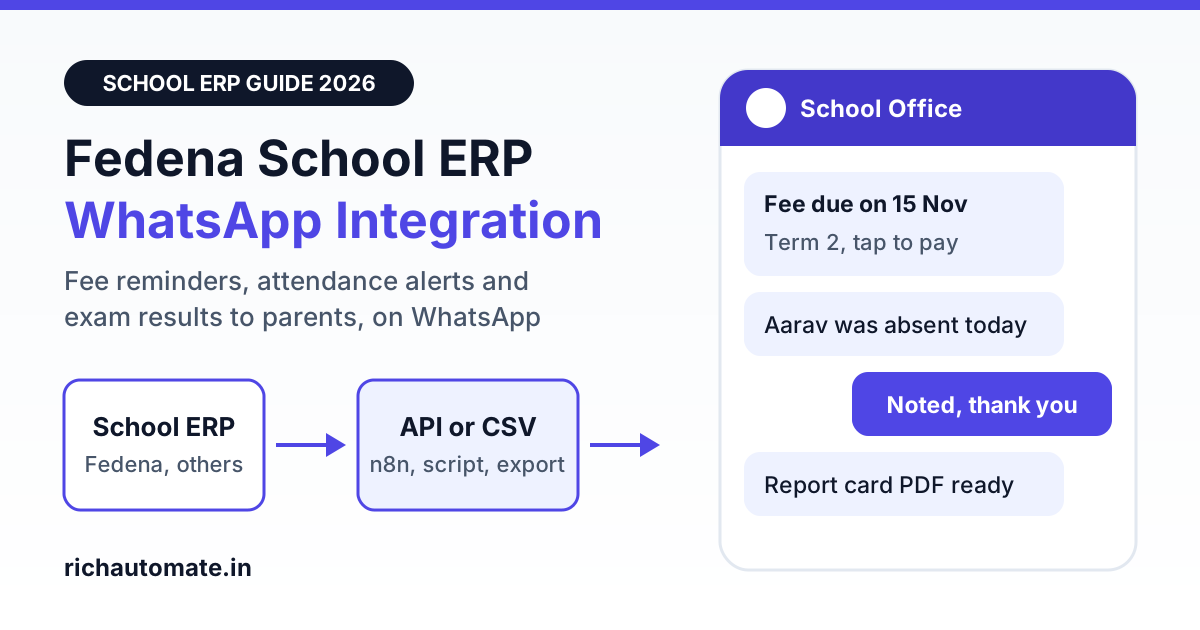
Yes, Fedena can be connected to the WhatsApp Business API, though not through a one-click connector: you take fee dues, attendance and exam data out of Fedena through its API or a CSV export, and a WhatsApp API platform sends an approved template to each parent from the school's own verified number. With RichAutomate a utility message such as a fee reminder costs about ₹0.215 all-in, so the 1,000-student school in the worked example below spends roughly ₹2,358 a month before GST.
One thing to be clear about before you plan anything: RichAutomate has no native connector for, and no partnership with, Fedena or its maker Foradian. What it gives a school is a developer API, template messaging, bulk campaigns from a CSV upload, a flow builder and a shared inbox. The bridge between the ERP and that API is something your IT coordinator, ERP implementation partner or a freelancer sets up. The same three methods apply to other school ERPs too, so if you run a different system, read "Fedena" as "your ERP" and check the equivalent features with your vendor.
What Fedena offers for parent messaging today
We checked Fedena's public feature, pricing and support pages in November 2026. They describe SMS and email as the outbound channels, and we found no WhatsApp channel listed there. Vendors add features often, so ask Foradian whether your version has anything newer before you build. This is what the public pages confirm.
| Fedena capability | What the public pages say | Why it matters for WhatsApp |
|---|---|---|
| SMS Integration | Listed as a core module. SMS settings can be configured to send automatic alert messages, and the page gives pending fees, events and emergency alerts as examples | These are the same alerts you would move to WhatsApp, so your existing SMS list is the first draft of your template list |
| Fee due reminders | Support documentation describes reminders by email, SMS or both, scheduled before a fee collection due date, with the SMS sent in a predefined template that cannot be edited | If you want your own wording, a pay link or a PDF receipt, the message has to be composed outside the ERP |
| Data Export | Exports data on students, employees, subjects and attendance in XML or CSV. Listed as a Premium module | A CSV file is all that a bulk WhatsApp campaign needs |
| Custom Report | Lets you choose filter criteria and the columns that appear. Listed as a Standard module | Useful for a clean list such as "parents with dues in Class 8" |
| API | An API Playground lists token-based actions for students (including fee dues), student attendance, exam groups and exam scores, events, news and finance transactions | Lets a script or automation tool read data on a schedule without manual exports |
Two caveats. The pricing page lists Standard, Premium, Ultimate and Enterprise plans, but it does not say which plans include API access, so confirm that with Foradian for your edition and hosting type. We also found no public documentation of outbound webhooks, meaning Fedena pushing an event to your URL the moment it happens. Plan on reading data at intervals instead. If your edition does not expose the API, the scheduled CSV export route below still works.
Colleges using an admissions CRM can compare this with our WhatsApp integration guide for Meritto and ExtraaEdge.
Why schools are moving alerts from SMS to WhatsApp
SMS still works and is worth keeping as a fallback, but it has limits that every school office knows. Commercial SMS in India needs sender headers and templates registered on a DLT platform under TRAI rules. A message is short plain text, so a fee reminder cannot carry the receipt, and a result alert cannot carry the report card. Parents cannot reply to a sender ID, so every question turns into a phone call to the front desk.
The official WhatsApp Business API changes four things:
- Documents and buttons. A template can carry a PDF header (report card, fee receipt, circular) and buttons such as a link to your payment page.
- A verified school identity. Messages arrive from the school's own number and display name, not from a teacher's personal phone or an unofficial class group.
- Two-way conversation. A parent can reply in the same chat, and the office answers from a shared inbox that several staff members can use together.
- Delivery visibility. You can see sent, delivered and read status per message, which helps when a parent says the notice never arrived.
For a wider view of the channel in schools, see our guide to WhatsApp for K12 school fees and parent communication.
Three ways to connect Fedena to WhatsApp
All three methods end the same way: a request to the RichAutomate developer API, or a campaign upload, that names an approved template, the parent's number and the variable values. They differ in how the data leaves the ERP.
| Method | How data leaves Fedena | Best for | Effort |
|---|---|---|---|
| 1. Fedena API to RichAutomate API | A script reads fee dues, attendance or exam scores with an API token on a schedule | Daily attendance alerts and schools with a developer or ERP partner | A few days of development and testing |
| 2. CSV export to bulk campaign | Office staff export a report as CSV, then upload it as a WhatsApp campaign | Fee reminders, circulars, results day and schools with no developer | Under an hour per send once templates are approved |
| 3. Middleware (n8n, Make, Zapier) | A visual workflow calls the Fedena API or reads an exported file from a folder, then calls RichAutomate | Schools that want automation without maintaining code | One to three days for the first workflow |
Method 1: Fedena API to the RichAutomate API
Fedena's API Playground lets you generate a token and try each action, and it advises testing against a sandbox or test account because API actions can change data. Use a read-only pattern in production: a small script runs every evening, asks Fedena for today's absentees or for students with fee dues, looks up the parent's mobile number, adds the 91 country code and calls the RichAutomate API with the template name and variables.
Method 2: scheduled CSV export to a bulk campaign
This is the route most schools should start with. Build a report in Fedena with the columns the message needs, for example student name, class, parent mobile, amount due and due date. Export it as CSV, upload it to RichAutomate as a campaign, map the columns to the template variables and send. It is manual, but fee cycles and circulars happen on known dates, so a 20-minute task on those days is reasonable. Our collection of fee payment reminder message templates for WhatsApp gives wording you can submit for approval.
Method 3: middleware such as n8n, Make or Zapier
If the tool has no ready-made Fedena app, its generic HTTP request and schedule steps do the same job as a script, with a visual editor that a non-developer can maintain. Self-hosted n8n keeps student data on a server you control, which many managements prefer. The pattern is the same one we describe in the Teachmint WhatsApp integration guide for schools on that platform.
Which school messages to automate first
Start with the messages parents already call the office about. Each one below is a single template with a clear trigger.
- Fee reminders. Sent a week before, a day before and after the due date, with the amount, the due date and a payment link button. Stop the sequence once the fee is marked paid in the ERP.
- Absence alerts. Sent after attendance is marked, with the child's name and date, so a parent knows the same morning.
- Exam schedules and results. The datesheet before exams, then a "report card ready" note with the PDF attached or a portal link.
- Circulars and holiday notices. Short text with the circular as a PDF. A sudden rain holiday reaches parents faster here than on paper.
- PTM and event reminders. Date, time slot and a quick reply button to confirm attendance.
Admission campaigns and summer camp promotions are a different kind of message. They are promotional, Meta is likely to class them as marketing, and they cost more, so keep them in separate templates and send them sparingly. If you are still choosing a platform, our comparison of the best WhatsApp Business API for schools in India lists what to look for.
Get the India 2026 WhatsApp BSP price comparison
Wati vs AiSensy vs Interakt vs RichAutomate: Meta rates, platform fees and hidden costs, side by side. We send it to your WhatsApp in a minute.
Parent consent, DPDP and children's data
A fee due, an attendance record and a mark sheet are personal data about a child. India's Digital Personal Data Protection Act, 2023 expects verifiable consent from a parent or guardian before a child's personal data is processed, and WhatsApp's own business policy requires opt-in before you message anyone. One well-worded consent line covers both. This is general guidance and not legal advice, so have your school's adviser review the wording.
- Add a WhatsApp consent line to the admission and re-enrolment forms, naming the message types: fees, attendance, exams, circulars.
- Record the consent date and the confirmed parent number against the student record in the ERP.
- Send only to numbers with that flag, and only that parent's own child's data.
- Honour opt-outs at once and fall back to SMS, email or the diary for those families.
- Remove a student from all sends when a transfer certificate is issued.
Our guide to DPDP parental consent for children's data on WhatsApp goes through the consent wording and record keeping in detail.
Templates, categories and number quality
Every message the school starts must use a template that Meta has approved. Notices tied to a student's own record, such as a fee due or an absence, are normally submitted as utility templates. Meta makes the final call on category during review, so write each template tightly around the event it reports and leave out promotional lines.
Meta also rates each business number on how recipients react. If parents block or report your messages, the rating drops and Meta can lower your messaging limits or restrict the number. No platform can promise that a number will never be restricted. What the official API does is reduce that risk compared with unofficial bulk tools, provided you message only opted-in parents, use approved templates, keep to one absence alert a day and avoid late-night sends.
What it costs: a worked example for 1,000 students
On RichAutomate's Client Pay model, Meta bills its charges directly to the school's own card: about ₹0.115 per utility template and about ₹0.86 per marketing template in India. RichAutomate adds a platform fee of ₹0.10 per message. That makes a utility message about ₹0.215 all-in and a marketing message about ₹0.96. Setup is ₹0. Meta revises its rate card from time to time, so check current rates before you budget.
The volumes below are an illustrative month for a 1,000-student school, not a benchmark. Replace them with your own counts.
| Message type (example volume per month) | Templates | Meta charge | Platform fee at ₹0.10 |
|---|---|---|---|
| Fee reminders, two per student (utility) | 2,000 | ₹230.00 | ₹200.00 |
| Absence alerts (utility) | 1,500 | ₹172.50 | ₹150.00 |
| Exam schedule or result note, one per student (utility) | 1,000 | ₹115.00 | ₹100.00 |
| Circulars, two per student (utility) | 2,000 | ₹230.00 | ₹200.00 |
| One admissions or camp promotion (marketing) | 1,000 | ₹860.00 | ₹100.00 |
| Total | 7,500 | ₹1,607.50 | ₹750.00 |
That is ₹2,357.50 a month before GST, or about ₹2.36 per student. The single marketing send is more than half of the Meta bill, so the month costs ₹1,397.50 without it. To compare with SMS, multiply your own per-SMS rate by the same 7,500 messages, and remember that a WhatsApp message can carry the PDF and the pay button that an SMS cannot.
Optional monthly plans are Starter at ₹499, Pro at ₹899 and White-label at ₹1,199, and the plan fee comes back as wallet credit that pays for platform fees. On Pro, the ₹750 of platform fees in this example would be drawn from the ₹899 credit, with Meta's charges billed separately by Meta. The WhatsApp Business API pricing page shows what each plan includes.
A go-live checklist for the school office
- Start the trial. Sign up for the 7-day free trial and test templates, the CSV campaign upload and the shared inbox before committing.
- Keep documents ready. To go live on the school's own number you need a GST registration or Udyam MSME certificate. Schools run by a trust or society should keep their registration documents ready for Meta's business verification. The trial can begin before this is complete.
- Pick a number. Use a school number that is not active on the regular WhatsApp app, ideally the front office line that parents already know.
- Ask Foradian two questions. Is API access included in our plan, and can reports be exported on a schedule?
- Submit five templates. Fee reminder, absence alert, result note, circular and PTM reminder.
- Collect consent. Circulate the opt-in line and record it in the ERP.
- Pilot with one class. Run the CSV method for two weeks with a single section, check the numbers and wording, then extend to the whole school and automate with the API or middleware.
Frequently asked questions
Can Fedena be integrated with WhatsApp?
Yes, through the WhatsApp Business API. Fedena publishes an API with actions for student fee dues, attendance and exam scores, and a Data Export module that produces CSV or XML files. A script, n8n or a scheduled export passes that data to a WhatsApp API platform, which sends an approved template to each parent. Confirm API access for your Fedena plan with Foradian first.
Does RichAutomate have a native Fedena connector?
No. RichAutomate has no native connector for, and no partnership with, Fedena or Foradian. It provides a developer API, template messaging, bulk campaigns from a CSV upload, a flow builder and a shared inbox. Your school's IT person, ERP vendor or a freelancer connects Fedena to it through the Fedena API, scheduled exports or a middleware tool.
How much does a school fee reminder cost on WhatsApp?
On RichAutomate's Client Pay model, Meta bills about ₹0.115 per utility template to the school's own card and RichAutomate charges ₹0.10 per message, so a fee reminder costs about ₹0.215 all-in. Marketing templates such as admission promotions cost about ₹0.96. Setup is ₹0, and Meta revises its rate card periodically, so check current rates before you budget.
Can a school send report cards and fee receipts as PDFs on WhatsApp?
Yes. An approved WhatsApp template can carry a PDF document as its header, so a report card, fee receipt or circular arrives as a file in the parent's chat. The PDF has to be generated by your school ERP or script first. Send each parent only their own child's record, and keep marks and dues out of the visible message text where possible.
Is parental consent needed before a school messages parents on WhatsApp?
Yes. WhatsApp's business policy requires opt-in before you message a person, and India's DPDP Act treats student records as personal data, with verifiable parental consent expected for children's data. Add a WhatsApp consent line to the admission or re-enrolment form, store the date and number in the ERP, and stop messaging when a parent opts out.
Prefer a walkthrough first? Book a WhatsApp API demo and bring a sample fee dues export from your school ERP.
Ready to send Fedena fee reminders and attendance alerts on WhatsApp? Setup is ₹0, the platform fee is ₹0.10 per message, and the trial gives you 14 days to test templates and campaign uploads with one class. Start your 7-day free trial.