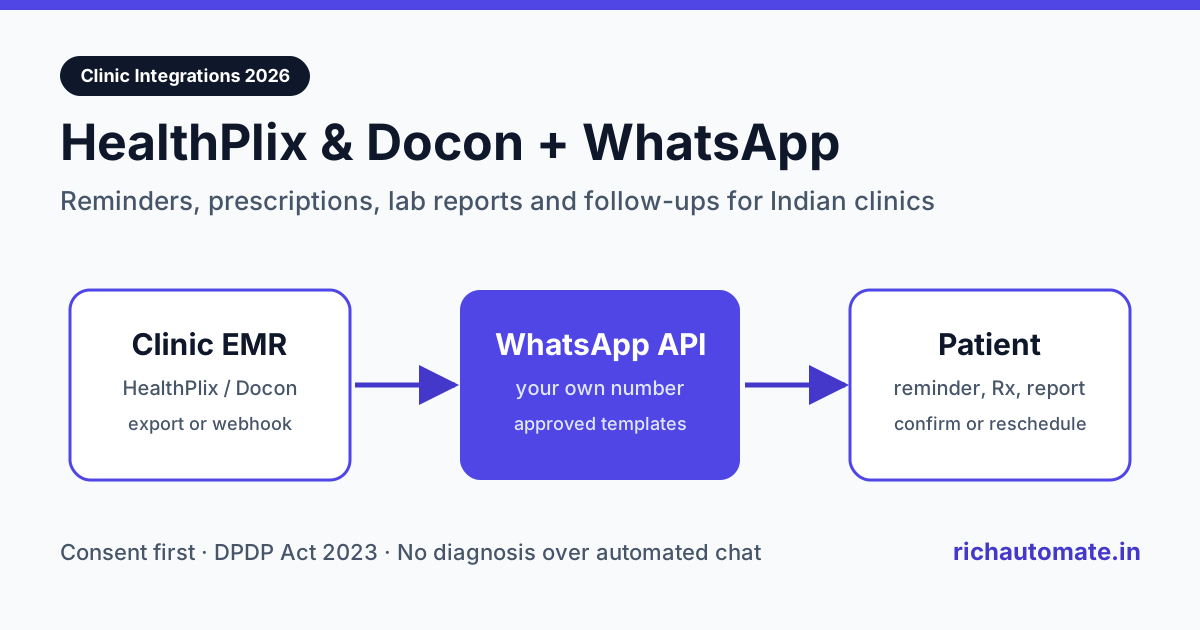
HealthPlix and Docon both help Indian clinics reach patients digitally, but neither replaces an official WhatsApp Business API number of your own: according to HealthPlix's site, doctors can share a prescription by SMS, WhatsApp or email within about 30 seconds, while Docon says its software sends automated follow-up and vaccination reminders and lets doctors broadcast messages to patients. If you want branded, automated reminders, lab-report alerts and two-way chat on your clinic's own verified number, you connect your EMR's export or webhook to a middleware tool and send approved templates through an API provider such as RichAutomate.
This guide explains what each EMR says it offers natively, where those features stop, and how a clinic can run its own WhatsApp Business API number alongside HealthPlix or Docon without breaking patient trust or Indian data-protection law. We have kept every vendor claim tied to what the vendor itself publishes. Where we could not confirm a feature on the vendor's own site, we say so rather than guess.
Why clinics want WhatsApp next to their EMR
Most Indian patients already live on WhatsApp. They read it faster than SMS, they can reply in their own language, and they can open a PDF prescription or lab report without installing another app. For a clinic, that turns into four practical jobs:
- Appointment reminders a day before and a few hours before the slot, with a simple confirm or reschedule reply.
- Prescriptions sent as a PDF right after the consultation, so the patient can show it at the pharmacy.
- Lab reports shared when results are ready, ideally with a note to book a review visit rather than an automated interpretation.
- Follow-ups for review visits, vaccination schedules, chronic-care check-ins and post-procedure care instructions.
An EMR is where this data is born: the appointment book, the prescription pad, the lab order and the follow-up date. WhatsApp is where the patient actually sees it. The question for every clinic is whether the EMR's own messaging is enough, or whether you need a dedicated WhatsApp channel you control. For a broader view of clinic messaging, see our guide to WhatsApp for healthcare clinics in India.
What HealthPlix says it offers on WhatsApp
HealthPlix positions itself as an EMR and clinic-management platform for Indian doctors, with a separate patient app. Here is what its own pages say, in its own words where possible:
- Prescription sharing: according to HealthPlix's FAQ page, once a prescription is written "you can share it with your patient via SMS/WhatsApp/ Email within 30 seconds."
- Patient engagement on WhatsApp: HealthPlix's doctor-facing site carries the line "Start Patient Engagement on WhatsApp, with a masked number!" The site does not spell out, on that page, how the masked number works, which templates it supports or whether you can bring your own number.
- Reminders inside the patient app: HealthPlix's patient-app page lists "Reminders & Notification" and says patients can "Get alerts to ensure you never miss an appointment." It also lists uploading and accessing lab test reports and booking follow-up appointments in the app.
What we could not confirm on HealthPlix's own site: a public API or webhook for sending custom WhatsApp templates, support for connecting a clinic's own WhatsApp Business API number, or automated lab-report WhatsApp alerts from a connected lab. These may exist in specific plans or on request, so ask HealthPlix directly before you design a workflow around them.
What Docon says it offers for patient messaging
Docon describes itself as an EHR and practice-management platform for doctors and clinics, with a patient app on Android and iOS. Its patient-engagement page lists these features:
- Broadcast messages to patients: Docon says doctors can "Share important information with your patients instantly."
- Send reminders: "Send automated follow-up and vaccination reminders."
- Follow-up chat: "Post consultation, interact with patients using the chat feature to answer questions."
- Report sharing: "Patients can upload and share reports with their doctors."
- E-Business card: Docon says doctors can "Share your digital business card with patients on WhatsApp or other media platforms."
A patient testimonial on that same Docon page mentions receiving follow-up reminders "via SMS and app notification from the doctor", and other testimonials mention receiving a digital prescription. On the pages we reviewed, Docon does not state that its reminders or prescriptions are delivered as WhatsApp messages from the clinic's own number. The only explicit WhatsApp mention is sharing the doctor's digital business card. If WhatsApp delivery matters to you, confirm it with Docon's sales team in writing.
HealthPlix vs Docon: native messaging at a glance
This table summarises only what each vendor says on its own website. "Not stated" means we did not find it on the vendor's pages, not that the feature is impossible.
| Capability | HealthPlix (per its site) | Docon (per its site) |
|---|---|---|
| Prescription to patient | SMS, WhatsApp or email, within about 30 seconds | Digital prescription mentioned in testimonials; channel shown as SMS and app |
| Appointment reminders | Alerts in the patient app | Automated follow-up and vaccination reminders |
| Broadcast to patients | Not stated | Yes, "Broadcast messages to patients" |
| Two-way chat after the visit | "Patient Engagement on WhatsApp, with a masked number" | In-app follow-up chat |
| Lab reports | Upload and access in the patient app | Patients can upload and share reports |
| Your own WhatsApp API number | Not stated | Not stated |
| Public API or webhook for custom messaging | Not stated | Not stated |
The pattern is clear. Both EMRs cover the basics of getting a prescription or reminder to a patient. Neither publicly offers what a growing clinic eventually needs: a verified WhatsApp number in the clinic's own name, custom approved templates, a shared team inbox, and automation that runs on the clinic's own rules. If you are also evaluating other platforms, our Practo WhatsApp integration guide covers the same question for Practo.
When a clinic should run its own WhatsApp Business API number
The EMR's built-in messaging is usually fine for a single doctor with a modest patient list. You should consider your own official WhatsApp Business API number when one or more of these is true:
- You want the clinic's name on every message. A number in your own business name, with your display name and profile, builds recognition. A masked or shared sender does not.
- No-shows are costing you money. Two-step reminders with confirm and reschedule buttons, plus an automatic slot-release rule, need template control that EMR messaging rarely gives you.
- Several doctors or branches share one front desk. A shared inbox where receptionists can see and answer patient replies is far easier than one doctor's personal phone.
- You run programmes, not just visits. Diabetes reviews, antenatal schedules, physiotherapy courses and vaccination calendars need multi-step sequences.
- You want to own the patient conversation history. If you ever switch EMR, a number and chat history in your own WhatsApp Business Account stay with you.
For a deeper comparison of providers built for this, read our list of the best WhatsApp Business API platforms for hospitals and clinics in India.
Get the India 2026 WhatsApp BSP price comparison
Wati vs AiSensy vs Interakt vs RichAutomate: Meta rates, platform fees and hidden costs, side by side. We send it to your WhatsApp in a minute.
How to connect HealthPlix or Docon to RichAutomate (the honest route)
Let us be plain: RichAutomate has no native HealthPlix or Docon connector today. There is no one-click integration in either direction. The route that works is the same one clinics use with most Indian EMRs:
- Get the data out of the EMR. Use whatever the EMR provides: a webhook, a scheduled CSV or Excel export of the next day's appointments, or an email notification when a prescription or report is ready. Ask your EMR vendor which of these your plan includes.
- Pass it through middleware. A no-code tool such as Zapier, Pabbly Connect or Make can watch a folder, a Google Sheet or an inbox, then reshape each row into a message request. If you have a developer, a small script on a schedule does the same job.
- Send through RichAutomate's public API. The middleware calls RichAutomate's API with the patient's number, the approved template name and the variables, such as patient name, doctor, date, time and a PDF link.
- Handle replies in RichAutomate. When a patient taps "Confirm" or "Reschedule", the reply lands in your team inbox or triggers a chatbot flow. Your front desk then updates the appointment in the EMR.
The gap to be aware of is the write-back. Unless your EMR accepts updates by API, a reschedule request still needs a receptionist to move the slot in HealthPlix or Docon. For most clinics that is acceptable, because the hard part, reaching the patient and getting an answer, is automated.
| Workflow | EMR trigger or export | WhatsApp template type | Patient action |
|---|---|---|---|
| Appointment reminder | Next-day appointment list, exported each evening | Utility | Confirm or Reschedule button |
| Prescription delivery | Prescription PDF generated or emailed | Utility with document | Open PDF, reply with questions |
| Lab report ready | Report uploaded to the EMR or lab portal | Utility | Book a review visit |
| Follow-up visit due | Follow-up date on the patient record | Utility | Pick a slot |
| Health camp or new service | Opted-in patient list | Marketing | Register interest |
Our step-by-step guide to WhatsApp API for clinic appointments shows sample templates and reminder timings you can copy.
What it costs: RichAutomate plans and Meta charges
RichAutomate uses Client Pay billing for this kind of setup. You connect your own payment method to your WhatsApp Business Account, and Meta bills its per-message charges to you directly. RichAutomate adds a flat platform fee of ₹0.10 per message. You get two invoices, one from Meta and one from RichAutomate, and the lowest unit cost.
| Item | Price | Notes |
|---|---|---|
| Starter plan | ₹499 per month | Go live on WhatsApp and send campaigns |
| Pro plan | ₹899 per month | Chatbots, payments, connected tools and the API |
| White-label plan | ₹1,199 per month | For agencies reselling under their own brand |
| Custom plan | On request | High volume or specific needs |
| RichAutomate platform fee | ₹0.10 per message | Client Pay |
| Meta utility message (India) | ₹0.115 + 18% GST | Billed by Meta to your payment method |
| Meta marketing message (India) | ₹0.8631 + 18% GST | Billed by Meta to your payment method |
Plan prices are GST-inclusive in INR, with ₹0 setup and a 7-day free trial. Meta's rates above are approximate and can change; always check Meta's official WhatsApp Business pricing page for the current India rates and the rules for replies inside the 24-hour customer service window. Full and current figures are on our WhatsApp Business API pricing page.
A quick example: a clinic sending 1,500 utility reminders and report alerts a month pays RichAutomate ₹150 in platform fees on top of its plan, plus about ₹173 (plus GST) to Meta at its ₹0.115 utility rate. Reminders, prescriptions and report alerts are utility messages, which is why clinic messaging stays cheap. Health camps and promotions are marketing messages and cost more, so keep them occasional and opt-in only.
Consent, privacy and the DPDP Act 2023
Health data is sensitive, and the Digital Personal Data Protection Act, 2023 (DPDP Act) applies to how a clinic collects and uses patient information. Before you switch on any automated WhatsApp workflow, put these basics in place:
- Get clear opt-in. Ask patients at registration whether they agree to receive appointment reminders, prescriptions and reports on WhatsApp. Record the consent with a date, and keep a separate, explicit opt-in for promotional messages.
- Make opting out easy. Honour "STOP" or similar replies quickly and remove the number from future sends.
- Share the minimum. A reminder needs a name, a doctor and a time, not a diagnosis. For reports, consider sending a secure link or a "your report is ready, please contact the clinic" message rather than full results.
- No diagnosis over automated chat. Chatbots can book, remind and route. They must not interpret lab values, suggest medication changes or give clinical advice. Anything clinical goes to a doctor.
- Control who sees the inbox. Give staff individual logins and limit access to the people who need it.
- Follow WhatsApp's rules. Use approved templates outside the 24-hour window and message only patients who opted in. Meta can limit or restrict any number that generates complaints or blocks, so no provider can promise your number will never be restricted. Good consent and relevant messages are the best protection.
This section is general guidance, not legal advice. Larger clinics and hospital groups should review their consent forms and data-retention policy with a lawyer familiar with the DPDP Act and applicable medical regulations.
A practical rollout plan for clinics
You do not need to automate everything on day one. A sensible order looks like this:
- Week 1: Register your official WhatsApp Business API number, set your clinic's display name and profile, and add a consent line to your registration form.
- Week 2: Submit three utility templates for approval: appointment reminder, prescription ready and report ready. Keep the wording short and factual.
- Week 3: Build the first automation: a nightly export of next-day appointments from HealthPlix or Docon into a Google Sheet, picked up by Zapier, Pabbly or Make, and sent through RichAutomate.
- Week 4: Measure confirmations, reschedules and no-shows against your previous month. Then add follow-up reminders and, only for opted-in patients, occasional health-camp announcements.
Keep your EMR's own messaging running during the pilot if you like. Many clinics continue to let the EMR send the prescription PDF while their own WhatsApp number handles reminders, follow-ups and patient questions.
Bottom line
HealthPlix, according to its own site, already lets doctors share prescriptions over WhatsApp and promotes patient engagement on WhatsApp through a masked number. Docon says it sends automated follow-up and vaccination reminders, offers broadcasts and in-app chat, and lets doctors share a digital business card on WhatsApp. Both are useful starting points. When your clinic wants its own verified number, custom reminder templates, a team inbox and automation you control, the dependable path is EMR export or webhook, then middleware, then an official WhatsApp Business API provider.
Ready to put your clinic's reminders, prescriptions and follow-ups on your own official WhatsApp number? Start your 14-day RichAutomate free trial, connect your number with ₹0 setup, and send your first approved reminder template this week.