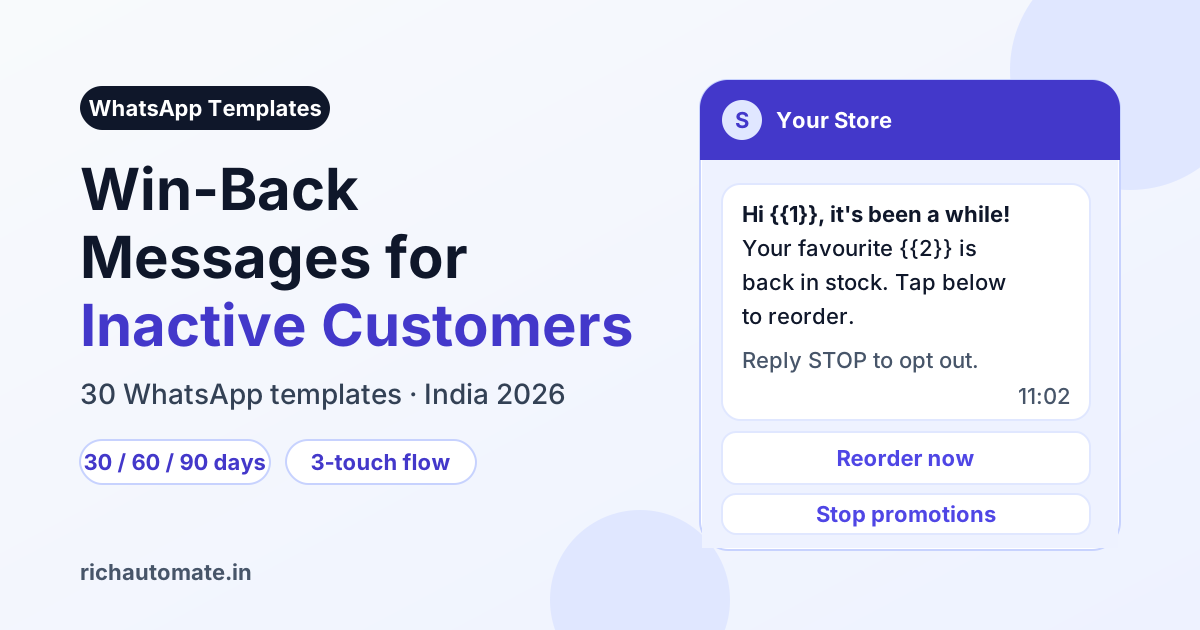
A good WhatsApp win-back message reminds an inactive customer what they last bought or booked, says "we miss you" in one warm line without guilt, and gives one reason to come back now: a new arrival, a restock or a time-boxed offer. It ends with a one-tap next step and an easy opt-out, and goes only to customers who opted in to WhatsApp updates. Below are 30 ready-to-use templates for Indian businesses, a 3-touch sequence, and the Meta rules and costs for 2026.
The 5-part win-back message formula
A win-back message is a WhatsApp marketing template sent to a past customer who has stopped buying, booking or logging in, designed to bring them back with a personal reminder and one easy next step. Every template below follows five parts:
- Personal recall: their name plus what they last used.
- A short "we miss you": one friendly line, never guilt.
- A reason to return now: a restock, new arrival, open slot or time-boxed offer.
- One-tap next step: a single button such as Reorder or Book now.
- An easy opt-out: "Reply STOP to opt out" or a marketing opt-out button.
Past buyers already know your brand, so win-back sits next to abandoned cart recovery as a high-intent WhatsApp flow.
When does a customer count as inactive?
Define inactivity by purchase cycle, not a fixed calendar number. A practical rule: a customer is inactive once they cross 1.5 to 2 times their normal reorder or visit gap. The table gives typical starting points to test, not benchmarks.
| Business | Normal gap | Inactive after | Best win-back hook |
|---|---|---|---|
| D2C fashion and lifestyle | 45-60 days | 90-120 days | New arrivals in their category |
| Skincare and beauty | 30-45 days | 60-75 days | Restock of the exact product |
| Pet food and supplements | 30 days | 45-60 days | One-tap reorder with delivery date |
| Salon and spa | 4-6 weeks | 8-12 weeks | Open slots with their stylist |
| Gym and fitness | Weekly visits | 2-3 weeks absent | Class invite or renewal bonus |
| Restaurant and cloud kitchen | 1-2 weeks | 3-4 weeks | Their usual dish, free delivery |
| SaaS and subscriptions | Monthly renewal | 30 days after churn | What is new since they left |
| B2B distributors and retailers | 2-4 weeks | 6-8 weeks | New stock or a trade scheme |
30 win-back message templates by situation
Variables use Meta's {{1}} format. Put "Reply STOP to opt out" in every footer and add one button. For more, browse the WhatsApp template library.
D2C and e-commerce repeat purchase
1. 30-day soft recall. When to use: one cycle passed, no offer.
Hi {{1}}, hope you're loving your {{2}}! We just added new pieces that pair well with it. Take a look below.
2. 60-day new arrivals. When to use: a full cycle skipped.
Hi {{1}}, it's been a while! Our new {{2}} collection just dropped, and we picked a few styles for you.
3. 90-day comeback offer. When to use: last try before suppression.
Hi {{1}}, we miss you at {{2}}! Enjoy {{3}} off your next order with code {{4}}, valid till {{5}}.
Consumables replenishment
4. Skincare restock. When to use: the product should be running out.
Hi {{1}}, your {{2}} usually lasts about {{3}} weeks, so you may be running low. Reorder the same size in one tap.
5. Pet food refill. When to use: days before the bag empties.
Hi {{1}}, is {{2}}'s bowl looking empty? Reorder {{3}} now for delivery by {{4}}.
6. Supplement continuity. When to use: the course is ending.
Hi {{1}}, your {{2}} pack should be finishing soon. Reorder to stay on track, or reply PAUSE if you're taking a break.
Salon, spa and clinic
7. Salon rebooking. When to use: past the usual haircut gap.
Hi {{1}}, it's been {{2}} weeks since your last {{3}}. Your stylist has open slots this week. Tap below to book.
8. Spa treat. When to use: clients who prefer treats to discounts.
Hi {{1}}, a little self-care is overdue! Book a {{2}} before {{3}} and enjoy a complimentary {{4}}.
9. Clinic recall. When to use: a routine visit is due.
Hello {{1}}, your last visit to {{2}} was on {{3}}, and a follow-up is usually advised around now. Reply BOOK for slots.
Gym and fitness
10. Missed check-ins. When to use: a member stops showing up.
Hi {{1}}, we've missed you at {{2}}! Join a {{3}} class this week and get back in rhythm.
11. Expired membership. When to use: within 30 days of expiry.
Hi {{1}}, your {{2}} membership ended on {{3}}. Renew before {{4}} and get {{5}} extra days free.
Restaurant and cloud kitchen
12. Usual order. When to use: a regular goes quiet.
Hi {{1}}, your usual {{2}} misses you! Order tonight and get free delivery above {{3}}.
13. New menu. When to use: you have genuinely new dishes.
Hi {{1}}, {{2}} has a new menu, and we think you'll love the {{3}}. Tap below to see what's cooking.
Coaching and edtech
14. Resume the course. When to use: a student stopped mid-course.
Hi {{1}}, you finished {{2}} of {{3}} lessons in {{4}}. Pick up where you left off, just 10 minutes a day.
15. New batch. When to use: a fresh cohort is starting.
Hi {{1}}, a new {{2}} batch starts on {{3}}. Past students get priority seats. Reply YES to reserve yours.
SaaS and subscriptions
16. What's new. When to use: about 30 days after cancellation.
Hi {{1}}, your {{2}} account and data are still here. Since you left we added {{3}}. Reactivate in one tap.
17. Churn survey. When to use: to learn why they left.
Hi {{1}}, why did you pause {{2}}? Reply 1 for price, 2 for missing features, 3 for no longer needed.
B2B distributors and retailers
18. Stopped ordering. When to use: two missed order cycles.
Namaste {{1}} ji, we haven't had an order from {{2}} since {{3}}. Fresh stock of {{4}} is in. Reply ORDER and your sales rep will call.
19. Trade scheme. When to use: a scheme gives a reason to restock.
Hi {{1}}, our {{2}} scheme runs till {{3}}: {{4}} on orders above {{5}}. Reply with your quantity to book.
Abandoned-then-silent leads
20. Cold enquiry. When to use: a lead asked weeks ago and never bought.
Hi {{1}}, you asked about {{2}} a few weeks ago. Still interested? Reply YES for the latest price.
21. Old cart. When to use: cart recovery ended without a sale.
Hi {{1}}, the {{2}} in your cart is still available. Need help choosing? Just reply here.
Festive comeback
22. Diwali early access. When to use: 2-3 weeks before Diwali.
Hi {{1}}, Diwali is almost here! Our festive {{2}} collection is live, and you get early access till {{3}}.
23. New year. When to use: the first week of January.
Hi {{1}}, new year, fresh start! Come back with {{2}} off your first order this year, valid till {{3}}.
24. Regional festival. When to use: Pongal, Onam, Eid or Durga Puja, by region.
Hi {{1}}, happy {{2}}! Celebrate with {{3}}, our festive gift for customers we've missed.
High-value and loyalty customers
25. VIP early access. When to use: high-LTV customers, instead of a discount.
Hi {{1}}, as one of our most valued customers, you get first look at {{2}} before everyone else on {{3}}.
26. Expiring points. When to use: an unused loyalty balance.
Hi {{1}}, your {{2}} reward points, worth {{3}}, expire on {{4}}. Tap below to use them.
27. Feedback ask. When to use: a loyal customer suddenly stopped.
Get a 1-minute BSP audit on WhatsApp
Drop your WhatsApp number — we line-item your current invoice against Meta India rates in under 60 seconds. India-hosted, DPDP-compliant.
Hi {{1}}, we haven't seen you at {{2}} in a while. Could we have done something better? A one-word reply helps.
The 3-touch win-back sequence
Stop the moment someone buys or replies, and never exceed three touches.
| Touch | Timing | Goal | Offer |
|---|---|---|---|
| 1 | Day 0 | Soft recall of last purchase | None |
| 2 | Day 4-5 | Reason to return | Small, time-boxed; early access for VIPs |
| 3 | Day 10-12 | Last call plus feedback ask | Same offer, never bigger |
28. Touch 1, soft recall. When to use: day 0.
Hi {{1}}, it's been a while since your {{2}}. Hope it worked well! Here's what's new at {{3}} this month.
29. Touch 2, the offer. When to use: day 4-5, if no purchase yet.
Hi {{1}}, we'd love to have you back. Here's {{2}} off your next order, valid for 72 hours.
30. Touch 3, last call. When to use: day 10-12, then stop.
Hi {{1}}, this is our last note for now. Your {{2}} offer ends tonight. If something wasn't right, reply and tell us.
After touch 3, suppress non-responders for 60-90 days. For a slower quarterly nurture, see our guide to re-engaging dormant WhatsApp contacts.
Meta rules: win-back messages are marketing templates
Outside the 24-hour customer service window you need an approved template, and every win-back or comeback-offer message is a Marketing template. It cannot be Utility, which is reserved for updates on a transaction the customer started. Meta can recategorise or reject promotional Utility submissions; see the WhatsApp template categories guide.
- Pacing: new marketing templates may go to a small batch first. Read up on marketing template pacing before a large send.
- Per-user marketing limit: Meta caps marketing templates per person across all businesses, so some customers will not get yours.
- Error 131049: Meta chose not to deliver. Do not retry-spam; wait several days or skip that contact.
Consent, opt-in and the STOP option
Only message customers who opted in to WhatsApp updates, for example via a checkbox at checkout or booking. An old email list or a number on an invoice is not WhatsApp consent. Opt-in also aligns with the consent principles of India's Digital Personal Data Protection Act, 2023.
Every template needs a visible way out: "Reply STOP to opt out" or a marketing opt-out button. Honour it immediately, across every number and campaign, and keep that list permanent. Messaging someone after STOP invites blocks and reports, which can lower your quality rating.
Segment, personalise and automate
Segment on four fields: last product (the recall line), last order date (which touch), LTV tier (VIPs get early access, not a discount) and city and language (festivals and tone).
Hinglish ("Aapka favourite {{2}} wapas stock mein hai!") often feels warmer for food, salon and local retail; plain English suits premium D2C, SaaS and B2B. Approve each language as its own template and test both.
To automate, sync last_order_date from Shopify, WooCommerce or your CRM into contact attributes. A daily job picks contacts crossing the threshold, excludes recent buyers and opt-outs, and starts the 3-touch flow, exiting on purchase or reply. Once the customer replies, you can continue the conversation with free-form messages inside the 24-hour customer service window without a template.
How to measure win-back
- Reactivation rate = customers who buy again within X days ÷ customers messaged. Match X to your cycle, such as 14 days for food or 30 for D2C.
- Revenue per 1,000 messages: repeat revenue from the campaign ÷ messages sent × 1,000. It compares segments and templates fairly.
- Opt-out rate: your guardrail. If STOP replies climb, targeting or frequency is off, whatever the revenue says.
Keep a holdout of about 10% who receive nothing. True lift is the gap between the groups, not raw reorders.
Mistakes that kill win-back campaigns
- Guilt-trip copy: "You forgot about us" feels manipulative. Stay warm and specific.
- A first-touch discount for high-LTV customers: a relevant restock nudge usually beats a blanket discount.
- Blasting everyone who ever bought: a three-year-old one-time buyer is a cold contact, not a lapsed customer.
- No suppression list: repeat sends to non-responders drive blocks.
- Messaging people who opted out: never, under any campaign name.
- Escalating discounts: a bigger offer every touch teaches customers to wait.
What win-back messages cost on WhatsApp in India
Win-back messages bill at Meta's marketing rate of ₹0.8631 per message in India. For contrast, a utility template costs ₹0.115, but a win-back message does not qualify as utility, so budget at the marketing rate.
| Billing model | Per message | Per 1,000 messages | Notes |
|---|---|---|---|
| Meta direct (Cloud API) | ₹0.8631 | ≈ ₹863 | You build and host the integration |
| RichAutomate Client Pay | ≈ ₹0.963 (Meta rate + ₹0.10) | ≈ ₹963 | ₹0 setup, ₹0 monthly; Meta bills your account |
| RichAutomate SaaS Pay | ₹1.50 | ₹1,500 | All-in, no Meta account billing needed |
Monthly plans are optional: Starter ₹499, Pro ₹899 and White-label ₹1,199. Every account starts with a 14-day free trial and 100 credits; GST registration is required to go live, though the trial works without it. See the RichAutomate pricing page. Results depend on your list, offer and timing, so treat every campaign as a test.
Frequently asked questions
How do I write a win-back message to an inactive customer?
Start with their name and what they last bought or booked, add one friendly line that you have missed them, then give a single reason to return now, such as a restock, new arrival or time-boxed offer. Finish with one tap-to-act button and an opt-out like Reply STOP. Keep it short and send it only to customers who opted in to WhatsApp updates.
Is a 'we miss you' WhatsApp message marketing or utility?
It is a marketing template. Meta reserves the utility category for updates tied to a specific transaction or account action the customer started, such as an order confirmation or payment reminder. A win-back, we miss you or comeback-offer message promotes a new purchase, so it must be submitted as marketing. Promotional content submitted as utility can be recategorised or rejected by Meta.
When should I send a win-back message?
Send the first touch when a customer has gone about 1.5 to 2 times their normal reorder or visit gap without buying, for example around day 60 to 75 for a skincare product that usually lasts 30 to 45 days. Send between late morning and early evening, follow with an offer on day 4 or 5 and a last call around day 10 to 12, then stop.
Should a win-back message include a discount?
Not always on the first touch. A relevant reminder, restock alert or new arrival often brings back customers who simply forgot, and it protects your margin. Save a time-boxed discount for the second touch, and for high-value customers try early access, loyalty points or a free add-on before a price cut. Never raise the discount with every message, or customers learn to wait.
How much does it cost to send win-back messages on WhatsApp in India?
Win-back messages are marketing templates. Meta's India rate is ₹0.8631 per marketing message, so 1,000 messages cost about ₹863 direct. On RichAutomate Client Pay you pay the Meta rate plus ₹0.10, about ₹963 per 1,000, with ₹0 setup and ₹0 monthly. SaaS Pay is ₹1.50 per marketing message all-in, or ₹1,500 per 1,000. A 14-day free trial includes 100 credits.
Bring lapsed customers back on autopilot. Get your win-back templates approved, trigger them from last-order dates and route every reply to your team. Start a free 14-day trial with 100 credits.