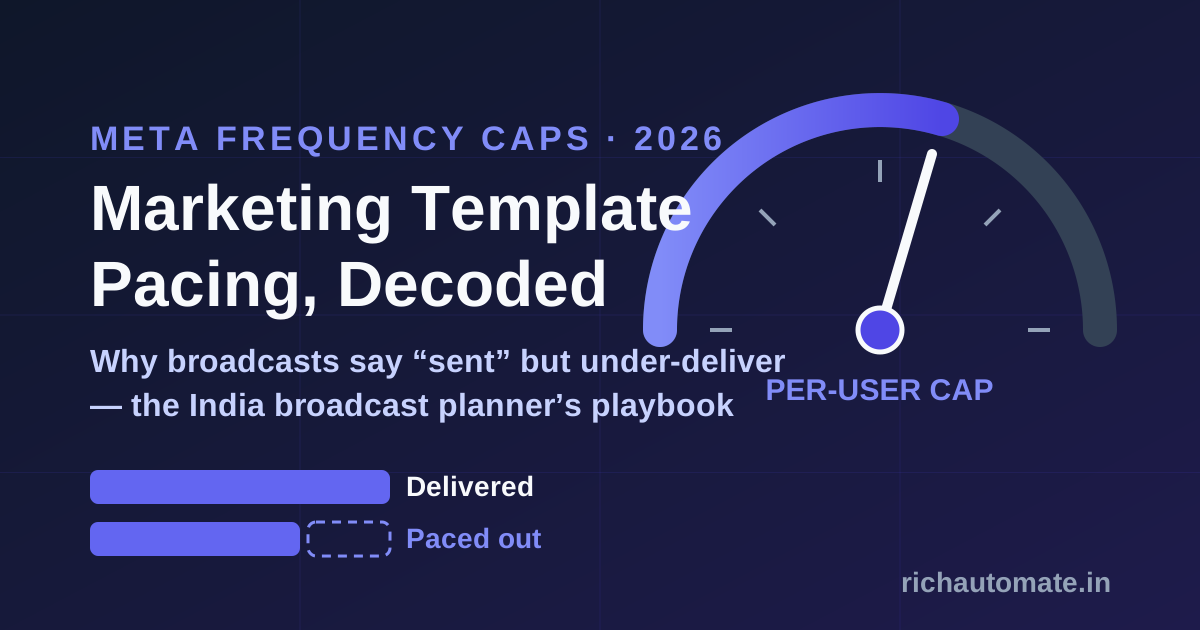
Marketing template pacing is Meta's per-user frequency cap: WhatsApp limits how many marketing messages any single user receives within a set window — counted across ALL businesses messaging that user, not just yours — and messages that exceed the cap are silently held or dropped even though your dashboard says "sent" (verify current Meta docs — this space changes quarterly). That is why your broadcast under-delivered: your send succeeded at the API, but Meta's pacing layer decided some recipients had already hit their marketing-message ceiling for the window, so those messages never reached a handset. For India broadcast planners this is the most consequential delivery mechanic of 2026, because India is WhatsApp's largest and most heavily marketed-to user base — the average Indian user sits closer to the cap on any given day than users in almost any other market. The rate-hike headlines got the attention (marketing conversations went to ₹0.8631 on 1 January 2026), but pacing is the quieter shift that actually reshapes planning: price changes what a message costs, pacing changes whether it arrives at all. This guide explains the mechanics — per-user caps, per-template quality scoring, and how the two interact — then gives you the reading skills to spot paced-out sends in your own numbers, and a six-part adaptation playbook: segmentation over spray, utility-first journeys, quality-rating protection, timing spread, template rotation, and measuring true reach instead of send counts. Treat every threshold below as "verify against current Meta documentation," because Meta tunes this system continuously and rarely announces the tuning.
Delivery rate ≠ send rate — the metric shift pacing forces. Before pacing, a broadcast planner's core metric was send success: did the API accept 50,000 messages? Under pacing, API acceptance tells you almost nothing. The message enters Meta's system, Meta checks the recipient's recent marketing-message load across every business, and only then decides whether to deliver now, deliver later, or not deliver at all. Your true metric is the delivered-to-sent ratio per campaign — and a falling ratio on stable list quality is the signature of pacing, not of bad numbers or blocks. Planners who still report "sent 50,000" are reporting a number Meta no longer promises means anything.
What exactly is Meta's marketing template pacing?
Pacing is a delivery-side control system with three interacting layers, all applied after your API call succeeds (verify current Meta docs — mechanics and thresholds change quarterly):
- Per-user frequency caps. Meta limits the number of marketing template messages a WhatsApp user can receive in a rolling window. Critically, the cap is shared across all businesses: if a user already received marketing messages from their bank, a fashion brand and a food app today, your message may be the one that exceeds the ceiling — through no fault of your list or content. Meta has publicly framed this as protecting the user experience so the channel keeps working for everyone.
- Per-template quality scoring. Each marketing template carries its own quality signal built from user actions — blocks, reports, and read/engagement behaviour on that template. Low-quality templates are paced harder and can be paused outright; high-engagement templates get more room. Pacing is therefore not uniform: two businesses sending to the same user at the same moment can see different outcomes based on template history.
- Eligibility ordering. When a user is near their cap, Meta effectively ranks which marketing messages still get through — and engagement history with your business (does this user read and reply to you?) is the strongest signal you control. Businesses the user actually engages with win the contested slots.
The strategic read: Meta has converted marketing delivery from a paid right into a ranked auction where the currency is user engagement. This is a delivery-limits story, distinct from the pricing story — for the cost side, see the WhatsApp Business API cost guide and the State of WhatsApp API Pricing India 2026 research. And pacing stacks on top of the older messaging-limit tiers (250 → 1K → 10K → 100K unique users/24h), which cap what you can send while pacing caps what gets delivered — the broadcast limits and tiers explainer covers that first layer.
Why does my broadcast say "sent" but not deliver?
Because "sent" only means Meta accepted the message; pacing decisions happen downstream. Here is how to read the signals in your own campaign data:
| Signal | What you see | What it means |
|---|---|---|
| Delivered-to-sent ratio drops | Campaigns that delivered 92–95% now deliver 70–85% on the same list | Classic pacing signature — recipients hitting shared caps; not blocks, not bad numbers |
| Delayed delivery tail | Deliveries trickle in hours after the send, instead of minutes | Meta holding messages until users fall back under their cap, then releasing |
| Per-template divergence | Template A delivers 90%, template B delivers 65% to overlapping audiences | Per-template quality scoring — B has weaker engagement or more reports |
| Error / status codes on marketing sends | API errors or webhook statuses indicating the message was not delivered for frequency reasons (exact codes vary — verify current Meta docs) | Explicit paced-out flag; log and count these per campaign, per template |
| Flat sends, falling revenue | Send counts stable, replies and conversions sliding quarter over quarter | Silent under-delivery compounding — the cost of measuring sends instead of reach |
The operational fix is instrumentation: store per-message webhook statuses, compute delivered/sent and read/delivered per campaign and per template, and alert when a template's delivery ratio drops more than ~10 points against its own baseline. A template whose delivery is decaying is usually also a template whose quality rating is decaying — catch it before Meta pauses it. (Template rejection at review time is a different failure mode with different fixes — see the template rejection fixes guide.)
How does pacing connect to the 2026 pricing shift?
One paragraph of context, because the two stories reinforce each other. Meta moved to per-template-category pricing and raised India marketing rates ~10% on 1 January 2026 — from ₹0.7846 to ₹0.8631 per marketing message, while utility and authentication sit at ₹0.115 and service replies cost ₹0 on SaaS Pay (about ₹0.115 each at Meta on Client Pay, after a reported 1,000 free a month) inside the 24-hour customer-service window (verify current Meta rate cards). Read together with pacing, the message from Meta is coherent: marketing messages are being made more expensive AND harder to deliver, while utility and service messages are cheap or free and are never paced. Meta is using both price and delivery levers to push businesses from broadcast-first to journey-first messaging. Planners who only re-budgeted for the rate hike solved half the problem; the delivery half is this guide.
Get a 1-minute BSP audit on WhatsApp
Drop your WhatsApp number — we line-item your current invoice against Meta India rates in under 60 seconds. India-hosted, DPDP-compliant.
How do I plan broadcasts around frequency caps? The adaptation playbook
Six disciplines, in priority order. Every one of them also improves ROI independently of pacing — which is exactly why Meta chose these incentives.
Run your figures through the WhatsApp ROI calculator before committing to a monthly spend.
- 1. Segmentation over spray. The full-list blast is the strategy pacing punishes hardest: it maximises contact with capped users and low-engagement users, dragging template quality down. Split by engagement recency — users who read or replied in the last 30/60/90 days — and send your best offers to the engaged core first. Smaller, warmer segments see higher delivery AND build the engagement history that wins contested cap slots later.
- 2. Utility-first journeys. Order confirmations, shipping updates, appointment reminders, payment receipts — utility templates are never paced, cost ₹0.115 instead of ₹0.8631, and every delivered utility message that gets read strengthens your engagement signal. Move every message that can honestly be utility out of the marketing category (honestly — mislabelled marketing content in utility templates is a recategorisation and quality risk; verify Meta's current category rules).
- 3. Quality-rating protection. Blocks and reports are the fastest way to get paced harder. Honour opt-outs instantly, keep frequency per user modest even below Meta's caps, front-load value in the first line, and retire templates whose read rates decay. Treat your quality rating as a delivery budget you spend with every weak send.
- 4. Timing spread. Everyone blasts at 10am and 6pm IST — which is when Indian users are most likely to be near their shared cap. Spreading sends across the day and across days flattens your collision risk and gives held messages room to release. Batch large campaigns into tranches rather than one spike.
- 5. Template rotation. Because quality scoring is per-template, concentrating all volume on one template concentrates risk: one bad week can pace or pause your whole programme. Maintain 2–3 approved variants per campaign type, rotate them, and watch per-template delivery ratios to spot decay early.
- 6. Measure true reach. Rebuild reporting around delivered and read, not sent. Cost per delivered message (spend ÷ delivered) is your honest unit economic; under pacing it can be 15–30% worse than cost per sent message, and that gap is invisible in send-count reporting.
What does this cost, and where does RichAutomate fit?
The Meta side of the ledger for India, current as of early 2026 (verify Meta's rate card):
| Message category | Meta rate (India, 2026) | Paced? |
|---|---|---|
| Marketing template | ₹0.8631 per message (was ₹0.7846 until 31 Dec 2025) | Yes — per-user caps + template quality scoring |
| Utility template | ₹0.115 per message | No |
| Authentication template | ₹0.115 per message | No |
| Service (24h window) | ~₹0.115 inside the customer-service window (first 1,000/month free) | No |
On the platform side, RichAutomate gives you the instrumentation this whole guide depends on — per-message delivery and read statuses, per-template performance, segmented broadcasts, and utility journey automation — at ₹0 platform fee, ₹0 setup, ₹0 monthly. On Client Pay you pay ₹0.10 per message plus Meta's charges billed to you directly by Meta at the rates above; on SaaS Pay it is an all-in ₹1.50 per marketing message and ₹0.50 per utility or authentication message. A 14-day free trial with 100 free credits is enough to run one segmented, instrumented campaign and see your real delivered-to-sent ratio before you commit — see the pricing page.
Plan for delivery, not just sends
Meta's marketing template pacing means every India broadcast now competes for a per-user delivery budget shared across all businesses — and the winners are decided by engagement history and template quality, not by who paid. The planners who thrive in 2026 are the ones who report delivered-to-sent instead of send counts, move every honest utility message out of the ₹0.8631 marketing lane into the ₹0.115 utility lane, segment by engagement recency, spread timing, rotate templates, and treat quality rating as a delivery budget. RichAutomate gives you the per-template delivery analytics and segmentation to run that playbook at ₹0 platform fee, ₹0 setup, ₹0 monthly — Client Pay at ₹0.10 per message plus Meta direct billing, or SaaS Pay at ₹1.50 marketing / ₹0.50 utility all-in. Start the 14-day free trial with 100 free credits, WhatsApp us at 918160311319, or book a 30-minute broadcast-planning walkthrough at https://richautomate.in/book/demo. (Pacing thresholds, category rules and rates are Meta's and change quarterly — verify current Meta documentation. No platform can promise delivery of paced messages or immunity from Meta quality actions.)
Start your 14-day free trial → · See full pricing · Read the broadcast limits explainer
Curating a multi-product promo? A single WhatsApp carousel template shows up to 10 swipeable cards for the price of one marketing message.
Writing the templates themselves? Start from these WhatsApp promotional message samples by occasion and industry.
Festive greetings are Marketing templates, so pacing applies. Here are ready Diwali wishes for clients and customers to send within the limits.