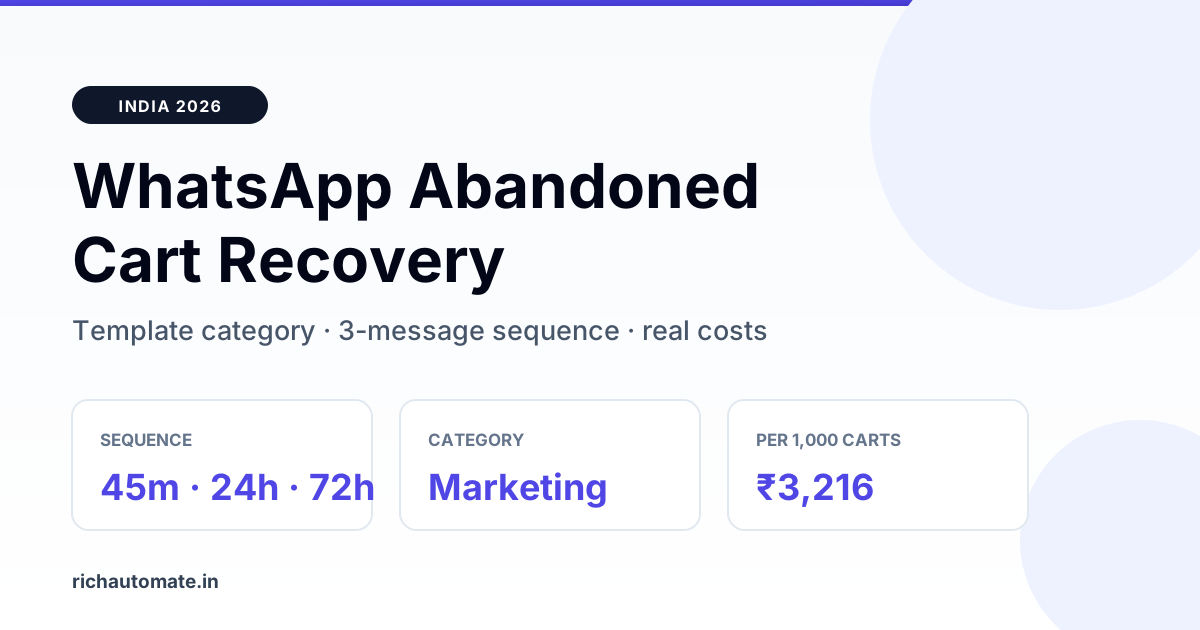
WhatsApp abandoned cart recovery works in India, but only if you send it as a Marketing template with recorded consent — a cart reminder is not a utility message, and treating it as one is the single most common reason these templates get rejected or paused. A three-message sequence at roughly 45 minutes, 24 hours and 72 hours, costing around ₹3.20 per cart in template fees, is the shape that actually survives Meta review.
The rest of this page is the operational detail: which category your template really falls under, what each message should say, what the maths looks like per thousand carts, how consent and opt-out work when the shopper never became a customer, and the four failure modes that quietly kill recovery rates in Indian stores.
Why a cart reminder is a Marketing message, not a utility one
This is the decision everything else hangs on. Utility templates cover a transaction the customer has already completed or explicitly requested — an order confirmation, a shipping update, an appointment reminder. An abandoned cart is, by definition, a transaction that did not complete. Nothing was requested. You are asking someone to come back and buy.
Meta classifies template category at review time, and that classification can be changed after approval. In practice, cart-recovery copy reviews as Marketing whenever it promotes the purchase, names a discount, or creates urgency. Some teams get a bare "your items are still in your bag" template through as Utility and treat that as a loophole; it is not a stable one, and a re-categorisation applies retroactively to your billing. Budget for Marketing rates and be pleasantly surprised, rather than the reverse. Our note on marketing vs utility messages covers where the line actually sits.
The practical consequence: cart recovery needs the same consent basis as any other promotional send, and the same opt-out handling. You cannot lean on "they were about to buy from us" as an implied opt-in.
The three-message sequence that works
Two messages is too few to catch the real reasons people abandon. Five is enough to get you reported. Three is the shape most Indian stores settle on, and each message should do a different job.
| # | Timing after abandonment | Job of the message | What to include | Category |
|---|---|---|---|---|
| 1 | 30–60 min | Remove friction, not price | Item name, cart link, one-line help offer. No discount. | Marketing |
| 2 | ~24 hours | Answer the unspoken objection | Delivery time, return policy, COD availability, payment options | Marketing |
| 3 | ~72 hours | Last call, with a reason to act | Time-boxed incentive or free shipping, explicit expiry | Marketing |
The discipline that matters is not discounting in message one. A large share of abandonment in Indian carts is not price resistance — it is a shipping charge that appeared at checkout, an unclear delivery date, a payment method that failed, or a phone that rang. Discounting at minute 45 pays a margin cost to recover people who would have come back anyway, and trains repeat buyers to abandon deliberately.
Message two is where most of the recoverable volume sits, because it is where you can address the objection directly. If your data shows prepaid drop-off, offering COD here converts; if it shows COD carts abandoning, the lever is different, and our page on COD-to-prepaid conversion covers that side of it.
What it costs per thousand carts
Run the numbers before you build the flow. Template fees are per message delivered, so the cost scales with the size of your abandonment pool, not with the number of orders you recover. At RichAutomate’s SaaS Pay rate of ₹1.20 per marketing message (usage-only, ₹0 setup, ₹0 monthly), a three-step sequence looks like this:
| Step | Recipients | Rate | Cost |
|---|---|---|---|
| Message 1 (45 min) | 1,000 | ₹1.20 | ₹1,200 |
| Message 2 (24 h, minus recovered + opted out) | 880 | ₹1.20 | ₹1,056 |
| Message 3 (72 h) | 800 | ₹1.20 | ₹960 |
| Total per 1,000 abandoned carts | 2,680 sends | — | ₹3,216 |
Roughly ₹3.20 in template fees per cart entered into the sequence. The numbers that decide whether that is cheap or expensive are yours, not ours, so substitute them: at a 10% recovery rate you spend about ₹32 in messaging per recovered order; at 5% it is about ₹64. Against an average order value anywhere north of ₹800 that is comfortable, and it stops being comfortable fast if your AOV is low and your recovery rate is weak. Model it before you build it.
Two cost details people miss. First, a shopper who replies opens a 24-hour service window, and conversation inside that window is charged differently from templates — see 24-hour window cost optimisation. Second, on Client Pay the platform fee is ₹0.10 per message and Meta bills the template cost to your own WhatsApp account directly, which changes the arithmetic above entirely; the per-message pricing breakdown and our pricing page set both models side by side.
Consent, when the shopper never became a customer
An abandoned cart means you have a phone number and no completed relationship. That is the weakest consent position you can send marketing from, so the capture point has to do real work.
Get a 1-minute BSP audit on WhatsApp
Drop your WhatsApp number — we line-item your current invoice against Meta India rates in under 60 seconds. India-hosted, DPDP-compliant.
- Capture opt-in at the field, not in the footer. A checkbox next to the phone field on checkout, worded as receiving order and offer updates on WhatsApp, with the business name visible. Store the timestamp, the page, and the exact wording shown.
- Pre-ticked boxes are not consent in any reading worth defending. Leave it unticked.
- Keep the evidence queryable. When Meta asks how a number entered your list, "it came from Shopify" is not an answer; a row with a timestamp and consent text is.
- Honour opt-out on every path. A STOP reply during a cart sequence must suppress the remaining two messages and every other campaign, not just this flow. That plumbing is the subject of our STOP keyword opt-out handling guide, and cart sequences are where suppression leaks most often, because the flow usually lives outside the main campaign system.
India’s data-protection regime has been moving, and obligations around notice, consent records and withdrawal continue to be phased in. Confirm the current position with your own counsel rather than taking a blog’s word for it — including this one. What is not in doubt is the platform rule: Meta requires opt-in for business-initiated messages, and unhonoured opt-outs show up as blocks and reports.
Wiring it to your store
The trigger is the same everywhere — a cart that has sat untouched past a threshold, with a phone number attached and no matching order. What differs is where the event comes from.
| Platform | Trigger source | Watch out for |
|---|---|---|
| Shopify | Checkout-created event plus an abandoned-checkout poll | Phone often lands only after the contact step; carts abandoned earlier have no number at all |
| WooCommerce | Cart session table or a cart-tracking plugin | Guest carts expire with the session — persist the record yourself or the trigger never fires |
| Custom / headless | Your own cart service emits the event to a webhook | Deduplicate: one shopper with three devices must not enter the sequence three times |
Whichever source you use, the cancellation check is the part to get right. The flow must re-verify order status immediately before each send, not only at enqueue time. A customer who completes the purchase at hour six and still receives the 24-hour "you left something behind" message has been told, plainly, that nobody is watching. Setup detail for the two common stacks sits in our Shopify WhatsApp integration guide.
Where the link should land
Send people back to a restored cart, not to your homepage. A cart URL that rebuilds the basket removes the single largest source of drop-off in the recovery flow; a homepage link asks the shopper to do the work again, and most will not.
If your catalogue is on WhatsApp itself, the shorter path is to keep the entire recovery inside the chat — item, quantity, payment link, done — which is what in-chat UPI checkout is for. Fewer hops means fewer places to lose someone, and it also keeps the conversation in a channel where you can answer a question instead of watching a session die silently.
Four failure modes that kill recovery rates
- Firing too fast. A message at five minutes reads as surveillance. The shopper is often still on the site. Thirty minutes is the practical floor.
- No dedupe against your other campaigns. A cart sequence running alongside a festive broadcast means three marketing messages in one afternoon. Frequency caps must be global, not per-flow.
- Ignoring quality rating until it is red. Cart recovery sends to people who never bought, which is the profile most likely to generate blocks. Watch the rating weekly; recovery from red is slow and costs you messaging limit in the meantime.
- Counting recovery wrong. Anyone who would have returned on their own gets counted as recovered in a naive attribution. Hold out a control group — five or ten per cent that receives nothing — and measure the difference. Without it you cannot tell a working sequence from an expensive one.
On the last point: no responsible provider can promise that a given send pattern will never attract a block or a restriction. What you control is consent quality, frequency and relevance, and those three explain most of the variance between accounts that stay healthy and accounts that do not.
A sequence you can copy
Message 1 — 45 minutes
"Hi {{1}}, you left {{2}} in your cart at {{3}}. Your basket is still saved — tap below to finish up. Any question about size, delivery or payment, just reply here and a person will answer."
Message 2 — 24 hours
"Hi {{1}}, your {{2}} is still reserved. Delivery is {{3}} working days, returns are open for {{4}} days, and you can pay by UPI, card or cash on delivery. Reply if anything is unclear."
Message 3 — 72 hours
"Last reminder from {{1}}: {{2}} is still in your cart, and {{3}} takes {{4}} off if you check out before {{5}}. After that the cart clears. Reply STOP to stop receiving these."
Keep variables to what you can reliably fill. A template that fails to hydrate because your product title exceeded the parameter length is a failed send you still reasoned about and planned around — and Meta counts it against you either way.
What to measure
Three numbers, weekly. Recovery rate against a holdout, not against the raw pool. Cost per recovered order, template fees divided by incremental orders. Opt-out and block rate on the sequence specifically — if it runs materially above your broadcast baseline, the sequence is too aggressive and you are borrowing against future deliverability to hit this month’s number.
A cart sequence that recovers well and quietly burns your list is not a win. It is a loan.