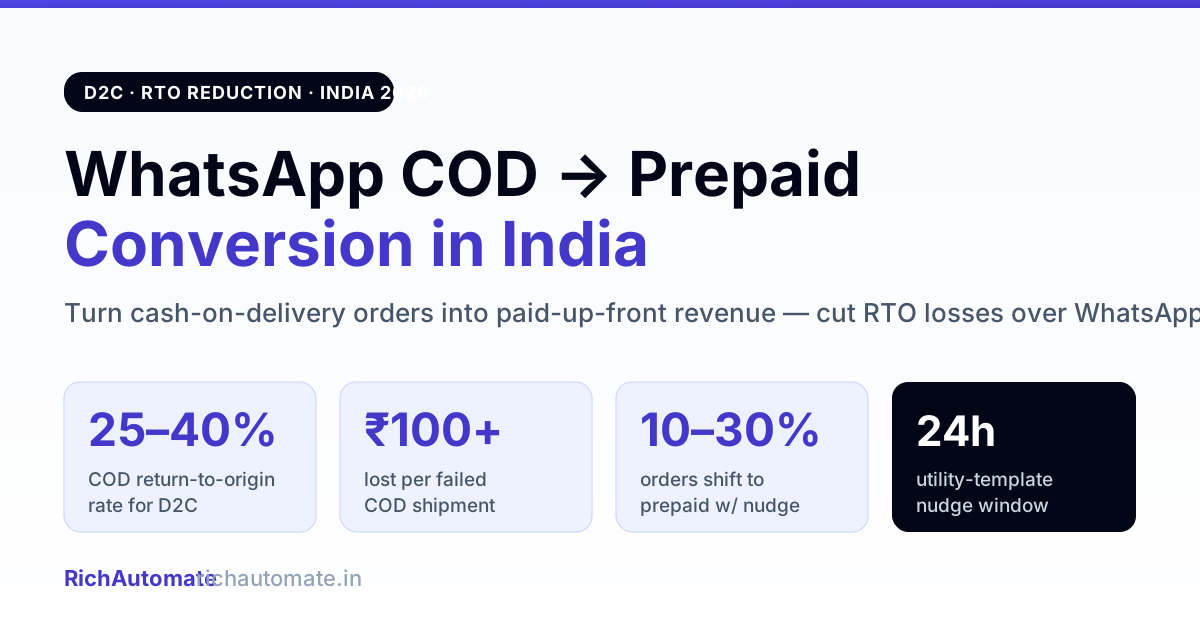
To convert WhatsApp COD orders to prepaid, message the customer within minutes of the order on a utility template, restate the order, and offer a small prepaid-only incentive with a one-tap UPI/payment link. Done well on live catalogues, this shifts 10–30% of cash-on-delivery orders to paid-up-front and directly cuts the 25–40% return-to-origin (RTO) losses that quietly eat D2C margins in India.
Why COD is silently killing D2C margins
Cash-on-delivery is still the default for most Indian shoppers — trust, no card, no UPI habit for a first purchase. But COD carries a hidden tax the P&L rarely shows cleanly:
- RTO (return-to-origin): 25–40% of COD orders for many D2C brands fail delivery — customer not home, changed mind, fake order, cash not ready. Each failed shipment burns forward + reverse logistics, packaging, and restocking.
- Cash-flow lag: money lands only after delivery + courier remittance cycle (often 7–15 days), versus instant on prepaid.
- Per-shipment bleed: a failed COD parcel routinely costs ₹100+ in round-trip freight alone before you count the blocked inventory.
Prepaid orders RTO far less because the customer already has money committed. So every COD order you flip to prepaid is both revenue pulled forward and an RTO risk removed. WhatsApp is the right channel to do it because it is where the order confirmation already lands and where a reply is one tap away — a link in an email or SMS converts a fraction as well.
The WhatsApp COD-to-prepaid conversion play
Five steps, all inside the 24-hour service window opened by the order or a utility template:
1. Order confirmation (immediately)
The moment an order is placed, fire a utility-category template that restates the order — items, amount, delivery address, ETA — and asks the customer to confirm. This alone kills fake/duplicate COD orders and opens the conversation. Wire it as an automated post-order message from your store webhook; if you run in-chat checkout, see the WhatsApp catalog commerce playbook for how the order object flows.
2. Prepaid nudge with a real incentive
In the same thread, offer a reason to pay now: a small flat discount (₹50–₹100), free shipping, or a small loyalty credit — prepaid only. Keep it honest and specific: "Pay now and save ₹75 + skip the cash-on-delivery handling fee." The incentive must be smaller than your RTO cost per order, so even a modest shift is margin-positive.
3. One-tap payment link
Send a UPI/Razorpay/Cashfree payment link as a button. One tap → pay → done. The lower the friction, the higher the flip rate. Never make the customer leave WhatsApp to log in somewhere.
Get the India 2026 WhatsApp BSP price comparison
Wati vs AiSensy vs Interakt vs RichAutomate: Meta rates, platform fees and hidden costs, side by side. We send it to your WhatsApp in a minute.
4. Address + intent confirm
If they decline prepaid, still confirm the address and delivery intent ("Reply YES to keep this as cash-on-delivery"). A confirmed COD order RTOs less than an unconfirmed one — you have already filtered the tyre-kickers.
5. Timed follow-up
No response in a few hours? One polite reminder before the window closes. This mirrors proven WhatsApp abandoned-cart recovery mechanics — same nudge muscle, applied to an order that already exists instead of a cart that was left behind.
Message templates that convert
Two template categories matter here, and the difference is money:
- Utility templates (order confirmation, payment reminder tied to a specific transaction) — lower per-message cost, high deliverability, no marketing opt-in gymnastics. Your confirmation + payment-link messages should be utility.
- Marketing templates (broad promos, "flat 20% today") — needed only if the nudge reads as promotional. Keep the prepaid nudge transactional and it stays utility.
Example utility body (gets Meta-approved cleanly): "Hi {{1}}, your order {{2}} for ₹{{3}} is confirmed. Pay now to save ₹75 and skip cash handling: {{4}}. Or reply YES to keep cash-on-delivery." Keep it under the character limits, one clear CTA, no emoji spam.
Compliance and cost in India
Three things to get right before you scale this:
- Opt-in: you can message a customer about their own order (utility) inside the service window; broad marketing needs prior opt-in. Order confirmation is the cleanest opt-in event — capture consent at checkout.
- Per-message pricing: Meta bills per conversation category. Utility conversations are cheaper than marketing; a confirmation + one reminder is a fraction of a rupee against ₹100+ of RTO risk — the ROI is not close.
- GST + going live: a WhatsApp Business API number that transacts commercially in India needs GST on file to go fully live (trial works without). Budget for it before launch. Full per-message economics are in our pricing breakdown.
Build vs buy
You can wire this by hand against the Meta Cloud API — webhook on order-created, template send, payment-link generation, reply parsing, window tracking. It is a few weeks of engineering plus ongoing template-approval and billing-reconciliation upkeep. Or you run it on a platform that already owns the messaging lifecycle, template management, and payment-link buttons, and you spend your time on the offer and the numbers instead of the plumbing. See what a managed setup covers in features.
Prepaid checkouts that fail at the UPI or card step can be recovered too — use these failed payment recovery templates on WhatsApp.
Your 7-day rollout checklist
- Day 1–2: Draft + submit two utility templates (order confirmation, prepaid nudge with payment link). Approval takes hours to a day.
- Day 3: Wire the store/order webhook to fire the confirmation on order-created.
- Day 4: Connect a UPI/Razorpay/Cashfree payment link into the nudge button.
- Day 5: Set the prepaid incentive below your measured RTO-per-order cost.
- Day 6: Add the timed follow-up + address-confirm branch.
- Day 7: Go live on 10% of COD orders, measure flip-rate and RTO delta, then scale.
Track one number above all: prepaid flip-rate × RTO saved per flip. That is the whole business case, and it usually pays back the setup inside the first week of volume.