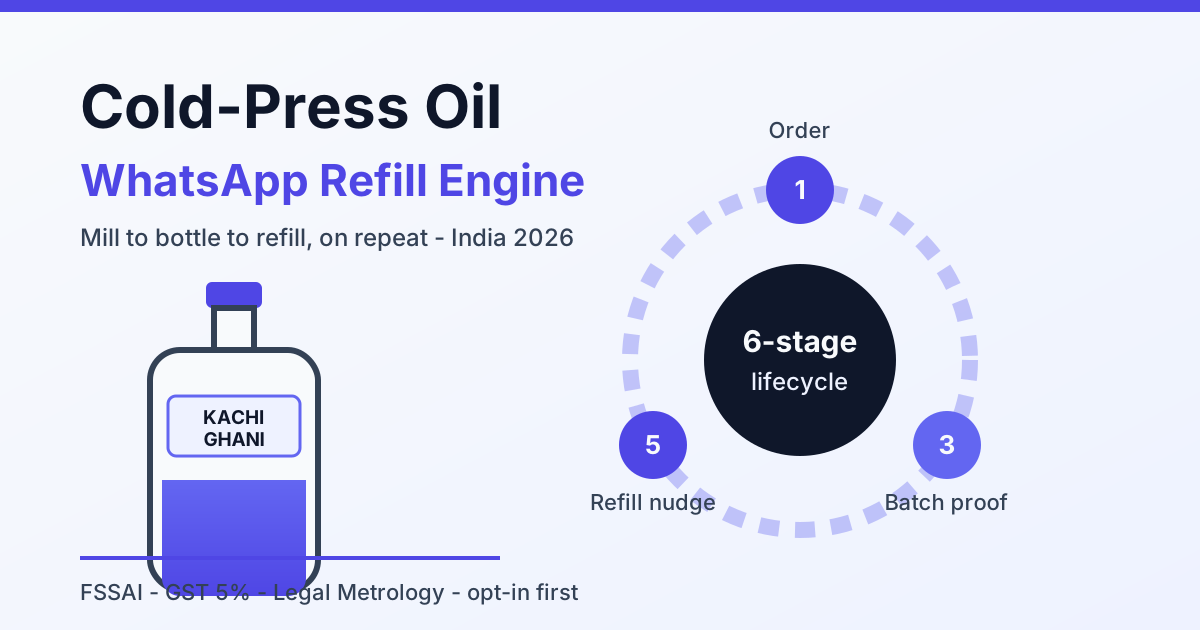
For a cold-press (kachi ghani) oil mill or D2C oil brand in India, WhatsApp Business API is the cheapest reliable way to turn a one-time 1L or 5L buyer into a monthly refill subscriber, because it lets you send pressing-date proof on dispatch and a refill nudge timed to the day the bottle actually runs out. The compliance side is equally fixed: an FSSAI licence (State or Central by turnover), 5% GST on edible oil, full Legal Metrology declarations on every pack, and documented opt-in before any WhatsApp template goes out.
This guide is for mills and brands selling mustard, groundnut, coconut, sesame and sunflower oil direct to Indian households in 2026. It covers the six-stage order-to-refill lifecycle, what each nudge really costs per thousand customers, how WhatsApp compares to SMS and email for this specific job, and the label and licence spine you cannot skip.
Why refill timing, not the first sale, decides your margin
Cold-press oil is unrefined and chemically fragile. A kachi ghani mustard or groundnut pack typically carries a best-before of roughly six to nine months against the twelve to eighteen months a refined oil claims, and buyers know it — which is exactly why they buy small and buy often. In practice a four-person Indian household finishes a 1L bottle in three to five weeks and a 5L tin in ten to fourteen weeks.
That creates a narrow window. Miss it by ten days and the household has already picked up a refined pouch from the kirana, and your next order slips a full cycle or never comes. Across Indian food-D2C accounts we work with, first-order-to-second-order conversion sits somewhere in the 18–30% band when nothing is done, and lands in the 35–50% band once a timed refill message reaches the buyer inside the depletion window. Treat those as observed ranges rather than a promise — pack size, price point and city mix move them a lot.
Store the two fields that make the timing work
Most mills store only the order. You need two more fields at checkout or in the first chat: pack size purchased and household size (or estimated monthly consumption). Pack size divided by consumption gives a depletion date per customer, and every downstream automation hangs off that single date. Without it you are broadcasting. With it you are reminding.
Freshness is your differentiator, so make it visible
Refined-oil brands compete on price. Cold-press competes on the pressing date, the seed source, and the fact that nothing was bleached or deodorised. Those are facts you can send as a photo and a line of text on the day of dispatch, and they are the most repeated reason buyers give for coming back. A brand that never proves freshness is priced against the big refined labels; a brand that proves it every order is priced against itself.
Channel reality check: SMS, IVR and email vs WhatsApp for refill nudges
The refill nudge has three requirements. It must be seen within a day or two, it must carry an image such as the batch photo or pack shot, and the customer must be able to reply "send 2 litres" without opening an app or a browser. Only one channel does all three.
| Channel | What Indian food-D2C operators typically observe | Rich media | Two-way reply | Fit for refill nudge |
|---|---|---|---|---|
| SMS (DLT-registered) | Delivers, but read rates are low and links are widely distrusted; DLT header and template approval add days of lead time | No | No | Weak — useful only as an OTP or delivery-slot backup |
| IVR / voice call | Answer rates fall sharply outside business hours and calls read as telemarketing on a repeat purchase | No | Live agent only | Poor — expensive per contact and intrusive |
| Open rates on Indian D2C food and grocery lists commonly sit in the low teens; the refill window closes before the mail is read | Yes | Slow | Weak — good for invoices, poor for timing | |
| WhatsApp Business API | Opt-in lists routinely read far higher than SMS or email because the message lands in a personal inbox already opened daily | Yes (image, PDF, buttons) | Yes, instantly | Strong — the only channel that closes the reorder inside the chat |
The catch is that WhatsApp is permissioned. You cannot buy a list of oil buyers and blast them. Unsolicited bulk sending gets numbers blocked and quality-rated down until your daily sending limit collapses, and no provider can make that risk disappear. Every number on your list must have opted in, and you should be able to show when and where.
The six-stage order-to-refill lifecycle
Here is the sequence we implement for oil mills. Each stage is one automation with a clear exit condition.
Stage 1 — Enquiry and opt-in
The entry points are a click-to-WhatsApp ad, a QR code at the mill gate and on the pack, a website chat button, and the phone number printed on the label. The first automated reply does three things: confirms what you press and where, asks pack size and city, and captures explicit consent to receive order and refill updates. Log the consent text, timestamp and source. If your mill has no e-commerce storefront, you can run WhatsApp Business API without a website and take the entire order inside the chat.
The click-to-WhatsApp link generator builds the wa.me link with your prefilled message in one step.
Stage 2 — First order and the freshness expectation
Confirm the order with the exact pack size, price with 5% GST shown separately, and one honest line about shelf life and storage: keep away from sunlight, use within the printed best-before, sediment at the bottom of cold-press oil is normal. Setting that expectation in writing kills most "the oil looks cloudy" complaints later. Record the calculated depletion date here.
Stage 3 — Dispatch with batch and pressing-date proof
On dispatch, send courier tracking plus a photo of the actual batch showing pressing date, batch number and the FSSAI licence number on the label. This is the message customers screenshot and forward, and it is the cheapest word-of-mouth an oil brand gets. It is a utility-category template because it relates to an existing transaction.
Stage 4 — Post-delivery usage check
Three to five days after delivery, ask one question with quick-reply buttons: taste and aroma as expected, or a problem. A reply opens a 24-hour service window in which your team can respond free-form, refund or replace. This message is also where you catch the customer who used 500ml in four days — a family that size needs the 5L tin, and that is an upsell you would otherwise never see.
Stage 5 — The refill-window nudge
Fire five to seven days before the calculated depletion date. Keep it specific: "Your 1L kachi ghani mustard pressed on 12 June should be finishing this week. Reorder the same pack, or switch to 5L?" with two buttons. If the message is genuinely about an existing order cycle it can often ride as utility; a discount or a new-variant push is marketing and must be categorised honestly. Miscategorising templates is the fastest way to get one rejected and an account flagged.
Get the India 2026 WhatsApp BSP price comparison
Wati vs AiSensy vs Interakt vs RichAutomate: Meta rates, platform fees and hidden costs, side by side. We send it to your WhatsApp in a minute.
Stage 6 — Subscription and loyalty
After the second or third repeat, offer a standing monthly or six-weekly dispatch on a fixed date with a skip button. Skip must be one tap, because a subscription a customer cannot pause is a subscription they cancel. The mechanics are the same ones used in WhatsApp subscription-box automation for monthly D2C boxes: a recurring dispatch date, a pre-dispatch confirmation, and one-tap skip or swap.
Template categories and what 1,000 refill nudges actually cost
Meta bills WhatsApp per 24-hour conversation, and the category decides the price. Utility conversations relate to an existing order or account. Marketing conversations promote, offer or re-engage. Authentication carries OTPs. For an oil brand, dispatch updates, delivery confirmations, invoices and genuine order-cycle reminders are utility; festive offers, new cold-press variant launches and win-back campaigns are marketing.
| Refill campaign to 1,000 customers | Category | Rate (SaaS Pay) | Cost per 1,000 |
|---|---|---|---|
| Order dispatch plus batch photo | Utility | ₹0.50 per conversation | ₹300 |
| Refill-window reminder tied to the order cycle | Utility | ₹0.50 per conversation | ₹300 |
| Diwali gift-pack or new-variant offer | Marketing | ₹1.50 per conversation | ₹1,200 |
| Same 1,000 nudges on your own Meta account | Client Pay | ₹0.10 per message plus your Meta bill | ₹100 platform fee |
Two things follow. First, disciplined utility messaging costs roughly a quarter of pushing everything as marketing, which is a real number at 10,000 customers a month. Second, at a 1L pack margin of even ₹60 to ₹90, a ₹0.50 nudge that converts one buyer in ten pays for itself many times over. Full rates sit on the RichAutomate pricing page: usage-only, ₹0 setup, ₹0 monthly.
The compliance spine for selling packaged edible oil
FSSAI licence — State or Central by turnover
Any unit that mills, packs or sells edible oil needs an FSSAI authorisation. Very small operations register; most working mills hold a State licence; a Central licence applies above the higher turnover threshold, for importers and exporters, and for operators running across multiple states or selling nationally through e-commerce marketplaces. The long-standing bands are basic registration below roughly ₹12 lakh annual turnover, State licence from there up to about ₹20 crore, and Central licence above that — verify the current thresholds and any capacity-based trigger for vegetable oil processing units before you file. The 14-digit licence number and the FSSAI logo must appear on every pack and every online listing.
GST on edible oil
Edible vegetable oils, including cold-press mustard, groundnut, coconut and sesame, sit in the 5% GST slab under HSN headings 1507 to 1518. Charge 5% on the pack and issue a tax invoice for every order, including orders confirmed inside a WhatsApp chat — sending the invoice PDF as a utility template is the cleanest way to do it. Note that packaging, labels and freight are usually taxed higher than the 5% you collect, so plan for the inverted duty position instead of discovering it at filing time.
Legal Metrology — what must be printed on the pack
The Legal Metrology (Packaged Commodities) Rules require, on every retail pack: name and complete address of the manufacturer or packer, the common or generic name of the commodity, net quantity in millilitres or litres (weight and volume declarations are not interchangeable), month and year of packing, retail sale price declared as MRP inclusive of all taxes, and consumer care contact details. Food labelling rules add the FSSAI logo and licence number, the vegetarian mark, a best-before date, an ingredient statement and a nutritional information panel per 100g or 100ml. If you sell online, the same declarations must be legible on the product listing before the customer pays, not only on the bottle that arrives later.
WhatsApp and Meta rules
Three rules govern everything above. Opt-in is mandatory and must be recorded. Free-form replies are allowed only inside the 24-hour customer-service window that opens when the customer messages you; outside it you need an approved template. And template category must match intent — promotional content sent as utility gets rejected on review or reclassified, and repeat offences damage account quality. Nobody can offer you a ban-proof number: quality rating and block rate are computed from what your recipients do, so the only durable protection is sending relevant messages to people who asked for them.
Manual WhatsApp vs WhatsApp Business API for an oil mill
| Capability | WhatsApp Business app (manual) | WhatsApp Business API |
|---|---|---|
| Devices and simultaneous agents | One phone, limited linked devices | Unlimited team members on one number, shared inbox |
| Broadcast reach | Broadcast lists reach only contacts who saved your number | Templates reach any opted-in number |
| Depletion-date automation | Manual reminders, a person with a diary | Scheduled per customer, fires on the calculated date |
| Order and batch data | Lives in the operator’s head | Stored against the contact, usable in every template |
| Verified business badge | Not available | Eligible after brand review — see WhatsApp green tick verification in India |
| Cost shape | Free, but capped by human hours | Per conversation, scales without new hires |
The honest cut-off is volume. Under roughly 200 active customers, the free app plus a disciplined spreadsheet works. Past that, refill dates stop being remembered and the repeat rate quietly decays. If you are comparing vendors before committing, the field is surveyed in our rundown of the best WhatsApp Business API platforms for D2C brands.
A 30-day rollout for a mill already shipping orders
Week one: confirm FSSAI licence status, audit one pack against the Legal Metrology checklist above, and get the WhatsApp Business number verified. Week two: build stages 1 to 3 — enquiry reply, order confirmation, dispatch with batch photo — and submit those templates for approval. Week three: add the post-delivery usage check and back-fill depletion dates for the last ninety days of orders. Week four: switch on the refill nudge for that back-filled cohort and measure second-order rate against the previous quarter. Only after that should you touch marketing-category campaigns.
Start your refill engine
A cold-press mill does not need a bigger ad budget to double revenue; it needs the second, third and fourth order from buyers it already has. That is a timing problem, and timing is exactly what WhatsApp automation solves. Pricing is usage-only — ₹0 setup, ₹0 monthly, Client Pay at ₹0.10 per message on your own Meta account, or SaaS Pay at ₹1.50 per marketing conversation and ₹0.50 per utility conversation.
Create a free RichAutomate account and build your first dispatch-proof and refill-window flow this week. Full details at https://richautomate.in.