All articles
Comparison

Interakt vs Wati India 2026: Pricing & Seat-Fee Decoded

Interakt vs Wati for WhatsApp Business API India 2026: Interakt scales with plan and volume, Wati with seat count. Decode the 5-agent cost trap.

RichAutomate Editorial
9 min read 2 views
Interakt vs Wati India 2026: Pricing & Seat-Fee Decoded

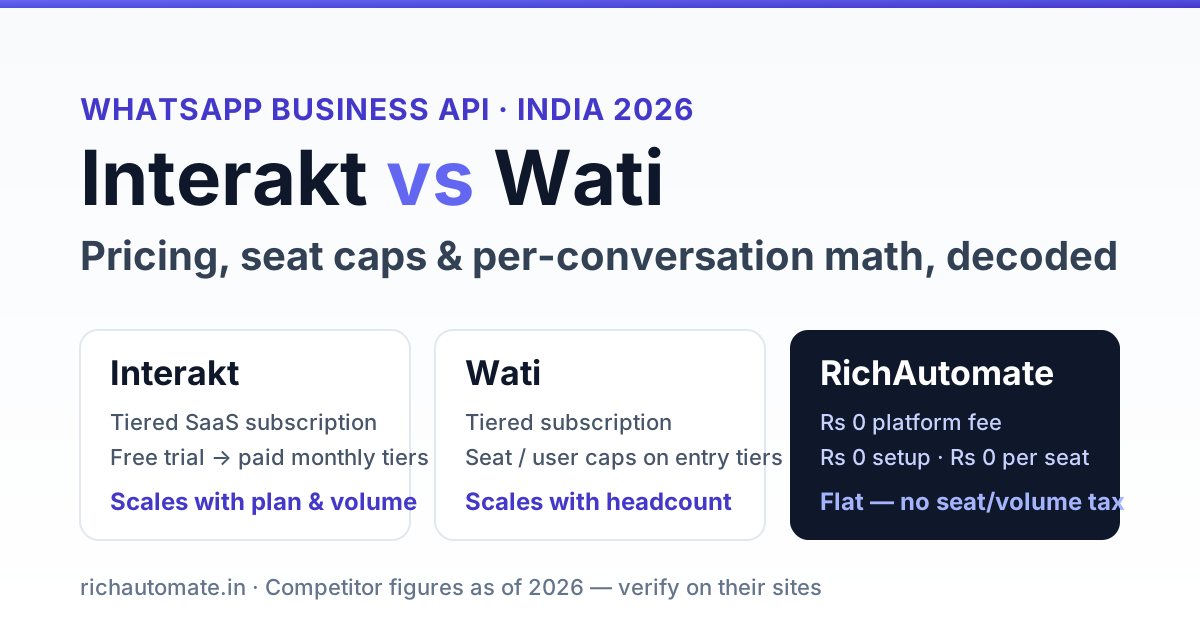
Choosing between Interakt and Wati for the WhatsApp Business API in India in 2026 comes down to one thing the feature sheets hide: the two tools price the same workload in opposite directions. Interakt leans on tiered SaaS subscription plans with usage-linked components, while Wati leans on tiered subscriptions with a seat/user cap on entry plans — so Interakt's cost tends to scale with your plan tier and message volume, and Wati's cost tends to scale with your team headcount. On top of either tool you still pay Meta's WhatsApp conversation charges separately. This guide decodes the real cost math for a growing 5-agent team, gives a verdict by use-case, and shows where a flat Rs 0-platform-fee model changes the calculation. Every competitor figure below is directional and as of 2026 — verify the live plans, seat caps and per-conversation components on the Interakt and Wati sites before committing, because both vendors revise pricing regularly. General information, not commercial advice.

Interakt vs Wati: the pricing models decoded

Before any numbers, understand the shape of what you are buying — that is where the cost difference lives, not the feature list. Both run on the same underlying Meta WhatsApp Business API, so deliverability and template approval are governed by Meta, not by the tool. What differs is how each vendor taxes your growth.

DimensionInterakt (2026 — verify)Wati (2026 — verify)
Core modelTiered SaaS subscription with usage-linked componentsTiered subscription with seat/user caps on entry tiers
Entry pointFree trial, then paid monthly/annual tiers (Growth and Advanced tiers commonly cited)Paid tiers; best headline rates typically on annual commitment
Where cost scalesPlan tier and message/conversation volumeAdding agents (seats) above the entry-tier cap
Seat / user handlingVerify per-tier agent limits on the Interakt siteEntry tiers commonly capped (~3–5 users cited); extra seats billed as add-ons
Meta conversation chargesBilled separately on top by MetaBilled separately on top by Meta

The single most important thing to internalise: a per-tier/volume model taxes you as you send more, a seat-capped model taxes you as you hire more. Most growing Indian SMBs grow on both axes at once — more agents and more messages — which is exactly where both models start to hurt.

The 5-agent cost trap

The mistake almost every buyer makes is treating the headline subscription as the total cost. It never is. Two lines get added on top:

Stop overpaying on WhatsApp

Get a 1-minute BSP audit on WhatsApp

Drop your WhatsApp number — we line-item your current invoice against Meta India rates in under 60 seconds. India-hosted, DPDP-compliant.

DPDP-compliant · India-hosted · 1-min reply
  • Seats above the cap. If a plan's entry tier is capped at roughly three users, agents four and five are add-on seats billed every month, indefinitely. The true cost is the headline tier plus those recurring seat fees.
  • Meta's conversation charges. Whichever tool you pick, Meta bills marketing, utility and authentication conversations separately at its own rates — verify the current category pricing as of 2026, because Meta revises it.

The honest method is to price your target agent count (5, 8 or 12), not today's, and to add Meta's charges to every option. On a seat-capped tool a headcount-heavy team pays the seat tax; on a volume-linked tool a broadcast-heavy team pays the per-conversation tax. Model both against your real numbers before you sign an annual plan.

Rule of thumb. Growing your agent count? Watch seat caps hardest. Growing your broadcast volume? Watch per-conversation markups hardest. Growing both? Neither tiered model is built for you — that is the gap a flat platform fee fills.

Feature matrix: how close are they?

For the core day-to-day, Interakt and Wati are close enough that features rarely decide the purchase. Both ship the essentials; depth varies by plan, so verify per-tier limits on each site.

CapabilityInteraktWatiRichAutomate
Shared team inboxYesYesYes
Broadcast campaignsYesYesYes
No-code chatbot / flow builderYesYesYes (visual flow builder)
Catalog / commerceYesYesYes
CRM-style contactsYesYesYes
Per-seat platform chargeVerify per tierAdd-on above entry capRs 0 — no seat charge
Platform feeMonthly tierMonthly/annual tierRs 0 platform / Rs 0 setup

Because feature parity is high, the decision properly comes back to the pricing model and how it fits your team's shape. For a deeper single-vendor breakdown, see our Interakt vs RichAutomate pricing decode and Wati vs RichAutomate pricing decode.

Verdict by use-case

  • Small team, modest volume, fits the seat cap. Either works — compare the headline tiers and the add-on seat rate, then pick the more predictable one for your numbers.
  • Growing sales team (5–10+ agents). Be wary of seat-capped subscription pricing; add-on seat fees compound monthly with every hire. Weigh Wati's seat math carefully.
  • High broadcast volume, lean team. Watch per-conversation and volume-linked components closely, because they stack on top of Meta's charges.
  • Growing on both axes. Both tiered models work against you — this is where a flat Rs 0-platform model changes the calculation. Compare the field in our AiSensy vs Interakt vs Wati vs RichAutomate comparison.

Where RichAutomate changes the math

RichAutomate prices on a different axis, which removes both the seat tax and the volume tax. The platform is flat — Rs 0 platform fee, Rs 0 setup and Rs 0 monthly — with no per-seat platform charge, so adding a fourth or fifth agent costs Rs 0 on the platform side. Two billing modes fit different businesses:

  • Client Pay: Rs 0.10 per message, and Meta's conversation charges billed to you directly by Meta at Meta's own rates — no markup layered on top.
  • SaaS Pay: an all-in Rs 1.20 per marketing conversation and Rs 0.30 per utility conversation.

A 14-day free trial with 100 credits lets you run a real campaign and a real 5-agent inbox before committing. The point is not that RichAutomate wins every single line item, but that growing on either axis — headcount or volume — does not trigger a platform tax. Meta's conversation-category pricing changes, so verify current rates as of 2026, and verify Interakt and Wati plans on their own sites. If you are cost-shopping the whole market, our cheapest WhatsApp Business API in India guide lays out the total-cost math, and if you have already picked a side you can read the Interakt alternative and Wati alternative switch guides.

One compliance note that is not optional. Going live on the WhatsApp Business API with any BSP — Interakt, Wati or RichAutomate — effectively requires a GST number for business verification. A trial without GST is fine, but treat GST as required to go live, never optional. And no provider can promise "no ban": WhatsApp policy compliance, opt-ins and quality ratings are governed by Meta.

How to decide in 10 minutes

  1. Write down your target agent count in 12 months, not today's.
  2. Estimate your monthly conversation volume by Meta category (marketing / utility).
  3. Get the live Interakt and Wati tier prices and seat-cap add-on rates from their sites.
  4. Add Meta's separate conversation charges to every option — this is the line buyers forget.
  5. Compare against a flat Rs 0-platform model so you can see the seat/volume tax in isolation.

Do that and the "Interakt vs Wati" question usually answers itself — and often reframes into "does a tiered model fit us at all?" Start a free 14-day RichAutomate trial to price your own team against both.

Ready to ship this?

Get the full migration playbook on WhatsApp

A founder-led 1-minute reply with the migration steps, template approval timeline, and a 14-day pilot offer. DPDP-compliant. India-hosted. No spam.

DPDP-compliant · India-hosted · 1-min reply
Tagged
InteraktWatiInterakt vs WatiWhatsApp Business API PricingSeat FeesPer-Conversation PricingWhatsApp CRMPricing ComparisonIndia2026
Written by
RichAutomate Editorial
Editorial team at RichAutomate. We build the WhatsApp Business automation platform Indian D2C brands, fintechs, and agencies use to ship campaigns and flows on the official Meta Cloud API.
FAQ

Frequently asked questions

What is the real difference between Interakt and Wati pricing?
They price the same workload in opposite directions. Interakt leans on tiered SaaS subscription plans with usage-linked components, so its cost tends to scale with your plan tier and message volume. Wati leans on tiered subscriptions with a seat/user cap on entry tiers (commonly cited around 3 to 5 users), so its cost tends to scale with your team headcount, with add-on charges for extra seats. On top of either tool you pay Meta's WhatsApp conversation charges separately. The practical takeaway: a headcount-heavy team is taxed by seat fees on a seat-capped tool, while a volume-heavy team is taxed by usage components. Verify the live plans, seat caps and usage components on the Interakt and Wati sites as of 2026, because both revise pricing regularly.
Which is cheaper for a 5-agent team, Interakt or Wati?
It depends on your growth axis, and the honest answer requires modelling both. On a seat-capped tool, if the entry tier is capped at roughly three users, agents four and five are add-on seats billed every month, so the true cost is the headline tier plus two recurring seat fees plus Meta's separate conversation charges. On a volume-linked tool, seats may matter less but message/conversation components stack on top of Meta's charge as volume grows. Price your target agent count (5, 8 or 12), not today's, and add Meta's charges to every option. Verify the current per-seat add-on rate and any usage component on the Wati and Interakt sites as of 2026. RichAutomate has no per-seat platform charge, so adding the fourth and fifth agent costs Rs 0 on the platform side.
Are Interakt and Wati feature-equivalent?
For the core day-to-day they are close enough that features rarely decide the purchase. Both ship a shared team inbox, broadcast campaigns, no-code chatbot or flow builders, catalog and commerce, and CRM-style contact management, and both run on the same underlying Meta WhatsApp Business API, which means deliverability and template approval are governed by Meta, not by the tool. Depth varies by plan, so verify catalog limits, flow depth and agent limits per tier on each site. Because feature parity is high, the decision comes back to the pricing model and how it fits your team's shape.
Do I need GST to go live on Interakt or Wati?
In practice yes. Going live on the WhatsApp Business API with any BSP, including Interakt and Wati, effectively requires a GST number for business verification. A free trial without GST is usually fine, but treat GST as required to go live, never optional. Verify the current onboarding and verification requirements on each provider's site and with Meta as of 2026.
How is RichAutomate priced compared to Interakt and Wati?
RichAutomate prices on a different axis, which removes both the seat tax and the volume tax. The platform is flat: Rs 0 platform fee, Rs 0 setup and Rs 0 monthly, with no per-seat platform charge, so adding a fourth or fifth agent costs Rs 0 on the platform side. On Client Pay you pay Rs 0.10 per message and Meta's conversation charges are billed to you directly by Meta at Meta's own rates, with no markup on top. On SaaS Pay it is an all-in Rs 1.20 per marketing conversation and Rs 0.30 per utility conversation. A 14-day free trial with 100 credits lets you run a real campaign and a real 5-agent inbox before committing. Meta's conversation-category pricing changes, so verify current rates as of 2026, and verify Interakt and Wati plans on their own sites. No provider can promise no ban; policy compliance is governed by Meta.
RichAutomate · WhatsApp BSP for India 2026

Ship WhatsApp campaigns + flows on a transparent, compliance-ready BSP.

₹0 platform fee. DPDP audit log included. Visual flow builder. Multi-tenant from day one.

Start free trial
Ship this on RichAutomate

Features that turn this guide into shipped code

Want this for your brand?

Get a free 24-hour BSP audit

Send us your last invoice. We line-item it against Meta's published rates and benchmark against three alternatives.

Limited Spots Available

Get a Free
Automation Audit

Stop leaving revenue on the table. Get a custom roadmap to automate your growth.

Secure & Confidential

Continue reading

All articles
Comparison

DoubleTick vs Wati India 2026: Pricing Decoded

A bottom-of-funnel DoubleTick vs Wati pricing decode for India 2026, built around the line item that actually decides the purchase: the billing model. Wati has historically leaned on tiered subscription plans with a seat/user cap (entry tiers commonly cited around 3 to 5 users with add-on seat charges above that), while DoubleTick has leaned on a base plan mixed with per-conversation or usage-linked fees — and Meta conversation charges sit separately on top of both. Decodes the seat-fee math for a 5-agent shared-inbox team, where a seat cap turns hiring into a recurring monthly billing event, and the per-conversation math for a lean high-volume team, where a markup stacks on Meta's own charge. Gives a verdict by use-case with a pricing-model table, a 5-agent seat-fee table, a feature-parity table and a buyer's checklist. RichAutomate prices on a different axis: Rs 0 platform fee, Rs 0 setup, Rs 0 monthly, no per-seat platform charge, Client Pay at Rs 0.10 per message with Meta billed direct, or SaaS Pay at Rs 1.20 marketing / Rs 0.30 utility, plus a 14-day trial with 100 credits. Every competitor price hedged "verify on the DoubleTick and Wati sites as of 2026".

Read article
Comparison

Interakt vs Wati India 2026: Pricing Decoded

Interakt vs Wati in India 2026: honest pricing, features and cost math for both WhatsApp Business API platforms, plus RichAutomate as the ₹0-platform pay-per-message pick.

Read article
Comparison

Best WhatsApp CRM India 2026: ₹ Pricing Compared

Best WhatsApp CRMs for India 2026 compared on real ₹ pricing, official Meta API, shared team inbox and automation — plus the cheapest pick for SMBs.

Read article
Comparison

Gupshup vs Wati vs Interakt India 2026: Pricing Decoded

A neutral analyst comparison of Gupshup, Wati, and Interakt WhatsApp Business API pricing in India 2026 — platform fees, per-message markup, free trials, and the 25,000-message cost math that actually decides which BSP is cheapest.

Read article
Comparison

Freshchat vs RichAutomate: India 2026 Pricing Decoded

An honest 2026 decode of Freshchat (Freshworks) vs RichAutomate for WhatsApp in India. Freshchat is an omnichannel customer-support and engagement suite priced largely per agent seat, strongest for multi-channel support desks across web chat, email, social and WhatsApp with the wider Freshworks and Freddy AI ecosystem. RichAutomate is a WhatsApp-first growth, marketing and commerce platform with a ₹0 platform fee and pay-per-message economics. Covers where each genuinely wins, a side-by-side pricing-model decode (per-seat vs per-message), the support-desk vs growth-engine fork, migration and lock-in checks, and an honest recommendation. RichAutomate flat pricing: ₹0 platform/setup/monthly, Client Pay ₹0.10 per message with Meta billed direct, SaaS Pay ₹1.20 marketing / ₹0.30 utility, 14-day trial plus 100 credits. All Freshchat figures hedged "verify on Freshworks site as of 2026"; no ban guarantees. Operational guidance, not legal or financial advice.

Read article
Comparison

Best Gallabox Alternatives India 2026

A buyer-led ranking of the best Gallabox alternatives for Indian teams in 2026 — RichAutomate, Wati, AiSensy, Interakt and Gupshup — with honest pros and cons per platform, a real INR pricing-model comparison table (every competitor figure hedged "verify on the vendor site as of 2026"), and a clear-eyed look at the per-seat tax, the platform fee and the reported six-user cap that drive most switches. Explains why the decisive axis is the pricing model — per-seat-plus-platform-fee versus per-message-with-zero-platform-fee — and how a Rs 0 platform-fee, no-per-seat model like RichAutomate changes the 12-month cost maths. Includes a four-question decision frame and RichAutomate flat pricing: Rs 0 platform/setup/monthly, Client Pay Rs 0.10 per message with Meta billed direct, SaaS Pay Rs 1.20 marketing / Rs 0.30 utility, 14-day free trial plus 100 credits. Competitor prices illustrative and to be verified on each vendor site as of 2026.

Read article