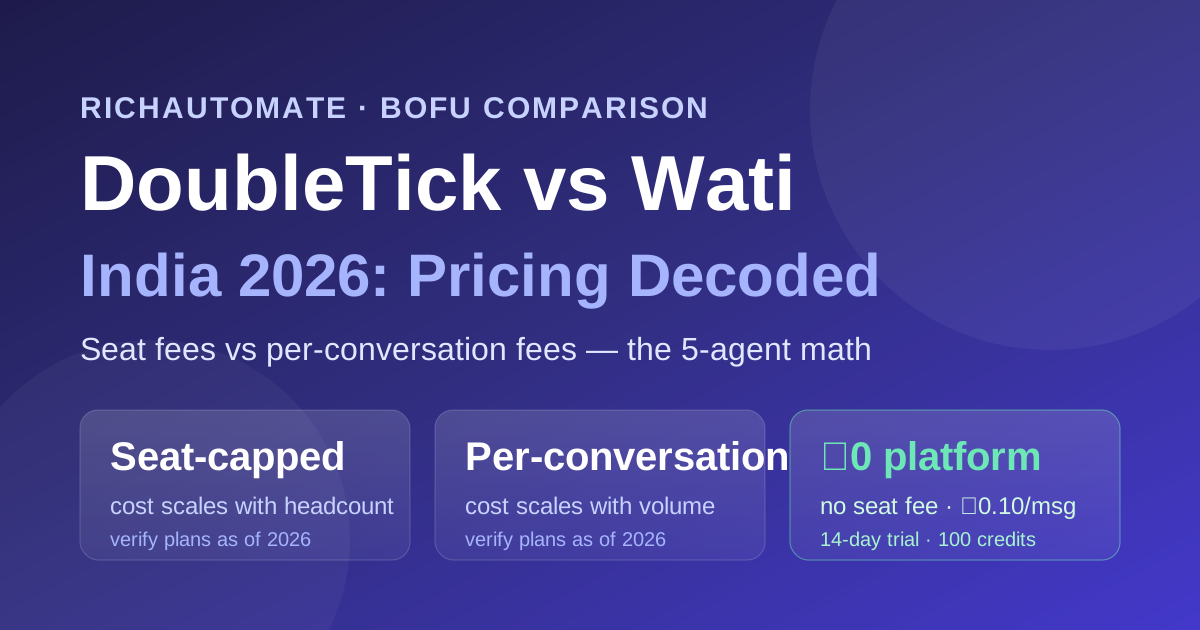
DoubleTick and Wati are two of the most-shortlisted WhatsApp Business API tools in India, and for a small sales-led team they look almost interchangeable on a feature sheet — shared team inbox, broadcast campaigns, chatbot flows, catalog and CRM-style contact management. The real decision is hidden in the pricing model, and the two tools price the exact same workload in opposite directions. Wati has historically leaned on tiered subscription plans with a seat/user cap (commonly cited around a 3-to-5 user band on entry tiers, with add-on seat charges above that), while DoubleTick has leaned on a model that mixes a base plan with per-conversation or usage-linked fees. Run a 5-agent team through both and the totals diverge fast — and on top of either tool you still pay Meta's conversation charges separately. This guide decodes the seat-fee and per-conversation math for a 5-agent team, gives a verdict by use-case, and shows where a flat ₹0-platform model changes the calculation entirely. Every competitor price here is hedged — verify the live plans on the DoubleTick and Wati sites as of 2026, because both vendors revise pricing and seat limits regularly.
The two pricing models, decoded
Before any numbers, understand the shape of what you are buying — that is where the cost difference comes from, not the feature list. The feature lists overlap heavily; the billing models do not.
| Dimension | Wati (as of 2026 — verify) | DoubleTick (as of 2026 — verify) |
|---|---|---|
| Core model | Tiered monthly/annual subscription | Base plan plus usage/per-conversation-linked fees |
| Seat / user cap | Entry tiers commonly capped (often cited ~3–5 users); extra seats charged as add-ons | Plan-dependent; verify seat handling on the DoubleTick site |
| Conversation charges | Meta conversation charges are separate and billed on top | Meta conversation charges separate; plan may add per-conversation markup |
| Annual lock-in | Best headline rates typically on annual commitment | Verify monthly vs annual terms on the DoubleTick site |
| Where cost scales | Adding agents (seats) | Sending more conversations (volume) |
This is the single most important thing to internalise: Wati's cost scales with your headcount; a per-conversation-leaning model scales with your message volume. A 5-agent team that sends modest volume is punished by seat fees. A 2-agent team that blasts high volume is punished by per-conversation fees. Your shape decides which tool hurts less — and all of these figures must be re-checked on the vendor sites as of 2026, because plans, caps and add-on rates change.
The 5-agent seat-fee math
The brief that breaks most "DoubleTick vs Wati" comparisons is a real one: a growing team with five people who all need to see and reply in the shared inbox. This is exactly where seat caps bite. On a tool whose entry tier is capped at roughly three users, those extra two agents are not free — they are add-on seats billed monthly, every month, whether or not message volume grows. Walk it through honestly with illustrative, hedged numbers:
| Scenario: 5 agents, shared inbox | Seat-capped subscription tool | Per-conversation-leaning tool | RichAutomate |
|---|---|---|---|
| Agents included in base | ~3 (verify on vendor site) | Plan-dependent (verify) | No per-seat cap on the platform |
| Cost of agents 4 and 5 | Add-on seat fee × 2, monthly | May be plan-dependent (verify) | ₹0 — no seat fee |
| Platform/base fee | Monthly subscription (verify tier) | Base plan (verify) | ₹0 platform, ₹0 setup, ₹0 monthly |
| Meta conversation charges | Separate, billed on top | Separate, billed on top | Billed direct by Meta (Client Pay) |
| What you pay per message | Subscription + Meta | Base + per-conv markup + Meta | ₹0.10 per message + Meta direct |
The trap is treating the headline subscription price as the cost. For a 5-agent team it is the headline price plus two add-on seats every month, indefinitely. That recurring seat tax is invisible at signup and very visible twelve months later. Always price your actual agent count, not the marketing tier — and verify the current per-seat add-on rate on the Wati site as of 2026.
The seat-fee insight: a seat cap turns hiring into a billing event. Every new agent who needs the inbox raises your monthly bill on a seat-capped tool, regardless of whether your message volume moved at all. If your team is growing, model the cost at your target headcount — 5, 8, 12 agents — not today's. The cheapest tool for a 3-person team can be the most expensive for an 8-person team. RichAutomate removes that variable entirely: there is no per-seat platform charge, so adding the fourth and fifth agent costs ₹0 on the platform side.
The per-conversation math — where DoubleTick's model bites
Flip the scenario. A lean 2-agent team that runs heavy broadcast and re-engagement campaigns has the opposite problem: seats are cheap, but volume is expensive. A model that layers a per-conversation fee on top of Meta's own conversation charge means you pay twice on the thing that scales — once to the tool, once to Meta. At low volume this is invisible; at tens of thousands of conversations a month it dominates the bill. The honest framing is that per-conversation markups are a tax on growth in volume, the same way seat fees are a tax on growth in headcount. Whichever vendor you pick, find the per-conversation markup (if any) in the fine print and multiply it by your real monthly conversation count — then add Meta's separate charge. Verify both the DoubleTick base plan and any per-conversation component on the DoubleTick site as of 2026, because this is precisely the line item vendors revise.
Feature parity — where they genuinely tie
It is worth being fair: for the core day-to-day, DoubleTick and Wati are close enough that features rarely decide the purchase. Both ship the things a sales-and-support team actually uses, and both run on the same underlying Meta WhatsApp Business API, so deliverability and template approval are governed by Meta, not by the tool.
The WhatsApp template library covers the common message types here if you want a starting point.
Get a 1-minute BSP audit on WhatsApp
Drop your WhatsApp number — we line-item your current invoice against Meta India rates in under 60 seconds. India-hosted, DPDP-compliant.
| Capability | Wati | DoubleTick | Notes |
|---|---|---|---|
| Shared team inbox | Yes | Yes | Seat handling differs — see pricing |
| Broadcast campaigns | Yes | Yes | Both subject to Meta marketing-conversation charges |
| No-code chatbot / flows | Yes | Yes | Depth varies by plan |
| Catalog / commerce | Yes | Yes | Verify catalog limits per plan |
| Contact management / CRM-style | Yes | Yes | Native CRM depth varies |
| Built on Meta WhatsApp Business API | Yes | Yes | Meta governs approval and delivery |
Because feature parity is high, the decision properly comes back to pricing model and how it fits your team's shape. If you want to dig into the CRM-style capabilities specifically — pipelines, contact tagging, ownership — our guide to the best WhatsApp CRM in India compares that layer across tools in more depth than a vs-page can.
Verdict by use-case
There is no single winner — there is a winner for your situation. Here is the honest call, with every competitor price treated as something to verify on the vendor site as of 2026.
| Your situation | Likely better fit | Why |
|---|---|---|
| Small team (≤3 agents), modest volume | Either — compare headline tiers | You fit inside the seat cap; subscription is predictable |
| Growing team (5–10+ agents), modest volume | Avoid seat-capped pricing; favour no-seat-fee | Add-on seat fees compound monthly with headcount |
| Lean team, very high broadcast volume | Avoid per-conversation markups | Volume markups stack on top of Meta charges |
| Both growing — agents and volume | Flat ₹0-platform + per-message | Neither headcount nor volume triggers a platform tax |
| Need predictable unit economics | Per-message transparency over bundled tiers | Easier to forecast cost per conversation |
If your honest answer is "we are growing on both axes — more agents and more messages," then both a seat-capped model and a per-conversation-markup model work against you, just in different quarters. That is the gap a flat-platform model is built for. To pressure-test any of these scenarios against your real numbers, model the conversation cost in the WABA cost calculator and read our breakdown of WhatsApp cost optimisation and unit economics before you commit to an annual plan.
The buyer's checklist before you sign anything: (1) Price your target agent count, not today's — include every add-on seat. (2) Find the per-conversation markup, if any, and multiply by your real monthly volume. (3) Add Meta's separate conversation charges to both — they are never included in the tool's headline price. (4) Check whether the headline rate needs an annual lock-in. (5) Re-verify every figure on the DoubleTick and Wati sites as of 2026, because plans and caps change. Do this and the "cheaper" tool often flips.
Where RichAutomate changes the calculation
RichAutomate prices on a different axis entirely, which is what removes both the seat tax and the volume tax. The platform itself is flat: ₹0 platform fee, ₹0 setup, ₹0 monthly, and there is no per-seat platform charge — adding your fourth and fifth agent costs ₹0 on the platform side, so a 5-agent team is not penalised for being five. On Client Pay, you pay ₹0.10 per message and Meta's conversation charges are billed to you directly by Meta at Meta's own rates — no markup layered on top. If you prefer a single bundled rate, SaaS Pay is an all-in ₹1.20 per marketing conversation and ₹0.30 per utility conversation. Either way, there is a 14-day free trial with 100 credits so you can run a real campaign and a real 5-agent inbox before you commit. The point is not that RichAutomate is universally cheapest on every single line — it is that growing on either axis, headcount or volume, does not trigger a platform tax. See the full card at richautomate.in/pricing. Meta's conversation-category pricing changes; verify current rates as of 2026, and verify DoubleTick and Wati plans on their own sites.
So which should you choose?
If you are a true small team that fits inside a 3-user seat cap and sends modest volume, either DoubleTick or Wati can work — compare the headline tiers and the add-on seat rate and pick the predictable one. If you are scaling agents, seat-capped subscription pricing will quietly become your largest line item; if you are scaling broadcast volume, a per-conversation markup will. The clean answer when you are scaling on both axes is a model where neither agents nor messages trigger a platform fee — flat ₹0 platform with transparent per-message economics. Whatever you choose, do the math on your real agent count and your real monthly conversation volume, add Meta's separate charges to every option, and verify the live competitor figures on the DoubleTick and Wati sites as of 2026 before you sign an annual plan. For one more competitor angle, our Wati vs RichAutomate pricing decode goes deeper on the Wati side specifically.
Decode your real WhatsApp bill before you sign
DoubleTick and Wati look alike on features and price the same workload in opposite directions: Wati's seat-capped tiers tax headcount, a per-conversation model taxes volume, and Meta's conversation charges sit on top of both. A 5-agent team should price its target headcount including add-on seats; a high-volume team should find the per-conversation markup and multiply by real volume — and verify every competitor figure on the DoubleTick and Wati sites as of 2026. RichAutomate prices on a different axis: ₹0 platform fee, ₹0 setup, ₹0 monthly, no per-seat platform charge, Client Pay at ₹0.10 per message with Meta conversation charges billed direct by Meta, or SaaS Pay at ₹1.20 marketing / ₹0.30 utility all-in. Start the 14-day free trial with 100 credits, WhatsApp us at 918160311319, or book a 30-minute walkthrough at https://calendly.com/inrichdaddy/30min.
Start your 14-day free trial → · See full pricing · Run the WABA cost calculator
Related: comparing the two biggest Indian BSPs head-to-head? Read Interakt vs Wati India 2026: pricing & seat-fee decoded.
Related reading: ManyChat vs RichAutomate 2026 pricing decoded.