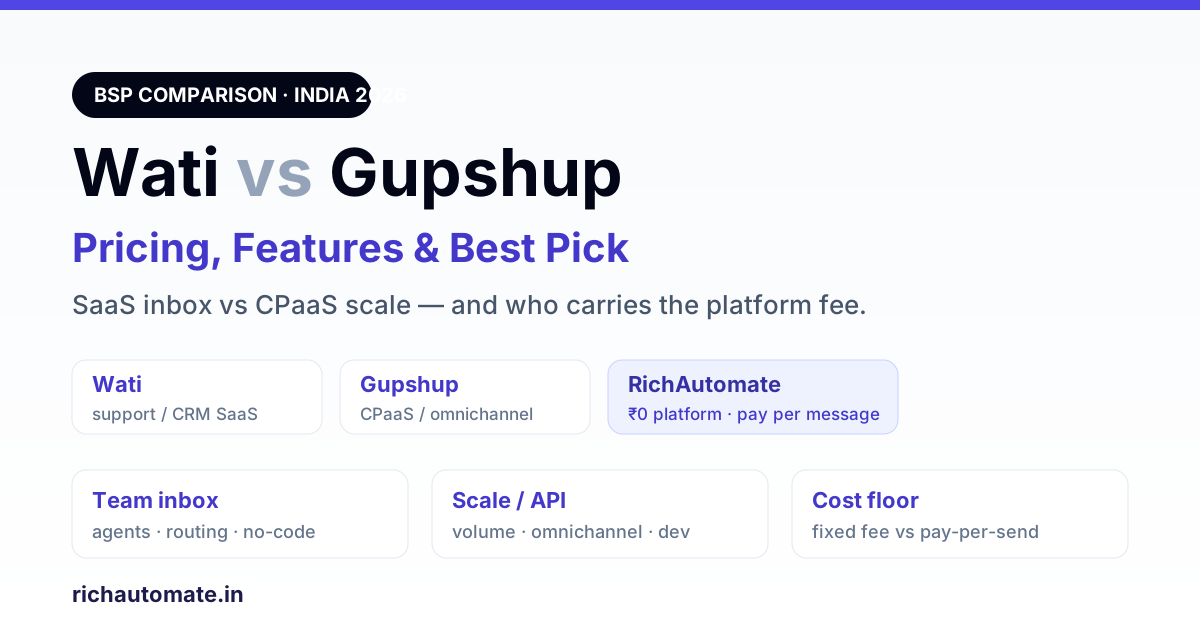
Wati and Gupshup are two of the most-searched WhatsApp Business API names in India — but they are not really the same kind of product, and picking between them by price alone is how businesses end up on the wrong platform. Wati is a support-and-CRM-led SaaS BSP built around a shared team inbox, agents and no-code automations. Gupshup is a CPaaS/omnichannel platform built for developer-scale, high-volume, API-first messaging across many channels. This 2026 head-to-head is written for the Indian buyer who wants the honest version: where each genuinely wins, an illustrative rupee break-even, and a plain who-should-pick-which — plus where a zero-platform-fee option like RichAutomate changes the math. Every Wati and Gupshup price below is hedged: their tiers change often, so verify on wati.io and gupshup.io before you sign. RichAutomate's pricing is stated as fact because it is ours.
The one line that decides most of it: SaaS inbox vs CPaaS scale — and who carries the platform fee. Feature checklists rarely settle a BSP choice, because broadcasts, no-code flows, shared inbox, template management and click-to-WhatsApp ads are table stakes in 2026. The separation is shape: Wati sells you a seat-and-tier SaaS product for teams handling conversations; Gupshup sells you a scale/omnichannel platform for engineering-led, high-volume sending. Both put a platform cost between you and Meta. RichAutomate's wedge is removing that fixed floor entirely — ₹0 platform fee, ₹0 setup, ₹0 monthly, pay only per message. That is the whole comparison in one line; the rest is detail.
Wati vs Gupshup vs RichAutomate: the head-to-head table
Here is the three-way view an Indian buyer actually needs. Wati and Gupshup figures are directional and typical of how each was structured heading into 2026 — they change frequently, so treat every cell in those two columns as "verify on wati.io / gupshup.io as of 2026." RichAutomate's column is our live pricing.
| Dimension | Wati (verify wati.io 2026) | Gupshup (verify gupshup.io 2026) | RichAutomate |
|---|---|---|---|
| Product shape | SaaS shared-inbox + no-code, team-led | CPaaS / omnichannel, developer + enterprise scale | SaaS + visual flow builder, SMB-led |
| Platform / monthly fee | Tiered monthly subscription + seats | Platform/enterprise pricing, often volume-committed | ₹0 platform fee, ₹0 monthly |
| Setup fee | Usually none / promotional | Varies by plan (verify) | ₹0 setup |
| Per-message / markup | Per-conversation markup on top of Meta (verify) | Per-message/per-conversation markup on top of Meta (verify) | Client Pay ₹0.10/msg, or SaaS Pay ₹1.20 marketing / ₹0.30 utility |
| Meta conversation cost | Billed via platform (verify pass-through) | Billed via platform (verify pass-through) | Client Pay: billed direct by Meta at Meta's rates |
| Best-fit volume | Low–mid, many agents on one number | High / enterprise, programmatic sends | Low–mid & spiky, pay-as-you-send |
| Shared inbox / agent routing | Yes — mature, its core strength | Yes, but scale/API-first orientation | Yes — team inbox + flows |
| Omnichannel (SMS/RCS/voice/etc.) | WhatsApp-focused | Yes — broad multichannel + CPaaS | WhatsApp-focused |
| DPDP-readiness | Consent + opt-out tooling (verify) | Consent + opt-out tooling (verify) | Consent capture, opt-out, data-minimisation guidance |
| Free trial | Trial available (verify terms) | Trial / sandbox (verify terms) | 14-day free trial + 100 credits |
The pattern: on raw WhatsApp features all three are close enough that you will rarely lose sleep over a missing capability. The separation is on shape and cost structure — Wati asks you to pay a seat-and-tier subscription whether you send 500 messages or 50,000; Gupshup is built for programmatic scale and typically volume-committed pricing; RichAutomate removes the fixed floor and charges only for what you send.
Where Wati genuinely wins
Wati is the stronger pick when your bottleneck is "many agents, one number, who-replies-to-whom." Its shared inbox, agent routing, no-code chatbot builder and integration ecosystem (Shopify, Zoho, HubSpot and the like) are mature and well-loved by support-led and mid-market teams. If you are running a customer-support or sales-conversation operation and want people productive in a polished dashboard on day one — without engineering effort — Wati fits. If your team is already trained on it and your workflows are wired into it, the switching cost may outweigh the savings, and that is a fair reason to stay. Verify current seat pricing, inbox features and integrations on wati.io as of 2026.
Where Gupshup genuinely wins
Gupshup is the stronger pick when you need developer-scale, high-volume, multichannel messaging. As a CPaaS platform it spans WhatsApp plus SMS, RCS, voice and more, with robust APIs, conversational-AI tooling and the enterprise plumbing that large senders need. If you are an engineering-led team sending programmatically at high volume, running omnichannel journeys, or you need a single vendor across many channels, Gupshup's scale orientation is a real advantage. That same enterprise shape can be heavier than an SMB needs, and pricing is often volume-committed — so it can be overkill for a small team that just wants a WhatsApp inbox. Verify current plans, API limits and pricing on gupshup.io as of 2026.
The honest take. Wati and Gupshup are both strong platforms serving different jobs — this is not a teardown. If you are a support-led team living in Wati's inbox, or an engineering-led enterprise sending at scale on Gupshup's CPaaS, staying put can be the right call. RichAutomate's argument is narrowly economic: if you are choosing fresh, or a fixed monthly subscription / volume commitment is becoming the dominant line item relative to what you actually send, a ₹0-platform model changes your math — especially at low-to-moderate or spiky volumes where a fixed floor hurts most.
Get a 1-minute BSP audit on WhatsApp
Drop your WhatsApp number — we line-item your current invoice against Meta India rates in under 60 seconds. India-hosted, DPDP-compliant.
The break-even math (illustrative)
Let's make it concrete. Suppose a growing Indian SMB sends 5,000 utility/transactional conversations a month (order updates, OTPs, reminders) plus 2,000 marketing conversations. On a subscription or volume-committed BSP you pay a platform/seat fee plus a per-conversation markup plus Meta's charge. On RichAutomate Client Pay you pay ₹0.10 per message and Meta bills you directly at its own rates; on SaaS Pay it is all-in ₹0.30 utility and ₹1.20 marketing. Every number below is illustrative — verify Wati/Gupshup tiers on their sites and model your own on the calculator.
| Cost line (illustrative) | Subscription / CPaaS BSP (Wati/Gupshup pattern) | RichAutomate SaaS Pay |
|---|---|---|
| Monthly platform / seat / commit fee | A fixed monthly tier or volume commitment you pay regardless of a slow month | ₹0 |
| Setup fee | Often ₹0 promo, varies (verify) | ₹0 |
| 2,000 marketing conversations | Platform markup + Meta charge per conversation | ₹2,400 (2,000 × ₹1.20 all-in) |
| 5,000 utility conversations | Platform markup + Meta charge per conversation | ₹1,500 (5,000 × ₹0.30 all-in) |
| Fixed monthly floor | You pay the tier/commit even in a slow month | None — pay only for what you send |
The logic is simple: the more a fixed subscription or volume commitment dominates your bill relative to actual send volume, the more a ₹0-platform model saves you. A team sending modest volumes pays the same tier as one sending far more — dead weight in a slow month. On Client Pay the gap widens further, because at ₹0.10 per message with Meta billed directly to you there is no per-conversation platform markup at all. Run your exact numbers on the WABA cost calculator and compare against your current Wati or Gupshup quote — verify their live tiers as of 2026.
Who should pick which — said plainly
- Pick Wati if you are a support-led or mid-market team with many agents on one number, you want a mature shared inbox and no-code automations that work out of the box, and you are already standardised on it. Verify pricing on wati.io 2026.
- Pick Gupshup if you are engineering-led, sending high-volume or programmatic, need omnichannel (WhatsApp + SMS/RCS/voice) and conversational-AI tooling under one vendor, and enterprise scale outweighs the heavier setup. Verify pricing on gupshup.io 2026.
- Pick RichAutomate if you are choosing fresh, a fixed monthly subscription or volume commitment is becoming your biggest WhatsApp line item, you send low-to-moderate or spiky volumes where a fixed fee hurts, or you simply want to pay only for what you send — ₹0 platform, ₹0 setup, ₹0 monthly, Client Pay ₹0.10/msg with Meta direct, or SaaS Pay ₹1.20 marketing / ₹0.30 utility.
There is no universally "best" platform — there is the best fit for your volume, team shape and switching cost. The mistake is paying a fixed platform fee or a volume commitment you do not need. For a wider field see the Gupshup vs Wati vs Interakt three-way comparison, and the one-to-one decodes for Wati vs RichAutomate and Gupshup vs RichAutomate. If team-inbox quality is your deciding factor, the best WhatsApp CRM for India guide ranks the field.
Migrating in 24–48 hours, without losing your number
The fear that keeps businesses overpaying is "migration will be a nightmare." In practice, porting a WhatsApp Business API number between BSPs is a well-trodden path, and a typical move completes inside 24–48 hours. The steps:
- Confirm your WABA ownership. Your WhatsApp Business Account lives in Meta Business Manager — you own it, not the BSP. Make sure you have admin access.
- Start embedded signup on the new platform. RichAutomate's onboarding uses Meta's embedded signup; you connect the same number and WABA.
- Re-submit / map your templates. Approved message templates may need re-submission or mapping on the new platform — keep a list of your live templates ready.
- Point your integrations and webhooks at the new platform, test a send and a receive, then switch live traffic over.
You do not lose your number, your green tick or your history with the customer — you change who sits between you and Meta. Understanding the Client Pay vs SaaS Pay billing models before you migrate helps you pick the cheaper lane for your volume from day one. See full pricing on the pricing page, and verify Wati/Gupshup's own offboarding terms as of 2026.
Stop paying a platform fee you do not need
Wati and Gupshup are both capable WhatsApp platforms — and if you are deeply invested in one and it fits your team, staying put is a fair call. But if you are choosing fresh, or a monthly subscription or volume commitment is quietly becoming your biggest WhatsApp line item, the math changes with a ₹0-platform model. RichAutomate charges ₹0 platform fee, ₹0 setup and ₹0 monthly — Client Pay at ₹0.10 per message with Meta's conversation charges billed directly to you by Meta, or SaaS Pay all-in at ₹1.20 per marketing conversation and ₹0.30 per utility conversation. Start the 14-day free trial with 100 credits, WhatsApp us at 918160311319, or book a 30-minute walkthrough at https://calendly.com/inrichdaddy/30min. (All Wati and Gupshup pricing and feature specifics are illustrative and change frequently — verify on wati.io and gupshup.io as of 2026 — and all break-even numbers here are illustrative; model your own on the calculator. This is a buyer's-guide comparison, not financial advice.)
Start your 14-day free trial → · See full pricing · Run the WABA cost calculator
Related reading: Periskope vs RichAutomate 2026 pricing decoded.