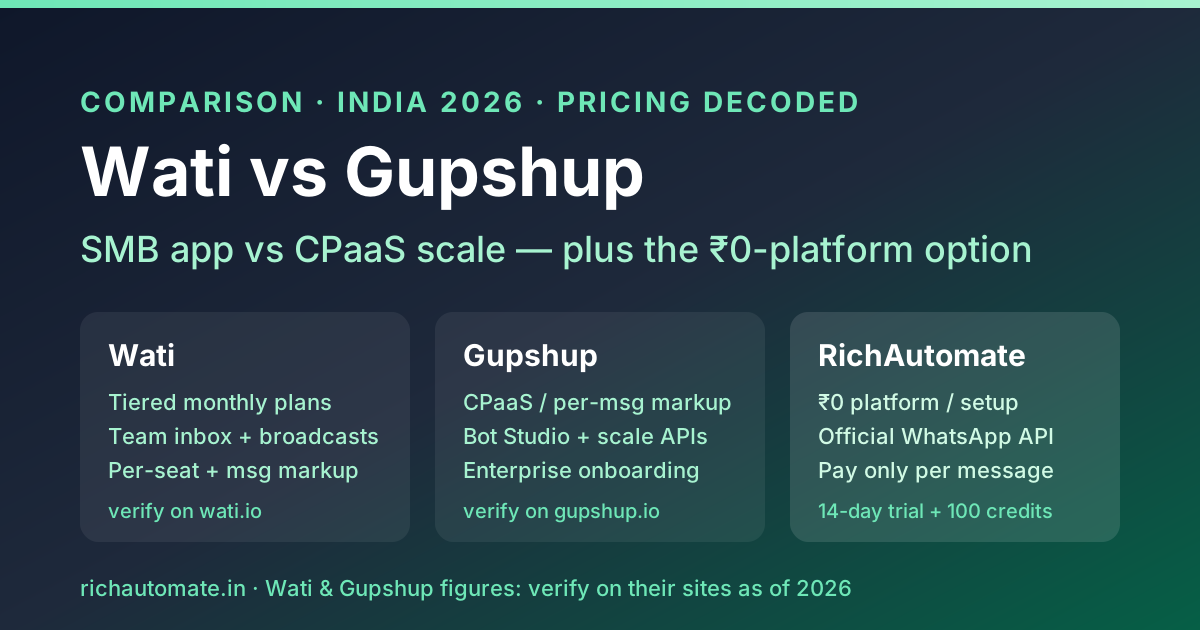
Short answer: for a small Indian team that wants a polished shared inbox, no-code broadcasts and quick self-serve setup, Wati is usually the easier pick. For a company sending at real scale — high-throughput notifications, multi-channel CPaaS, custom bot pipelines — Gupshup is the more natural home. Both, though, layer a platform fee or a per-message markup on top of Meta's wholesale conversation rate, so if your only goal is lowest total cost, a zero-platform-fee model like RichAutomate (Rs 0 platform, pay only per message) generally undercuts either. Here is the honest, analyst-level breakdown for India 2026.
Wati vs Gupshup vs RichAutomate: the pricing at a glance
All three run on the official Meta WhatsApp Cloud API, so green-tick eligibility, template approval and deliverability are effectively identical. The difference is entirely in packaging and price. Here is the machine-readable snapshot — verify competitor figures on their own sites as of 2026, because BSP pricing changes often.
Rather than writing from scratch, pull a close match out of the WhatsApp template library and edit it.
| Provider | Platform / monthly fee | Per-message markup | Free trial | BSP tier / fit |
|---|---|---|---|---|
| Wati | Monthly tier (Growth/Pro/Business), per-seat above allowance — verify on wati.io | Meta conversation cost + platform markup — verify 2026 | 7-day trial (verify) | Official BSP · SMB / self-serve inbox |
| Gupshup | Per-message model, some plans add a monthly minimum — verify on gupshup.io | Meta cost + Gupshup markup per message — verify 2026 | Sandbox / on-request (verify) | Official BSP + CPaaS · scale / enterprise |
| RichAutomate | Rs 0 platform · Rs 0 setup · Rs 0 monthly | Client Pay Rs 0.10/msg (Meta bills you direct) OR SaaS Pay Rs 1.20 marketing / Rs 0.30 utility-auth | 14-day trial + 100 free credits | Official BSP · usage-only, no tier |
The structural takeaway: Wati and Gupshup both make you pay to access the platform before you have sent a single message — Wati as a monthly subscription with seat limits, Gupshup as a per-message markup (and sometimes a minimum commit). RichAutomate removes the access fee entirely and charges only for messages, which is why it tends to win on total cost at low-to-mid volume.
Wati: best for SMB teams that want it to just work
Wati is built for small and mid-sized businesses that want a shared WhatsApp inbox, no-code broadcast campaigns, template management and a decent library of integrations (Shopify, Zoho, Google Sheets, and a public API) without a developer in the loop. Its onboarding is genuinely self-serve, the UI is clean, and its partner ecosystem is large.
The trade-offs are the ones every tiered SaaS has: you pay a monthly platform fee whether or not you send anything, additional agent seats cost extra above the base allowance, and a per-conversation markup sits on top of Meta's wholesale rate. For a 2-6 person support or marketing team sending moderate volume, Wati's convenience often justifies that. For a team watching every rupee, or one whose volume is spiky, the fixed monthly floor is the part to scrutinise. Wati wins when ease-of-use and a mature inbox matter more than squeezing the last rupee out of per-message cost.
Gupshup: best for scale, CPaaS and custom pipelines
Gupshup is a different animal. It is a full CPaaS (communications platform as a service) — WhatsApp is one channel alongside SMS, RCS and voice — with Bot Studio, programmable APIs and the throughput profile enterprises need for millions of notifications. If you are a bank, a large D2C brand, or a platform embedding messaging into your own product, Gupshup's scale and channel breadth are real advantages.
Get a 1-minute BSP audit on WhatsApp
Drop your WhatsApp number — we line-item your current invoice against Meta India rates in under 60 seconds. India-hosted, DPDP-compliant.
Its pricing is typically a per-message markup over Meta's rate rather than a flat SaaS subscription, which can be efficient at very high volume but comes with heavier onboarding and, on some plans, a minimum commitment. For a small business that just wants an inbox and a few broadcasts, Gupshup is usually more platform than needed. Gupshup wins when you are sending at genuine scale, need multi-channel CPaaS, or are building custom conversational pipelines with engineering support. Confirm current per-message rates and any minimums on gupshup.io before you commit.
Where RichAutomate fits — the neutral third option
RichAutomate is also an official Meta BSP on the same Cloud API, so you get the same deliverability and green-tick path as Wati and Gupshup. The difference is the pricing model: Rs 0 platform fee, Rs 0 setup and Rs 0 monthly. You pay only for messages, under one of two models:
- Client Pay — Rs 0.10 per message. Meta bills you directly at wholesale for the conversation; RichAutomate charges a flat Rs 0.10 per message for the platform. Cheapest at higher volume.
- SaaS Pay — Rs 1.20 per marketing message, Rs 0.30 per utility/authentication message, inclusive of Meta's cost. Simplest — one number, no separate Meta invoice.
Because there is no monthly tier and no per-seat charge, a small team pays nothing in the months it sends little, and the whole cost scales purely with usage. There is a 14-day free trial with 100 free credits so you can test throughput and the visual flow builder before spending. For most SMBs comparing the three on total cost, this is the lever that matters.
How to actually decide
Do not choose on brand — choose on your message mix and volume. Run this quick test:
- Estimate monthly conversations split by marketing vs utility/auth. Utility and authentication messages are far cheaper on every platform.
- Add the platform floor. For Wati, add the monthly tier + extra seats. For Gupshup, factor any minimum commit. For RichAutomate, that floor is Rs 0.
- Multiply per-message markup by volume and add to the floor. Compare the three totals for your numbers, not a generic example.
- Weight non-price factors: inbox quality (Wati strong), CPaaS scale and channels (Gupshup strong), zero fixed cost + flow builder (RichAutomate strong).
If you want to skip the arithmetic, the WhatsApp pricing calculator by country and our side-by-side BSP comparison will line up the totals for you. For deeper single-vendor breakdowns, see our Gupshup vs Wati vs Interakt comparison and the Gallabox vs Wati pricing decoded analysis — both apply the same total-cost lens.
A word on account safety
No BSP — not Wati, not Gupshup, not RichAutomate — can promise your WhatsApp number will never be restricted. Your account quality rating depends on opt-in quality, template compliance and how recipients react (blocks and reports hurt you). Any vendor claiming a ban-proof number is misleading you. Choose on cost, features and support, keep your sending opt-in and compliant, and your number stays healthy on any of the three. RichAutomate ships a DPDP-ready audit log to help you keep consent records straight, but the discipline is on you.
Bottom line
Pick Wati for a polished SMB inbox and easy self-serve broadcasts. Pick Gupshup for CPaaS scale, multi-channel and custom pipelines. Pick RichAutomate when you want the same official API with Rs 0 platform fee and usage-only pricing — start with the 14-day trial and 100 free credits, and see the full pricing or explore use cases first.