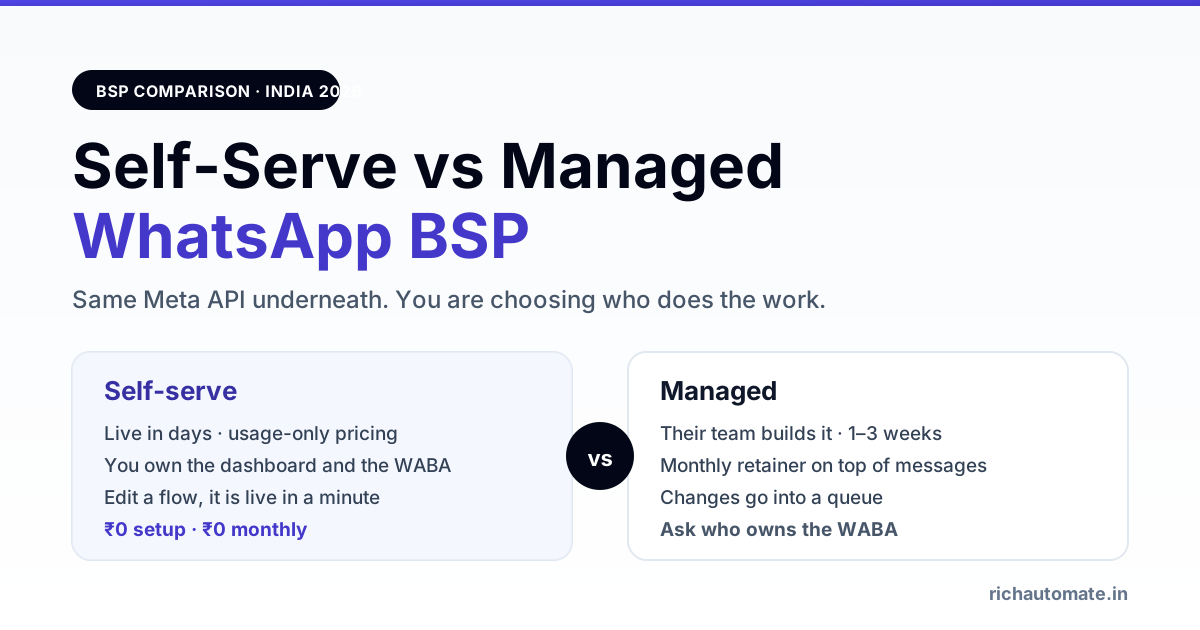
Pick self-serve if someone on your team can read an API doc and you want to be live this week; pick a managed BSP only if you are paying for people, not software. The platform underneath is identical either way — both route through Meta's WhatsApp Cloud API, both charge you Meta's per-conversation rates, and both give you the same templates, the same quality rating and the same messaging limits. What you are actually choosing between is who does the setup, who writes the flows, and who picks up the phone when a template gets rejected at 9pm.
Most Indian businesses over-buy here. They pay a managed retainer for work that took four hours once, then never use the account manager again. Others under-buy — they take the cheapest self-serve plan with zero onboarding help, stall on Facebook Business Verification for three weeks, and blame the platform. This page is the decision, laid out honestly, including the cases where we are the wrong answer.
What "self-serve" and "managed" actually mean
The labels are used loosely, so pin them down first.
Self-serve BSP. You sign up, connect your Facebook Business account through an embedded signup flow, verify your number, and you are in a dashboard. Templates, flows, broadcasts, team inbox, API keys — all self-configured. Support exists, but it is reactive: you raise a ticket, someone answers. Pricing is usage-based, and you can usually start on a trial without a card.
Managed BSP. You sign a contract, often with a monthly minimum or a setup fee. A named person or pod handles onboarding, writes your first templates, builds your chatbot flows, and reviews performance monthly. Some managed providers will not even give you dashboard access — they operate the account and send you reports.
The hybrid. Increasingly common and usually the right answer: a self-serve platform plus a bounded setup engagement. You own the account and the dashboard; someone helps for the first two weeks and then steps back. You stop paying for the hand-holding once you no longer need it.
One thing that is not a difference: access to Meta. A self-serve BSP and a managed BSP are both Meta Business Solution Providers with the same API surface. Nobody has a secret faster template-approval queue. If a provider implies they do, that is a sales claim, not a technical one.
The four things that actually differ
Strip the marketing away and there are four real axes. Everything else follows from these.
| Axis | Self-serve | Managed |
|---|---|---|
| Who does the setup | You, in an afternoon to a week | Their team, in one to three weeks of scheduled calls |
| Who owns the account | You — your Business Manager, your WABA, your number | Usually you, sometimes them. Ask before signing. |
| What you pay for | Messages sent, plus a small per-message platform fee or a flat SaaS rate | Messages, plus a monthly retainer or minimum commitment for the people |
| Speed of change | You edit a flow and it is live in a minute | You raise a request and it lands in someone's queue |
That last row is the one teams underestimate. A managed arrangement is excellent when your messaging is stable — order confirmations, delivery updates, payment reminders that change twice a year. It is frustrating when you are iterating weekly, because every change becomes a ticket. If your marketing team wants to test a new broadcast angle on Thursday for a Saturday sale, a queue is the wrong shape.
What each model actually costs in India
Cost is where the two models stop looking similar. Meta charges per conversation, and those rates are the same for everyone — around ₹0.8631 per marketing conversation and ₹0.115 per utility or authentication conversation on the India rate card. What sits on top of that is the BSP's own charge, and there are only three shapes of it.
| Charging model | What you pay | Typical of |
|---|---|---|
| Pay Meta directly, platform fee to BSP | Meta's rate billed to your own payment method, plus a small per-message platform fee (ours is ₹0.10 outgoing, plus ₹0.20 when a new 24-hour window opens) | Self-serve, higher volumes |
| BSP pays Meta, you pay a bundled rate | One all-in rate per message — ours is ₹1.20 marketing, ₹0.30 utility, no setup fee, no monthly fee | Self-serve, easier accounting |
| Retainer plus messages | A monthly fee for the people, typically ₹10,000 to ₹50,000, on top of whichever message rate applies | Managed |
Run your own number before you decide. At 20,000 marketing messages a month, the message cost is roughly ₹24,000 on a bundled SaaS rate — so a ₹25,000 retainer is not a small add-on, it doubles your bill. At 2,000 messages a month it is worse: ₹2,400 of messages against a ₹25,000 retainer means you are buying consulting with a messaging channel attached. That can still be the right call, but name it for what it is.
If you want to work the arithmetic properly, the WhatsApp Business API cost calculator for India breaks the components down, and platform fee versus per-message pricing explains which of the two billing shapes wins at your volume. For a quick view of what we charge, see our pricing page.
Where self-serve genuinely breaks
Honest version, because most comparison pages written by self-serve vendors skip this part.
Get a 1-minute BSP audit on WhatsApp
Drop your WhatsApp number — we line-item your current invoice against Meta India rates in under 60 seconds. India-hosted, DPDP-compliant.
- Facebook Business Verification. This is the single biggest stall point in India. You need a matching business name, a verifiable address, and a document set that Meta accepts — GST certificate, Certificate of Incorporation, or a utility bill in the business name. Teams that have never done it lose one to three weeks to rejections over a mismatched address line.
- The first template rejection. Nothing tells you why in useful detail. You get a reason code and a guess. Someone who has seen two hundred rejections fixes it in ten minutes; on your own it can take three attempts.
- Flow design, not flow building. The builder is drag-and-drop. Knowing that an AI pathway node with no no-match edge silently dead-ends the conversation is experience, not UI.
- Nobody owns it internally. The most common self-serve failure is not technical — it is that the person who set it up changed roles, and six months later the templates are stale and nobody knows the login.
All four are solvable. Three of them are solvable once, which is exactly why a bounded setup engagement beats an open-ended retainer for most teams.
Where managed BSPs genuinely break
The symmetric list, and these are the complaints we hear most often from teams switching to us.
- Account ownership ambiguity. If the WABA sits inside the provider's Business Manager rather than yours, leaving is painful and sometimes means losing the number. This is the most expensive mistake on this page. Ask, in writing, before you sign: is the WhatsApp Business Account inside my Business Manager?
- Retainer drift. Month one earns its fee. Month seven is a status call and a report nobody reads.
- Change latency. Campaign ideas have a shelf life. A two-day turnaround on a template edit kills more revenue than the retainer costs.
- No visibility into delivery. If you only see a monthly PDF, you will not notice your quality rating sliding to yellow until the daily limit has already been cut.
- Markup you cannot see. Bundled per-message rates inside a managed contract are frequently well above Meta's published rate. BSP markup over Meta rates shows how to check.
Which one fits your team
Pick the row that describes you, not the one that describes the company you want to be.
| Your situation | Choose | Why |
|---|---|---|
| You have a developer, or a marketer who is comfortable with tools like Zoho or HubSpot | Self-serve | You will be live faster than a managed kickoff call can be scheduled |
| Under 5,000 messages a month, simple notification use case | Self-serve | A retainer would cost several times your message spend |
| No technical staff, and WhatsApp is a core revenue channel | Managed, or self-serve plus bounded setup | The setup cost is real, but it is a one-time cost |
| Complex flows — CRM sync, payment links, multi-agent routing, order status from an ERP | Self-serve with a developer, or managed | Integration work is real engineering either way |
| Regulated sector with sign-off on every outbound message | Managed | You are buying process discipline, not software |
| You want to test whether WhatsApp works at all for you | Self-serve trial | Never sign an annual retainer to run an experiment |
Questions to ask before you sign either one
Six questions. Any provider who dodges one of them has told you something.
- Is the WABA inside my own Facebook Business Manager? The only acceptable answer is yes.
- If I leave, do I keep the number? You should be able to migrate a number between BSPs without losing it — switching BSP while keeping your number covers the mechanics.
- What exactly do I pay per marketing and per utility message, in rupees? Compare it against Meta's published India rate. A gap is normal; a large unexplained gap is not.
- Is there a minimum commitment, lock-in period, or setup fee? Get the number, not "we can discuss it".
- Can I export my contacts and message history? If the answer is no, your customer data is hostage.
- What is the response time when a template is rejected or the number gets restricted? This is the moment the relationship is actually tested.
One India-specific item to plan for regardless of model: a GST number is required to take a WhatsApp Business API number live. A trial works without it, going live does not. Nobody can waive that for you.
The honest recommendation
For most Indian SMBs and mid-market teams, the right shape is self-serve with help for the first two weeks. You get the speed and the cost structure of self-serve, you get the Business Verification and first-template hurdles cleared by someone who has done it before, and you are not paying a retainer in month seven for a monthly call.
Go fully managed when the messaging is genuinely mission-critical and you have nobody internal to own it — high-volume BFSI notifications, regulated communications requiring sign-off, or a multi-location operation where consistency across branches matters more than iteration speed. That is a real category, it is just smaller than the managed-BSP sales pitch suggests.
Go fully self-serve when you have anyone technical at all. The platform is not the hard part.
If you are currently on a managed contract and suspect you are paying for hand-holding you stopped needing, the practical move is to price the alternative before your renewal date, not after. Migrating your WhatsApp BSP walks through the sequence, and a free WhatsApp Business API trial lets you test the self-serve path on a second number before you touch the live one.