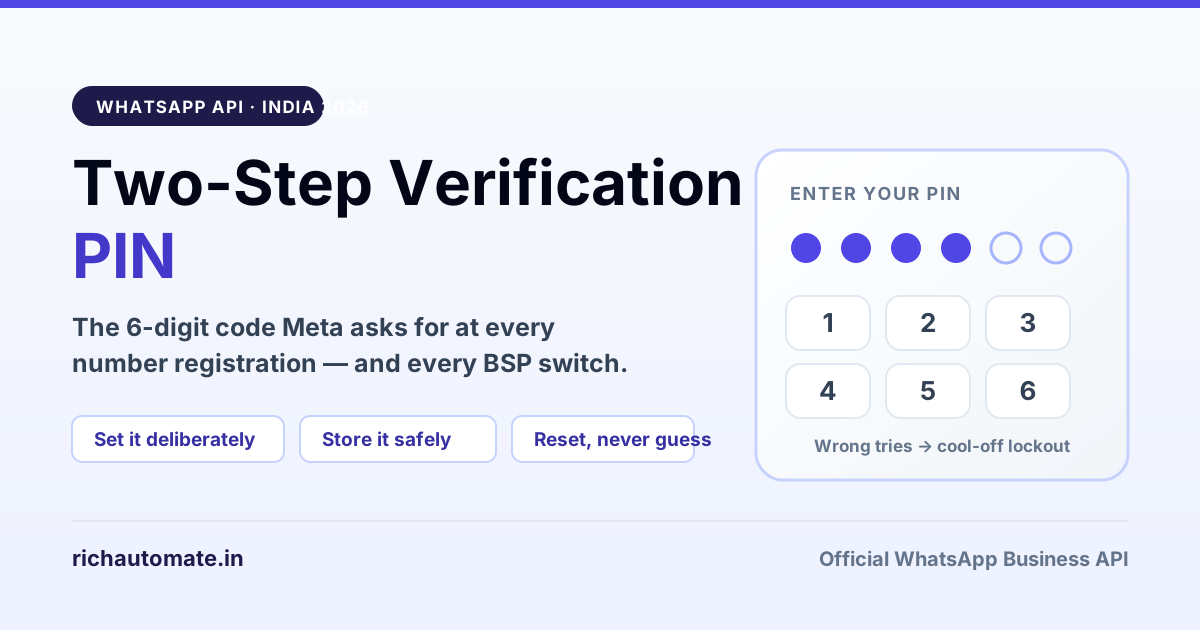
Most Indian WhatsApp API migrations that stall for a week stall on the same thing — nobody can find the PIN. This guide covers what the PIN is and is not, when Meta will ask for it, how it is set and cleared, what the lockout actually costs, and how to hold it so a provider switch never becomes a hostage negotiation. Nothing here is legal advice, and Meta changes API surfaces regularly, so verify endpoint shapes against Meta’s current Cloud API reference before you script anything.
What the PIN actually is
Two-step verification on WhatsApp is a long-standing consumer feature: a six-digit PIN that must be entered when your number is registered on WhatsApp again, on a new device or after a reinstall. Its purpose is to stop somebody who has hijacked your SIM or intercepted your SMS one-time password from simply claiming the number.
The Business API inherits that mechanism with the same shape and a far larger blast radius. The PIN belongs to a phone number — not to a person, not to a Meta account, not to a WhatsApp Business Account. In practice:
- One PIN per registered number. A WABA carrying five numbers can carry five different PINs, and usually does if different teams onboarded them.
- It is set, not issued. Nobody sends it to you. Somebody chose it during onboarding — frequently an implementation partner, which is exactly why it goes missing.
- It is not an OTP. The SMS or voice code you receive during registration is separate and single-use. The PIN is persistent and reusable.
- It does not gate day-to-day sending. Messages, templates and webhooks never ask for it. It gates registration — which is why you can run happily for a year without knowing yours, then discover the gap on the worst possible day.
When Meta asks for it
The PIN is demanded at registration boundaries, and registration boundaries are more common than teams assume.
| Event | PIN required? | Why it bites |
|---|---|---|
| First Cloud API onboarding of a fresh number | You set it | The moment it is chosen — and the moment it is usually not written down |
| Moving a number from the WhatsApp Business app to the API | Yes | Two-step may already be enabled on the app account; that existing PIN is the one Meta wants |
| Switching Business Solution Provider | Yes | The new provider re-registers the number; without the PIN the migration cannot start |
| Re-registering after a number was removed from a WABA | Yes | Usually discovered mid-incident, under time pressure |
| Routine sending, templates, webhooks | No | Never prompted — precisely why the gap stays hidden |
The migration case is the expensive one. If that move is on your roadmap, read the sequence end to end first: migrating a number from the WhatsApp Business app to the API puts the PIN right at the front of it, where it belongs.
Setting, changing and clearing the PIN
Three routes exist, and which one you have depends on how the number was onboarded.
Through your provider’s dashboard
Most Indian Business Solution Providers expose two-step verification in the number or channel settings for a connected number: set a new PIN, change an existing one, or disable it. Prefer this route, because it is the one a non-developer on your team can execute during an incident. If your provider does not expose it at all, that is a real question to ask them before you sign.
Get a 1-minute BSP audit on WhatsApp
Drop your WhatsApp number — we line-item your current invoice against Meta India rates in under 60 seconds. India-hosted, DPDP-compliant.
Through the Cloud API
On the Cloud API the PIN appears in two places. Registering a phone number takes the PIN as a parameter alongside the messaging product, so the value must be known before the call is made. Separately, two-step verification can be set or updated on an already-registered number through that number’s settings endpoint. Both are ordinary authenticated Graph calls made with a token carrying WhatsApp business management permissions. Endpoint paths and field names move between Graph versions, so read them off Meta’s current Cloud API reference rather than copying a snippet from a two-year-old blog post — including this one.
Through Meta’s own business surfaces
Where the number is visible in Meta’s WhatsApp Manager, two-step verification is usually manageable from that number’s settings. This is the fallback when the provider relationship has gone sour and you need to act without them — and a good argument for making sure your own business, not an agency, owns the Meta Business Manager holding the WABA.
123456. It gets typed roughly once a year, so there is no convenience argument for a weak one.The lockout, and what it actually costs
Repeated wrong PIN entries trigger a cool-off before further attempts are accepted. The important thing is not the exact duration — Meta tunes it — but the shape of the failure:
- Guessing is not a strategy. A handful of wrong tries converts a two-minute task into a multi-day block, typically on the day you were switching providers.
- The lockout blocks registration, not messaging. A number already live keeps sending. If you were mid-migration, you are stranded between providers.
- Reset beats retry. The moment you are unsure, stop entering candidates and reset the PIN through whichever surface you still control.
Plan around it the way you plan around messaging limits and tier graduation: assume the constraint exists, and never schedule a go-live that depends on clearing it perfectly first time.
PIN hygiene for Indian teams
The technical part is trivial. The operational part is where businesses lose weeks.
- The business owns the PIN, not the implementer. If an agency onboarded your number, get the PIN in writing before the engagement ends. This is the single most common cause of stalled BSP migrations.
- Store it where a business stores secrets — a password manager entry named for the number, carrying the WABA id and the onboarding date. Not a WhatsApp message, not an email thread, not a spreadsheet tab called final.
- Record it per number. Multi-number WABAs drift; a single company-wide PIN note is wrong the moment somebody onboards number six.
- Rotate on people-change, not on a calendar. When the person or agency who set it stops working with you, reset it. Routine rotation buys nothing here and adds a fresh chance to lose the value.
- Verify it during onboarding, not during migration. Once the number is live, deliberately confirm the PIN is recorded correctly. Cheapest fire drill in the entire WhatsApp stack.
Where the PIN fits in the wider onboarding chain
The PIN is one of four artefacts that decide whether a WhatsApp API go-live is smooth or painful. The others are business verification, the display name, and the webhook — each with its own failure mode, and any one can block a number:
- Business verification gates going live at all, and in India GST registration is effectively required for it. A trial can run without GST; going live cannot.
- Display name gets reviewed and can be rejected for reasons that surprise people — see why WhatsApp display names get rejected.
- Green tick is a separate, notability-based decision that neither the PIN nor verification buys you: how green tick verification actually works in India.
- Webhook delivery is what makes inbound messages appear at all; when it silently stops, the symptoms look like a WhatsApp outage. See WhatsApp webhook not receiving messages.
Treat all four as one onboarding checklist owned by your business, and the PIN stops being the thing that derails a migration.
Moving providers without losing the number
A BSP switch is a re-registration, so sequence matters:
- Confirm the PIN before you give notice. Produce it from your own store, or reset it while the current provider still cooperates.
- Confirm who owns the Meta Business Manager and the WABA. If the agency owns it, fix that first — the PIN alone is not control.
- Export what does not travel. Templates generally live with the WABA; per-provider automation, flows and contact segmentation usually do not.
- Re-register on the new provider with the PIN in hand, then re-verify webhook delivery and send a real test message rather than trusting a green status indicator.
- Expect messaging limits and quality signals to follow the number, not the provider. Switching does not reset a damaged quality rating.
RichAutomate and your PIN
We put two-step verification in the number settings of every connected channel, so your own team can set, change or clear it without raising a ticket, and we hand the PIN to the business rather than holding it as leverage. The commercial model works the same way — no platform fee, usage-only billing, and a WABA that stays yours if you leave. Current rates and the two billing modes are on the pricing page; verify them there rather than trusting a figure in an article.