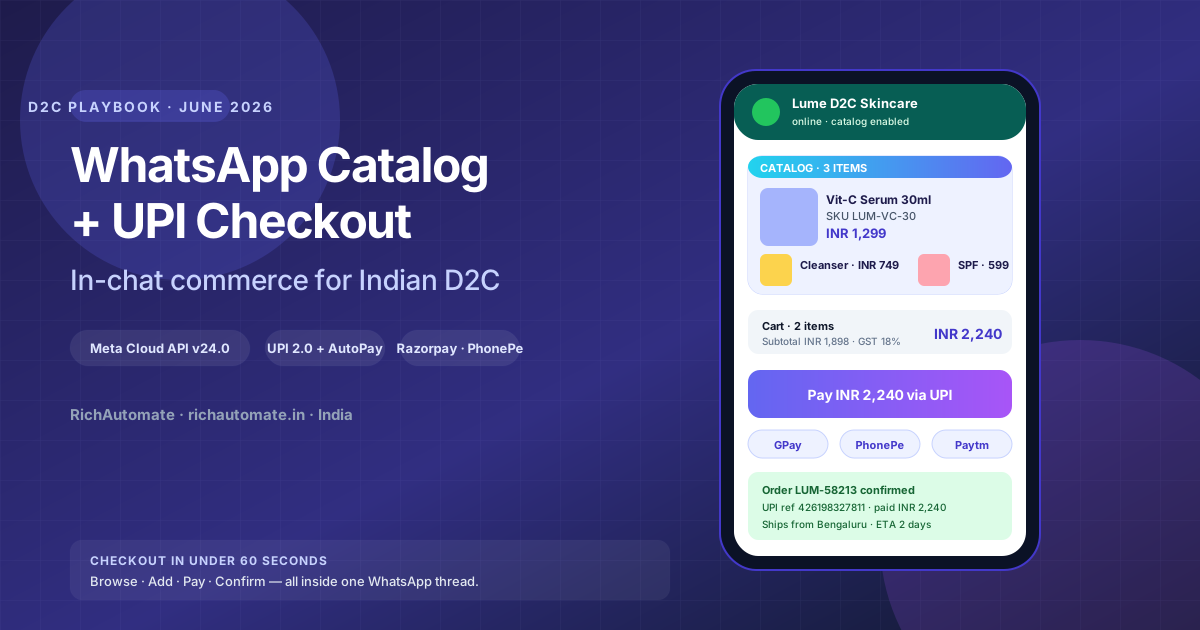
Indian D2C brands that still send customers to a web checkout in 2026 are leaking conversions every time. WhatsApp Catalog plus a UPI checkout node now closes the loop entirely inside one thread — browse, add, pay, confirm, ship — in under sixty seconds on a mid-range Android handset. The technical stack stabilised through 2025, NPCI extended UPI 2.0 AutoPay coverage, and Meta's Cloud API v24.0 ships native cart messages that no longer require third-party catalog mirrors. This playbook is for D2C founders, growth heads and Shopify operators deciding whether to ship in-chat commerce in the next quarter, and what the real INR economics look like after the Meta India 1 January 2026 rate revision.
Why in-chat commerce won the 2025-26 D2C cycle in India
In-chat commerce won because web checkout in India has structural friction that does not exist inside a WhatsApp thread. Six structural shifts compounded between 2024 and mid-2026:
- UPI 2.0 AutoPay coverage extended. NPCI expanded recurring-mandate handle support, unlocking Subscribe-and-Save D2C without web redirects. See the NPCI UPI product overview.
- Meta Cloud API v24.0 shipped native cart. The catalog message type now carries multi-item cart state inside the WhatsApp client itself, removing the previous round-trip to an external cart page. Reference at Meta WhatsApp Cloud API documentation.
- Cookie loss broke web attribution. Third-party-cookie deprecation and ATT enforcement gutted retargeting on web; WhatsApp threads are first-party identity by definition.
- UPI handoffs got faster than card OTP. Median UPI Intent handoff in 2026 is under 2 seconds. The card-plus-OTP flow on a web checkout is 30 to 90 seconds when the bank OTP gateway is healthy, and minutes when it is not.
- Tier-2/3 city share of D2C revenue passed 55 percent. Web checkout friction is highest exactly where the new D2C revenue is coming from.
- Meta India 1 January 2026 rate revision rewarded utility conversations. Order-confirmation, shipment-update and refund templates fall under the cheaper utility category, making post-purchase WhatsApp economics better than email.
The six components of an in-chat commerce stack
A working WhatsApp Catalog plus UPI checkout flow has six components. Skip one and the flow leaks. Build them in this order:
- Meta WhatsApp Cloud API v24.0 access. Either direct (RichAutomate) or through a Meta Business Solution Provider. Phone number verified, display name approved, green tick optional but recommended for D2C brands above INR 5 crore annual revenue.
- Catalog synced to WABA. Product feed (CSV, Shopify, WooCommerce, Unicommerce) mapped to the WhatsApp Business Catalog inside Meta Commerce Manager. Image, title, description, INR price, SKU, stock status and shipping window must all sync. Catalog refresh window is 24 hours; for high-velocity SKUs run hourly delta sync.
- Native cart message templates. Approved by Meta for the marketing or utility category as relevant. The cart message itself is sent inside the 24-hour customer service window or via an opted-in marketing template.
- UPI checkout node. A payment-link or UPI Intent node inside the chatbot flow that hits Razorpay, PhonePe or Cashfree, generates a one-time payment link, sends it inside WhatsApp, and listens on the gateway webhook for success or failure.
- Order webhook back to ERP or commerce stack. On payment success, the chatbot fires a webhook to Shopify, WooCommerce, Unicommerce or the brand backend to debit inventory, generate the GST invoice, and assign the shipping carrier.
- Post-purchase utility templates. Order-confirmed, dispatched, out-for-delivery, delivered, review-request templates. Cheap (utility category), high open rate, and they are what makes WhatsApp commerce LTV-positive over a single web purchase.
Payment gateway comparison: Razorpay vs PhonePe vs Cashfree vs Paytm
| Gateway | UPI rate | Card rate | WhatsApp integration | Best for |
|---|---|---|---|---|
| Razorpay | 0% up to cap | 2.0% domestic | Native payment-link API, mature webhooks | Default D2C pick under 5,000 orders/month |
| PhonePe PG | 0% up to cap | 2.0% domestic | UPI Switch handoff, reconciles with offline QR | Brands with PhonePe offline footprint |
| Cashfree | 0% up to cap | 1.9% domestic, 3.5% intl | Smart Collect for VPA + intl cards | NRI exports and intl D2C |
| Shopify Payments | 0% up to cap | 2.0% domestic | Razorpay-powered, one-click Shopify install | Shopify-first brands |
| Paytm PG | 0% up to cap | 1.99% domestic | UPI Intent + wallet, slower webhook SLA | Wallet-heavy customer base |
Real INR economics: a 1,000-order/month D2C example
Take a D2C skincare brand selling at an average order value of INR 1,800 with 1,000 orders per month, half from new customers and half from existing customers. The 2026 economics of a fully in-chat path versus a web checkout look like this:
- WhatsApp conversation cost. Marketing conversation (Meta India January 2026 rate) at roughly INR 0.86 per outbound; utility at roughly INR 0.115 per outbound. Order-confirmation, dispatch, delivered templates are utility, so most post-purchase volume is at the cheaper rate.
- UPI processing. Effectively INR 0 merchant discount rate under NPCI caps. Razorpay charges INR 2 per UPI transaction at the floor; on AOV of INR 1,800 that is 0.11 percent.
- Platform. RichAutomate at INR 0 monthly platform fee plus INR 0.10 per conversation markup. Total markup across 1,000 orders with say 4 conversations each is INR 400. AiSensy Pro at INR 2,399 monthly would be the next-cheapest fixed-tier alternative.
- Conversion lift. Versus a redirected Shopify web checkout, expect 1.6x to 2.4x conversion at the catalog-to-paid step. On 25,000 catalog impressions a month at a base 4 percent conversion (1,000 orders), the lifted flow at 6.4 percent to 9.6 percent yields 1,600 to 2,400 orders — INR 10.8 lakh to INR 25.2 lakh of incremental monthly revenue at the same ad spend.
- LTV uplift. Post-purchase utility templates push repeat-purchase rate up 35 to 60 percent in the first 90 days for D2C verticals where natural reorder cadence is under 60 days (skincare, supplements, coffee, pet food).
How to launch in 14 days: the six-step playbook
A working WhatsApp Catalog plus UPI checkout flow goes live in 14 calendar days from a clean start. The six steps and the realistic timing:
- Days 1-2: WABA + display name approval. Provision the WhatsApp Business Account, verify the phone number, submit display name. Approval lands in 24-48 hours.
- Days 3-5: Catalog sync. Push your Shopify or WooCommerce product feed into Meta Commerce Manager, map fields, approve catalog items. The first sync takes the longest; subsequent syncs are minutes.
- Days 5-7: Cart and payment templates. Submit 4 to 6 templates for approval: welcome marketing, cart-recovery utility, payment-link utility, order-confirmed utility, dispatched utility, delivered utility. Meta approves utility templates within 24 hours; marketing can take 48 hours.
- Days 7-10: Payment gateway wiring. Connect Razorpay (or PhonePe / Cashfree / Shopify Payments) credentials inside the bot. Set the order-success and order-failure webhooks. Test with a INR 1 live transaction.
- Days 10-12: Order webhook to ERP. Wire the bot order-success webhook to Shopify, WooCommerce or your internal ERP. Confirm GST invoice PDF is generated and attached automatically.
- Days 12-14: Soft launch. Send a marketing template to your top 10 percent of customers (highest LTV) inviting them to browse the new in-chat catalog. Watch the first 100 orders end-to-end. Fix what breaks. Then expand to the full list.
DPDP Act 2023 compliance: the address capture problem
The shipping address, phone, payment metadata and order history are personal data under the Digital Personal Data Protection Act 2023. The brand is the Data Fiduciary; the WhatsApp marketing platform is a Data Processor. The November 2024 draft DPDP Rules formalise three tenant-facing controls that an in-chat checkout flow must surface:
- Explicit consent at the point of address capture. A one-line consent statement plus a reply or button confirmation logged in the audit trail. Generic site-wide consent does not survive a complaint.
- Configurable retention windows. Non-order data such as abandoned-cart state should default to 90 days. Order data with GST relevance retains for 8 years per the Central Goods and Services Tax Act 2017.
- One-tap delete for data subject requests. An admin-facing one-click delete that purges the contact, conversation history and PII fields. RichAutomate ships a DPDP Penalty Calculator and Privacy Policy Generator for exposure modelling, and the underlying mechanics are covered in our DPDP consent-manager checklist.
DPDP exposure for a 50,000-contact D2C brand running an unconsented catalog flow can hit the upper-end Schedule penalties under the Act. Treat the consent surface as a feature, not a checkbox.
Where in-chat commerce does not work (yet)
Three D2C categories still belong on a web checkout, or on web-plus-WhatsApp rather than WhatsApp-only:
- High-SKU catalogs above 500 items. The catalog message renders well for 5 to 50 SKUs. For full long-tail D2C catalogs, lead the customer into a category browse on web and bring them back into chat for the cart and pay step.
- Heavy configuration (gifting, monograms, custom-sized apparel). If the purchase needs a configurator UI, web stays as the configuration surface; WhatsApp handles cart-recovery, payment and post-purchase.
- BNPL-heavy AOVs over INR 8,000. Lazypay, Simpl and ZestMoney pre-approval flows are still cleaner on web. Capture intent in WhatsApp, complete BNPL on the partner page, return to WhatsApp for confirmation.
For the broader D2C-on-WhatsApp pattern library see our D2C brands pillar, the cart abandonment recovery feature, and city-vertical playbooks like jewellery showrooms in Surat.
What to do this week
If your D2C brand is doing more than 500 orders per month and still routing every checkout through a web flow, you have an immediate revenue leak. The fix is two weeks of focused work and the economics pay back in the first month. Bring three months of conversion data and your current AOV to a short call and we will build a real-numbers model for your account — including the cases where the in-chat path is not the right move. Book a 30-minute fit call, or message us on WhatsApp at +91 81603 11319. For the broader competitive context, see WATI vs AiSensy vs Interakt vs RichAutomate, the SleekFlow comparison, the Zoko comparison, and the cycle-1 top 11 WhatsApp marketing software listicle.