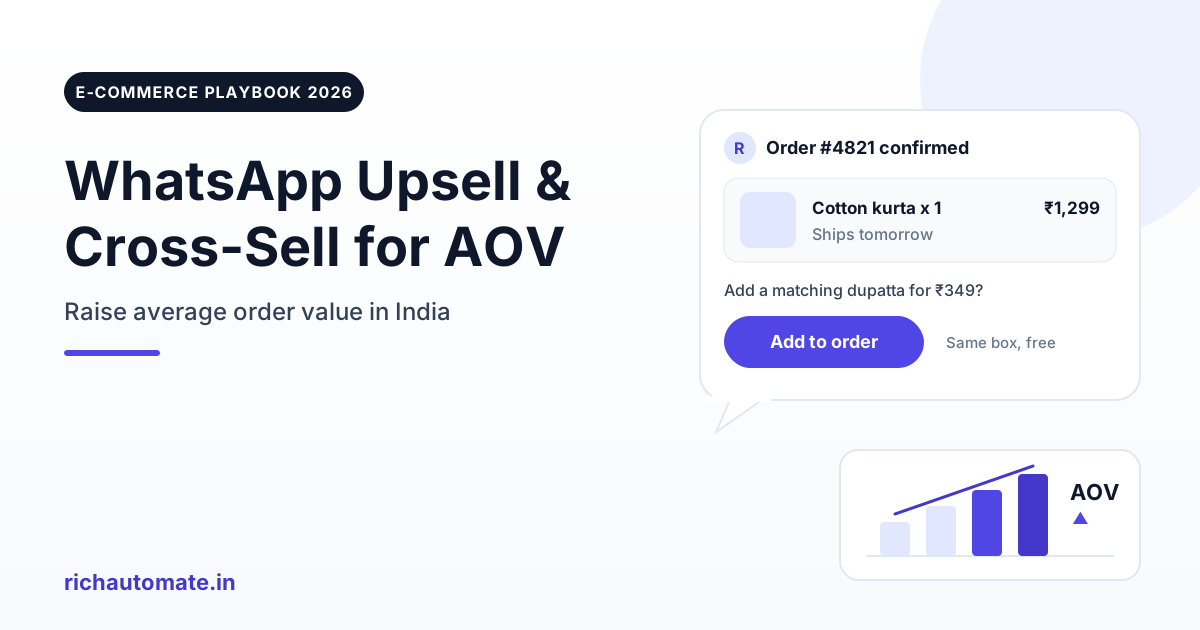
WhatsApp upsell and cross-sell means offering a relevant add-on, bundle, upgrade or service at the exact moment a customer is already engaged with an order, and it is one of the cheapest ways for Indian D2C, retail and service brands to raise average order value (AOV). The playbook is simple: offer the right thing at order confirmation, before dispatch, at replenishment time or inside a live chat, put it in the correct Meta template category, cap frequency, and measure lift against a holdout group.
This guide is about the moments after a customer has said yes. If you are still trying to get the first order over the line, start with our guide to WhatsApp abandoned cart recovery. If you want reviews and ratings after delivery, see the post-purchase NPS and review request playbook. Here we focus on one number: how much more each order is worth.
Why WhatsApp works so well for upsell in India
India has well over 500 million WhatsApp users, and for most of them it is the app they open first in the morning. An order confirmation on WhatsApp gets read. The same message by email often sits unopened in a Promotions tab, and SMS has become a wall of OTPs and bank alerts that people skim past.
The bigger advantage is that WhatsApp is two-way. A customer can reply "yes, add it", ask "does it come in blue?", or send a photo of the room where the AC will be installed. That conversation is where upsells convert, because the customer gets an answer instead of a dead-end link.
| Factor | SMS | ||
|---|---|---|---|
| Typical read behaviour | Read quickly, often within minutes | Skimmed, buried among OTPs | Often unopened or filtered to Promotions |
| Rich content | Images, product cards, buttons, catalogues | Plain text and a link | Rich, but only if opened |
| Two-way conversation | Yes, native replies and quick-reply buttons | Rarely used for replies | Slow, rarely used |
| One-tap add to order | Yes, with buttons or payment links | Link only | Link only |
| Regional language support | Full Unicode templates in Hindi and regional languages | Possible, but DLT template rules apply | Possible |
| Best upsell use | Time-sensitive add-ons, bundles, service add-ons | Fallback reminders | Long-form catalogues and newsletters |
None of this means SMS and email are useless. They are good backups. But when the goal is a fast, relevant add-on while the order is still fresh, WhatsApp usually wins. Measure it on your own base rather than taking any channel's word for it.
The six upsell and cross-sell moments that actually work
Most brands blast one generic "you may also like" message and wonder why nothing happens. Upsell works when the offer matches the moment. These are the six windows worth building for.
1. The order-confirmation add-on
The customer has just paid or placed a COD order. Confidence is at its peak. Offer one small, complementary item that ships in the same box: a phone cover with a phone, socks with shoes, a refill pack with a skincare kit. Keep the price low relative to the order value, ideally something the customer can say yes to without thinking.
2. The before-dispatch add-on window
Between order placement and packing there is often a window of a few hours to a day. Tell the customer plainly: "Your order ships tomorrow morning. Want to add anything to the same box, with no extra delivery charge?" Free shipping on the add-on is a genuine benefit because it rides on a parcel that is already going. Close the window when the warehouse starts packing.
3. Replenishment and consumable cross-sell
Coffee, protein powder, pet food, diapers, water purifier filters and skincare all run out on a predictable cycle. Time the message a few days before the product is likely to finish, and cross-sell something related alongside the refill: a new flavour, a travel size, a cleaning kit. This is different from retention broadcasts because it is triggered per customer by their own purchase date.
4. The complementary bundle
Instead of offering one item, offer a curated set at a small bundle saving: kurta plus dupatta plus mojari, or a phone plus earbuds plus charger. Bundles raise AOV more than single add-ons but convert at a lower rate, so test both.
5. The upgrade or premium tier
Before dispatch, some customers will happily upgrade: 1 kg instead of 500 g, the 256 GB variant instead of 128 GB, the premium gift wrap, or express delivery. Frame the upgrade as a price difference ("just ₹200 more for double the quantity") rather than a new purchase.
6. Service add-ons
For electronics, appliances, furniture and home services, the highest-margin upsell is often a service: extended warranty, professional installation, an annual maintenance contract (AMC), or a deep-clean visit. These sell best right after purchase and again as the standard warranty approaches its end.
Offer map: what to send, when, and in which category
Use this as your planning sheet. The attach-rate bands are directional, based on what is commonly reported by D2C teams. Your own numbers will depend on price point, category and audience, so treat them as a starting hypothesis and measure your own.
| Offer type | Best timing | Template category | Typical attach rate (directional) |
|---|---|---|---|
| Order-confirmation add-on | Within minutes of order | Marketing (separate from the utility confirmation) | Moderate: small, low-priced items convert best |
| Before-dispatch add-on | Hours before packing | Marketing, or free-form inside an open chat | Moderate to higher, helped by free shipping |
| Replenishment cross-sell | A few days before expected run-out | Marketing | Higher for true consumables |
| Complementary bundle | Confirmation or pre-dispatch | Marketing | Lower rate, bigger basket gain |
| Upgrade or premium tier | Before dispatch | Marketing | Lower to moderate |
| Service add-on (warranty, installation, AMC) | Post-delivery and near warranty expiry | Marketing | Varies widely by category and price |
| Pure order or delivery update | Order lifecycle events | Utility (only if it has no offer) | Not an upsell, keep it clean |
Utility or marketing? The template category rule
This is where many Indian brands get caught out, so it is worth being very clear.
A pure order update is utility. Any add-on offer inside it makes it marketing.
An order confirmation, shipping update, delivery notification or payment receipt that only informs the customer about their existing transaction fits Meta's utility category. The moment you add "add a matching belt for ₹299", a coupon code, a "you may also like" product card or any promotional call to action, the template is marketing, even if 90 percent of the text is about the order.
Trying to sneak offers into utility templates is a bad idea for three reasons:
- Meta reviews templates and can reject or recategorise them, which disrupts your order notifications at exactly the wrong time.
- Recategorised templates get billed at the marketing rate anyway, so the saving you hoped for disappears.
- Customers who expected a simple update and got a sales pitch are more likely to block or report you, which hurts your quality rating.
The clean pattern is two messages: a utility confirmation that does its job, followed by a separate marketing template with the add-on, sent only to customers who have opted in to promotional messages. Or, better still, use the live chat window described next.
The 24-hour window trick: offers inside a live chat
When a customer sends you a message, a 24-hour customer-service window opens. Inside that window you can reply with free-form messages, including product suggestions, images and payment links, without needing an approved template for each one. Per Meta's current pricing, service conversations are charged differently from template messages, and in many cases replies within the window carry no Meta template charge. Pricing mechanics change, so confirm on your dashboard before building a budget around it.
Get a 1-minute BSP audit on WhatsApp
Drop your WhatsApp number — we line-item your current invoice against Meta India rates in under 60 seconds. India-hosted, DPDP-compliant.
The practical trick is to give customers a reason to reply first. For example:
- Your utility confirmation ends with a quick-reply button such as "Track my order" or "Change delivery slot".
- The customer taps it, which opens the service window.
- Your bot answers the question, then offers one relevant add-on in the same chat: "Your order ships tomorrow. Want to add a screen guard for ₹199 in the same box?"
- A "Yes, add it" button updates the order or sends a UPI payment link.
Two cautions. First, the customer's reply must be genuine, not engineered through misleading buttons. Second, the offer should still be relevant and occasional. The window is not a licence to spam. For a deeper look at how session timing affects your bill, read our guide to 24-hour window cost optimisation.
What upsell messages cost: a worked example
RichAutomate uses usage-only pricing: ₹0 setup and ₹0 monthly fee. You choose one of two billing models, explained in detail in our Client Pay vs SaaS Pay comparison:
- Client Pay: ₹0.10 per message platform fee. Your business pays Meta directly for Meta's charges.
- SaaS Pay: ₹1.20 per marketing message and ₹0.30 per utility message, all-in.
| Message type | Example | SaaS Pay (all-in) | Client Pay |
|---|---|---|---|
| Utility template | Order confirmation with no offer | ₹0.30 per message | ₹0.10 platform fee + Meta's utility charge |
| Marketing template | Add-on, bundle or upgrade offer | ₹1.20 per message | ₹0.10 platform fee + Meta's marketing charge |
| In-session reply | Offer inside an open 24-hour chat | Depends on Meta's current service pricing, confirm on your dashboard | ₹0.10 platform fee + any Meta charge, confirm on your dashboard |
Worked example. A D2C skincare brand sends 10,000 upsell marketing templates a month.
- On SaaS Pay: 10,000 × ₹1.20 = ₹12,000 a month, all-in.
- On Client Pay: 10,000 × ₹0.10 = ₹1,000 a month in platform fees, plus Meta's marketing charges paid directly to Meta.
- For comparison, 10,000 clean utility order confirmations on SaaS Pay would cost 10,000 × ₹0.30 = ₹3,000.
Now the revenue side, as an illustration only. If 3 percent of those 10,000 customers add a ₹400 item, that is 300 add-ons and ₹1,20,000 in extra revenue for ₹12,000 of messaging on SaaS Pay. Plug in your own attach rate, add-on price and margin. The point is that even a modest attach rate can cover message cost many times over, but only if the offer is relevant. Full rates are on the RichAutomate pricing page.
India specifics: COD, UPI, festive timing and language
Turn COD orders into prepaid
Cash on delivery still makes up a large share of Indian e-commerce orders, especially outside the metros, and COD orders carry higher return-to-origin risk. A prepaid-conversion nudge is a quiet upsell in its own right: "Pay now via UPI and get your order a day earlier" or "Prepay and get a free sample in the box." Include a UPI payment link so the customer can pay in two taps. A plain payment request can often sit in utility, but once it carries a discount or free gift, treat it as marketing. Always leave COD in place for those who ignore it.
UPI makes one-tap add-ons possible
Because UPI is the dominant way Indians pay digitally, an add-on no longer needs a full checkout. Send a payment link for the add-on amount, confirm payment through your gateway webhook, and update the order automatically. The fewer screens, the higher the attach rate.
Festive season timing
Diwali, Navratri, Raksha Bandhan, wedding season and big sale events like Big Billion Days and Great Indian Festival are when baskets are biggest and customers are most open to gifting bundles. They are also when every brand is messaging at once. Plan festive upsells as gift add-ons (gift wrap, greeting cards, hampers) and keep your frequency caps in place, because blocks during a festive rush can hurt the quality rating you need for the whole season.
Hindi and regional-language templates
Tier-2 and tier-3 buyers are a growing part of Indian online shopping, and many prefer Hindi, Tamil, Telugu, Marathi, Bengali or Gujarati. WhatsApp templates support these languages natively. A short Hindi add-on message such as "Isi order ke saath matching dupatta add karein, sirf ₹349" often feels more natural than English. Keep one template per language and route by the customer's preferred language.
Frequency caps, opt-out and quality rating
Upsell messages are marketing messages, and marketing messages are what customers block when they feel spammed. Blocks and reports lower your quality rating, and a low rating can limit how many people you can message. Protect it with a few simple rules:
- One upsell per order. Pick the single best offer for that basket rather than three weak ones.
- A weekly cap across all campaigns. Two or three promotional messages per customer per week is a sensible ceiling to start with, and less is often better.
- Relevance first. Only offer items that pair with what the customer bought. Use purchase history and WhatsApp broadcast audience segmentation to decide who gets which offer.
- Visible opt-out. Add a "Stop offers" quick-reply button to every marketing template and honour it immediately, while still sending utility order updates.
- Consent on record. Collect clear marketing opt-in at checkout. India's DPDP Act 2023 puts weight on informed consent for personal data use; this is general guidance, not legal advice, so check with your advisor.
- Weekly quality check. Look at your quality rating and block rate every week and reduce frequency the moment it drops.
Also keep upsells separate from stock-driven messages. If a customer asked to be notified when a size comes back, that is a back-in-stock alert, and cramming unrelated cross-sells into it wastes a high-intent moment.
Measuring AOV lift the honest way
Many brands look at total revenue from customers who received an upsell message and call it lift. That overstates results, because some of those customers would have bought more anyway. Measure properly with these metrics:
- Attach rate: the share of messaged orders where the customer accepted the add-on.
- AOV lift: average order value of the messaged group minus that of the holdout group.
- Incremental revenue per 1,000 messages: extra revenue from the messaged group over the holdout, scaled to 1,000 messages. Compare this directly with the cost of 1,000 messages (₹1,200 on SaaS Pay for marketing templates).
- Block and opt-out rate: the cost side of the equation that does not show up in revenue.
- Return rate on add-ons: an add-on that gets returned is not a real upsell.
The key is a holdout group. Randomly exclude around 10 to 20 percent of eligible orders from the upsell flow, run both groups over the same weeks, and compare. Randomise by customer, not by day, so festive spikes do not skew results. Once you have a baseline, test one variable at a time: offer, price point, timing, language or button copy.
Start free on RichAutomate
RichAutomate lets you build these upsell flows without code: utility order confirmations, separate marketing add-on templates, before-dispatch windows, replenishment triggers, UPI payment links, regional-language templates and holdout-based reporting, all on the official WhatsApp Business API. Pricing is usage-only, with ₹0 setup and ₹0 monthly fee, so you only pay for messages you actually send.
Start free on RichAutomate and set up your first order-confirmation add-on today.