All articles
WhatsApp Business

WATI vs AiSensy: India 2026 Pricing Decoded

WATI vs AiSensy India 2026 pricing decoded — WATI's per-agent SaaS fee vs AiSensy's annual-billed tiers, plus the ₹0-platform RichAutomate alternative.

RichAutomate Editorial
10 min read 0 views
WATI vs AiSensy: India 2026 Pricing Decoded
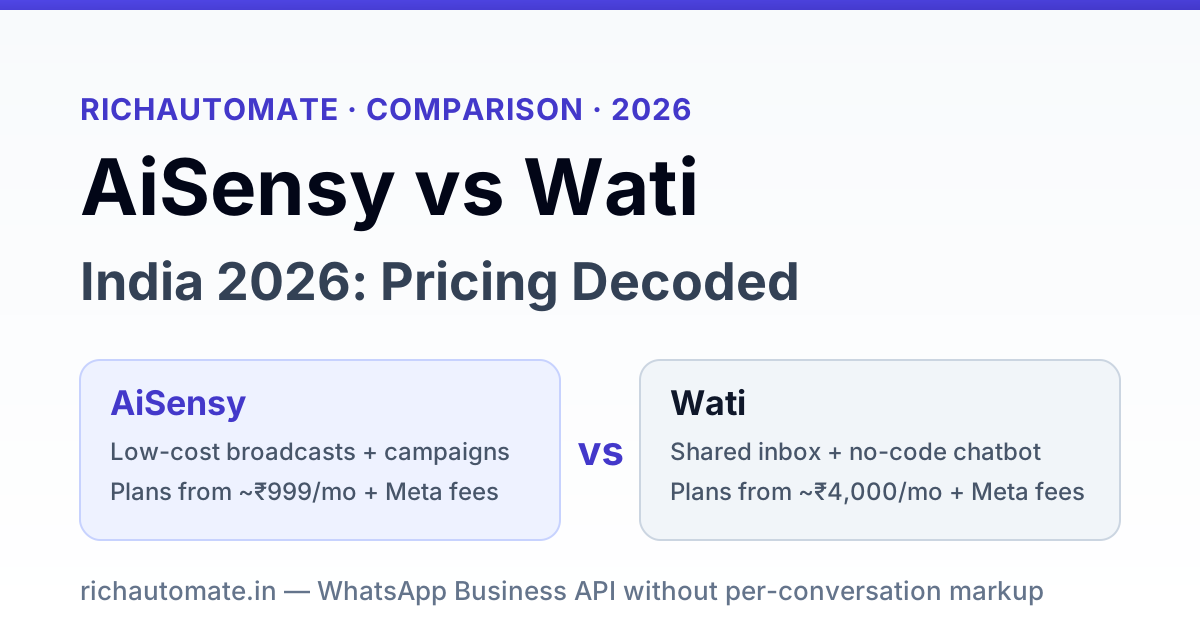
The short answer. WATI and AiSensy are both mature, Meta-verified WhatsApp Business API platforms built for Indian SMBs — the split is in how they charge. WATI bills a per-agent SaaS subscription (a platform fee that climbs with team seats) plus Meta conversation costs. AiSensy bills flat annual-billed tiers (a ~₹999 Basic headline, most land on the ~₹2,399 Pro) plus Meta costs. Neither is wrong — but both carry a fixed platform fee you pay whether you send 500 messages or 50,000. If a fixed monthly fee is the thing you want gone, a ₹0-platform usage model like RichAutomate (₹0.10/msg Client Pay, or all-in SaaS Pay, no annual lock-in) is the third option this guide decodes. All tier and rupee figures below are illustrative — verify current rates on each vendor's site.

This is a practical India-2026 pricing comparison of WATI, AiSensy and where a ₹0-platform alternative fits. We break down how each one actually bills, what you get for the platform fee, the migration reality (spoiler: your WABA never moves), and how to pick based on your volume and team shape rather than a headline number. Treat every figure as illustrative, confirm current pricing with each vendor, and remember going live in India effectively requires GST for Meta Business Verification — nothing here is legal or financial advice.

How WATI charges: per-agent SaaS

WATI's model is a classic per-seat SaaS subscription. You pick a plan tier, and the platform fee scales with the number of agent seats and the feature set (broadcast limits, API access, integrations, chatbot builder). On top of the subscription you pay Meta's per-conversation charges at actuals. The strength: a polished, mature product with a large integration marketplace and a well-known shared-team-inbox. The cost shape: the platform fee is fixed and grows with your team — a five-agent support desk pays materially more in platform fee than a solo operator, before a single message is sent. For a growing team that lives in the inbox all day, that fee amortizes fine. For a lean business where most messaging is automated flows rather than human agents, you are paying seat cost you do not fully use.

How AiSensy charges: annual-billed tiers

AiSensy's model is flat monthly tiers, but the attractive headline rate assumes annual billing. The ~₹999 Basic tier is the shop-window number; in practice most businesses that need a chatbot, retargeting or higher limits land on the ~₹2,399 Pro tier. On top of the tier you pay Meta conversation charges at actuals. The strength: predictable flat pricing that does not scale with agent seats, a strong template and campaign gallery, and no per-seat penalty for a bigger team. The cost shape: the platform fee is paid every month regardless of volume, and the best rate is locked behind an annual commit — so a seasonal business or one still proving the channel carries a fixed fee in the quiet months and cannot walk away mid-year without eating the commitment.

WATI vs AiSensy: the head-to-head

DimensionWATIAiSensy
Platform fee modelPer-agent SaaS subscription (scales with seats)Flat monthly tier (~₹999 Basic / ~₹2,399 Pro, best rate annual-billed)
Grows with team size?Yes — more agents, higher feeNo — flat regardless of seats
Commitment for best rateMonthly or annual plansAnnual billing for the headline rate
Meta conversation costPassed through at Meta actualsPassed through at Meta actuals
Best fitHuman-agent-heavy support desks with several seatsCampaign/marketing-led teams wanting flat pricing, comfortable on annual
Watch-outPer-seat fee stacks as you add agentsFixed fee paid in slow months; annual lock-in

Both run on the same official Meta WhatsApp Cloud API, so green tick, template approval speed and deliverability are a Meta function — identical across both. The real decision is the fee shape against your team and volume: WATI's cost rises with agent seats, AiSensy's is flat but always-on and annual-committed. For a deeper single-vendor breakdown see our WATI alternative guide and the AiSensy pricing decode, and if you are weighing WATI against another inbox tool, the DoubleTick vs WATI comparison.

Stop overpaying on WhatsApp

Get a 1-minute BSP audit on WhatsApp

Drop your WhatsApp number — we line-item your current invoice against Meta India rates in under 60 seconds. India-hosted, DPDP-compliant.

DPDP-compliant · India-hosted · 1-min reply

The third option: a ₹0-platform usage model

Both WATI and AiSensy answer the same question — "what fixed fee do I pay to be on the platform?" — with a number greater than zero. The alternative is to make that number zero and pay only for what you send. That is the RichAutomate model, and it is worth understanding as a reference point even if you stay with either incumbent:

  • ₹0 platform fee, ₹0 setup, ₹0 monthly. No per-seat charge, no tier gate, no annual commit — a quiet month costs almost nothing.
  • Client Pay — ₹0.10/message. Meta bills you direct for conversations on your own number; RichAutomate adds a flat ₹0.10/msg platform charge, so you keep full Meta wholesale visibility with zero markup on Meta cost.
  • SaaS Pay — all-inclusive. ₹1.20 per marketing conversation and ₹0.30 per utility or authentication conversation, Meta cost included, one GST invoice via Razorpay.
  • No lock-in. Month-to-month usage — cancel any time, pay ₹0 platform in a slow month.

The trade-off is honest: WATI and AiSensy are older, larger brands with deep integration galleries and years of feature polish. A ₹0-platform newcomer wins on cost shape and flexibility, not on brand maturity. Which matters more depends on you.

Illustrative cost: 8,000 conversations/month

Say a growing D2C brand runs ~8,000 WhatsApp conversations a month with a three-agent inbox — roughly 5,500 utility (order, delivery, support) and 2,500 marketing. Meta conversation cost is the same on all three platforms; the difference is the platform fee on top. Figures are illustrative — model your own.

PlatformPlatform fee (illustrative)Cost shape on top of Meta
WATIPer-agent subscription × 3 seats (verify current plan)Fixed seat fee whether the agents are busy or idle; rises if you add a fourth agent
AiSensy~₹2,399/mo Pro tier, annual-billed (verify)Flat regardless of seats or volume; paid in slow months; annual commit
RichAutomate — Client Pay₹0 platform + ₹0.10/msgScales with volume only; no seat fee, no annual commit
RichAutomate — SaaS Pay₹0 platform, all-in per-conversation₹0.30 utility / ₹1.20 marketing, one bill, most traffic in the cheap utility tier

The point is the shape, not one magic number. At low-to-mid volume with a small team, a ₹0-platform usage model is usually cheapest because there is no fixed fee to absorb. As volume and agent count climb, a flat tier like AiSensy's amortizes better per conversation, and a seat-based tool like WATI makes sense when you genuinely have many human agents earning their seats. Run your real numbers through the WABA cost calculator before deciding — and verify each vendor's current pricing, because BSP plans change.

Switching costs: your WABA never moves

The biggest myth in BSP comparison is that switching is painful. It is not. Your WhatsApp Business Account, phone number, green tick and approved template library all live with Meta, not with WATI or AiSensy. Only the BSP integration layer swaps — there is zero downtime on the Meta side, and template approval speed (a 0-to-24-hour Meta SLA) is identical whichever platform you use. If a fixed platform fee is the only reason you are hesitating, the migration itself is a low-risk, reversible move.

Not sure which fee shape fits your volume?

Tell us your monthly conversation volume, your utility-vs-marketing split and how many human agents you actually staff, and we will model WATI's seat fee, AiSensy's tier and a ₹0-platform usage bill side by side — no pressure. WhatsApp us at 917434901027 or book a 30-minute walkthrough at https://calendly.com/inrichdaddy/30min.

Start a 14-day free trial → · See full pricing · Run the WABA cost calculator

Bottom line

WATI and AiSensy are both solid, mature Indian BSPs on the same Meta Cloud API — the real choice is fee shape. Pick WATI if you run a human-agent-heavy support desk where several seats earn their keep and you value its integration depth. Pick AiSensy if you are campaign-led, want flat pricing that does not scale with seats, and are comfortable on an annual commit for the best rate. Pick a ₹0-platform usage model like RichAutomate if you are low-to-mid volume, seasonal, lock-in-averse, or automation-led rather than agent-led, and you want channel cost to track what you actually send with full Meta direct-billing transparency. Two honest caveats: no vendor can guarantee against a WhatsApp restriction or guarantee delivery, and all tier and rupee figures here are illustrative — verify current Meta and vendor pricing before you decide. For the wider field, compare the best WhatsApp Business API providers in India.

Ready to ship this?

Get the full migration playbook on WhatsApp

A founder-led 1-minute reply with the migration steps, template approval timeline, and a 14-day pilot offer. DPDP-compliant. India-hosted. No spam.

DPDP-compliant · India-hosted · 1-min reply
Tagged
WATIAiSensyRichAutomateBSP ComparisonWhatsApp PricingPer-agent PricingAnnual BillingMeta Cloud API v24BOFUIndia2026Pricing Decoded
Written by
RichAutomate Editorial
Editorial team at RichAutomate. We build the WhatsApp Business automation platform Indian D2C brands, fintechs, and agencies use to ship campaigns and flows on the official Meta Cloud API.
FAQ

Frequently asked questions

Is WATI or AiSensy cheaper for an Indian SMB in 2026?
It depends on your team size and volume, because the two bill differently. WATI charges a per-agent SaaS subscription, so its platform fee rises with the number of agent seats you staff, on top of Meta conversation costs at actuals. AiSensy charges flat monthly tiers, with a roughly 999 rupee Basic headline and a roughly 2,399 rupee Pro tier that most businesses land on, billed annually for the best rate, again on top of Meta costs. For a lean team with few human agents, WATI can be cheaper if you stay on one or two seats, but its cost climbs as you add agents. For a team that wants flat pricing regardless of seats and is comfortable committing annually, AiSensy is more predictable. Both, however, carry a fixed platform fee you pay whether you send 500 or 50,000 messages. If removing that fixed fee matters, a zero-platform usage model that charges only per message can be cheaper at low-to-mid volume. All figures are illustrative, so verify current rates on each vendor site.
What is the real difference between WATI and AiSensy pricing?
The core difference is what the platform fee scales with. WATI uses a per-agent subscription, so its fee is tied to how many human agent seats you buy, which suits support desks with several people answering chats but stacks up as the team grows. AiSensy uses flat monthly tiers that do not change with seat count, so a bigger team does not raise the platform fee, but the attractive headline rate assumes annual billing and the fee is paid every month regardless of how much you send. Both then pass through Meta conversation charges at actuals, and both run on the same official Meta WhatsApp Cloud API, so green tick, deliverability and template approval speed are identical between them. In short, WATI cost is driven by team size and AiSensy cost is driven by a fixed always-on tier with an annual commit for the best price. Choose based on whether your cost should follow agent seats, sit flat, or follow message volume.
Do I lose my green tick or templates if I switch between WATI, AiSensy or another provider?
No. Your WhatsApp Business Account, phone number, green tick and approved template library all live with Meta, not with the BSP. When you switch platforms, only the integration layer between your WABA and the provider changes, so there is zero downtime on the Meta side and you keep your verification and templates. The green tick is a Meta Business Verification status that stays on your account, and template approval runs through Meta on a 0-to-24-hour SLA that is the same whichever platform you use. This is why switching BSPs is a lower-risk, more reversible move than most businesses assume, and why a fixed platform fee alone is rarely a good reason to stay put if the numbers favour moving. Confirm the exact migration steps with your chosen provider before you start.
When should I choose a zero-platform model over WATI or AiSensy?
A zero-platform usage model, where you pay no fixed monthly fee and only pay per message, tends to win in three situations. First, when you are low-to-mid volume, because there is no fixed fee to absorb and a quiet month costs almost nothing. Second, when you are seasonal or still proving the channel, because you are not locked into an annual commit and can scale down without penalty. Third, when your messaging is automation-led rather than agent-led, so you are not paying for human agent seats you do not fully use, as you might on a per-seat tool like WATI. RichAutomate is one such model, charging 0 platform fee and either 0.10 rupees per message on Client Pay with Meta billing you direct, or an all-in SaaS Pay rate of 1.20 rupees per marketing and 0.30 rupees per utility conversation. The honest trade-off is that older, larger brands carry deeper integration galleries and more feature polish, so weigh cost shape against brand maturity for your needs.
Are WATI, AiSensy and RichAutomate all on the official WhatsApp Business API?
Yes. WATI, AiSensy and RichAutomate are all official Meta WhatsApp Business Solution Providers operating on the same Meta WhatsApp Cloud API, so the underlying messaging infrastructure, green tick verification, per-conversation Meta pricing and template approval process are the same across all three. What differs is the software layer each wraps around that API and, crucially, how each one charges for it: WATI on a per-agent subscription, AiSensy on flat annual-billed tiers, and RichAutomate on a zero-platform usage model. Because the Meta layer is identical, deliverability and compliance obligations do not change when you switch, and your choice should come down to fee shape, feature fit and how much fixed cost you want to carry. Going live in India effectively requires GST for Meta Business Verification on any of them. Verify each vendor current pricing and terms before deciding, as this is general information and not legal or financial advice.
RichAutomate · WhatsApp BSP for India 2026

Ship WhatsApp campaigns + flows on a transparent, compliance-ready BSP.

₹0 platform fee. DPDP audit log included. Visual flow builder. Multi-tenant from day one.

Start free trial
Want this for your brand?

Get a free 24-hour BSP audit

Send us your last invoice. We line-item it against Meta's published rates and benchmark against three alternatives.

Limited Spots Available

Get a Free
Automation Audit

Stop leaving revenue on the table. Get a custom roadmap to automate your growth.

Secure & Confidential

Continue reading

All articles