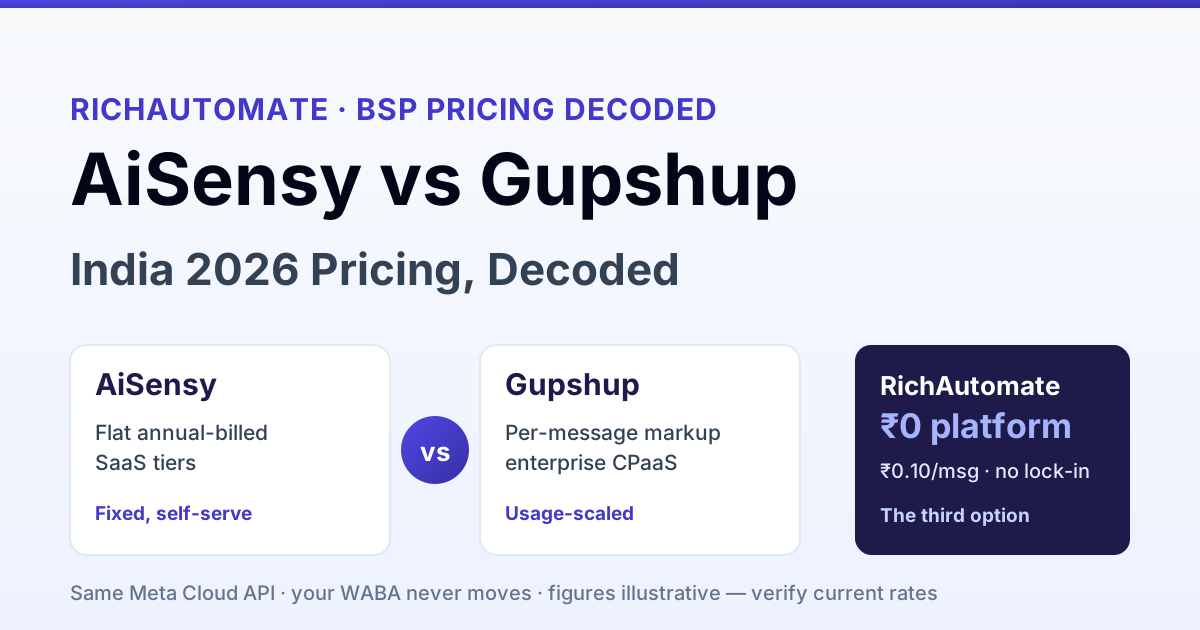
This is a practical India-2026 pricing comparison of AiSensy, Gupshup and where a ₹0-platform alternative fits. We break down how each one actually bills, who each is built for, the migration reality (spoiler: your WABA never moves), and how to pick based on your volume and buying style rather than a headline number. Treat every figure as illustrative, confirm current pricing with each vendor, and remember going live in India effectively requires GST for Meta Business Verification — nothing here is legal or financial advice.
How AiSensy charges: flat annual-billed tiers
AiSensy's model is flat monthly tiers, but the attractive headline rate assumes annual billing. The ~₹999 Basic tier is the shop-window number; in practice most businesses that need a chatbot, retargeting or higher limits land on the ~₹2,399 Pro tier. On top of the tier you pay Meta's per-conversation charges at actuals, with no per-message markup on the Meta cost itself. The strength: predictable flat pricing that does not scale with agent seats or volume, a strong template and campaign gallery, and true self-serve sign-up — you can be live the same day without talking to sales. The cost shape: the platform fee is paid every month regardless of volume, and the best rate is locked behind an annual commit — so a seasonal business or one still proving the channel carries a fixed fee in the quiet months and cannot walk away mid-year without eating the commitment.
How Gupshup charges: per-message markup on an enterprise CPaaS
Gupshup is a different animal — a large enterprise CPaaS (WhatsApp is one channel among SMS, RCS, voice and more). Instead of a flat SaaS tier, Gupshup typically adds a per-message platform markup on top of Meta's conversation rate, frequently paired with volume commitments, prepaid top-ups or minimum monthly spend for the better rates, and a sales-led onboarding rather than instant self-serve. The strength: enterprise-grade scale, multi-channel reach, deep developer APIs and the muscle to handle very high volume with SLAs. The cost shape: your cost scales with every message you send, and each one carries a markup over the raw Meta price — efficient sourcing at massive scale, but at low-to-mid volume you pay both a markup per message and, often, a commitment floor. For a lean SMB, the enterprise machinery is more than you need and the per-message markup quietly adds up. For a like-for-like read on the other SMS-heritage CPaaS, see our MSG91 vs Gupshup pricing comparison.
AiSensy vs Gupshup: the head-to-head
| Dimension | AiSensy | Gupshup |
|---|---|---|
| Platform fee model | Flat monthly tier (~₹999 Basic / ~₹2,399 Pro, best rate annual-billed) | Per-message markup over Meta rate, often with volume commitment / top-ups |
| Buyer & onboarding | Self-serve SMB, live same day | Sales-led enterprise, account-managed onboarding |
| Cost driver | Fixed tier, flat regardless of volume | Message volume × per-message markup |
| Meta conversation cost | Passed through at Meta actuals | Meta actuals plus Gupshup per-message markup |
| Best fit | Campaign/marketing-led SMBs wanting flat pricing, comfortable on annual | High-volume enterprises needing multi-channel + SLAs |
| Watch-out | Fixed fee paid in slow months; annual lock-in | Markup on every message; commitment floors at low volume |
Both run on the same official Meta WhatsApp Cloud API, so green tick, template approval speed and deliverability are a Meta function — identical across both. The real decision is the fee shape against your volume and buying style: AiSensy is a fixed, self-serve tier that ignores volume, Gupshup is an enterprise usage model that marks up every message. For deeper single-vendor breakdowns see our AiSensy pricing decode, the Gupshup pricing decode, and the Gupshup alternative guide.
Get a 1-minute BSP audit on WhatsApp
Drop your WhatsApp number — we line-item your current invoice against Meta India rates in under 60 seconds. India-hosted, DPDP-compliant.
The third option: a ₹0-platform usage model
AiSensy answers "what fixed fee do I pay to be on the platform?" with a number greater than zero; Gupshup answers "what markup do I pay per message?" with a number greater than zero. The alternative is to make the fixed fee zero and keep the per-message charge as thin as possible. That is the RichAutomate model, worth understanding as a reference point even if you stay with either incumbent:
- ₹0 platform fee, ₹0 setup, ₹0 monthly. No tier gate, no annual commit, no minimum spend — a quiet month costs almost nothing.
- Client Pay — ₹0.10/message. Meta bills you direct for conversations on your own number; RichAutomate adds a flat ₹0.10/msg platform charge, so you keep full Meta wholesale visibility with no markup on the Meta cost itself.
- SaaS Pay — all-inclusive. ₹1.50 per marketing conversation and ₹0.50 per utility or authentication conversation, Meta cost included, one GST invoice via Razorpay.
- No lock-in, no commitment floor. Month-to-month usage — cancel any time, pay ₹0 platform in a slow month.
The trade-off is honest: Gupshup is an enterprise giant with multi-channel reach and SLAs a newcomer cannot match, and AiSensy is a polished, established SMB brand. A ₹0-platform newcomer wins on cost shape and flexibility, not on enterprise scale or brand maturity. Which matters more depends on you.
Illustrative cost: 8,000 conversations/month
Say a growing D2C brand runs ~8,000 WhatsApp conversations a month — roughly 5,500 utility (order, delivery, support) and 2,500 marketing. Meta conversation cost is the same on all three platforms; the difference is what sits on top. Figures are illustrative — model your own.
| Platform | On top of Meta (illustrative) | Cost shape |
|---|---|---|
| AiSensy | ~₹2,399/mo Pro tier, annual-billed (verify) | Flat regardless of volume; paid in slow months; annual commit |
| Gupshup | Per-message markup × 8,000 msgs + any commitment floor (verify) | Scales up with every message; markup over raw Meta price |
| RichAutomate — Client Pay | ₹0 platform + ₹0.10/msg | Scales with volume only; no tier, no markup on Meta, no commit |
| RichAutomate — SaaS Pay | ₹0 platform, all-in per-conversation | ₹0.50 utility / ₹1.50 marketing, one bill, most traffic in the cheap utility tier |
The point is the shape, not one magic number. At low-to-mid volume, a ₹0-platform usage model is usually cheapest because there is neither a fixed tier to absorb nor a markup on every message. AiSensy's flat tier amortizes better as volume climbs past the tier price, and Gupshup's enterprise model earns its markup when you genuinely need multi-channel scale, SLAs and very high throughput. Run your real numbers through the WABA cost calculator before deciding — and verify each vendor's current pricing, because BSP plans change.
Switching costs: your WABA never moves
The biggest myth in BSP comparison is that switching is painful. It is not. Your WhatsApp Business Account, phone number, green tick and approved template library all live with Meta, not with AiSensy or Gupshup. Only the BSP integration layer swaps — there is zero downtime on the Meta side, and template approval speed (a 0-to-24-hour Meta SLA) is identical whichever platform you use. If a fixed tier or a per-message markup is the only reason you are hesitating, the migration itself is a low-risk, reversible move.
Not sure which fee shape fits your volume?
Tell us your monthly conversation volume and your utility-vs-marketing split, and we will model AiSensy's flat tier, Gupshup's per-message markup and a ₹0-platform usage bill side by side — no pressure. WhatsApp us at 918160311319 or book a 30-minute walkthrough at https://richautomate.in/book/demo.
Start a 14-day free trial → · See full pricing · Run the WABA cost calculator
Bottom line
AiSensy and Gupshup are both solid, Meta-verified BSPs on the same Meta Cloud API — the real choice is fee shape and buyer fit. Pick AiSensy if you are a campaign-led SMB, want flat pricing that ignores volume, value same-day self-serve, and are comfortable on an annual commit for the best rate. Pick Gupshup if you are a high-volume enterprise that needs multi-channel reach, developer depth and SLAs, and can absorb a per-message markup and commitment floors. Pick a ₹0-platform usage model like RichAutomate if you are low-to-mid volume, seasonal, lock-in-averse, or want channel cost to track exactly what you send with no fixed tier and no markup on the Meta price. Two honest caveats: no vendor can guarantee against a WhatsApp restriction or guarantee delivery, and all tier and rupee figures here are illustrative — verify current Meta and vendor pricing before you decide. For the wider field, compare the best WhatsApp Business API providers in India.
Related reading: WhatsApp Channels vs Business API in India 2026.
Still deciding? We compared six options side by side in best Gupshup alternatives in India for 2026, with real rupee costs.