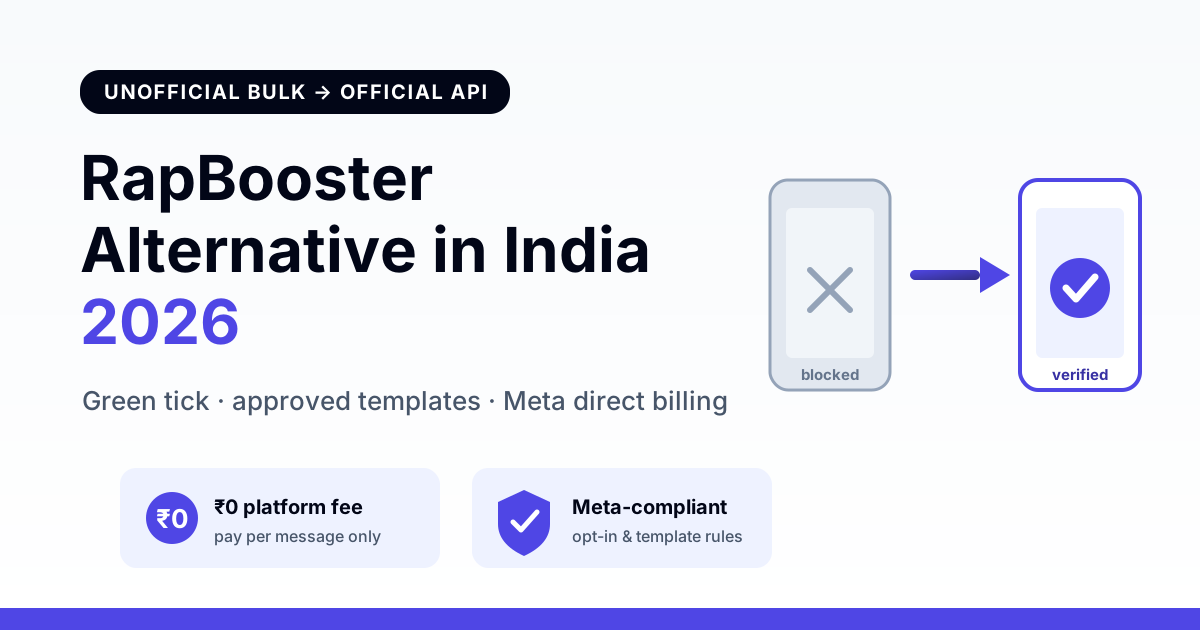
If you are searching for a RapBooster alternative in 2026, you are usually in one of two places: your sending number just got restricted, or you have read enough to know it is coming. This guide explains what the unofficial tools actually do, why the ban is a design outcome rather than bad luck, what the official Meta API gives you instead, what it genuinely costs in India, and how to move without losing your contact list. Nothing here is legal advice, and no provider — including us — can guarantee a number will never be restricted.
What RapBooster-style tools actually are
RapBooster belongs to a large family of Indian desktop and Android bulk-WhatsApp senders. The category shares one architecture: the software drives a real WhatsApp account you already own, usually by automating WhatsApp Web in a hidden browser or by scripting an emulator. You scan a QR code, paste a list of numbers, load a message with a few spintax variations, and the tool clicks send in a loop with randomised delays. There is no Meta integration anywhere in that chain.
That design is why the tools are cheap — a one-time licence rather than a per-message cost — and it is also why they are fragile. Every send is WhatsApp's own client being puppeted by a script, and WhatsApp is very good at telling a script from a person: message velocity, identical or near-identical bodies, a burst of first-contact chats to numbers that never messaged you, and a block-and-report rate far above a normal account. Randomised delays slow the detection down; they do not change the signal.
Why the ban is the expected outcome, not bad luck
Automating a consumer WhatsApp account is a direct breach of the WhatsApp Terms of Service. Enforcement is graduated and largely automated: first the number gets soft rate limits (sends start silently failing), then a temporary block, then a permanent ban. The parts that hurt a business are structural rather than punitive:
- The ban lands on your number, not the tool. The vendor's licence is unaffected; your business line is what stops working.
- Appeals rarely succeed when the account was demonstrably automated, and there is no support queue you can escalate through.
- Your chat history and contacts are stranded on a device-bound account with no export path into a proper system.
- A banned number poisons the number itself — and if it was printed on packaging, listed on Google Business or used as your OTP line, replacing it is expensive.
- Recipients never opted in, so block-and-report rates stay high, which under India's DPDP Act framework is also a consent-hygiene problem, not only a WhatsApp one.
The honest framing: unofficial senders are not risky because enforcement is random. They are risky because the thing that makes them work — unsolicited volume from a consumer account — is exactly the thing WhatsApp's integrity systems are built to stop.
The official alternative: Meta WhatsApp Business API
The official Cloud API is a different product, not a licensed version of the same trick. You register a business phone number as a WhatsApp Business Account (WABA), verify the business with Meta, and send through an API. The trade-offs run in both directions:
- You get a durable asset. The WABA, the green tick if approved, and your template library live with Meta and stay yours if you change providers.
- Business-initiated messages must use approved templates. You cannot blast arbitrary text to a cold list; template categories (marketing, utility, authentication) are reviewed, typically within 0–24 hours.
- Opt-in is mandatory. Recipients must have consented, which is a real constraint if your current list was scraped or bought.
- You pay per conversation at Meta's published India rates, rather than a one-time licence — so cost scales with volume instead of being free-at-the-margin.
- Quality rating and messaging limits are visible: you can see when recipients are blocking you and fix it before Meta throttles the number.
- GST is effectively required for Meta Business Verification to go live in India. A trial can run without it; going live cannot.
If you want the wider field before committing, see our roundup of the best WhatsApp Business API providers in India and the broader WhatsApp Business API alternatives guide.
Get a 1-minute BSP audit on WhatsApp
Drop your WhatsApp number — we line-item your current invoice against Meta India rates in under 60 seconds. India-hosted, DPDP-compliant.
RapBooster-style sender vs official API: the head-to-head
| Dimension | Unofficial bulk sender | Official Meta Cloud API |
|---|---|---|
| How it sends | Automates your own WhatsApp account via web/emulator | Server-to-server API call to Meta |
| Terms of Service | Breach — automation of a consumer account | Compliant and Meta-supported |
| Cost shape | One-time or annual licence, no per-message cost | Per-conversation Meta pricing plus any platform fee |
| Green tick eligible | No | Yes, subject to Meta Business Verification |
| Message format | Any free text, unrestricted | Approved templates for business-initiated; free-form inside the 24-hour window |
| Delivery visibility | Client-side ticks only, no reliable reporting | Webhook delivery, read and failure receipts |
| What happens on enforcement | Your number is rate-limited, then banned; contacts stranded | Quality rating drops and limits tighten — visible and recoverable |
| Portability | None — account is device-bound | WABA and templates move with you between providers |
Two honest caveats on that table. First, the official API is not a ban-proof route — no vendor can promise that a number will never be restricted. If you send unsolicited marketing at volume on the official API, recipients still block and report, your quality rating still falls, and Meta still tightens your messaging limits. What changes is that the signals are visible in advance and the failure is recoverable rather than terminal. Second, the official route is genuinely more expensive per message; if your entire model depends on messages being free at the margin, the official API will not reproduce that economics, and that is the real decision you are making.
What it actually costs in India in 2026
Official-API cost has two layers. The first is Meta's per-conversation charge, billed by category — marketing conversations cost meaningfully more than utility ones, and service conversations inside the 24-hour customer-care window are free. The second is the platform fee your BSP charges on top, and this is where Indian providers differ sharply: some bill a per-agent SaaS subscription that climbs with team seats, some bill flat annual-committed tiers, and some bill nothing at all and pass through usage.
RichAutomate sits in the third bucket: ₹0 platform fee, with either Client Pay (₹0.10 per message, Meta bills your own ad account direct so you see Meta's real rate) or SaaS Pay (all-in, roughly ₹1.20 per marketing and ₹0.30 per utility conversation). For a business coming off a licence-based sender, the useful exercise is not comparing licence price to per-message price — it is pricing the messages you would actually send to an opted-in list, which is nearly always far smaller than the list you were blasting. Run the numbers on the WABA cost calculator, and if you are weighing channels, compare against WhatsApp API vs SMS cost in India.
How to migrate off an unofficial sender
- Do not use your banned or at-risk number as the WABA number if you can avoid it. A number with a poor history carries that history. A clean business number is the safer registration.
- Export what you can before the account dies. Chat exports from the WhatsApp app are per-conversation and painful, but a contact list with consent evidence is the asset worth saving.
- Rebuild opt-in. This is the step people skip and the reason official-API sends still fail for them. Add a WhatsApp opt-in checkbox at checkout, on your forms and on your website widget, and keep the timestamp and source.
- Get Meta Business Verification started early — GST certificate, business documents, a matching website and business email. This is usually the longest step.
- Write templates for what you actually send. Order updates, delivery alerts, payment reminders and appointment confirmations are utility-category and cheap; convert your promotional blasts into an opt-in marketing template and accept the lower reach.
- Start small and watch the quality rating. Send to your warmest opted-in segment first, let messaging limits step up naturally, and treat a falling quality rating as a content problem to fix rather than a threshold to dodge.
Agencies and resellers migrating multiple clients off unofficial tools at once should read the agency and reseller WhatsApp API guide, and if you are comparing named platforms rather than models, the WATI alternative breakdown covers the per-agent side of the market.
Coming off a bulk sender and not sure what it will cost?
Tell us your monthly send volume, how much of it is order or delivery updates versus promotion, and roughly how many contacts have genuinely opted in. We will model the official-API bill against what you were doing — no pressure, and we will tell you plainly if the volume does not justify the move yet. WhatsApp us at 917434901027 or book a 30-minute walkthrough at https://calendly.com/inrichdaddy/30min.
Start a 14-day free trial → · See full pricing · Run the WABA cost calculator
Bottom line
There is no like-for-like RapBooster alternative, because the thing that made it attractive — unlimited free-at-the-margin sends from your own number — is precisely what WhatsApp enforces against. The real alternative is a different model: an official Meta WhatsApp Business API number with verification, approved templates, real opt-in and per-conversation billing. It costs more per message and reaches a smaller, consented list, but the number is an asset you keep, the deliverability is reported rather than guessed, and enforcement shows up as a visible quality-rating dip instead of a dead line. Pick a provider on fee shape: per-agent subscription if you run a big human support desk, flat tiers if you want predictability, and a ₹0-platform usage model like RichAutomate if you are low-to-mid volume and want cost to track what you actually send. Verify current Meta and vendor pricing before you commit — this is general information, not legal or financial advice.