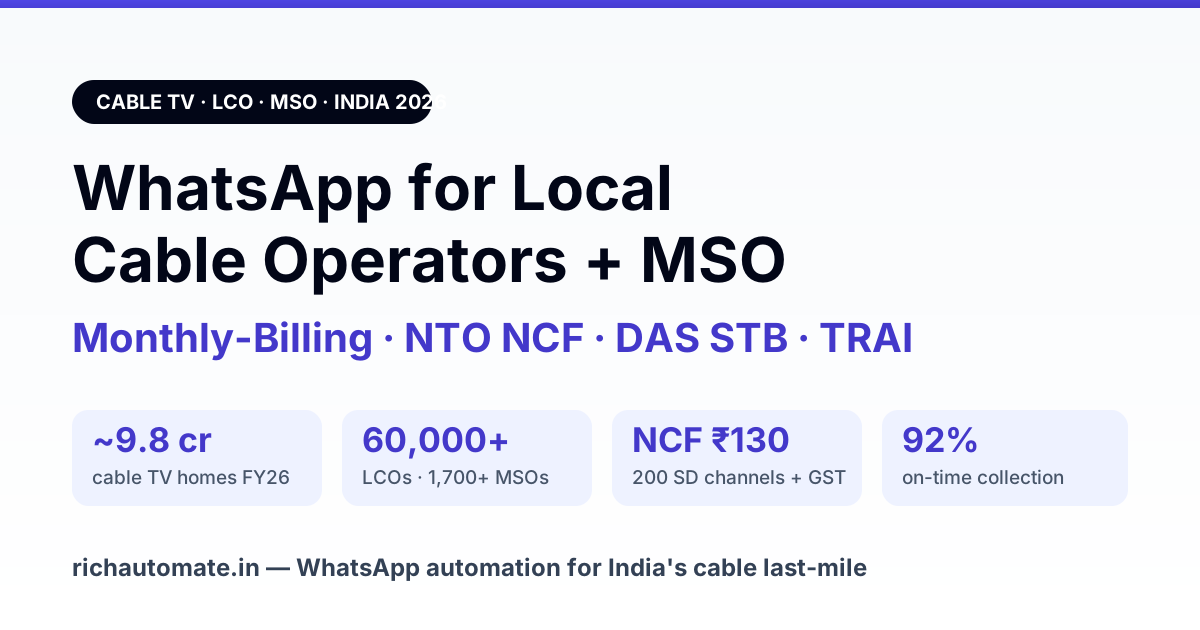
WhatsApp collapses a local cable operator's (LCO) three costliest chores — door-to-door monthly cash collection, NTO a-la-carte pack-change consent, and set-top-box (STB) complaint follow-up — into one automated, TRAI-compliant subscriber Pathway. India's cable TV last mile is still ~9.8 crore homes in FY26 (FICCI-EY Media & Entertainment Report + TRAI Performance Indicator Report Q4 + MIB registrations), served by 1,700+ registered MSOs and 60,000+ LCOs who own the customer, the cash, and the complaint — yet run it on a diary, a cash bag, and a WhatsApp status. This is the operating manual to fix that without breaking the Cable Television Networks (Regulation) Act, the New Tariff Order, or Digital Addressable System (DAS) rules.
Why the cable last mile is a WhatsApp problem, not a broadcast problem
Under DAS, every cable connection in India is digital and addressable — one STB, one subscriber ID, one monthly bill. The MSO owns the headend and the TRAI-filed tariff; the LCO owns the last mile: the physical drop, the KYC, the monthly collection, and the "no-signal" call at 9pm. TRAI's New Tariff Order (NTO 2.0/3.0) fixed the economics — Network Capacity Fee (NCF) of ₹130 + 18% GST for the first 200 SD channels, a-la-carte MRP per channel, twin-condition bouquet caps — but it did nothing for the operations. The LCO still walks the gully with a receipt book.
Cable's real enemy is not the tariff; it is churn to DTH and OTT plus the cost of manual collection. A cable subscriber who forgets to pay by the 5th, waits three days for a reconnection, and gets a busy tone on the complaint line is a subscriber who ports to DTH or drops to a ₹149 OTT pack. Every one of those five failure points is a message that never got sent on time.
The seven broken moments in a cable subscriber's month
- New connection + KYC. Aadhaar/address capture on paper, STB pairing done by memory, activation confirmation never sent. First impression: analog-era.
- First-bill shock. The subscriber sees "NCF ₹130 + pay channels + LCO charge + GST" and assumes they were overcharged. No one explained NCF vs pay-channel MRP. Complaint filed on day one.
- Monthly collection. Door-to-door cash on 40-200 homes per LCO. On-time collection sits at roughly 55-65%; the rest needs a second and third visit, or a reconnection after disconnection.
- A-la-carte pack change. NTO makes channel selection the subscriber's right — but consent for adding/removing a pay channel is captured verbally, unlogged. A TRAI audit asks "where is the opt-in?" and there is none.
- STB complaint. "No signal" / "channel missing" / "STB rebooting." TRAI's QoS regulation for DPOs mandates a complaint number, a docket, and defined resolution timelines — most LCOs have a personal mobile that rings busy.
- OTT + broadband bundle. The LCO who also sells broadband (a huge and growing share) has the highest-value cross-sell in Indian telecom sitting idle in a diary.
- Renewal & win-back. A disconnected box is silent. No reminder, no offer, no reason given not to switch to DTH.
The 8-stage WhatsApp Pathway for cable operators
Each stage maps to a WhatsApp Business template (utility/transactional where the interaction is billing or service, marketing only with opt-in) and a subscriber-ID keyed record — because DAS is addressable, every message is per-STB, per-subscriber, auditable.
- New-connection KYC + STB activation. Collect name, address, Aadhaar-last-4/alt-ID over a WhatsApp flow; confirm STB pairing and the subscriber ID back to the customer in writing. One clean record instead of a paper file.
- First-bill NCF + MRP primer. A one-tap explainer: "Your ₹X = NCF ₹130 (200 channels) + your chosen pay channels at TRAI MRP + LCO service + 18% GST." Bill-shock complaints drop when the maths is shown, not defended.
- Monthly UPI-link reminder. On the 1st: amount + a UPI deep-link (or the LCO's collection link). On the 4th: gentle nudge. On due: final reminder before disconnection. This single stage is the ROI — it converts door-runs into taps.
- A-la-carte pack-change consent. Subscriber requests add/drop of a pay channel; WhatsApp captures the explicit opt-in with a timestamp. That timestamped consent is your TRAI NTO audit trail — the thing verbal collection can never produce.
- STB complaint + TRAI QoS SLA. "No signal" opens a docket with a complaint number, routes to the LCO's technician, and tracks against the DPO resolution timeline. The subscriber gets the docket ID — QoS-compliant, not a busy tone.
- OTT / broadband bundle upsell. To broadband-attached homes only, with opt-in: bundle offers, add-on OTT packs, higher-speed tiers — the cross-sell cable has always had but never worked.
- Renewal & win-back. Pre-expiry reminder; post-disconnection win-back with a reason to stay. Silence is what loses cable homes to DTH — this stage breaks the silence.
- Annual KYC re-verification. Cable Act + DAS require current subscriber records; a scheduled WhatsApp re-KYC keeps the MSO's Subscriber Management System (SMS) clean without a re-survey.
Modelled cohort projection
Applied to a mid-size cohort (roughly 22,000 subscribers across a cluster of LCOs under one MSO), the Pathway models the following operational shift. These are projected outcomes from the stage design and comparable service-automation deployments, not a single audited deployment — treat them as the target the Pathway is built to hit:
Get a 1-minute BSP audit on WhatsApp
Drop your WhatsApp number — we line-item your current invoice against Meta India rates in under 60 seconds. India-hosted, DPDP-compliant.
- On-time monthly collection: 61% → 92%
- Cash door-runs per cycle: -74% (UPI-link deflection)
- A-la-carte pack-change consent logged: ~55% verbal → 100% timestamped
- STB complaint resolution: 38h → ~5h (docketed + SLA-tracked)
- First-bill shock complaints: -68% (NCF/MRP primer)
- OTT/broadband bundle attach: +2.3x on broadband-attached homes
- Monthly churn: 2.6% → 0.9%
- Collection opex (staff-hours + fuel): -71%
The compliance guardrails you cannot skip
Cable is a regulated distribution business. The Pathway is only an asset if it respects the rules that govern it:
- Never bill for a channel the subscriber did not opt into. NTO is a-la-carte-first. The WhatsApp consent capture is exactly what proves compliance — use it, do not shortcut it.
- Never quote a channel above its TRAI-declared MRP, and never above the a-la-carte/bouquet caps. Pull prices from the MSO's TRAI-filed Reference Interconnect Offer, not from memory.
- Bill reminders are utility/transactional, not marketing. Use the correct WhatsApp template category and DLT registration; keep promotional bundle offers behind explicit opt-in.
- Honour the TRAI QoS complaint framework — docket number, defined timelines, and a monitoring record. The WhatsApp docket is a compliance win, not a bypass.
- Keep subscriber data per DPDP norms. Addressable means personal — KYC and consent records are protected data, scoped to the operator who collected them.
Where cable meets the rest of the stack
The cable Pathway shares its billing-reminder and consent spine with the wider telecom and subscription playbook. If you run or advise a cable business, these are the adjacent builds worth reading:
- WhatsApp for postpaid telecom + roaming — the same bill-shock and itemised-invoice problem at national-operator scale.
- Telecommunications Act 2023 + OTT messaging — the regulatory frame cable's OTT-bundle upsell now sits inside.
- Regional OTT subscription automation — the churn competitor cable operators must out-service.
- WhatsApp broadcast limits & tiers — how messaging limits scale as your subscriber base grows.
- Offline-first, low-bandwidth UX for rural India — where most cable homes actually live.
Ready to build it? See RichAutomate pricing and the automation feature set for the flow builder, template management, and per-subscriber Pathway engine behind everything above.
Bottom line
India's LCO/MSO cable last mile is not dying — it is under-served. The operator who moves monthly collection, NTO consent, and STB complaints onto a compliant WhatsApp Pathway keeps the customer that DTH and OTT are trying to take, at a fraction of the door-to-door cost. The tariff is fixed; the operations are the edge.