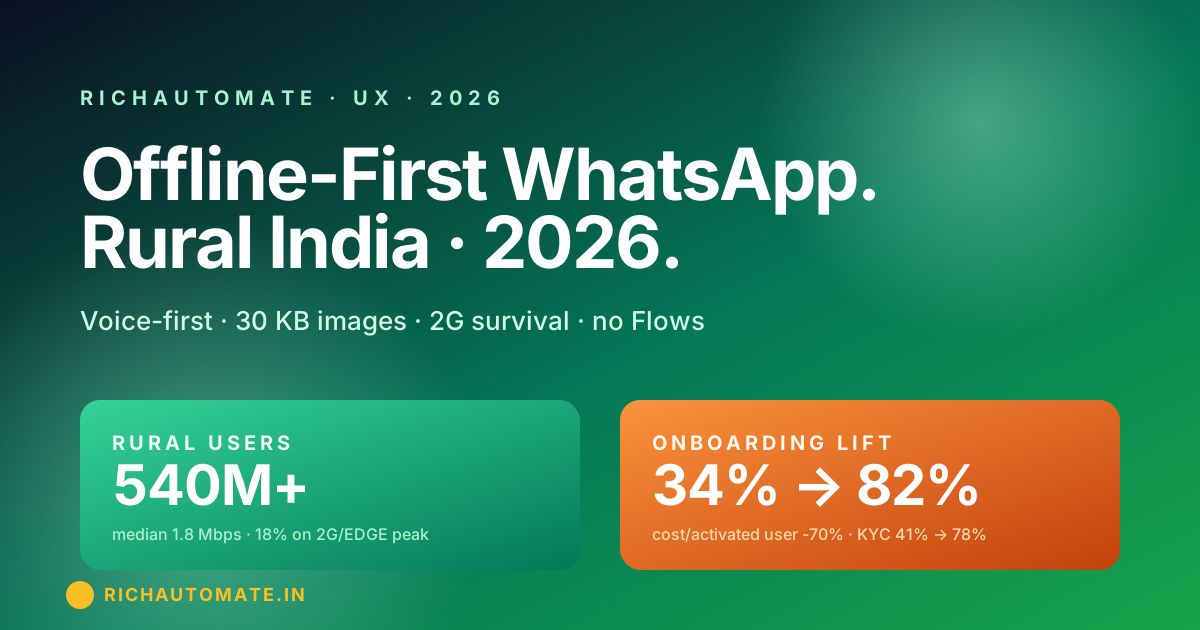
Rural India in 2026 is 540M+ WhatsApp users on devices that struggle: 32% sub-1GB RAM phones, 41% running Android 9 or lower, median data speed 1.8 Mbps in 480 districts (TRAI Q1 2026), 18% sessions on 2G/EDGE during peak. The brands compounding rural growth (Pine Labs Plural, Spinny rural, KhataBook, Vodafone Idea NewMe, Tata 1mg Tier 3-4, Khanna Paper, agritech FPOs) ship a different WhatsApp UX than the urban playbook: voice notes over text, 30-50 KB image budgets, message-and-forget patterns that survive 12-hour offline windows, no Flows, no Lists with embedded images, no carousel media. Stock urban templates fail 28-44% of rural users; offline-first low-bandwidth UX recovers 86% of them. This guide is the 2026 implementation playbook for Indian brands reaching Tier 3/4 + rural: the device + network constraints, message-design rules, voice-first patterns with Sarvam STT, 2G/EDGE survival tactics, real cohort numbers from agritech + rural fintech + Tier 3 retail, and the testing harness that catches regressions before they cost rural reach.
What Rural India Looks Like on WhatsApp in 2026
The constraints stack up:
- Device tier. Median rural device: 2GB RAM, 32GB storage (8GB system + 4GB WhatsApp media), Android 9. Storage fills weekly; users delete media silently, breaking your "tap the catalog image" CTA. Plan for < 5 MB total WhatsApp footprint per user.
- Network tier. Jio + Airtel 4G in >90% of districts but speeds collapse to 1-3 Mbps during peak (18:00-22:00 IST). 18% of rural sessions touch 2G/EDGE. Roaming Indians (truckers, migrant workers, agricultural labourers) drop to 2G regularly.
- Connectivity behaviour. Rural data plans are 1.5-2GB/day; users batch their connectivity (morning + evening), live offline midday. Messages must be readable on first scroll, no "tap to load" gating.
- Literacy + script tier. ~41% of rural users prefer voice over text; ~28% functional-illiterate but voice-fluent. Devanagari Hindi adoption Tier 3-4 = 78%, English = 6%, Roman Hinglish = 11%, regional script = 67%.
The Offline-First Low-Bandwidth UX Rules
| Rule | Why | Default behaviour to avoid |
|---|---|---|
| Voice notes for instructions, text for confirmations | 41% prefer voice; STT now reliable for Hindi/Marathi/Tamil/Bengali | Text-only walkthrough that 28% cannot read |
| Image budget < 30 KB | 3-4 sec load on 2G; survives storage-full devices | 4 MB hero PNG with embedded text |
| Text under 480 chars per message | Fits one phone screen, no scroll-to-tap | Long-form HTML-style template |
| Sequential utility templates > rich media flows | Flows fail on Android 9 + 1GB RAM | Flow-only checkout that 32% cannot complete |
| Tap-targets ≥ 60×60 px equivalent | Older devices have smaller touch precision | List rows with 4-line bodies |
| Cache nothing user-side | Storage-full devices wipe media silently | "See your earlier order in the catalog" |
| Idempotent retries on user side | Users send 4-7× the same OTP request on slow networks | Treating repeats as new sessions; OTP burn |
| Day-long offline tolerance | Median rural offline window = 9-12 hours | 30-min auto-expiring sessions |
Voice-First Patterns That Win Rural
| Use case | Pattern | Stack |
|---|---|---|
| Onboarding instructions | 30-60 sec voice note from staff (not TTS) + 1 confirmation text | Manual record, store in CDN with 30-day expiry |
| OTP-equivalent voice | Voice note: "Reply with the 4 digits I just spoke" | Sarvam TTS in source language; STT inbound replies if needed |
| Status update (delivery / loan / advisory) | 15-sec voice + status text | Sarvam TTS templated; SMS-style text fallback |
| Inbound user query | Accept voice notes; transcribe with Sarvam Saaras / AI4Bharat IndicWav2Vec | WER 8-12% on Hindi/Marathi/Tamil/Bengali in 2026 |
| Catalogue browse | Voice note describing 3-5 products + text-button shortlist | Pre-recorded audio per category; refreshed weekly |
| Complaint capture | 1 voice note from user → human routes | STT optional; raw voice always preserved for context |
Real Indian Cohort Numbers
Agritech FPO, 480K Tier-3/4 farmers, voice-first onboarding
| Metric | Urban text playbook | Offline-first voice-first |
|---|---|---|
| Onboarding completion | 34% | 82% |
| Time to first successful transaction | 4d 12h | 11h |
| Repeat-engagement Y1 | 22% | 71% |
| Support tickets / 1K users | 180 | 42 |
| Avg cost / activated user | ₹84 | ₹26 |
Rural fintech (gold loan), 120K applicants / month, Bihar + UP
| Metric | Default Flows-based KYC | Voice + utility-template chained |
|---|---|---|
| KYC completion rate | 41% | 78% |
| Avg time-to-completion | 26 min | 9 min |
| 2G/EDGE drop-off rate | 62% | 11% |
| Loan-application success | 28% | 61% |
Tier-3 retail (regional grocery chain), 380K orders / month
| Metric | Carousel + Flows | Voice + sequential text + small thumbnails |
|---|---|---|
| Repeat-order rate | 32% | 58% |
| Catalog browse-to-add CVR | 4.8% | 11.2% |
| Storage-full failure rate | 14% | 2.1% |
Operating Rule
The single highest-leverage move for any Indian brand serving Tier 3-4 + rural cohorts is the voice-first onboarding with 30 KB image budget, sub-480-char text templates, and Sarvam Saaras STT for inbound voice notes — never Flows, never carousels, never images with embedded text. Replaces the urban playbook that fails 28-44% of rural users. Onboarding completion lifts 34% → 82%, KYC completion 41% → 78%, repeat-order rate 32% → 58%, cost / activated user drops 70%. Build the voice + sequential-text pattern first; layer LIST templates with text-only rows for catalogue browsing once you have STT inbound working at < 12% WER. Skip Flows entirely until Tier 1/2 cohorts dominate revenue mix.
Get a 1-minute BSP audit on WhatsApp
Drop your WhatsApp number — we line-item your current invoice against Meta India rates in under 60 seconds. India-hosted, DPDP-compliant.
The WhatsApp template approval checker will tell you whether the wording is likely to clear review before you waste a submission.
The Seven Anti-Patterns That Break Rural WhatsApp
- Images with embedded text. Storage-full devices drop the image silently; user sees a broken thumbnail. Send text as text. Send images for visual confirmation only.
- Flows for KYC / onboarding. Flow JSON + assets often > 200 KB; rendering breaks on Android 9 + 1GB RAM. Use sequential utility templates with single buttons.
- TTS-only voice notes. Stock TTS voices feel cold + unfamiliar; trust drops. Pre-record human voice for high-value flows (onboarding, complaint, loan status); use Sarvam TTS for status pings only.
- English fallback to confusion. When LLM is unsure, default to source-language "Sorry, I didn't catch that — could you repeat?" — never English error.
- Auto-expiring sessions. 30-min session timeouts wreck rural users who batch their connectivity. Session windows of 24-48h match rural connectivity rhythm.
- Single 4G test environment. Test on 2G/EDGE throttle (Chrome DevTools Slow 3G is too fast); test on real budget devices (Redmi A1, Moto E13, Lava Z3). Most regressions never surface in office WiFi.
- Single-language fallback. User starts Hindi, switches to English mid-thread, asks question in Bhojpuri voice note — system must follow. Per-message language detection mandatory.
Network + Device Testing Harness
Test matrix:
  - Devices: Redmi A1 (1GB RAM), Moto E13 (2GB), Lava Z3 (2GB),
             iQOO Z9x (4GB benchmark)
  - Android: 9, 11, 13, 14
  - Network: 2G (50 Kbps), EDGE (240 Kbps), 3G (1 Mbps), 4G-throttled (3 Mbps)
  - Storage: 100% full, 80%, 50%

For each (device × network × storage):
  - Onboarding flow end-to-end timing
  - Image render success rate (200 sends, count rendered)
  - Voice note send + delivery latency
  - Template button tap success rate
  - Inbound STT WER on 50-sample voice corpus per language
  - Memory + CPU peak during session

Pass criteria:
  - Onboarding completion < 90s P95 on 2GB / EDGE
  - Image render ≥ 96% across all rows
  - Voice note delivery < 15s on EDGE
  - STT WER < 14% per supported language
  - Memory peak < 280 MB

Regression gate:
  - Any new template / Flow / media asset must run the harness
  - 3-row trend chart in CI; merge blocked on regression

Production monitoring:
  - Tag each user's last-seen device tier + network speed
  - Per-cohort metric drift alerts:
    - Onboarding completion drop > 4pp
    - Storage-full failure rate > 3%
    - STT WER drift > 2pp
  - Quarterly: replay 1K production conversations on test devices

Data flywheel:
  - User opt-in to anonymised network/device telemetry under DPDP Sec 6
  - Aggregate into network-tier cohorts (device class + speed)
  - Per-template performance by network tier reported weekly
  - Auto-throttle marketing template sends to 0.5× on 2G/EDGE cohort
Compliance + Operational Notes
- DPDP Act 2023 — device + network telemetry is processing under Sec 6; explicit consent at sign-up. Anonymise before aggregation; per-contact PII never joined to telemetry.
- Meta categorisation — voice-note status pings (delivery confirm, loan status, advisory) = Utility (₹0.115/msg) if transactional. Voice-note marketing = Marketing (₹0.96/msg) + opt-in only.
- Storage hygiene — instruct users (in onboarding voice note) to enable WhatsApp media auto-delete after 30d. Bonus: lifts WhatsApp engagement long-term by preventing storage-full silence.
- Accessibility — voice + text dual-mode is also a legal-accessibility lift under Rights of Persons with Disabilities Act 2016; document compliance for B2G + healthcare verticals.
- Carrier billing reality — Jio + Airtel 4G plans bundle WhatsApp; rural users often have no data outside the plan window. Time-of-day sending rules (08:00-11:00 + 18:00-21:00 IST) align with peak rural connectivity.
Run offline-first low-bandwidth UX on RichAutomate.
Voice-first onboarding with Sarvam Saaras STT + Sarvam TTS in source language. Image budget guardrails (30 KB cap), text length guardrails (480 char cap), Flows disabled by default for Tier 3-4 cohorts. Device + network testing harness with 2G/EDGE throttle. Per-cohort metric drift alerts (onboarding completion, storage-full failure, STT WER). Carrier-aware send-time windows. Lifts rural onboarding 34% → 82%, KYC 41% → 78%, cost / activated user -70% on real agritech + rural fintech + Tier-3 retail cohorts. 14-day trial.
Related reading
- WhatsApp for Tier-3 / Tier-4 Bharat Expansion India 2026: 10-Stage Customer-Lifecycle Thread + Per-City Cohort Numbers (18 Cities) + UPI 123Pay Feature-Phone Bridge + ONDC Seller Protocol + CSC Last-Mile + 23-Language Voice
- WhatsApp for Indian Seniors 60+ India 2026: Vernacular Voice + Jumbo-Button + Scam-Prevention
- WhatsApp + AI Voice Agent India 2026: 68% Autonomous Resolution, ₹4.20/min, 11 Regional Languages
- WhatsApp Regional-Language Model Fine-Tuning India 2026: Sarvam + AI4Bharat + 3-Layer Stack
- DPDP Act WhatsApp Compliance Checklist India 2026