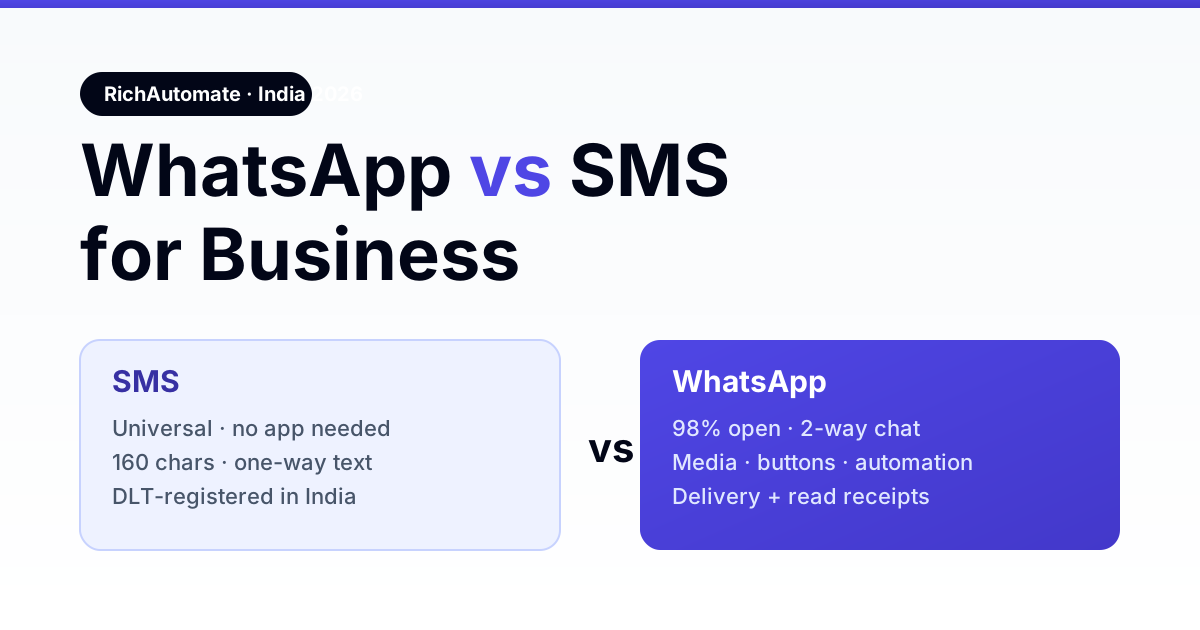
For Indian businesses in 2026, WhatsApp beats SMS for anything that needs engagement — it opens at ~98% versus SMS's ~20%, supports two-way chat, images, buttons and automation, and shows delivery plus read receipts. SMS still wins on exactly two things: it reaches every phone with no app required, and it is the reliable fallback for critical OTPs and alerts when a customer isn't on WhatsApp. The smart play is not either/or — use WhatsApp as your primary channel and keep SMS as the universal safety net.
Both are paid, regulated channels in India, but they were built for different jobs. This 2026 guide compares them on reach, cost, engagement, compliance and use-case fit, then gives you a clear rule for where each belongs.
WhatsApp vs SMS: the 30-second answer
| Factor | WhatsApp Business | SMS |
|---|---|---|
| Typical open rate | ~98% | ~15–20% |
| Direction | Two-way conversation | Mostly one-way |
| Rich media | Images, PDF, video, buttons, lists | Plain text (160 chars) |
| Delivery insight | Sent, delivered, read receipts | Delivered (carrier-dependent) |
| Reach | Only users with WhatsApp installed | Every mobile number |
| India compliance | Meta opt-in + approved templates | TRAI DLT registration |
| Automation | Full chatbots, flows, CRM sync | Blast only |
Reach: SMS is universal, WhatsApp is where attention lives
SMS's one unbeatable edge is that it works on every phone — feature phone or smartphone, app or no app. WhatsApp reaches only the ~500M+ Indians who have it installed, but that is exactly where they actually read messages. An SMS often sits unopened in a crowded inbox; a WhatsApp message lands in the same thread people check dozens of times a day. For any audience that is on WhatsApp, engagement is not close.
Cost in India: different meters
SMS is priced per segment (each 160-character part) through your DLT-registered route. WhatsApp uses Meta's conversation/per-message model — see our breakdown of Meta's WhatsApp per-message pricing. Transactional SMS looks cheap per unit, but WhatsApp's far higher open and response rates usually make the cost per outcome lower for marketing, support and re-engagement. For a promo blast to a cold, opted-in list, run the numbers on conversions, not send price. Our pricing page shows the effective India rates.
Get the India 2026 WhatsApp BSP price comparison
Wati vs AiSensy vs Interakt vs RichAutomate: Meta rates, platform fees and hidden costs, side by side. We send it to your WhatsApp in a minute.
OTP and alerts: where SMS still earns its keep
For login OTPs, payment confirmations and time-critical alerts, SMS remains the dependable fallback because it needs no app and no prior opt-in. That said, WhatsApp OTP authentication is now a cheaper, higher-delivery option for users who have WhatsApp — many Indian businesses send the OTP on WhatsApp first and fall back to SMS only if it isn't delivered. Best of both: reliability where you need it, cost savings everywhere else.
Engagement and conversion: WhatsApp is a conversation, SMS is a shout
SMS is one-directional — you push text, the customer can't easily reply into a workflow. WhatsApp is a live channel: buttons, quick replies, catalogs, and chatbots that qualify a lead or resolve a query without a human. That is why Click-to-WhatsApp ads outperform SMS-driven campaigns for lead capture — the click lands in a chat that can convert on the spot. If you're deciding how to reach WhatsApp at scale, see WhatsApp Business App vs API.
Compliance: both are regulated, differently
SMS in India runs on TRAI's DLT framework — registered sender IDs, templates and consent scrubbing. WhatsApp requires explicit customer opt-in and Meta-approved message templates for business-initiated conversations, with quality ratings that throttle senders who get blocked or reported. Neither is a free-for-all; plan opt-in for both.
The decision rule
- Use WhatsApp for marketing, order updates, support, re-engagement, lead qualification and anything conversational or media-rich — it's where engagement and conversion happen.
- Use SMS as the universal fallback: reaching non-WhatsApp users, and delivering critical OTPs/alerts when guaranteed reach matters more than richness.
- Best practice: WhatsApp-first with SMS fallback — send on WhatsApp, retry on SMS only if undelivered.
RichAutomate runs WhatsApp as your primary channel — approved templates, chatbots, shared team inbox and CRM sync — so you capture the engagement WhatsApp gives while keeping SMS for the edge cases it still owns.
Sending login or verification codes? Compare channels in WhatsApp OTP vs SMS OTP.
Weighing a free OTT alternative too? See our WhatsApp vs Telegram for business comparison for India.
For vendor-by-vendor SMS rate ranges, read the bulk SMS price India 2026 vs WhatsApp guide.