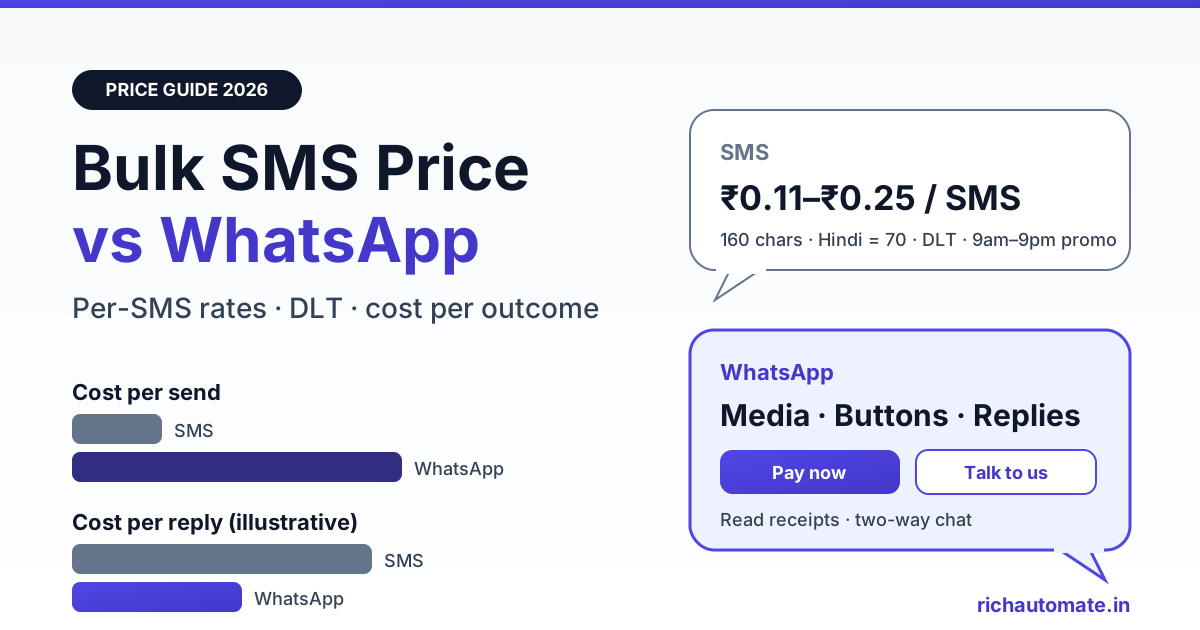
Bulk SMS in India typically costs between ₹0.11 and ₹0.25 per SMS on published 2026 rate cards, with the lowest rates reserved for very large prepaid volumes and 18% GST usually added on top. WhatsApp costs more per message, but it can work out cheaper per reply, click or sale, so the real question is cost per outcome, not cost per send.
This guide is for Indian business owners and marketers comparing SMS vendors such as MSG91, Gupshup and Fast2SMS, and wondering whether to move part of that budget to WhatsApp. We cover current per-SMS prices, DLT costs, the hidden charges that inflate an SMS bill, and a simple formula to decide which channel is cheaper for your use case.
Bulk SMS price in India: per-SMS rates by volume
SMS pricing in India is almost always prepaid and volume-tiered. The more credits you buy in one go, the lower the per-SMS rate. Two vendors publish clear self-serve rate cards, which makes them a useful benchmark.
| Volume (approx.) | MSG91 published rate | Fast2SMS published rate |
|---|---|---|
| Starter (5,000 SMS or recharge up to ₹3,999) | ₹0.25 per SMS | ₹0.25 per SMS |
| Small business (16,500–30,000 SMS) | ₹0.20 to ₹0.18 per SMS | ₹0.21 to ₹0.19 per SMS (₹4,000–₹13,999 recharge) |
| Growing (60,000–4.5 lakh SMS) | ₹0.17 per SMS | ₹0.17 to ₹0.15 per SMS (₹14,000–₹1,29,999 recharge) |
| High volume (around 10 lakh SMS) | ₹0.16 per SMS; custom deals "up to ₹0.13" | ₹0.13 per SMS (₹1.3 lakh–₹5,99,999 recharge) |
| Very high volume | Custom quote | ₹0.11 per SMS (₹6 lakh+ recharge) |
| GST | 18% GST added, per the pricing page | Not stated on the pricing page; confirm at checkout |
Rates above are from each vendor's public pricing page as of October 2026 and can change at any time. Confirm the current figure before you budget. MSG91 also offers custom deals for larger senders, so ask for a written quote once you cross a few lakh SMS a month.
Promotional vs transactional vs OTP pricing
Under TRAI's commercial communication framework (TCCCPR 2018), SMS falls into broad categories: promotional (offers and marketing), transactional (OTPs and alerts), and service messages, split into service-implicit (updates to existing customers) and service-explicit (sent with recorded consent).
Pricing by category varies by vendor. Fast2SMS states one rate for every type, whether promotional, transactional, service, OTP or API SMS. Other vendors price OTP and transactional routes separately, often at a premium because of priority delivery. Enterprise vendors usually quote per category, so ask for a written rate for each route you plan to use.
DLT registration: what you must register and what it costs
No commercial SMS reaches an Indian mobile number unless it passes DLT (Distributed Ledger Technology) scrubbing. Before your first campaign you need three registrations on a telecom operator's DLT portal, such as Jio, Airtel, Vodafone Idea or BSNL:
- Entity registration: your business, verified with documents such as PAN, GST certificate or incorporation papers.
- Header (sender ID) registration: the 6-character name that appears as the sender, for example your brand name.
- Template registration: every message format you will send, with variable fields marked, tagged to a category and a consent type where needed.
Cost: entity registration fees of around ₹5,900 (₹5,000 plus GST) are commonly quoted for some operator portals, while some vendors report that certain portals have charged nothing. Renewal terms also differ by portal. Treat ₹0 to ₹5,900 as the realistic range and confirm on the portal you pick. Registration on one operator's DLT platform is generally recognised across the others, so you should not need to pay four times.
The bigger cost is time. Template approvals, header disputes and document rework can delay a launch by days. If you are also starting on WhatsApp, note that WhatsApp templates are approved by Meta, not through the SMS DLT process; we explain this in whether WhatsApp Business API needs DLT registration.
Hidden costs that inflate your SMS bill
The headline per-SMS rate is rarely what you actually pay per message delivered. Five factors push the real number up.
1. DLT scrubbing failures
If your message text does not match a registered template exactly, or the header and template are not linked correctly, the SMS is rejected at scrubbing. Depending on your vendor's terms, you may still lose the credit. A single extra space or changed word in a fixed portion of the template is enough to fail.
2. 160-character segments
One standard SMS carries 160 characters in the GSM-7 character set. Go even one character over and the message splits into segments of 153 characters each, and you are billed for every segment. A 300-character offer message costs two SMS, not one.
3. Hindi and Unicode cost up to 2.3x more
Hindi, Tamil, Bengali and other Indian scripts, plus emojis, force Unicode encoding. A Unicode SMS fits only 70 characters, or 67 per segment when split. A 200-character Hindi message becomes three billable segments. For regional-language campaigns, your real per-message cost can be two to three times the rate card.
4. Delivery-rate gaps
You pay for SMS submitted, but not every SMS is delivered. Switched-off phones, invalid numbers, operator filtering and DND blocks all reduce delivery. Vendors differ on whether failed messages are refunded. Always compare cost per delivered SMS using your vendor's delivery reports, not cost per credit.
5. DND and the 9am–9pm promotional window
Promotional SMS cannot be sent to numbers registered on the Do Not Disturb preference list unless the customer has given consent for that category, and it can only be sent between 9 AM and 9 PM IST. A flash sale planned for 10 PM simply cannot go out by SMS. On a typical Indian list, a meaningful share of numbers may be on DND, which shrinks your reachable audience before you spend a rupee. Our guide to TRAI TCCCPR and DLT rules for WhatsApp and SMS explains how these rules apply to each channel.
Bulk SMS vendor landscape in India
India has dozens of SMS providers. They fall into two groups: self-serve vendors with published prepaid rates, and enterprise CPaaS vendors that quote on request.
| Vendor | Pricing model | Typically suits |
|---|---|---|
| MSG91 | Published volume tiers (₹0.25 to ₹0.16 per SMS, plus GST); custom deals for scale | Startups and SaaS needing OTP and transactional SMS via API |
| Fast2SMS | Published recharge tiers (₹0.25 to ₹0.11 per SMS), one rate for all SMS types | SMBs and small teams wanting simple prepaid bulk SMS |
| Gupshup | Quote-based for SMS; get a written rate per route | Larger brands running SMS alongside conversational messaging |
| Textlocal | Prepaid credit packs; check the current rate card | Small businesses sending occasional campaigns |
| Kaleyra | Enterprise, quote-based | Banks, fintech and large enterprises with high OTP volume |
| Exotel | Bundled with calling and contact-centre products; quote-based | Businesses that already use Exotel for voice |
Published rates for quote-based vendors are not available, so we have not listed numbers for them. Third-party blogs quote figures for these providers, but the only reliable number is a written quote from the vendor itself. For more on one of the biggest names, read our Gupshup pricing breakdown for India.
Get a 1-minute BSP audit on WhatsApp
Drop your WhatsApp number — we line-item your current invoice against Meta India rates in under 60 seconds. India-hosted, DPDP-compliant.
Cost per outcome: SMS vs WhatsApp
Per send, SMS is cheaper. That is not in doubt. Meta's per-message WhatsApp rates in India for marketing messages are meaningfully higher than a bulk SMS, and you should check Meta's current rate card for India before you plan a budget. On RichAutomate, SaaS Pay costs ₹1.50 per marketing message and ₹0.50 per utility message, all-in. On Client Pay, you pay Meta's rate directly plus a ₹0.10 per message platform fee.
But nobody sends messages for the sake of sending them. You want a reply, a click, a payment, a booked appointment. That is where the comparison changes.
The breakeven formula
Divide the WhatsApp price per message by the effective SMS price per message (including GST and extra segments). The result is the breakeven multiple. WhatsApp is cheaper per outcome only if its response rate is higher than SMS by at least that multiple.
| Scenario | SMS effective cost | WhatsApp cost (RichAutomate SaaS Pay) | Breakeven multiple |
|---|---|---|---|
| English promo, 1 segment, ₹0.17 + 18% GST | ≈ ₹0.20 | ₹1.50 marketing | WhatsApp must convert about 7.5x better |
| Hindi promo, 3 Unicode segments at ₹0.20 each | ≈ ₹0.60 | ₹1.50 marketing | WhatsApp must convert about 2.5x better |
| English order update, 1 segment | ≈ ₹0.20 | ₹0.50 utility | WhatsApp must perform about 2.5x better |
| Hindi payment reminder, 2 Unicode segments | ≈ ₹0.40 | ₹0.50 utility | WhatsApp must perform about 1.25x better |
These are worked examples using the published rates above, not benchmarks. Plug in your own vendor rate, segment count and measured response rates. Two patterns stand out:
- Regional-language messaging narrows the gap sharply. Unicode segment billing can make SMS cost two to three times its rate card, while a WhatsApp message is priced per message regardless of length or script.
- Utility messages are the easiest win. At ₹0.50 all-in, a WhatsApp order or payment update needs only a modest improvement in response (for example, more customers tapping "Pay now") to beat SMS per outcome.
To measure response honestly, run an A/B split on the same audience: half by SMS with a tracked link, half by WhatsApp with a tracked button. Compare cost per click or cost per payment after seven days. Our longer analysis of WhatsApp Business API vs SMS cost in India walks through more scenarios.
When SMS still wins
SMS is not going away, and it should not. It remains the better tool in a few clear cases.
- OTP fallback. If a WhatsApp OTP fails, or the user is not on WhatsApp, an SMS fallback keeps login and checkout working.
- Feature-phone and non-smartphone users. In parts of rural India and among older customers, SMS reaches people WhatsApp cannot.
- Very short, critical alerts. A one-line English alert under 160 characters, where you need reach and do not expect a reply, is cheapest on SMS.
- No-opt-in transactional needs. Some transactional and service messages can be sent by SMS under the relevant DLT category, whereas WhatsApp requires the customer's opt-in for business-initiated messages.
When WhatsApp wins
WhatsApp earns its higher per-message price when the message needs to do more than inform.
- Rich media: product images, PDF invoices, catalogues and short videos in the message itself.
- Buttons: quick replies and call-to-action buttons such as "Confirm order", "Pay now" or "Book slot" that customers tap instead of typing.
- Two-way conversation: customers reply in the same thread, and a shared team inbox lets your staff answer.
- Read receipts and delivery status: you see delivered and read events, not just "submitted".
- Automation: chatbot flows and WhatsApp Flows (native in-chat forms) for lead capture, bookings and surveys.
Account health on WhatsApp depends on opt-in quality, template content and how customers react. No provider can promise a number will never be restricted, so send only to customers who opted in. Treat SMS as the fallback for customers who have not opted in to WhatsApp.
Decision checklist: SMS, WhatsApp or both?
Run through these questions before you renew an SMS pack or sign a WhatsApp plan.
- What is your real SMS cost per delivered message? Include GST, extra segments, Unicode and failed deliveries, not just the rate card.
- What language do you message in? If most messages are in Hindi or a regional script, recalculate with 70-character segments.
- What outcome do you need? If it is a reply, payment or booking, measure cost per outcome, not cost per send.
- Do your customers use WhatsApp? If a large share are on feature phones, keep SMS as the primary channel for them.
- Do you have opt-in for WhatsApp? Collect it at checkout, signup or via click-to-WhatsApp ads before moving campaigns.
- Is timing critical? If you send promotions late at night or around the clock, the SMS promotional window will block you.
- Do you need SMS for OTP fallback? Keep your DLT entity, header and OTP template active even if WhatsApp becomes primary.
- Have you tested both? Run a one-week A/B split on the same segment and let the cost-per-outcome number decide.
Most Indian businesses end up with a hybrid: WhatsApp for marketing, order updates, reminders and support, and SMS for OTP fallback and non-WhatsApp users.
Running the WhatsApp side with RichAutomate
RichAutomate runs on the official Meta Cloud API and is built for Indian businesses moving messaging from SMS to WhatsApp.
- ₹0 setup and ₹0 monthly on pay-as-you-go.
- Client Pay: Meta's per-message rate, paid directly to Meta, plus a ₹0.10 per message platform fee.
- SaaS Pay: ₹1.50 per marketing message and ₹0.50 per utility message, all-in.
- Plans: Starter ₹499/month, Pro ₹899/month, White-label ₹1,199/month for agencies.
- Compliance: GST registration is required to take a WhatsApp number live.
Compare the full rate card on RichAutomate pricing and plug those numbers into the breakeven formula above.
The fastest way to know whether WhatsApp beats SMS for your business is to test it on a real segment. Start the 14-day free trial with 100 credits, send one campaign by WhatsApp alongside your usual SMS, and compare cost per reply after a week.