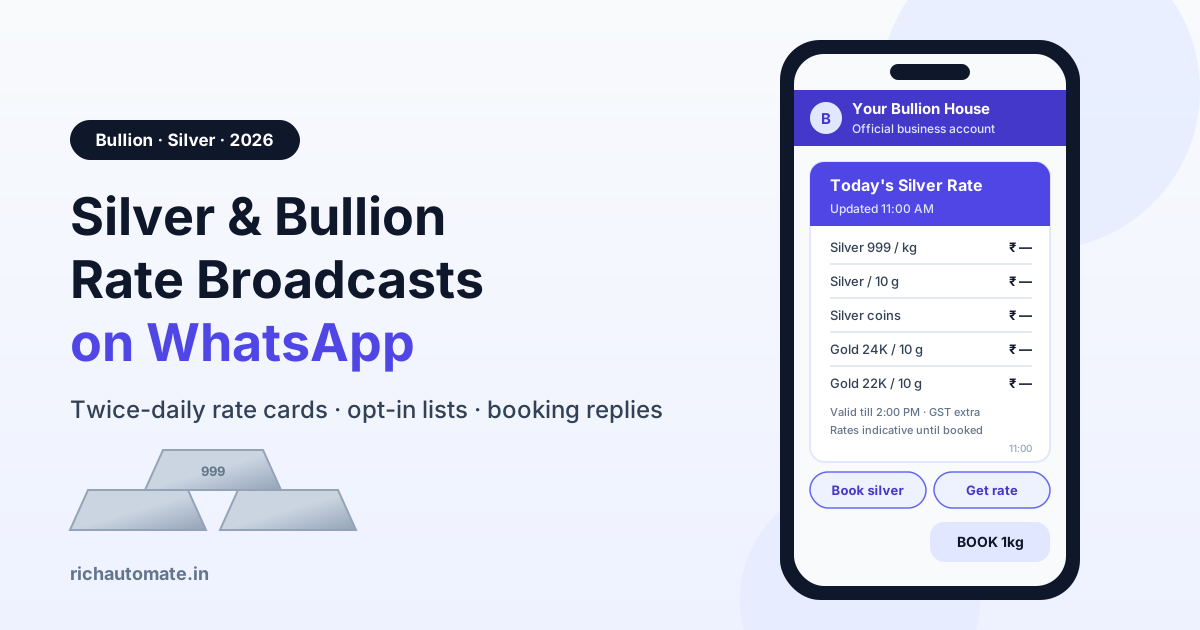
A WhatsApp silver rate broadcast lets a bullion dealer, silver wholesaler or jeweller send the day's silver and bullion rates to an opt-in customer list through the official WhatsApp Business API, usually once or twice a day. Done properly, it replaces noisy WhatsApp groups and SMS blasts with a branded rate card, measurable read rates and a reply-to-book flow that turns rate updates into confirmed orders.
Gold rate broadcasts get most of the attention, and we have covered that use case in our guide to WhatsApp gold rate broadcasts for jewellers. Silver is a different business. Silver buyers are more price-sensitive, trade in larger weights, and include a big B2B layer of karigars, utensil makers and wholesalers who check rates several times a day. This guide covers how to build a silver and bullion rate broadcast that suits that audience in 2026.
What is a silver and bullion rate broadcast?
A rate broadcast is a scheduled, templated WhatsApp message that tells subscribers the current buying or selling rate for a metal, the time it was set, and how long it is valid. For a bullion dealer, one message typically carries silver 999 per kg, silver per 10 grams, silver coins, and often gold 24K and 22K for reference.
Three things separate a professional rate broadcast from a forwarded screenshot:
- It goes only to people who opted in. Every recipient asked to receive your rates.
- It uses an approved Meta template. The layout is fixed, the numbers change through variables.
- It is measurable. You see how many messages were delivered, read and replied to.
Silver moves faster in percentage terms than gold on most days, so stale rates cost silver dealers more. A clear "valid till" time on every card is not decoration. It protects your margin.
Why WhatsApp API beats SMS and WhatsApp groups for rate cards
Most Indian bullion shops started with a WhatsApp group or a broadcast list on a personal number. Both hit limits quickly.
WhatsApp groups have a member cap, show every member's number to everyone else, and give you no data on who actually saw the rate. Competitors can sit in your group and copy your rates.
Personal-number broadcasts carry a different risk. Sending the same message to hundreds of contacts from a regular WhatsApp or WhatsApp Business app is the pattern that gets numbers restricted, especially when recipients have not saved your number or report the message. Losing the number your customers know is a serious setback for a rate-driven business.
SMS reaches everyone but looks like spam, cannot carry a rate card image, and gives customers no easy way to reply and book.
| Channel | Reach and limits | Analytics | Replies and booking | Main risk |
|---|---|---|---|---|
| WhatsApp group | Capped members, numbers exposed | None | Messy, public | Competitors copying rates, privacy |
| Personal-number broadcast | Only contacts who saved you | Basic ticks only | Manual, one by one | Number restriction on bulk sends |
| SMS blast | Wide, but plain text | Delivery only | Rarely used | Ignored as promotional |
| WhatsApp Business API broadcast | Opt-in list, no member cap per template send (subject to Meta messaging limits) | Sent, delivered, read, replied | Private chat, bot or agent | Quality rating drops if users block or report |
The API is not a free pass. Meta tracks your quality rating, and if many recipients block or report your messages, your messaging limits can shrink. No provider can promise you will never be restricted. What the API gives you is a compliant route with opt-in lists, approved templates and the data to keep quality high.
Rate cadence: twice daily, tied to IBJA and MCX movements
Most Indian bullion dealers anchor their day to two reference points: the IBJA benchmark rates published in the morning and afternoon sessions, and live MCX silver futures that move through the trading day. A practical broadcast cadence follows the same rhythm.
- Morning rate card: sent shortly after the morning IBJA rate and your own premium or discount are set. This is the card most retail buyers and karigars use to plan purchases.
- Afternoon rate card: sent after the afternoon reference rate, or when MCX silver has moved enough that your morning rate no longer holds.
- Volatility alert (optional): on sharp-move days, a short update to B2B buyers only, rather than the whole list.
Twice daily is the common upper limit. Sending every hour trains customers to mute you, and each message costs money. A good rule: broadcast when the rate changes enough to affect a buying decision, not every time the screen flickers.
Always state the rate basis in the card. Say whether the rate is per kg or per 10 grams, whether GST is extra, and the time the rate was set. Customers comparing your card with another dealer's need to compare like with like.
Designing the silver rate template
On the WhatsApp Business API, every business-initiated message uses a template that Meta approves once. After approval you send it many times, changing only the variables. For a silver and bullion dealer, a strong template has four parts.
1. Image header
Use a branded rate card image: your logo, shop name, and the date. The image is what customers screenshot and forward, so keep it clean and readable on a small phone screen.
2. Body with variables
The body carries the actual rates as variables, so the same approved template works every day. A typical silver body might include:
| Variable | Example label in template | Notes |
|---|---|---|
| {{1}} | Silver 999 per kg | Main B2B and investor reference |
| {{2}} | Silver per 10 g | Retail jewellery and utensil buyers |
| {{3}} | Silver coins (10 g / 50 g) | Gifting and festival demand |
| {{4}} | Gold 24K per 10 g | Reference for mixed-metal buyers |
| {{5}} | Gold 22K per 10 g | Jewellery reference |
| {{6}} | Valid till (time) | Essential for rate protection |
Add a fixed line such as "Making charges and GST extra as applicable" so the template does not need a variable for it.
3. Footer and buttons
Use the footer for a short disclaimer ("Rates indicative, subject to confirmation at booking"). Add quick-reply buttons like "Book silver", "Get latest rate" and "Talk to us". Buttons make replies one tap, and replies open a free service conversation window.
4. Language
Many silver buyers prefer Hindi, Gujarati, Marathi or Tamil. Meta lets you submit the same template in multiple languages. Segment your list by language and send each group its own version.
Template category: rate broadcasts are marketing
This is where many dealers get confused. Under Meta's template rules, a daily price or rate broadcast is a marketing template. It is sent to many people at once and it encourages purchases, so Meta treats it as promotional even though it feels informational.
Utility templates are for a specific customer's own transaction: a booking confirmation, an order dispatch update, a payment receipt, or a pickup reminder for an order they already placed. If you submit a rate card as utility, Meta will usually reclassify it as marketing, and repeated miscategorisation can affect your account.
The practical split for a bullion business:
- Marketing: daily silver rate card, festival coin offers, new collection announcements.
- Utility: "Your booking of silver bars is confirmed at the locked rate, valid till delivery", invoice ready, order ready for pickup.
- Service (free): any reply you send within 24 hours of the customer messaging you.
If you also sell hallmarked silver or gold jewellery, the same split applies to HUID and certification messages. Our guide on sharing hallmarking and HUID details on WhatsApp covers which of those messages count as utility.
Collecting opt-ins and segmenting your list
An opt-in is a customer's explicit, recorded agreement to receive your rate messages on WhatsApp. Meta requires it, and your quality rating depends on it. People who asked for your rates rarely block you.
Good opt-in sources for silver and bullion dealers:
- Counter QR code: a stand at the billing counter saying "Scan to get daily silver rates on WhatsApp". The customer sends a pre-filled message such as "RATES ON", which is a clear opt-in.
- Click-to-WhatsApp ads: Facebook or Instagram ads that open a chat. Ask in the first reply whether they want daily rates, and record the yes.
- Website or Google Business Profile button: a "Get daily rates" link that opens WhatsApp with a pre-filled opt-in message.
- Invoice and packaging: a printed line inviting customers to subscribe.
A missed call is not an opt-in by itself. If you run a missed-call number, follow it with a clear question ("Reply YES to receive daily silver rates on WhatsApp") and only add the number after a yes. Old customer lists, purchased databases and numbers collected for other purposes should not go straight into a rate broadcast. Opt-in must be explicit, and an easy "STOP" reply should remove anyone instantly.
Get a 1-minute BSP audit on WhatsApp
Drop your WhatsApp number — we line-item your current invoice against Meta India rates in under 60 seconds. India-hosted, DPDP-compliant.
Segmenting retail, B2B and investor lists
One list for everyone wastes money and annoys people. Silver audiences split naturally into three groups.
- Retail buyers: jewellery, pooja items, gifting. They care about per 10 g rates and coins, and usually buy around festivals and weddings. One rate card a day is plenty.
- B2B karigars, utensil makers and wholesalers: they buy by the kg and watch every move. They justify twice-daily cards and volatility alerts.
- Investors in coins and bars: they want silver 999 per kg, coin and bar rates, and buy-back rates. A daily or weekly digest suits them better than intraday noise.
Tag each contact at opt-in time with a simple question ("Are you buying for jewellery, business or investment?"). The tag decides which template, which language and which frequency they get. Dealers who also run gold savings or SIP-style schemes can reuse the same tags; see our guide to running gold savings scheme reminders on WhatsApp.
From rate card to booking: reply flow and compliance
A rate broadcast earns its cost when people reply. The simplest booking flow works like this:
- The customer reads the morning card and replies "BOOK 1kg" or taps the "Book silver" button.
- A chatbot recognises the keyword, asks for quantity, product (bar, granules, coins) and pickup or delivery.
- For B2B buyers, the bot hands over to a staff member who confirms the rate and any advance or margin requirement.
- Once confirmed, you send a utility booking confirmation template with the locked rate, quantity, valid-till time and booking reference.
Everything between the customer's first reply and your confirmation sits inside the 24-hour customer service window. Per Meta, replies you send in that window are free. That is why reply buttons matter: every customer who replies gives you a free conversation window for questions, negotiation and follow-up.
A cost-saving pattern many dealers use: send one broadcast a day, and set up a "RATE" keyword. Any subscriber who messages "RATE" during the day gets your latest rate instantly from the bot, inside the free service window. Heavy B2B users get live rates on demand, and you avoid paying for a second broadcast to people who did not need it.
Rate-lock disclaimers and compliance
Bullion messages touch money, so wording matters:
- Mark rates as indicative until confirmed at booking, with a valid-till time.
- State the rate-lock terms clearly: how long a booked rate is held, any advance required, and what happens if the customer does not complete the purchase.
- Avoid investment promises. Never write "guaranteed returns", "silver will double" or "risk-free". Rate cards inform; they do not advise.
- Mention tax generically: "GST extra as applicable; GST invoice provided." Do not quote tax amounts you have not calculated for that customer.
- Honour opt-outs the same day. Keep a record of when and how each contact opted in.
What a silver rate broadcast costs in 2026
RichAutomate charges ₹0 setup and ₹0 monthly fee. You choose one of two message billing modes:
- Client Pay: Meta's rate plus ₹0.10 per message. In India that works out to about ₹0.96 per marketing message and about ₹0.215 per utility message.
- SaaS Pay: a flat ₹1.50 per marketing message and ₹0.50 per utility message.
Customer-initiated service replies within the 24-hour window are free per Meta. Prices exclude GST. Here is what a 500-subscriber list costs per month across three cadences, assuming 26 working days and about 4 weekly digests.
| Cadence (500 subscribers) | Marketing messages per month | Client Pay (about ₹0.96 each) | SaaS Pay (₹1.50 each) |
|---|---|---|---|
| Twice daily × 26 days | 26,000 | ≈ ₹24,960 | ₹39,000 |
| Once daily × 26 days | 13,000 | ≈ ₹12,480 | ₹19,500 |
| Weekly digest × 4 weeks | 2,000 | ≈ ₹1,920 | ₹3,000 |
Booking confirmations add a small amount. For example, 200 utility confirmations in a month cost about ₹43 on Client Pay or ₹100 on SaaS Pay. Replies to "RATE" requests and booking chats inside the service window cost nothing.
The cheapest effective setup for most dealers is a mix: twice-daily cards only for the B2B segment, once daily for retail, a weekly digest for investors, and the "RATE" keyword for anyone who wants an update in between. Full plan details are on our pricing page.
You can test the whole flow on a 14-day free trial with 100 credits. The trial works without a GST number, but a GST number is required to go live on the WhatsApp Business API.
Measuring delivery, reads and replies
Every API broadcast reports four numbers per message: sent, delivered, read and replied. Track them by segment and by time of day.
- Delivery rate tells you how clean your list is. Falling delivery usually means old or invalid numbers.
- Read rate tells you whether the timing and header image work. Compare the morning and afternoon card.
- Reply rate is the number that matters. Replies are booking intent, and each one opens a free service window.
- Opt-out and block signals warn you that frequency is too high for a segment. Cut that segment to once daily before Meta's quality rating does it for you.
Most dealers find that a smaller, well-segmented list with a strong reply rate beats a large list that mostly ignores the card.
If you are still choosing a platform, compare features like template scheduling, keyword bots, segmentation tags and agent inbox in our roundup of the best WhatsApp Business API for jewellers in India. For the gold side of the same counter, the gold rate broadcast playbook uses the same opt-in and template rules, so one setup can serve both metals.
Frequently asked questions
How do bullion dealers send daily silver rates on WhatsApp?
Bullion dealers use the official WhatsApp Business API to send an approved rate card template to an opt-in subscriber list. The template has a branded image header and variables for silver 999 per kg, silver per 10 g, coins, gold 24K and 22K, and a valid-till time. The dealer updates the variables each morning and afternoon and the platform sends the card to the whole list at once.
Is a daily silver rate broadcast a marketing or utility template?
A daily silver or bullion rate broadcast is a marketing template under Meta rules, because it goes to many people and encourages purchases. Utility templates are only for a specific customer's own transaction, such as a booking confirmation with a locked rate, an invoice notice or an order pickup reminder. Submitting rate cards as utility usually leads Meta to reclassify them as marketing.
How much does a WhatsApp silver rate broadcast cost in India?
RichAutomate has zero setup and zero monthly fee. On Client Pay a marketing message costs about ₹0.96 and a utility message about ₹0.215. On SaaS Pay it is a flat ₹1.50 per marketing and ₹0.50 per utility message. For 500 subscribers, once daily for 26 days, that is 13,000 messages, about ₹12,480 on Client Pay or ₹19,500 on SaaS Pay, excluding GST.
How can silver dealers reduce WhatsApp broadcast costs?
Send one rate broadcast a day instead of two, and set up a RATE keyword so any subscriber can message RATE to get your latest rate from the chatbot. Replies sent within the 24-hour customer service window are free per Meta, so on-demand rate requests and booking chats cost nothing. Keep twice-daily cards only for the B2B segment that genuinely needs intraday updates.
What counts as a valid opt-in for WhatsApp rate broadcasts?
An opt-in is the customer's explicit, recorded agreement to receive your rate messages on WhatsApp. Good sources are a counter QR code with a pre-filled message, a click-to-WhatsApp ad where the customer says yes, or a website button. A missed call alone is not an opt-in. Follow it with a clear question and add the number only after the customer replies yes.
Send your daily silver and bullion rate card on WhatsApp. Get your rate template approved, broadcast to opted-in buyers and take bookings in one shared inbox. Start a free 14-day trial with 100 credits.