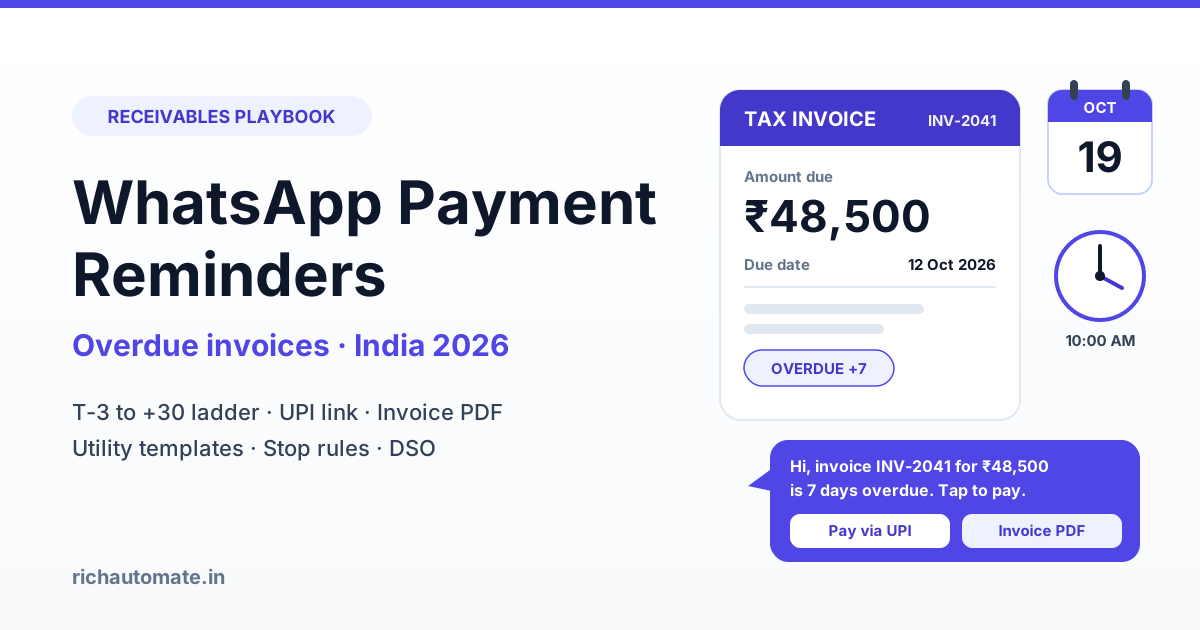
To send WhatsApp payment reminders for overdue invoices, use approved utility templates on a fixed ladder (three days before the due date, on the due date, then 3, 7, 15 and 30 days after it) and put the amount, invoice PDF and a UPI payment link in every message. Escalate tone from friendly to firm without threats, stop the sequence the moment a payment is recorded, and track days sales outstanding (DSO) to prove it works.
For Indian SMBs and B2B suppliers, late receivables decide whether a month ends comfortably or in a cash crunch. Email reminders sit unread in shared accounts inboxes, SMS gets buried under OTPs, and phone calls eat an accountant's whole afternoon. WhatsApp is where the owner or accounts person actually reads messages. This guide covers cadence, wording, template category, costs, partial payments, stop rules, legal cautions and the metrics that show whether your dunning process works.
Key takeaways
- Run a six-step ladder (T-3, due day, +3, +7, +15, +30) during business hours, one message per stage.
- Send reminders as utility templates with the invoice PDF and a payment button; offers or promotions can push them into marketing.
- Pause for promises to pay, route disputes to a person, and cancel queued reminders the moment payment is recorded.
- Stay courteous and factual, and measure DSO, collection rate and payments by ladder stage.
The payment reminder cadence ladder: T-3 to +30
A reminder ladder works because it is predictable. The customer knows what is coming, and your accounts team stops deciding case by case whom to chase. Count every step from the due date on the invoice, not the invoice date.
| Stage | Timing | Tone | What the message does |
|---|---|---|---|
| T-3 | 3 days before the due date | Friendly heads-up | Invoice number, amount, due date and pay button |
| Due day | On the due date | Friendly and clear | Amount due today, invoice PDF and pay button |
| +3 | 3 days overdue | Polite check-in | Asks whether anything is blocking payment |
| +7 | 7 days overdue | Firm and factual | Asks for a committed payment date |
| +15 | 15 days overdue | Formal | States your terms and the next step, such as holding new orders |
| +30 | 30 days overdue | Final reminder | Attaches the statement of account and hands over to a person |
Adapt the ladder to your terms and ticket size. On 30- or 45-day credit, it still starts three days before the due date. For high-value invoices, add a call from your accounts team at +7 instead of waiting for +30; for small retail dues, stop automation at +15. Send one message per stage, between roughly 10 am and 6 pm on working days, and skip Sundays and bank holidays.
Most late payers are not refusing to pay. The invoice is stuck in approval, a PO number is missing, or the payment run happens only on fixed dates. The early stages exist to surface those problems while the relationship is still warm.
Tone escalation: friendly to firm, never threatening
Each stage should sound a little more serious than the last, but firm means specific, not aggressive. A firm message states the amount, the days overdue and a consequence your terms allow and you actually intend to apply, such as holding new dispatches. Sample wording, with template variables in double braces:
- T-3: Hi {{1}}, a quick reminder that invoice {{2}} for ₹{{3}} is due on {{4}}. You can pay using the button below. Thank you.
- Due day: Hi {{1}}, invoice {{2}} for ₹{{3}} is due today. The invoice is attached and the button below opens the payment page.
- +3: Hi {{1}}, invoice {{2}} for ₹{{3}} is still open in our records. If you have already paid, please reply with the UTR so we can match it.
- +7: Hi {{1}}, invoice {{2}} for ₹{{3}} is now 7 days overdue. Please reply with the date you expect to release payment, or tap Talk to accounts.
- +15: Dear {{1}}, invoice {{2}} for ₹{{3}} is 15 days past the agreed terms. As per our terms of supply, new orders may be held until the account is cleared.
- +30: Dear {{1}}, this is a final reminder for invoice {{2}} for ₹{{3}}, now 30 days overdue. Our accounts team will call you, and your statement of account is attached.
Create each language version, such as Hindi, Gujarati or Tamil, as its own approved template, and address the person your customer has named for payments. A consistent sender name and signature make the reminder instantly recognisable as yours.
What every reminder should contain: invoice PDF, amount and UPI link
Every extra step between reading a reminder and paying costs you days. The best reminders let the customer check the invoice and pay in under a minute from the same chat.
- Invoice PDF as the document header. The customer can forward it to their accounts person without asking you for a copy.
- A short body with the facts. Invoice number, amount, due date and, from +3 onwards, the number of days overdue.
- A dynamic URL button to a payment page. Link to a hosted page from your payment gateway that accepts UPI, cards and net banking, with the invoice reference pre-filled. Template buttons generally expect a web address, so a raw UPI deep link may not work as a button; check Meta's current rules before you build.
- A UPI QR code where it fits. A template has only one header, so if the PDF is the header, put the UPI QR code on the payment page or print it on the invoice itself.
- Quick reply buttons. Paid already, Pay on a date and Talk to accounts. Each tap opens the 24-hour customer service window and tells you what to do next.
- Bank details for large invoices. B2B buyers often pay by NEFT or RTGS, so ask them to reply with the UTR.
For customers who pay the same amount every month, a mandate beats a reminder. See our guide to UPI AutoPay mandate reminders on WhatsApp for pre-debit notices and failed-mandate follow-ups.
Utility or marketing? Keep reminders in the right category
A reminder about an invoice the customer already owes normally belongs in Meta's utility category, because it concerns a specific existing transaction. Marketing covers offers, new products and anything meant to drive new sales. The difference matters: marketing templates cost more, and Meta limits how many marketing messages a person receives, so a reclassified reminder can cost more and still fail to deliver.
Meta reviews the whole template, mixed content usually lands in marketing, and an approved template can be re-categorised later if its wording drifts.
| Reminder wording | Likely category | Why |
|---|---|---|
| Invoice INV-2041 for ₹48,500 is due on 12 October. Pay using the button below. | Utility | A specific transaction, no promotion |
| Invoice INV-2041 is 7 days overdue. Please reply with your payment date. | Utility | Status of an existing account |
| Your statement of account for September is attached. | Utility | An account update the customer expects |
| Pay today and get 5% off your next order. | Marketing | Incentive tied to a future purchase |
| Invoice due today. Also, see our new festive collection. | Marketing risk | A reminder mixed with a promotion |
| Clear your dues to unlock our special dealer scheme. | Marketing risk | A promotional offer attached to payment |
If your terms include an early-payment cash discount, state it only as a factual term of that invoice, or leave it out. Our guide to WhatsApp marketing vs utility message categories explains where Meta draws the line.
Get a 1-minute BSP audit on WhatsApp
Drop your WhatsApp number — we line-item your current invoice against Meta India rates in under 60 seconds. India-hosted, DPDP-compliant.
The 24-hour window and what reminders cost
A reminder you start is a business-initiated message, so outside an open 24-hour customer service window it must be an approved template, charged by Meta per delivered message according to its category. When the customer replies, for example to ask for a ledger copy, the window opens and your free-form replies inside it carry no Meta charge. Under Meta's current pricing, utility templates delivered inside an open window are also not charged; check Meta's latest rate card, because these rules change.
So the economics are simple: a full ladder is at most six utility messages per invoice, and most invoices close at the first or second step.
| Channel | Main cost driver | Invoice PDF and pay link | India notes |
|---|---|---|---|
| WhatsApp utility template | Per delivered template: Meta charge plus platform fee | Yes: PDF header, URL button and two-way replies | Needs opt-in and approved templates |
| SMS | Per SMS through your vendor | Link only, no attachment | Sender header and template must be registered on DLT under TRAI rules |
| Very low per message | Yes, but replies are slow | Often lands in a shared inbox or spam folder | |
| Phone call | Staff time per call | No, needs a follow-up message | Intrusive if repeated; keep to business hours |
On RichAutomate, pricing is usage-only with ₹0 setup and ₹0 monthly fee. SaaS Pay charges ₹0.30 per utility message all-in, so a full six-step ladder costs at most ₹1.80 per invoice, while a marketing message costs ₹1.20. Client Pay charges a ₹0.10 platform fee per message, and Meta bills its charges to your own Meta account. Details are on the WhatsApp API pricing page. Collect WhatsApp consent on your onboarding form or purchase order so every reminder reaches someone who agreed to receive it.
Handling partial payments and promise-to-pay replies
Customers pay half, promise a date or dispute a line item. Each reply needs a rule so the automation never sends the wrong next message.
- Partial payment. Update the balance and make the next reminder state the balance, not the original amount. Continue from the current stage rather than restarting the ladder, and thank the customer for the part payment.
- Promise to pay. Record the date, confirm it back in one line and pause reminders until the day after. If the promise is missed, resume at the next stage with a polite reference to the date they gave.
- Paid already. Ask for the UTR or a screenshot, route it to accounts for matching, and pause reminders for two working days.
- Dispute. Stop automation for that invoice and assign it to a person. B2B delays often come from a short supply, a GST mismatch, a missing PO number or a pending credit note, and no reminder fixes those.
- No reply by +30. Hand the account to a person with the chat history visible, and handle credit holds or formal notices outside WhatsApp.
Stop rules: reconcile so paid customers are never chased
The most damaging reminder is the one sent after payment. It makes your business look disorganised and invites blocks and reports, which can hurt your number's quality rating and messaging limits.
- Check status at send time. Look up the invoice balance right before each reminder goes out, not when it was scheduled.
- Use payment webhooks. When your gateway reports a successful payment for an invoice reference, mark the invoice paid, cancel queued reminders and send a short receipt.
- Sync your accounting system. Bank transfers and cheques appear in your books, not your gateway, so pull invoice status from Tally or Zoho through an integration or API at least daily. Our Tally WhatsApp integration setup guide and WhatsApp Zoho CRM integration guide cover the connection patterns.
- Allow for TDS. B2B payers often deduct TDS, so the amount received is lower than the invoice value. Treat the invoice as settled once the balance after the deduction is nil instead of chasing the difference, and confirm the treatment with your CA.
- Honour opt-outs. If a customer replies STOP, end the WhatsApp ladder and switch to email or a formal letter.
What not to do: frequency, third parties and threats
WhatsApp feels personal, which is exactly why misuse backfires. Keep every reminder courteous and factual.
- No harassment-like frequency. No daily messages, no several reminders in one day, and nothing late at night or on Sundays.
- No third parties. Never contact relatives, unrelated employees or business associates about someone's dues, or post about a debt in a group. Beyond the reputational damage, it raises privacy concerns under India's data protection law.
- No threats. No abuse, shaming, fake legal notices or references to police and courts. Formal legal steps belong in a lawyer's notice, not a chat template.
- Know who the RBI rules cover. The RBI's Fair Practices Code and its directions on recovery agents bind banks, NBFCs and other regulated lenders, restricting things like contact timings and intimidation. An ordinary supplier is not a regulated lender, but following the same spirit is sensible, and aggressive conduct can still create exposure under other laws. Confirm specifics with your lawyer.
- No bulk blasts from the app. Broadcasting to every debtor from a WhatsApp Business app number invites blocks. Relevant, expected messages keep the risk low, though no setup can guarantee a number will never be restricted.
The MSME 45-day rule and MSME Samadhaan
If you are a micro or small enterprise registered on Udyam, the MSMED Act, 2006 generally requires buyers to pay within the agreed period, capped at 45 days, with a shorter default where no period is agreed. Delayed payment can attract compound interest linked to the RBI bank rate, and suppliers can file a delayed-payment case on the government's MSME Samadhaan portal, which routes it to the Micro and Small Enterprises Facilitation Council. Separately, Section 43B(h) of the Income-tax Act can restrict the buyer's tax deduction for such payments made late.
Used well, this is a fact, not a threat. At +15 or +30, one neutral line can move an invoice up a buyer's payment queue, for example: This invoice is from a Udyam-registered micro enterprise, and the payment terms of the MSMED Act, 2006 apply. Eligibility, periods and interest depend on your registration and contract, so confirm with your CA first. Our explainer on the MSME 45-day payment rule and Section 43B(h) goes deeper.
Measuring results: DSO, collection rate and stage conversion
Record a baseline for two or three months before switching on WhatsApp reminders, or you cannot tell whether the ladder worked or the market simply improved.
- Days sales outstanding (DSO). Accounts receivable at period end, divided by credit sales for the period, multiplied by the number of days in the period. Falling DSO means cash arrives faster.
- Collection rate. The share of amounts due in a month that is collected within 30 days of the due date, tracked by customer segment.
- Payments by stage. The share of invoices paid after each ladder step. If almost nobody pays after +15, rewrite that message or hand over to a person earlier.
- Promise-to-pay kept rate. A low rate flags customers who need a call, not another message.
- Block and opt-out rate. A rising rate means your wording or frequency is too aggressive.
Review these numbers monthly with your accounts team and change one thing at a time: one stage's wording, the send time or the gap between steps.
Ready to get paid faster without afternoons of follow-up calls? Create your free account to send approved utility reminders with invoice PDFs and payment buttons, handle replies in a shared team inbox, and connect your payment gateway and accounting system through webhooks and the API.