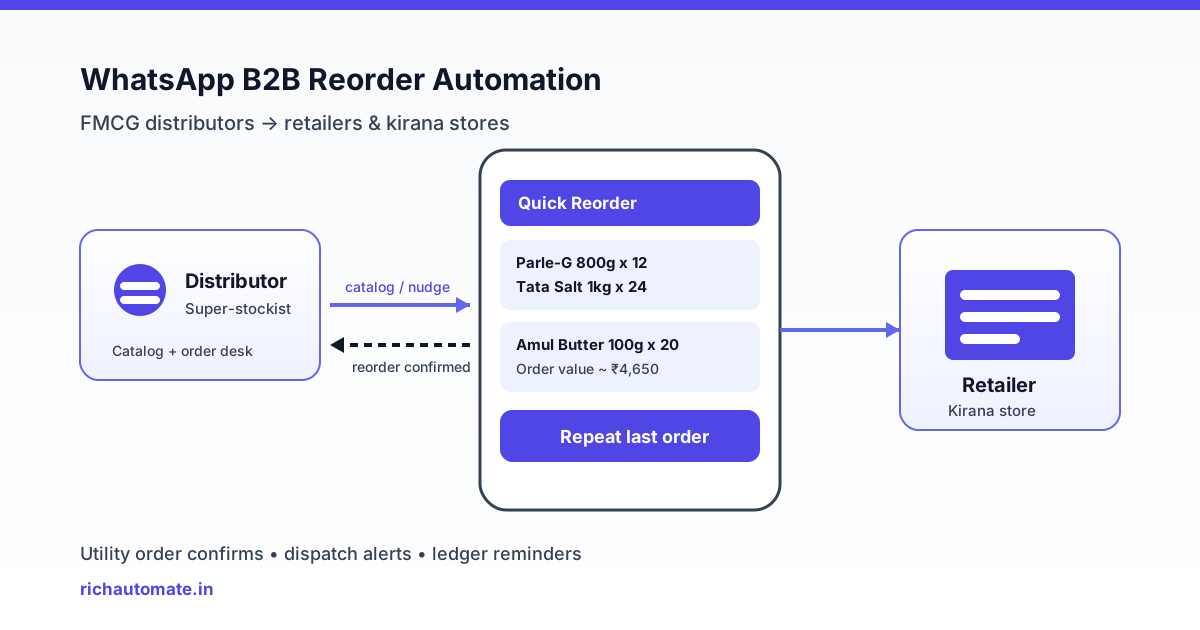
WhatsApp B2B reorder automation lets your retailer and kirana customers restock in under a minute by tapping a catalog or a repeat-order button, instead of waiting for a field-rep visit or a phone call. For an FMCG distributor, super-stockist or wholesaler, that means faster reorder cycles, fewer missed orders, and DSRs freed to sell rather than take dictation.
This is a practical playbook for distribution ops and sales heads in India: how the reorder stack fits together, what it costs, where it saves field-rep money, and how to keep it compliant with opt-in rules. It is grounded in how Indian distribution actually runs — beat plans, udhaar cycles, GST invoices and all.
Why retailer reorders still run on phone calls
Walk into any FMCG distributor godown and the reorder flow is the same: a DSR walks the beat, notes quantities in a diary or an order app, or the retailer WhatsApps a voice note or calls the desk when stock runs low. It works, but it leaks. Calls go unanswered during peak hours. A retailer who wants to reorder at 9pm after downing the shutter cannot reach anyone. The rep visits on a fixed beat day, so an outlet that runs out on day two waits five more days. Every one of those gaps is a lost order that walks to whichever distributor picks up first.
The cost side is worse. A field visit is the most expensive way to capture a routine reorder of fast-moving lines the retailer would have bought anyway. You are paying salary, fuel and time for a transaction that needed no persuasion. The senior-operator instinct is right: keep the rep for what only a human does — opening new outlets, pushing range and schemes, recovering payments — and let predictable reorders run themselves.
What a phone-first reorder process costs
The numbers below are typical ranges we see across distributor onboarding cohorts in India. Treat them as a planning baseline, not a guarantee — your beat density, SKU mix and geography move them.
| Channel to capture one reorder | Typical cost per order | Outlets reached / day | Turnaround |
|---|---|---|---|
| Field rep (DSR) beat visit | ₹60–₹95 | 30–40 outlets | 3–7 day beat cycle |
| Tele-calling / order desk | ₹18–₹30 | 80–120 calls (if answered) | Same day, when reachable |
| WhatsApp quick-reorder | ~₹0.30 msg + minor setup | Unlimited, self-serve | Minutes, 24x7 |
The point is not that reps are wasteful — it is that a ₹60–₹95 visit and a ₹0.30 utility message should not be doing the same job. Route the routine reorder to WhatsApp and keep the visit for the work that justifies its cost.
There is a second, quieter cost: order accuracy. A quantity dictated over a noisy phone line or scrawled in a beat diary gets mis-keyed, and the retailer who ordered 12 cartons receives 21. Every such error is a return trip, a credit note, and a dent in trust. A structured tap-to-order removes the transcription step entirely — what the retailer confirms is exactly what your picker sees.
The WhatsApp reorder stack: catalog, flow and utility confirms
Three pieces do the work. First, a product catalog inside WhatsApp so retailers browse your live range with prices and pack sizes, the same way they would flip a rate list — except it is always current. If you want the full mechanics of building this, see our guide to WhatsApp catalog and in-chat checkout.
Second, a quick-reorder flow. When a retailer opens the chat, the bot can surface their last order with quantities pre-filled and a single "repeat last order" button, plus their top fast-moving SKUs. The retailer nudges quantities up or down, confirms, and the order arrives in your system as structured data — SKU codes, quantities, outlet ID — ready to pick, not a blurry voice note someone has to transcribe.
Third, utility-category templates that close the loop: order confirmation, dispatch/out-for-delivery alert, GST invoice, and payment or ledger reminders. These fire automatically off the order and outstanding balance, so the retailer always knows where their order and their udhaar stand without calling the desk.
Building the quick-reorder flow
The flow itself is simple to reason about. A retailer message (or a scheduled cycle nudge) triggers it. The bot looks up that outlet’s purchase history, builds a reorder card of the lines they buy most, and offers three moves: repeat the last order as-is, edit quantities, or browse the full catalog for something new. On confirm, the order posts to your distribution or ERP system and an order-confirmation utility template goes back with the order number and expected dispatch.
Because the reorder card is built from real purchase history, it doubles as a gentle range-selling tool: you can slot in one adjacent SKU the outlet has not stocked yet. Keep it to one suggestion — a wall of cross-sells kills the one-minute reorder you were trying to protect. If you already send other automated nudges, the same discipline that makes automated WhatsApp reminders work applies here: timely, relevant, one clear action.
Utility templates: confirmations, dispatch and ledger reminders
This is where WhatsApp quietly earns its keep for distributors, because these messages are utility-category and cheap. An order-confirmation template acknowledges the reorder. A dispatch template tells the retailer the vehicle is out. An invoice template can carry the GST invoice as a document. And a ledger/credit reminder — "₹12,400 outstanding, ₹4,200 overdue since 12 days" — nudges payment without the awkward collection call.
The udhaar cycle is where Indian distribution bleeds working capital, and a polite, automated, on-time reminder recovers days off your receivables far more consistently than a rep who forgets. Because these are transactional utility messages tied to a real order and a real balance, they sit in the utility category — not marketing — which matters for cost. To understand where the line sits, read our breakdown of utility vs marketing message categories.
Get a 1-minute BSP audit on WhatsApp
Drop your WhatsApp number — we line-item your current invoice against Meta India rates in under 60 seconds. India-hosted, DPDP-compliant.
Timing is the whole game with ledger reminders. A reminder that lands the morning after a bill falls due, framed as an FYI rather than a demand, gets paid quietly. One that lands three weeks late reads as chasing and sours the relationship. Because the reminder fires automatically off the outstanding balance and due date in your books, it is always on time and never emotional — which is exactly why it works better than a collection call the rep dreads making.
What the messaging actually costs
Reorder-cycle economics only work if the messaging is cheap. The reason utility categorisation is a genuine selling point, not jargon, is the price gap:
| Message category | Used for | SaaS-Pay (per msg) | Client-Pay (per msg) |
|---|---|---|---|
| Utility | Order confirm, dispatch, invoice, ledger reminder | ₹0.30 | ₹0.10 |
| Marketing | New SKU launch, scheme / promo push | ₹1.20 | ₹0.10 |
Because the bulk of reorder traffic — confirmations, dispatch, ledger — is utility, your running cost stays tiny even at high outlet counts. RichAutomate runs a usage-only model: ₹0 setup, ₹0 monthly platform fee, and you pay per message. On Client-Pay you bring your own Meta credit line and pay a flat ₹0.10 per message regardless of category; on SaaS-Pay we carry the Meta cost and you pay ₹0.30 utility / ₹1.20 marketing. Full numbers are on the pricing page.
Field-rep augmentation, not replacement
The distributors who get this right do not fire their DSRs — they redeploy them. Once routine reorders self-serve, the rep’s beat day is spent on the work that moves the P&L: acquiring new outlets, widening the range an outlet stocks, pushing the month’s scheme, and sitting down with slow payers. The WhatsApp channel also arms the rep — they can see, before a visit, which outlets reordered online and which went quiet, so the beat is prioritised instead of mechanical.
Here is the kind of shift a distributor typically sees across a 90-day onboarding cohort. Again, ranges, not promises:
| Metric | Before (phone / rep only) | After ~90 days (typical cohort) |
|---|---|---|
| Reorders placed via phone / rep | ~82% | ~46% |
| Average reorder cycle | ~11 days | ~7 days |
| Average order value | ~₹4,200 | ~₹4,650 |
| Orders needing a rep follow-up call | 100% | ~55% |
The AOV lift is not magic — it comes from the one-tap reorder catching low-stock moments the beat cycle missed, plus the single adjacent-SKU suggestion on the reorder card. The shorter cycle is the retailer reordering when they run low, not when the rep happens to arrive.
There is a morale angle senior sales heads underrate. DSRs paid partly on incentive resent spending half their day writing repeat quantities that earn them nothing. Move that to self-serve and their day fills with the visits that actually move the incentive — new outlets, wider range, scheme conversions. Reps who feared the technology tend to become its advocates once they see it clearing the drudgery off their beat rather than replacing them.
Connecting it to Tally, ERP and your books
A reorder that lands in WhatsApp but has to be re-keyed into your accounting software is only half-automated. The reorder payload should post straight into your distribution system or ERP, and confirmations, invoices and outstanding-balance figures should be pulled back from it so the numbers the retailer sees are the real ones. Most Indian distributors keep their books in Tally; you can wire the confirmation and ledger flow to Tally so invoices and udhaar balances flow both ways — our guide to connecting Tally to WhatsApp walks through the setup. RichAutomate exposes a developer API so your team or software vendor connects both directions without waiting on us.
Opt-in and compliance for B2B reorder nudges
Be accurate about this, because it protects the account that runs your whole operation. Sending order updates, confirmations and reminders to existing retailer customers who have opted in — shared their number and agreed to receive order communication — is exactly what utility templates are for, and it is fine. What is not fine is cold, unsolicited broadcasting to numbers that never opted in, and no vendor can honestly promise your number will never be actioned for that. Keep opt-in evidence: a tick on the onboarding form, the retailer’s first inbound message, or a clause in the distributor agreement.
Practical opt-in that works for distribution: capture consent when you onboard the outlet, let retailers start the conversation by messaging your business number first, and always give a clear way to stop reminders. If you are also onboarding smaller kirana sellers into digital ordering, the same consent-first approach in our note on onboarding kirana sellers on ONDC applies directly.
Getting started
You do not need to rebuild your distribution system to start. Pick your top 30–50 fast-moving SKUs, load a catalog, wire an order-confirmation utility template, and switch on the repeat-order button for the outlets that already WhatsApp you. Measure the reorder-cycle and phone-share numbers for one beat, then widen. Because setup and the monthly platform fee are ₹0 and you only pay per message, the downside of trying it on one route is close to nothing.
To build your reorder catalog, quick-reorder flow and utility templates on the WhatsApp Business API, create your RichAutomate account and start with a single distribution route. Keep the field reps — just stop paying visit-cost for orders a tap can capture.