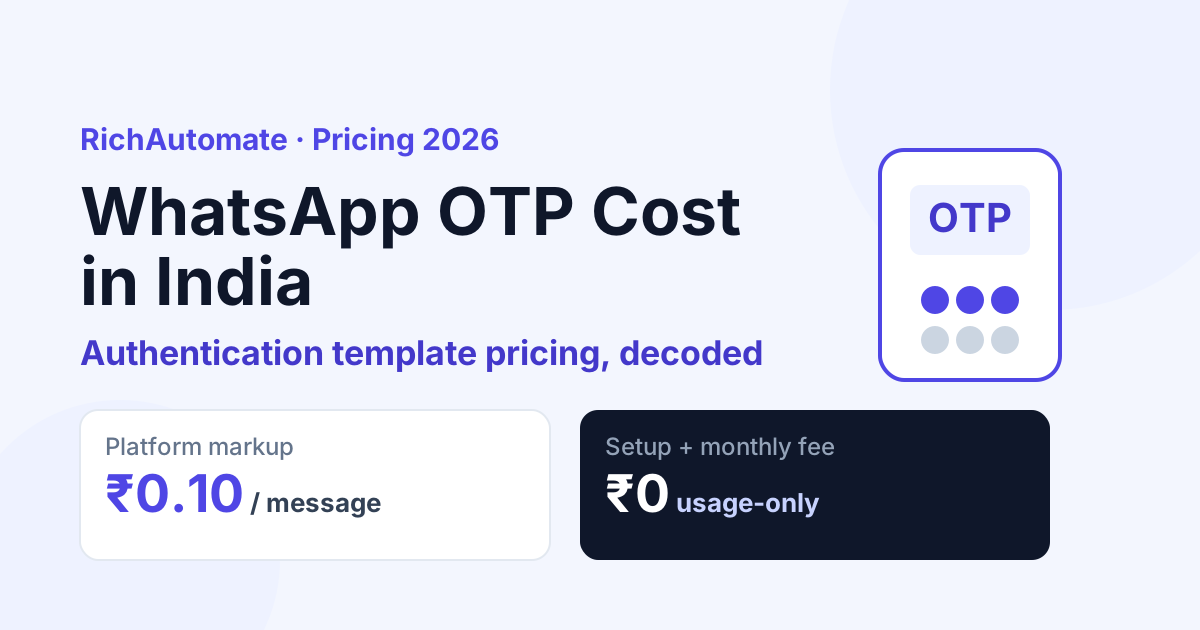
A WhatsApp OTP (authentication-template) message in India costs you Meta's published per-message authentication-conversation rate plus whatever markup your BSP charges — on RichAutomate that markup is just ₹0.10 per message with zero setup and zero monthly platform fee. In practice a business sending 40,000 OTPs a month pays only the Meta pass-through rate plus about ₹4,000 in platform markup, which is dramatically cheaper than legacy per-SMS OTP once you factor DLT-registered SMS at ₹0.12–0.18 each and the monthly platform fees most competitors bolt on.
WhatsApp OTP has quietly become the default second factor for Indian fintechs, D2C brands, logistics apps and neobanks — delivery is faster, read rates are near 100%, and users already live inside WhatsApp. But the pricing is layered, and most "cost calculators" online quote outdated 2023 conversation-based numbers. This guide breaks down exactly what an authentication-category message costs in India in 2026, with real cohort math in rupees, and shows where you actually save money.
How WhatsApp authentication pricing works in India (2026)
Since Meta moved to per-message pricing for authentication and utility categories, every OTP you send is billed individually rather than as part of a 24-hour "conversation." That change matters for OTP-heavy senders: an authentication template is a single-shot message, so per-message billing is usually cheaper and far easier to forecast than the old conversation model.
Your total cost per OTP is the sum of two things:
- Meta's per-message authentication rate for India — set by Meta, charged on the WhatsApp Business Platform, and revised periodically. Always check the current Meta rate card before you model a budget; Meta has adjusted category rates more than once and India-specific authentication pricing is a lever they tune.
- Your BSP / platform markup — what your WhatsApp Business Solution Provider adds on top. This is where costs balloon or stay lean, because many providers charge a per-message markup and a fixed monthly platform fee on top of Meta's rate.
The Meta component is largely non-negotiable — everyone pays Meta. The BSP component is where you win or lose. If you want the full backdrop on how the platform layer is priced, our breakdown of how much the WhatsApp Business API costs in India in 2026 maps every fee line most vendors bury in their contracts.
RichAutomate authentication pricing: two clean models
RichAutomate runs a usage-only pricing model — ₹0 setup, ₹0 monthly platform fee. You never pay to keep the account alive; you pay only when you send. There are two ways to buy:
- Client Pay — you bring your own Meta WhatsApp Business Account and pay Meta directly for conversation/message charges. RichAutomate adds a flat ₹0.10 per message platform markup and nothing else. This is the leanest possible structure for high-volume OTP senders.
- SaaS Pay — RichAutomate bills you all-in, so you get one invoice instead of juggling a Meta billing account. All-in rates are ₹1.20 per marketing message and ₹0.30 per utility message, with authentication conversations billed at Meta's per-message authentication rate passed through on top of the ₹0 platform fee.
Either way, the authentication-category charge itself is Meta's per-message rate — RichAutomate does not inflate Meta's category pricing. What we remove is the fixed platform tax. Compare that against our full transparent WhatsApp API pricing page and you'll see there is no "minimum monthly commitment" line, which is the single biggest hidden cost in this market.
Real cohort math: what OTP volume actually costs
Abstract per-message rates mean nothing until you plug in real volume. Below is the platform-markup cost (the part you control) for four common Indian sender profiles on RichAutomate's Client Pay model at ₹0.10/message. Meta's per-message authentication pass-through is charged separately and added on top — identical for every provider, so it is not the deciding factor.
| Sender profile | OTPs / month | Platform markup @ ₹0.10 | What a fee-based rival adds |
|---|---|---|---|
| Early-stage D2C store | 8,000 | ₹800 | + ₹2,000–5,000 monthly platform fee |
| Growth-stage fintech | 40,000 | ₹4,000 | + ₹8,000–15,000 monthly platform fee |
| Logistics / delivery app | 120,000 | ₹12,000 | + ₹20,000–40,000 monthly platform fee |
| Neobank / large marketplace | 500,000 | ₹50,000 | + ₹50,000–1,00,000 monthly platform fee |
The pattern is obvious: on a usage-only model the fintech sending 40,000 OTPs pays a flat ₹4,000 markup, while a competitor charging even a modest ₹10,000/month platform fee has tripled the controllable portion of the bill before a single extra OTP is sent. At 500,000 OTPs the monthly-fee model can quietly add ₹6–12 lakh a year of pure platform tax on top of identical Meta charges.
Client Pay vs SaaS Pay: which is cheaper for OTP senders?
For pure OTP traffic the decision usually comes down to how you want to handle Meta billing. Client Pay is the mathematical floor: you settle Meta's authentication charges directly and RichAutomate adds only ₹0.10 per message, so there is no intermediary margin on the Meta portion at all. This suits fintechs and marketplaces that already run a Meta billing account and want the absolute lowest per-OTP number.
Get a 1-minute BSP audit on WhatsApp
Drop your WhatsApp number — we line-item your current invoice against Meta India rates in under 60 seconds. India-hosted, DPDP-compliant.
SaaS Pay trades a sliver of that saving for a single consolidated invoice and no Meta billing account to manage — RichAutomate handles the Meta relationship and bills you all-in. Because authentication is still passed through at Meta's per-message rate on top of a ₹0 platform fee, the gap between the two models on OTP-only traffic is small; the real fork is operational, not a hidden premium. A team sending 40,000 OTPs a month can start on SaaS Pay for simplicity and move to Client Pay once volume justifies running its own Meta billing, without changing platforms or paying a migration fee.
WhatsApp OTP vs SMS OTP cost in India
The real comparison most teams care about is WhatsApp versus the SMS OTP they're currently paying for. DLT-registered transactional SMS in India runs roughly ₹0.12–0.18 per message through most aggregators, and that's before failed-delivery retries, operator downtime, and the DLT template registration overhead.
| Factor | SMS OTP (India) | WhatsApp OTP (India) |
|---|---|---|
| Per-message cost | ₹0.12–0.18 (DLT-registered) | Meta auth rate + ₹0.10 markup |
| Delivery / read visibility | Sent only; no read receipt | Delivered + read receipts |
| Retry cost on failure | Charged again per resend | Charged per message; higher first-try success |
| Registration overhead | DLT header + template scrubbing | Template approval inside WhatsApp Manager |
| Fraud / spoofing risk | Higher (SIM/SMS interception) | Lower (encrypted, verified sender) |
SMS still wins on absolute floor price for feature-phone-only audiences, but for smartphone-first Indian users WhatsApp OTP closes the gap fast once you count retries and lift in successful first-attempt verification. We've modelled the full break-even in WhatsApp OTP vs SMS OTP in India for 2026, and for most app-based fintechs the crossover happens well before 50,000 monthly sends.
The hidden costs nobody quotes you
Sticker per-message rates hide three line items that decide your real annual spend:
- Setup / onboarding fees. Some BSPs charge ₹10,000–50,000 just to provision your WABA. RichAutomate's is ₹0.
- Monthly platform / seat fees. The killer. A "₹2,500/month" plan is ₹30,000/year before you send one OTP. Usage-only models remove this entirely.
- Minimum commitments and message-credit expiry. Prepaid credit that expires monthly is a hidden fee — you pay for volume you never sent.
Below is how the same 40,000-OTP fintech's controllable annual cost compares across pricing structures (Meta pass-through excluded because it's identical everywhere):
| Pricing structure | Setup | Monthly platform fee | Markup on 40k OTPs | Annual controllable cost |
|---|---|---|---|---|
| RichAutomate (usage-only) | ₹0 | ₹0 | ₹4,000 | ₹48,000 |
| Typical mid-tier BSP | ₹15,000 | ₹8,000 | ₹4,000 | ₹1,59,000 |
| Enterprise BSP | ₹40,000 | ₹25,000 | bundled | ₹3,40,000+ |
Same Meta rate, same 40,000 OTPs, but the controllable spend ranges from ₹48,000 to over ₹3.4 lakh a year purely on platform structure. If minimising total cost is the goal, our deep-dive on the cheapest WhatsApp Business API in India with total cost decoded walks through every one of these line items with worked examples.
GST, DLT and going live: the compliance line
Two factual notes for Indian budgeting. First, GST applies to your platform and messaging spend, so add 18% to the controllable figures above when you forecast cash outflow. Second, taking a WhatsApp Business Account live for production requires GST registration — you can trial and test without it, but going live with real customer OTP traffic needs your GSTIN on file. Budget for both from day one so a launch isn't blocked at the compliance step.
How to cut your WhatsApp OTP bill
Four levers, in order of impact:
- Kill the monthly platform fee. Move to a usage-only provider. This alone often saves more than any per-message optimisation.
- Use authentication templates, not utility, for OTPs. Categorising correctly keeps you on Meta's authentication rate and avoids mis-billing.
- Cut retries with WhatsApp-first delivery. Higher first-attempt success means fewer paid resends than SMS fallback chains.
- Bring your own WABA (Client Pay). If you already have a Meta billing relationship, paying Meta directly plus a ₹0.10 markup is the floor.
For the full authentication setup walkthrough — template creation, approval, and rate configuration — see our guide to WhatsApp OTP and authentication in India for 2026.
The bottom line on WhatsApp OTP cost in India
In 2026 the price of a WhatsApp OTP in India is Meta's per-message authentication rate (revised periodically — always check the current Meta rate card) plus your BSP's markup. The Meta half is the same for everyone; the markup half is where a ₹48,000/year account and a ₹3.4-lakh/year account diverge on identical volume. RichAutomate's usage-only model — ₹0 setup, ₹0 monthly fee, ₹0.10 per message on Client Pay — is built to keep the controllable half as close to zero as the market allows.
Ready to send OTPs at pass-through cost? Create your free RichAutomate account and start with zero setup, zero platform fee, and per-message pricing you can actually forecast.