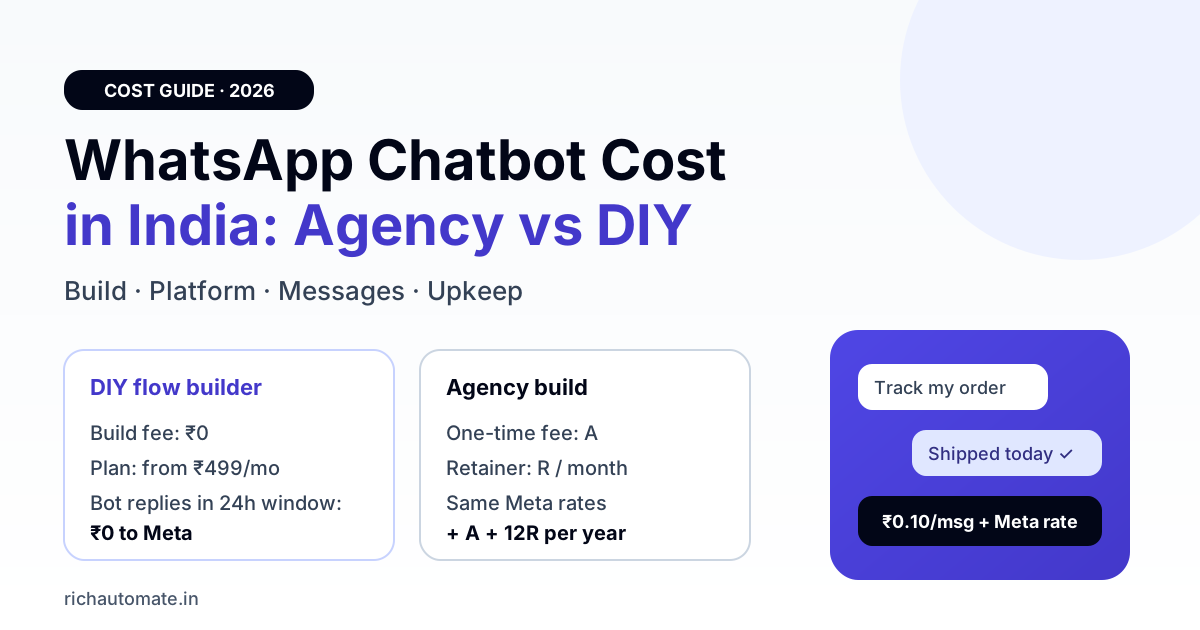
A WhatsApp chatbot in India costs ₹0 to build if you make it yourself on a no-code flow builder, and you then pay a monthly platform plan (from ₹499 on RichAutomate) plus Meta's per-message charges, which are zero for bot replies inside the 24-hour customer service window. Hiring an agency adds a one-time build fee and usually a monthly retainer on top of those same running costs, so the real question is not "what does a chatbot cost" but "who builds it, and what will it send every month".
This guide breaks a WhatsApp chatbot budget into the four lines every quote is made of, shows what each build path (DIY, agency, custom code) really adds, and walks through a 12-month cost worked out from Meta's published India rates. If you only want vendor-by-vendor AI add-on prices, our WhatsApp AI agent and chatbot pricing comparison covers that; this page is about the total cost of getting a bot live and keeping it running.
The four cost lines in every WhatsApp chatbot budget
Whether a freelancer quotes you on a phone call or an enterprise vendor sends a 20-page proposal, the money always lands in the same four buckets. Separate them before you compare any two quotes, because vendors love to hide a cheap build fee behind an expensive monthly line, or the other way round.
- 1. Build (one-time): mapping conversations, writing replies and templates, building the flow and connecting your number. Done by you, an agency or your developers, plus change requests later.
- 2. Platform (monthly): the software that runs the bot, meaning the flow builder, shared inbox, broadcasts and API access. Priced by your platform or BSP.
- 3. Messages (per message): Meta's charge for each template message delivered, plus any per-message platform fee. Priced by Meta's rate card and your platform.
- 4. Upkeep (monthly or per request): editing flows, new templates, fixing broken steps, adding integrations, and AI usage if you use a language model. Done by your team or covered by an agency retainer.
Lines 2 and 3 exist no matter who builds the bot. Lines 1 and 4 are where the build path changes the bill. Keep that in mind for the rest of this guide: an agency cannot make Meta's rates cheaper, and a DIY build does not make them more expensive.
What Meta actually charges a chatbot in India
Most first-time buyers overestimate this line, because they assume every bot reply is a paid message. It is not. Since 1 July 2025 Meta bills the WhatsApp Business Platform per delivered template message, and its pricing documentation sets out three rules that matter for chatbots:
- Service messages are free. When a customer messages you first, a 24-hour customer service window opens. Every free-form reply your bot sends inside that window costs nothing from Meta, however many replies it takes.
- Utility templates sent inside an open window are free. An order update or booking confirmation sent while the customer is still in an active chat is not charged.
- Free entry point windows last 72 hours. If the customer arrives from a Click-to-WhatsApp ad or a Facebook Page call-to-action button and you reply within 24 hours, all messages for the next 72 hours are free.
You pay Meta when the business starts the conversation with a template, or when you message outside an open window. These are the India rates shown on our live pricing page, which follow Meta's published rate card:
| Message type | Meta's charge (India) | RichAutomate Client Pay fee | Total per message |
|---|---|---|---|
| Bot reply inside the 24-hour window (service) | ₹0 | ₹0.10 | ₹0.10 |
| Utility template (order update, reminder) outside a window | ₹0.115 | ₹0.10 | ₹0.215 |
| Authentication template (OTP) | ₹0.115 | ₹0.10 | ₹0.215 |
| Marketing template (offer, broadcast) | ₹0.8631 | ₹0.10 | ₹0.9631 |
On Client Pay, Meta bills its share to your own card and RichAutomate adds a flat ₹0.10 per outgoing message. Meta adds GST to its own invoice separately. The practical lesson for a support or sales bot: if most chats start with the customer, your Meta bill is close to zero and the platform fee is the main per-message cost. The bill grows with the messages you start, especially marketing broadcasts. Our 24-hour window cost guide shows how to plan follow-ups so more of them land inside free windows.
Path 1: build it yourself on a no-code flow builder
For most small and mid-sized Indian businesses, the do-it-yourself path is now the default, because a visual builder removes the need for code. You drag question, button, list and condition blocks onto a canvas, connect them, and publish. A typical first bot for a D2C store, clinic, coaching institute or service business covers five jobs: a welcome menu, FAQs, order or booking status, lead capture into a sheet or CRM, and a hand-off to a human agent.
What it costs on RichAutomate:
- Build: ₹0 in fees. You spend your own time instead, usually a few working days for a first version if your FAQs and product data are ready.
- Platform: keyword auto-replies come with the Starter plan at ₹499 a month. The drag-and-drop visual flow builder, campaign drips, the developer API and webhooks are on the Pro plan at ₹899 a month. Prices are GST-inclusive, with ₹0 setup and a 14-day free trial.
- Messages: as per the table above. Each plan also credits monthly message credits to your wallet (499 on Starter and 999 on Pro, on Client Pay).
- Upkeep: your own time to update replies, prices and offers.
The trade-off is skill, not money. Someone on your team has to think through the conversation, test every branch and own it after launch. If you want to see which builders make that easiest, compare them in our best WhatsApp chatbot builder guide.
Path 2: hire an agency or freelancer
Agencies sell expertise and time: they interview you, design the conversation, write templates that pass Meta review, build the flows on a platform and train your staff. That is worth paying for when nobody on your team has the bandwidth, or when the bot touches money (payments, refunds, loan or insurance journeys) and mistakes are expensive.
There is no standard price list for chatbot agencies in India, so ignore any blog that quotes one "market rate". Quotes depend on scope, and they come in three common shapes:
| Quote model | How it is billed | Good for | Watch out for |
|---|---|---|---|
| Fixed project fee | One price for a defined set of flows, then change requests billed separately | A clear, stable scope such as an FAQ and lead-capture bot | A vague scope document, so every small edit becomes a paid change request |
| Setup fee + monthly retainer | Lower upfront fee, then a fixed monthly amount for edits, reports and support | Businesses that change offers and flows every month | Retainers that bundle the platform at a markup you cannot see |
| Bundled "all-in" package | One monthly figure covering build, platform and sometimes messages | Owners who want a single bill | Per-message rates hidden inside the bundle, and contracts that make leaving hard |
Whichever model you get, ask the agency to split the quote into the four cost lines from the first table. In particular, ask which platform the bot will run on, whose account the WhatsApp number and templates sit in, and what you pay per message. If the WhatsApp Business Account is created under the agency's business instead of yours, moving away later is painful. Agencies that build on a white-label platform can keep the client's account in the client's name and still bill for their work; our guide to running WhatsApp services as a digital marketing agency covers how that set-up works from the agency side.
Get a 1-minute BSP audit on WhatsApp
Drop your WhatsApp number — we line-item your current invoice against Meta India rates in under 60 seconds. India-hosted, DPDP-compliant.
Path 3: a custom build on the WhatsApp Cloud API
Some teams skip platforms and code directly against Meta's Cloud API. This makes sense when the chatbot is really part of your product: a fintech app that verifies users on WhatsApp, a marketplace syncing live inventory, or a logistics company pushing events from its own systems at high volume.
The costs move around rather than disappear. Meta's message charges are the same as above. In place of a platform fee you pay for engineering time, hosting, a database for conversation state, monitoring, and someone on call when a webhook fails at 2 a.m. You also have to build the parts a platform gives you for free: a shared inbox for human hand-off, template management, opt-out handling, retries and delivery reports.
A middle route works for many teams: run the conversation on a platform with a visual builder, and use its developer API and webhooks to call your own systems for the parts that are truly custom, such as checking an order or creating a ticket. On RichAutomate that is the Pro plan, so you keep the inbox, templates and analytics without writing them yourself.
A 12-month cost worked out for a typical Indian SMB bot
Here is a worked example using only published prices. The business is an online store with one WhatsApp number on the Pro plan. Each month its bot handles 2,000 customer-started chats with an average of 5 bot replies each, sends 1,500 utility order updates outside open windows, and runs two marketing broadcasts to 1,500 opted-in customers each.
| Item | Monthly calculation | Per month | 12 months |
|---|---|---|---|
| Pro plan | Flat, GST-inclusive | ₹899 | ₹10,788 |
| Bot replies (service) | 10,000 × (₹0 Meta + ₹0.10) | ₹1,000 | ₹12,000 |
| Utility order updates | 1,500 × (₹0.115 + ₹0.10) | ₹322.50 | ₹3,870 |
| Marketing broadcasts | 3,000 × (₹0.8631 + ₹0.10) | ₹2,889.30 | ₹34,672 |
| Running cost (DIY) | ₹5,110.80 | ₹61,330 |
Three things stand out. First, 14,500 messages a month cost about ₹5,100 to run, and more than half of that is the two marketing broadcasts. Second, the 10,000 bot replies cost only the platform fee, because Meta does not charge for service messages. Third, the Pro plan's 999 monthly credits reduce the wallet spend a little further, which this table leaves out to stay conservative. Meta's GST on its share is also extra.
Now compare an agency path for the same bot. If the agency quotes a one-time build fee of A and a monthly retainer of R, your first-year total is ₹61,330 + A + 12 × R, assuming the agency passes messages through at cost. The DIY path saves exactly A + 12 × R, minus the value of your own team's time. That is the number to put in front of whoever signs off the budget, rather than a vague "agencies are expensive" or "DIY is free".
What pushes a build quote up (and what doesn't)
When you scope a bot, or read an agency's estimate, these are the items that genuinely add work. If a quote is high, check which of these it includes before you negotiate.
- Menu, FAQs, business hours, human hand-off (low effort): Standard blocks on any flow builder.
- Lead capture to Google Sheets or a CRM (low to medium effort): Ready connectors usually exist; custom CRMs need API work.
- Order or booking status from your own system (medium effort): Needs an API or webhook from your store, POS or booking software.
- Payments inside the chat (medium effort): Payment links and status callbacks have to be tested end to end.
- Several Indian languages (medium effort): Every reply and template is written and approved once per language.
- AI answers from your documents or catalogue (medium to high effort): Needs a knowledge source, guardrails, fallbacks to humans and testing.
- Regulated journeys (lending, insurance, health) (high effort): Consent records, disclosures and audit trails add review cycles.
What does not justify a higher quote: the number of contacts you have, the number of messages you plan to send (that is the message line, not the build), or "WhatsApp API approval", which is a standard onboarding step on any official platform.
Rule-based or AI chatbot: does AI change the cost?
A rule-based bot follows the buttons and keywords you design. It is predictable, cheap to run and easy to audit, and it handles the bulk of Indian SMB use cases: order status, timings, prices, appointment slots and lead forms. An AI chatbot reads free text and answers in natural language, which helps when customers ask the same thing a hundred different ways.
AI changes two cost lines. Build effort goes up, because someone has to prepare the knowledge the bot answers from and define when it must hand over to a person. Upkeep gets a new usage cost for the language model. On RichAutomate you can connect your own AI provider key (OpenAI, Claude, Gemini or Sarvam) as an add-on and pay that provider directly, without a markup. Meta's message charges do not change: an AI reply inside the 24-hour window is still a free service message.
A sensible order is to launch rule-based flows for your top intents first, measure how many chats the bot closes without a human, and add AI only where customers keep typing questions your buttons do not cover. Our guide to chatbot containment rate and cost per resolution shows how to measure that before you spend on AI.
Questions to ask before you sign any chatbot quote
- Whose Meta business account will the number and templates live in? It should be yours.
- What is the per-message price, split into Meta's charge and the platform's fee? Compare it with Meta's rate card, not with another bundle.
- Is there a minimum monthly commitment or a lock-in period? Get the exit terms in writing.
- How many change requests are included each month, and what does the next one cost?
- Who writes and submits templates, and who fixes them if Meta rejects one?
- How will the bot be tested before launch? Ask for a test-case list; our chatbot test cases template is a good checklist to hand over.
- What reporting will you get? At minimum: chats handled, hand-offs to humans, and messages sent by category.
If an agency or vendor cannot answer these clearly, the low headline price will not stay low.
The cheapest way to find out what your bot will cost
Build a small version yourself before you commit to anyone. Pick your three most common customer questions, make a flow for them, connect your number, and run it for two weeks. You will learn your real chat volume, how many chats start with the customer (and are therefore free from Meta), and how much broadcasting you actually need. Those three numbers turn any agency quote from a guess into a comparison.
RichAutomate gives you a 14-day free trial with ₹0 setup, a visual flow builder on the Pro plan, and Client Pay billing at Meta's rate plus ₹0.10 per message, so you can test the full cost picture on your own number. Start your free trial and build your first flow today.