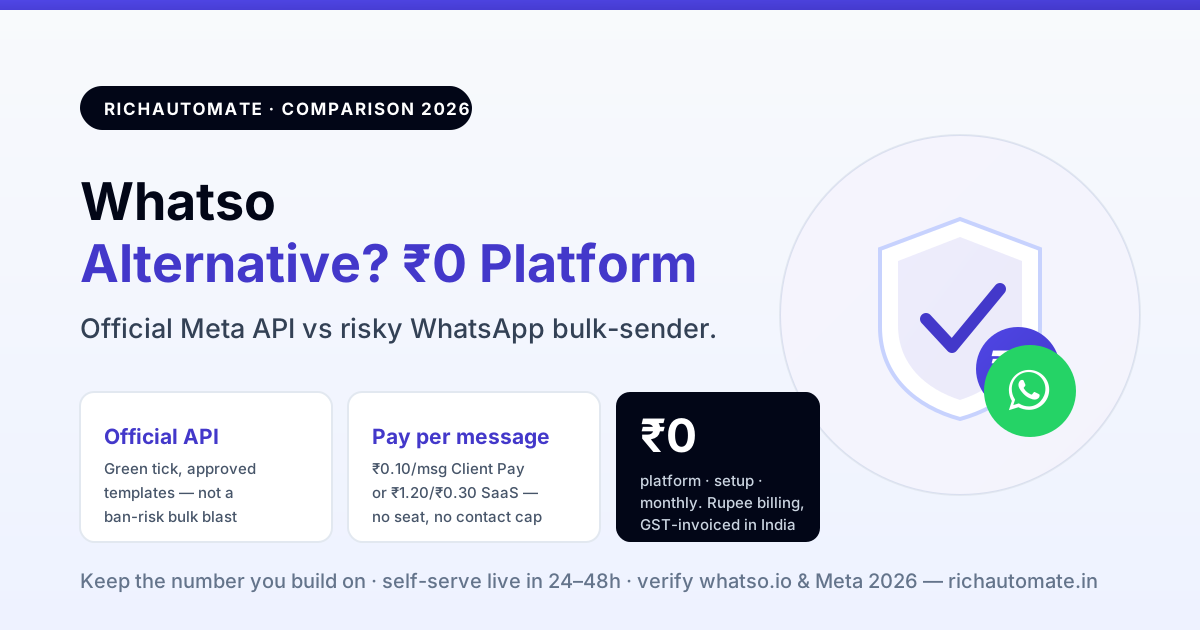
The short answer. The best Whatso alternative for an India business in 2026 is RichAutomate when you want your WhatsApp sending to run on the official Meta WhatsApp Business API with transparent, self-serve, rupee pricing and no platform fee. Whatso is best known as a WhatsApp bulk-message sender — desktop software that blasts messages from a WhatsApp Web or personal-account session — and it also markets an official WhatsApp Business API product (as listed on whatso.io, verify the current offering). The catch with any bulk-sender that drives a personal or WhatsApp Web session is deliverability and ban risk: Meta actively restricts numbers that send unsolicited bulk from unofficial automation, and once a number is blocked you lose the audience with it. RichAutomate is India-native and WhatsApp-first on the official Meta WhatsApp Business API, with the platform fee stripped to zero: ₹0 platform, ₹0 setup, ₹0 monthly, no per-seat and no per-contact charge, and you pay only per message — Client Pay at a flat ₹0.10/message with Meta billed directly to you, or SaaS Pay all-in at ₹1.20 marketing / ₹0.30 utility-auth — plus a 14-day free trial with 100 free credits (a GST number is required to go live). If your job is a tiny, one-off personal blast to a handful of contacts and you accept the risk, a bulk-sender might do it; if you want reliable delivery, the green tick, approved templates and broadcasts that scale without your number being restricted, the official API is the right place to be. Treat every Whatso figure as “as listed on whatso.io, verify”; all rupee figures are illustrative; and note plainly — no tool, on either side, can promise a WhatsApp number will never be banned.
If you are looking for a Whatso alternative, you are usually one of two people: a business that bought Whatso’s WhatsApp bulk-sender to blast offers, then watched numbers get blocked or delivery collapse, and now wants a compliant way to reach customers at scale; or someone comparing tools upfront and asking whether an India-native platform on the official WhatsApp Business API would be safer and cheaper to run than desktop bulk software. Whatso is an India-origin WhatsApp marketing tool best known for its bulk-message sender, and it also lists an official WhatsApp Business API product (as listed on whatso.io, verify the current packaging). RichAutomate sits firmly on the official side: an India-native, WhatsApp-first platform on the official Meta WhatsApp Business API, priced in rupees, designed so a founder, a lean team, an agency running several client numbers, or a scaling brand can be live this week and pay nothing but the per-message cost — no platform fee, no setup, no monthly, no seat caps, no contact caps, no sales call. This guide walks the real differences honestly: a head-to-head table across the lines that move a decision, a straight “who should pick which” that names the narrow case where a bulk-sender might still suit someone, illustrative rupee math, the 24–48 hour steps to move onto the official API with RichAutomate, and a five-question FAQ. Every Whatso price and feature is hedged “as listed on whatso.io, verify” because offerings evolve; every RichAutomate number is real and current; all cohort figures are illustrative, so model your own. This is general commercial information, not legal advice, and — the honest headline that runs through the whole page — no platform can guarantee against a WhatsApp number restriction; Meta controls enforcement, not the vendor.
The core difference in one paragraph
Whatso and RichAutomate solve overlapping goals by fundamentally different means, and being honest about that is the whole point. Whatso’s signature product is a WhatsApp bulk-message sender — desktop software that automates sending from a WhatsApp Web or personal-account session so you can push the same message to many contacts (as listed on whatso.io, verify; the site also markets an official Business API product separately). The upside people chase is a low upfront cost and no template-approval step; the downside Meta enforces is that unsolicited bulk from unofficial automation is exactly what gets numbers rate-limited, blocked or banned, and there is no green tick, no delivery guarantee and no support window behind it. RichAutomate is a WhatsApp-first platform on the official Meta WhatsApp Business API, built for India, priced in rupees, self-serve, that charges ₹0 for the platform itself — no monthly fee, no setup, no per-seat charge, no per-contact charge — and bills only for the WhatsApp messages you actually send, either at a flat ₹0.10 per message on your own number with Meta billed direct (Client Pay), or all-in at ₹1.20 marketing / ₹0.30 utility-auth (SaaS Pay). The practical upshot: a bulk-sender optimises for cheap-and-now at real risk to the number you are building on; the official API optimises for deliverability, scale and a number you can keep — opted-in broadcasts, approved templates, the green-tick path and Meta’s own conversation-pricing behind every send. If the job is a serious, repeatable WhatsApp channel in India, the official API is the place to be, and RichAutomate makes it ₹0-platform to run.
Head-to-head comparison
The table below lines up the two on the dimensions that genuinely change the decision. Every Whatso cell is hedged because its offering spans a desktop bulk-sender and a separately-marketed official API product that change over time; verify the live position on whatso.io. RichAutomate’s figures are current, rupee-denominated, self-serve and flat.
| Dimension | Whatso (as listed on whatso.io, verify) | RichAutomate |
|---|---|---|
| Best known for | WhatsApp bulk-message sender (desktop, WhatsApp Web / personal-account automation) — verify | WhatsApp-first, official Meta Business API for India |
| Sends via | Bulk-sender drives a personal / WhatsApp Web session; also markets an official API separately — verify | Official Meta WhatsApp Business (Cloud) API only |
| Deliverability & ban risk | Unofficial bulk from a personal session is a common cause of number blocks/bans — verify how their API tier differs | Official API path — still no guarantee, but the sanctioned rails for scale |
| Green tick / verified business | Not available via personal-session bulk sending — verify API tier | Green-tick path via official Meta Business verification |
| Message templates / approval | Bulk-sender skips template approval; API tier would use them — verify | Approved marketing / utility / authentication templates |
| Pricing model | Software licence / plan for the bulk-sender; API priced separately — verify | ₹0 platform; pay only per message, priced in ₹ |
| Platform fee | Licence or plan fee likely applies — verify | ₹0 platform fee |
| Currency / billing | Verify currency and GST invoicing on whatso.io | Indian rupees, GST-invoiced in India |
| Buying motion | Buy the software / plan, self-serve — verify API onboarding | Self-serve — sign up and go live, no sales call |
| No-code flow builder | Bulk-send focus; automation by product/tier — verify | Yes — visual WhatsApp flow builder, all features |
| Broadcasts | Bulk blast from a session (risk) vs opted-in on API tier — verify | Opted-in broadcasts on the official API |
| Shared team inbox | Verify availability | Shared team inbox: contacts, tags, assignment |
| Shopify / WooCommerce | Verify availability | Shopify & WooCommerce integrations for WhatsApp order/cart flows |
| Per-message WhatsApp cost | Bulk-sender: no per-message API charge but ban risk; API tier: Meta charges plus markup — verify | Client Pay ₹0.10/msg, or SaaS Pay ₹1.20 marketing / ₹0.30 utility-auth |
| Free trial | Trial may exist — verify current terms | 14-day free trial + 100 free credits, self-serve |
The shape that emerges is consistent: Whatso’s best-known product is a desktop bulk-sender that trades template approval and the green tick for a cheap upfront blast at real risk to the number, while RichAutomate is a WhatsApp-first, India-native platform on the official API, billed at ₹0 for the platform and only per message, self-serve. If your eyes went to the cheap-upfront, no-approval bulk rows, understand what they cost you in deliverability and ban risk; if they went to the official-API, green-tick, template and per-message rows, RichAutomate’s zero-platform rupee proposition is what you want. For how RichAutomate’s two pricing modes work, see the Client Pay vs SaaS Pay billing guide, and for the cost mechanics underneath any WhatsApp tool read the WhatsApp Business API cost guide.
Honest — who should pick which
This is the section most alternative pages dodge, so here it is straight, both ways.
A bulk-sender like Whatso might suit you if your entire need is a tiny, one-off, low-volume message to a handful of people who already expect to hear from you — a personal contact list, a small community you run, a one-time notice — and you fully accept that you are sending from a personal or WhatsApp Web session with no deliverability guarantee, no green tick, no approved templates and a real chance the number gets restricted. Some very small, informal senders knowingly take that trade for the low upfront cost, and if that is genuinely your case, evaluate Whatso on its merits and verify the current software and any official-API tier on whatso.io. Be clear-eyed, though: the moment this becomes a repeatable marketing channel, a business you are building on that number, or a list of people who did not explicitly opt in, unofficial bulk sending is the single most common way to get a WhatsApp number blocked — and you cannot get the audience back once it is gone.
Pick RichAutomate if WhatsApp is a real channel for your business in India and you want to keep the number you build on. Because RichAutomate runs on the official Meta WhatsApp Business API, charges ₹0 for the platform and bills only per message in rupees, self-serve, you get the sanctioned rails for scale — the green-tick path, approved marketing, utility and authentication templates, opted-in broadcasts, a no-code flow builder, Shopify and WooCommerce integrations for order and cart flows, and a shared team inbox — without a per-seat or per-contact platform charge, and your cost tracks your real message volume rather than a software licence. This fits founders and SMBs who want to reach customers reliably without gambling the number, agencies running many client WhatsApp numbers who need a compliant path per client, and any brand whose WhatsApp volume is growing past what a risky desktop blast can survive. The honest line: a bulk-sender may be tempting on upfront price, but for anything you are seriously building it is a false economy once a ban takes the number and its audience with it; RichAutomate gives you the official API at ₹0 platform fee and transparent rupee per-message pricing, which is the durable way to run WhatsApp at scale. For the wider field, see the best WhatsApp Business API providers in India 2026 roundup, and if delivery discipline is your concern, read how to warm up a WhatsApp number and avoid a day-one block.
Get a 1-minute BSP audit on WhatsApp
Drop your WhatsApp number — we line-item your current invoice against Meta India rates in under 60 seconds. India-hosted, DPDP-compliant.
One honest compliance note — read this before you send a single bulk message. Meta’s policy is explicit: business messaging at scale belongs on the official WhatsApp Business API, and sending unsolicited bulk from a personal account or WhatsApp Web automation is exactly what triggers rate-limits, blocks and bans. Moving to the official API through RichAutomate puts you on the sanctioned rails — but that is not a “no-ban” button, and no platform, on either side, can promise that a WhatsApp number will never be restricted. Meta controls enforcement, not the provider, and you should walk away from anyone who offers a “no-ban guarantee.” What actually keeps a number healthy is the same on any official-API tool: message only people who opted in, categorise templates honestly (marketing vs utility vs authentication), space your sends sensibly, keep content relevant, and handle opt-outs promptly and automatically. Your quality rating responds to how recipients react — low block and report rates protect the number, aggressive or irrelevant sending degrades it. The official API gives you the rails; how you drive on them decides your standing. Verify Meta’s current messaging policy and quality-rating rules for 2026 before you scale.
Illustrative cost math
Numbers make the trade-off concrete, so here is illustrative math — model your own. Take a growing Indian business that has decided WhatsApp is a real channel, running, say, 10,000 WhatsApp conversations a month: roughly 7,000 utility (order updates, shipping, COD confirmation, support replies) and 3,000 marketing (offers, cart recovery, re-engagement). Every figure is illustrative and every Whatso figure must be verified on whatso.io, since Whatso’s bulk-sender is a software licence with no per-message API charge but real ban risk, while its official-API tier (if you use it) carries Meta’s own conversation charges plus any markup.
| Line item (illustrative) | Desktop bulk-sender (verify) | RichAutomate SaaS Pay | RichAutomate Client Pay |
|---|---|---|---|
| Platform / licence fee | Software licence or plan fee (verify) | ₹0 | ₹0 |
| 7,000 utility conversations | “Free” to send but no delivery guarantee; ban risk (verify) | ~₹2,100 (7,000 × ₹0.30) | Meta direct + ~₹700 markup (7,000 × ₹0.10) |
| 3,000 marketing conversations | “Free” to send but high block/ban exposure (verify) | ~₹3,600 (3,000 × ₹1.20) | Meta direct + ~₹300 markup (3,000 × ₹0.10) |
| Hidden cost | Number blocked / banned → lose the audience on it | Official API — number you can keep and scale | Official API — number you can keep and scale |
| Indicative monthly total | Low cash, high risk to the asset | ~₹5,700 + 18% GST, no platform fee | ~₹1,000 markup + Meta’s own charge |
The structural point is not that the official API is cheaper per message than a “free” bulk blast — it is that a bulk-sender’s low cash cost hides a large risk cost, because the asset you are spending is the number itself and the audience attached to it. A desktop blast looks free until a ban erases the list you built; the official API charges a transparent per-message rate but protects the number, the deliverability and the ability to scale. RichAutomate removes the platform fee entirely and charges only per WhatsApp message in rupees, self-serve, so the bill tracks your actual sending volume with no licence floor, while you stay on the sanctioned rails. For a business seriously building on WhatsApp in India, the ₹0-platform rupee model on the official API is the durable choice; a bulk-sender is only ever a short-term gamble on a number you cannot afford to lose. Run your real message mix through the WABA cost calculator, read the deeper numbers in the cheapest WhatsApp Business API in India guide, and verify Meta’s live conversation rates and the GST treatment as of 2026.
How to move onto the official API with RichAutomate in 24–48 hours
If you decide WhatsApp is a real channel and want it on the official API rather than a risky desktop blast, standing up RichAutomate is a clean, self-serve process. Note this is a fresh WhatsApp Business API setup rather than a like-for-like migration, because a desktop bulk-sender is not on the official API to begin with — so you are moving from unofficial automation onto the sanctioned rails, which is the whole point. The steps below are the typical route; timing depends on Meta’s own verification. First, start the 14-day free trial and create your account — no card, no sales call required (a GST number is needed to go fully live). Second, connect a WhatsApp Business number and complete Meta’s standard business verification once; if you were bulk-sending from a personal number, consider whether to onboard that number to the official API or start clean, and verify the current path for 2026. Third, create your message templates — write the wording for your order, shipping, support and offer messages and submit them for approval, which is usually quick for utility and authentication categories; this is the step a bulk-sender skips, and it is exactly what makes delivery reliable. Fourth, connect your store if you sell online — wire up the Shopify or WooCommerce integration so order and cart events can drive your WhatsApp order-update and cart-recovery flows. Fifth, build your core WhatsApp flows in the visual no-code builder — start with the one or two journeys that carry the most volume (order updates, support routing, cart recovery, lead capture), rebuild your opt-in list properly so every recipient has consented, and add your agents to the team inbox. Crucially, do not import a scraped or non-consented list from your old bulk-sending — sending to people who did not opt in is the fastest way to damage a brand-new number’s quality rating. Verify the current number-onboarding and template-approval rules against Meta’s live 2026 documentation, and treat the 24–48 hour window as typical rather than guaranteed.
What you gain by moving to the official API. Leaving a desktop bulk-sender for the official WhatsApp Business API is not a lateral move — it is an upgrade in what you can rely on. You gain the green-tick path via Meta Business verification, approved templates that actually deliver, opted-in broadcasts that scale, Meta’s own conversation-pricing categories, a 24-hour service window for two-way conversations, and — on RichAutomate specifically — a no-code flow builder, Shopify and WooCommerce integrations, a shared team inbox, and rupee billing with GST invoicing, all at ₹0 platform fee. What you give up is the illusion that unofficial bulk is “free”: it is only free until the number is gone. The question is not “which is cheaper today” — it is “do I want a WhatsApp channel I can keep and grow, or a blast that risks the number every time I press send.” For a wider view of how RichAutomate sits against managed WhatsApp tools, see the best WhatsApp CRM for India 2026 guide.
The honest bottom line
Whatso and RichAutomate answer the same wish — reach customers on WhatsApp — from opposite ends of the risk curve, and the choice should follow how seriously you are building. Whatso is best known for a WhatsApp bulk-message sender that is cheap upfront and skips template approval, and it also markets an official API tier (verify both on whatso.io); a desktop blast can suit a tiny, one-off, low-volume send to people who expect it, if you knowingly accept that the number can be restricted and the audience lost. RichAutomate is the WhatsApp-first, India-native, platform-fee-free alternative on the official Meta WhatsApp Business API that wins whenever WhatsApp is a real channel you intend to keep — live fast on the sanctioned rails, self-serve, with the green tick, approved templates and broadcasts, a no-code builder, Shopify and WooCommerce integrations and a team inbox, priced in rupees, tracking only what you send, with no platform, contact or seat fees — ₹0 platform, ₹0 setup, ₹0 monthly, with Client Pay at a flat ₹0.10 per message (Meta billed direct to you) or SaaS Pay at an all-in ₹1.20 marketing / ₹0.30 utility-auth, plus a 14-day free trial with 100 free credits (a GST number is required to go live). Verify every Whatso specific on whatso.io and every Meta and GST detail against the live 2026 position; all rupee figures here are illustrative. This is general commercial information, not legal advice; no vendor can guarantee against a WhatsApp number restriction, and what keeps a number healthy is relevant, consented, well-spaced messaging on the official API with prompt opt-out handling.
Move off risky bulk sending — official API, ₹0 platform, pay only per message
If you have been blasting WhatsApp from a desktop bulk-sender and watching numbers get blocked, or you simply want to run WhatsApp the right way from day one, RichAutomate gets you onto the official WhatsApp Business API — self-serve, typically within 24–48 hours — with no platform fee, no setup, no monthly, no contact caps, no seat caps and no sales cycle, rupee billing with GST invoicing, the green-tick path, approved templates and opted-in broadcasts, transparent per-message pricing, Shopify and WooCommerce integrations, and a no-code flow builder and team inbox you operate yourself. Pricing is flat: ₹0 platform fee, ₹0 setup, ₹0 monthly, with Client Pay at a flat ₹0.10 per message on your own WhatsApp number (Meta’s conversation charge billed to you directly by Meta) or SaaS Pay at an all-in ₹1.20 marketing / ₹0.30 utility-auth. Start the 14-day free trial with 100 free credits, rebuild one high-volume flow with a properly opted-in list, and compare deliverability against your old bulk blast before you commit. WhatsApp us at 918160311319 or book a 30-minute walkthrough at https://calendly.com/inrichdaddy/30min. (This is general commercial information, not legal advice. Every Whatso specific must be verified on whatso.io and every Meta and GST detail against the live 2026 position; all rupee figures are illustrative; a GST number is required to go live; and no vendor — ours included — can guarantee against a WhatsApp ban. The official API is the sanctioned path; consent and pacing keep the number healthy.)
Start your 14-day free trial → · See full pricing · Run the WABA cost calculator