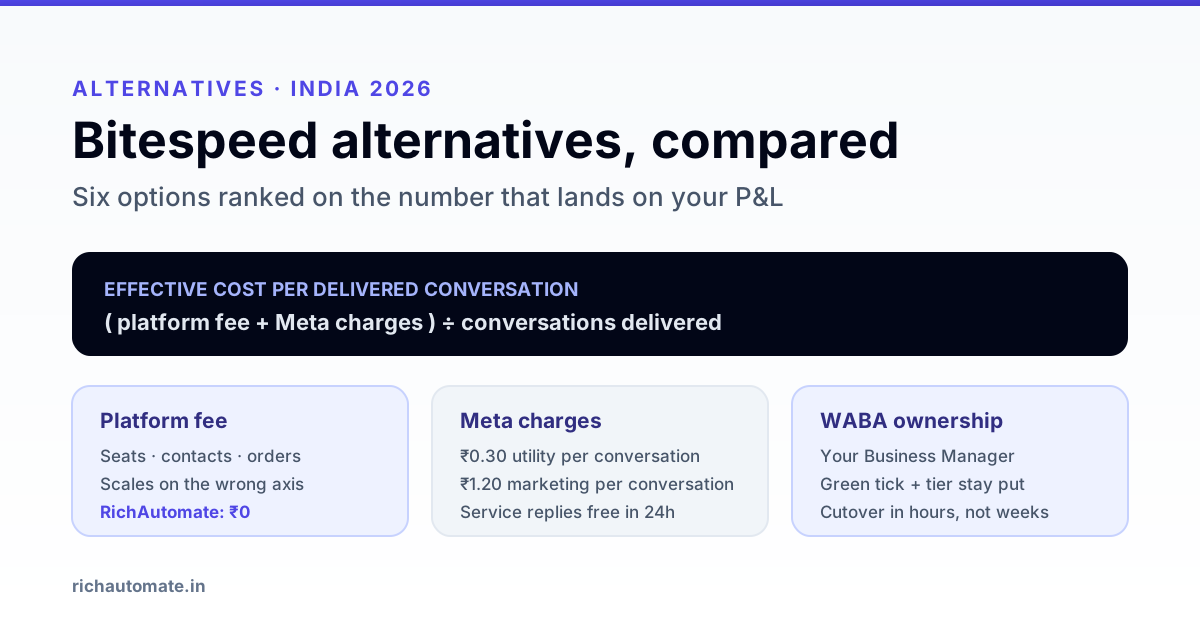
The short answer. The best Bitespeed alternative for an India business in 2026 is RichAutomate when WhatsApp is your primary channel and you want transparent, self-serve, rupee pricing with no platform fee. Bitespeed is a capable D2C growth suite — built for Shopify brands to run WhatsApp and Instagram marketing, abandoned-cart and checkout recovery, an AI chatbot and a shared support inbox, wired tightly into the store so campaigns and replies see the customer’s order and cart context (as listed on bitespeed.co, verify the current plans). But it is sold on tiered plans priced by contact and message volume, so your cost rises with your list size and plan tier rather than only with the messages you actually send. RichAutomate is India-native and WhatsApp-first on the official Meta WhatsApp Business API, with the platform fee stripped to zero: ₹0 platform, ₹0 setup, ₹0 monthly, no per-seat and no per-contact charge, and you pay only per message — Client Pay at a flat ₹0.10/message with Meta billed directly to you, or SaaS Pay all-in at ₹1.20 marketing / ₹0.30 utility-auth — plus a 14-day free trial with 100 free credits (a GST number is required to go live). If you genuinely want a bundled D2C growth-and-AI marketing suite wired into your Shopify store, Bitespeed may be the better fit, and we say so plainly below. If WhatsApp in India is the job, RichAutomate wins on price and speed. Treat every Bitespeed figure as “as listed on bitespeed.co, verify”; all rupee figures are illustrative.
If you are looking for a Bitespeed alternative, you are usually one of two people: a D2C brand that adopted Bitespeed for its Shopify-connected WhatsApp marketing and now finds the contact-and-message-tier pricing heavy for the WhatsApp volume you actually run; or a business comparing tools upfront and asking whether an India-native, WhatsApp-first platform would be cheaper and faster to operate. Bitespeed is a genuine e-commerce growth suite built in India (YC-backed), and for a Shopify brand whose value is cart recovery, retention campaigns, an AI concierge and support across WhatsApp and Instagram from one place, it can be an excellent tool (as listed on bitespeed.co, verify the current packaging). RichAutomate sits at the other end: an India-native, WhatsApp-first platform on the official Meta WhatsApp Business API, priced in rupees, designed so a founder, a lean team, an agency running several client numbers, or a scaling D2C brand can be live this week and pay nothing but the per-message cost — no platform fee, no setup, no monthly, no seat caps, no contact caps, no sales call. This guide walks the real differences honestly: a head-to-head table across the lines that move a decision, a straight “who should pick which” that names the buyer for whom Bitespeed is the better choice, illustrative rupee math, the 24–48 hour steps to stand up RichAutomate, and a five-question FAQ. Every Bitespeed price and feature is hedged “as listed on bitespeed.co, verify” because plans and packaging evolve; every RichAutomate number is real and current; and all cohort figures are illustrative, so model your own. This is general commercial information, not legal or pricing advice — confirm both vendors’ live terms before you commit.
The core difference in one paragraph
Bitespeed and RichAutomate solve overlapping but distinct problems, and being honest about that helps you choose well. Bitespeed is a D2C growth suite — its value is driving revenue for a Shopify brand through WhatsApp and Instagram marketing, abandoned-cart and checkout recovery, an AI chatbot that answers and recommends, and a shared support inbox, all reading the customer’s store, order and cart context — and it is sold on tiered plans priced by the size of your contact list and your message volume, so your bill scales with your audience and plan tier (as listed on bitespeed.co, verify). RichAutomate is a WhatsApp-first platform on the official Meta WhatsApp Business API, built for India, priced in rupees, self-serve, that charges ₹0 for the platform itself — no monthly fee, no setup, no per-seat charge, no per-contact charge — and bills only for the WhatsApp messages you actually send, either at a flat ₹0.10 per message on your own number with Meta billed direct (Client Pay), or all-in at ₹1.20 marketing / ₹0.30 utility-auth (SaaS Pay). The practical upshot: if the job to be done is “run a growth-and-retention machine for my Shopify store with AI and multichannel marketing baked in,” Bitespeed is purpose-built for it; if the job is “run WhatsApp as my primary channel in India at the lowest possible cost, transparently and self-serve, with official-API deliverability,” RichAutomate is purpose-built for that. Neither is universally better; the rest of this page matches the model to your shape.
Head-to-head comparison
The table below lines up the two on the dimensions that genuinely change the decision. Every Bitespeed cell is hedged because its plans are a published-but-tiered offering priced on contacts and volume that changes over time; verify the live position on bitespeed.co. RichAutomate’s figures are current, rupee-denominated, self-serve and flat.
| Dimension | Bitespeed (as listed on bitespeed.co, verify) | RichAutomate |
|---|---|---|
| Primary strength | D2C growth suite — cart recovery, retention, AI chatbot, WhatsApp + Instagram marketing tied to Shopify | WhatsApp-first, official Business API for India |
| Origin / market focus | India-origin (YC-backed), Shopify D2C focus — verify | India-native, built for Indian businesses |
| Pricing model | Tiered plans by contacts / message volume — verify | ₹0 platform; pay only per message, priced in ₹ |
| Platform fee | Monthly plan fee likely applies — verify | ₹0 platform fee |
| Cost driver | Contact-list size and plan tier — verify | Actual messages sent — nothing else |
| Buying motion | Self-serve tiers plus sales-led higher plans — verify | Self-serve — sign up and go live, no sales call |
| WhatsApp channel | Supported via official API within the suite — verify | Native, official Meta WhatsApp Business (Cloud) API |
| Instagram / other channels | Yes — WhatsApp + Instagram marketing — verify | Not the focus — WhatsApp-first by design |
| Abandoned-cart / checkout recovery | Yes — core growth-suite strength — verify | Shopify & WooCommerce cart/order flows via WhatsApp |
| AI chatbot / concierge | Yes — AI agent for support/recommendations — verify | No-code visual flow builder; official-API automation |
| Shopify / WooCommerce integration | Yes — deep Shopify order/cart context — verify | Shopify & WooCommerce integrations for WhatsApp flows |
| Shared support inbox | Yes — agent inbox with store context — verify | Shared team inbox: contacts, tags, assignment |
| WhatsApp broadcasts / templates | Yes — WhatsApp marketing on official API — verify | Native — marketing / utility / authentication templates, opted-in broadcasts |
| Per-message WhatsApp cost | Meta conversation charges plus plan/markup — verify | Client Pay ₹0.10/msg, or SaaS Pay ₹1.20 marketing / ₹0.30 utility-auth |
| Contact / seat caps | Contact-tier pricing; limits by plan — verify | No per-contact and no per-seat platform charge |
| Free trial | Free trial may exist — verify current terms | 14-day free trial + 100 free credits, self-serve |
The shape that emerges is consistent: Bitespeed is a tiered, contact-and-volume-priced D2C growth suite whose strength is Shopify-wired marketing, cart recovery and an AI concierge across WhatsApp and Instagram, while RichAutomate is a WhatsApp-first, India-native platform billed at ₹0 for the platform and only per message, self-serve. If your eyes went to the cart-recovery, AI-chatbot and Instagram-marketing rows, Bitespeed is likely your tool; if they went to the platform-fee, cost-driver, self-serve and per-message rows, RichAutomate’s zero-platform rupee proposition is what you want. For a clear breakdown of how RichAutomate’s two pricing modes work, see the Client Pay vs SaaS Pay billing guide, and for the cost mechanics underneath any WhatsApp tool read the WhatsApp Business API cost guide.
Honest — who should pick which
This is the section most alternative pages dodge, so here it is straight, both ways.
Pick Bitespeed if you run a D2C Shopify brand and your real need is a bundled growth-and-retention machine, not just a WhatsApp sender. If abandoned-cart and checkout recovery, retention and win-back campaigns, an AI chatbot that recommends products and deflects support, and marketing across both WhatsApp and Instagram — all reading your Shopify order and cart context out of the box — are the point, Bitespeed is built for exactly that e-commerce growth job and can be an excellent fit; evaluate it on those merits and verify the current plans and pricing on bitespeed.co. Do not switch to RichAutomate purely on WhatsApp price if a deep Shopify-wired marketing suite with an AI concierge and Instagram is the actual requirement, because RichAutomate is WhatsApp-first by design and does not try to be an omnichannel D2C growth suite; choosing it for a job it is not built for would be the wrong call.
Pick RichAutomate if WhatsApp is your primary channel and you are running it in India. Because RichAutomate charges ₹0 for the platform and bills only per message in rupees, self-serve, your cost tracks your real WhatsApp volume rather than your contact-list size or a plan tier, and you can go live without a sales cycle, grow your audience and add agents to the shared inbox without a per-contact or per-seat platform charge. This fits founders and SMBs watching every rupee, agencies running many client WhatsApp numbers who do not want a per-contact subscription per client, and scaling brands whose WhatsApp message volume — not a contact count — drives their cost. You get the official Meta WhatsApp Business API, the green-tick path, approved marketing, utility and authentication templates, opted-in broadcasts, a no-code flow builder, Shopify and WooCommerce integrations for order and cart flows, and a team inbox, all in rupees with GST invoicing in India, and a published price you can read before you sign up. The honest line: Bitespeed wins for D2C Shopify brands that truly want a bundled growth-and-AI marketing suite; RichAutomate wins decisively for WhatsApp-first India businesses that want zero platform fee, transparent rupee per-message pricing and no contact or seat ceilings. Weigh which of those two jobs is actually yours. For the wider field, see the best WhatsApp Business API providers in India 2026 roundup, and for how RichAutomate compares against managed WhatsApp tools read the best WhatsApp CRM for India 2026 guide.
Get a 1-minute BSP audit on WhatsApp
Drop your WhatsApp number — we line-item your current invoice against Meta India rates in under 60 seconds. India-hosted, DPDP-compliant.
One honest compliance note. For the WhatsApp channel specifically, both Bitespeed and RichAutomate route through Meta’s official WhatsApp Business API — which is the right place to be for broadcasts at scale. That said, no platform, on either side, can promise that a WhatsApp number will never be restricted. Meta controls enforcement, not the provider, and you should walk away from anyone who offers a “no-ban guarantee.” What actually keeps a number healthy is the same on any official-API tool: message only people who opted in, categorise templates honestly (marketing vs utility vs authentication), space your sends sensibly, keep content relevant, and handle opt-outs promptly and automatically. The platform gives you the rails; how you drive on them decides your quality rating. Verify Meta’s current messaging policy and quality-rating rules for 2026 before you scale.
Illustrative cost math
Numbers make the trade-off concrete, so here is illustrative math — model your own. Take a growing Indian D2C brand that has decided WhatsApp is its primary channel, running, say, 10,000 WhatsApp conversations a month: roughly 7,000 utility (order updates, shipping, COD confirmation, support replies) and 3,000 marketing (offers, cart recovery, re-engagement), with a contact list of tens of thousands. Every figure is illustrative and every Bitespeed figure must be verified on bitespeed.co, since Bitespeed’s cost is a tiered plan priced by contacts and message volume on top of Meta’s own WhatsApp conversation charges.
| Line item (illustrative) | Contact-tier growth suite (verify) | RichAutomate SaaS Pay | RichAutomate Client Pay |
|---|---|---|---|
| Platform / plan fee | Monthly plan fee by contact tier (verify) | ₹0 | ₹0 |
| 7,000 utility conversations | Meta conversation charges plus plan/markup (verify) | ~₹2,100 (7,000 × ₹0.30) | Meta direct + ~₹700 markup (7,000 × ₹0.10) |
| 3,000 marketing conversations | Meta conversation charges plus plan/markup (verify) | ~₹3,600 (3,000 × ₹1.20) | Meta direct + ~₹300 markup (3,000 × ₹0.10) |
| Buying / setup | Pick a tier by contact count, self-serve or sales (verify) | Self-serve, live in 24–48h | Self-serve, live in 24–48h |
| Indicative monthly total | Plan by contact tier + Meta’s WhatsApp charges | ~₹5,700 + 18% GST, no platform fee | ~₹1,000 markup + Meta’s own charge |
The structural point is not that one is always cheaper on every line — it is that the cost models differ in kind. A contact-tier growth suite bundles a monthly plan fee, contact-list pricing and marketing-and-AI breadth you may or may not use; a business that only needs WhatsApp can end up on a higher plan tier because its contact list grew, not because it sent more messages. RichAutomate removes the platform fee entirely and charges only per WhatsApp message in rupees, self-serve, so the bill tracks your actual sending volume, not your list size, and your team can grow contacts without a tier upgrade. For a WhatsApp-first brand in India whose cost is driven by message volume, the ₹0-platform rupee model is usually meaningfully cheaper over a year and far faster to start; for a business whose real value is a bundled Shopify growth suite with cart recovery and an AI concierge, the Bitespeed plan buys breadth the WhatsApp-only model does not centre on. Run your real message mix through the WABA cost calculator, read the deeper numbers in the cheapest WhatsApp Business API in India guide, and verify Meta’s live conversation rates and the GST treatment as of 2026.
How to go live on RichAutomate in 24–48 hours
If you decide WhatsApp is your primary channel in India and RichAutomate is the right fit, standing it up is a clean, self-serve process. Note that this is a fresh WhatsApp Business API setup rather than a like-for-like migration, because Bitespeed is a broader D2C growth suite — but if your WhatsApp number is already on the official API through Bitespeed, the number and its verification can be moved across rather than started from scratch; confirm the current path for 2026. The steps below are the typical route; timing depends on Meta’s own verification. First, start the 14-day free trial and create your account — no card, no sales call required (a GST number is needed to go fully live). Second, connect your WhatsApp Business number: if it already sits on the official API you initiate a migration and your Meta Business verification and WABA carry across, otherwise you complete Meta’s standard verification once. Third, create your message templates — write the wording for your order, shipping, support and offer messages and submit them for approval, which is usually quick for utility and authentication categories. Fourth, connect your store — wire up the Shopify or WooCommerce integration so order and cart events can drive your WhatsApp order-update and cart-recovery flows. Fifth, rebuild your core WhatsApp flows in the visual no-code builder — start with the one or two journeys that carry the most volume (order updates, cart recovery, support routing, lead capture) rather than porting everything at once, and add your agents to the team inbox. Then run both side by side: keep Bitespeed live for any Instagram marketing, AI-concierge or retention automation you still need, route your WhatsApp traffic through RichAutomate, and compare the all-in WhatsApp cost and deliverability before you change anything. Keep opt-in and opt-out handling intact throughout so consent is never broken in the move, and time the switch so it does not clash with a major campaign. Verify the current number-migration and template-approval rules against Meta’s live 2026 documentation, and treat the 24–48 hour window as typical rather than guaranteed.
What you keep either way. For the WhatsApp channel, because both Bitespeed and RichAutomate use the official API, moving your WhatsApp workload does not cost you the things that matter most — your verified number, the green-tick path, approved templates, the 24-hour service window and Meta’s conversation-pricing categories all carry across. What changes is the model underneath: a tiered, contact-priced D2C growth suite (Bitespeed) versus ₹0 platform and pay-only-per-WhatsApp-message in rupees, self-serve (RichAutomate). So the question is not “which one does official WhatsApp” — both do — but “is WhatsApp my main channel in India that I want to run transparently and self-serve, or is it one part of a bundled Shopify growth suite priced by my contact list.” For the deeper cost view underneath either choice, see the WhatsApp Business API cost guide.
The honest bottom line
Bitespeed and RichAutomate are both credible, India-built tools, but they answer different questions, and the choice should follow the job you actually need done. Bitespeed earns its contact-tier plan when you want a D2C growth suite for a Shopify brand — cart and checkout recovery, retention campaigns, an AI chatbot and marketing across WhatsApp and Instagram, all reading your store context; if that breadth is the point, evaluate it on its merits and verify the current plans on bitespeed.co. RichAutomate is the WhatsApp-first, India-native, platform-fee-free alternative that wins when WhatsApp is your primary channel — live fast on the official Business API, self-serve, with the green tick, approved templates and broadcasts, a no-code builder, Shopify and WooCommerce integrations and a team inbox, priced in rupees, tracking only what you send, with no platform, contact or seat fees — ₹0 platform, ₹0 setup, ₹0 monthly, with Client Pay at a flat ₹0.10 per message (Meta billed direct to you) or SaaS Pay at an all-in ₹1.20 marketing / ₹0.30 utility-auth, plus a 14-day free trial with 100 free credits (a GST number is required to go live). Verify every Bitespeed specific on bitespeed.co and every Meta and GST detail against the live 2026 position; all rupee figures here are illustrative. This is general commercial information, not legal or pricing advice; no vendor can guarantee against a WhatsApp number restriction, and what keeps a number healthy is relevant, consented, well-spaced messaging on the official API with prompt opt-out handling.
Run WhatsApp as your main channel — ₹0 platform, ₹0 setup, pay only per message
If WhatsApp is your primary channel in India and you want the speed and cost of a self-serve, official WhatsApp Business API platform — no platform fee, no setup, no monthly, no contact caps, no seat caps, no sales cycle, rupee billing with GST invoicing, the green-tick path, approved templates and broadcasts, transparent per-message pricing, Shopify and WooCommerce integrations, and a no-code flow builder and team inbox you operate yourself — RichAutomate gets you live on the official API, typically within 24–48 hours. Pricing is flat: ₹0 platform fee, ₹0 setup, ₹0 monthly, with Client Pay at a flat ₹0.10 per message on your own WhatsApp number (Meta’s conversation charge billed to you directly by Meta) or SaaS Pay at an all-in ₹1.20 marketing / ₹0.30 utility-auth. Start the 14-day free trial with 100 free credits, set up one high-volume WhatsApp flow, run it side by side with your current tool, and compare the bill before you commit. If you truly want a bundled D2C growth suite with cart recovery, an AI concierge and Instagram marketing wired into your Shopify store — the job Bitespeed is built for — we will tell you so. WhatsApp us at 917434901027 or book a 30-minute walkthrough at https://calendly.com/inrichdaddy/30min. (This is general commercial information, not legal or pricing advice. Every Bitespeed specific must be verified on bitespeed.co and every Meta and GST detail against the live 2026 position; all rupee figures are illustrative; a GST number is required to go live; no vendor can guarantee against a ban.)
Start your 14-day free trial → · See full pricing · Run the WABA cost calculator
Related reading: Pinnacle vs RichAutomate 2026 pricing decoded · BizMagnets vs RichAutomate 2026 pricing decoded.