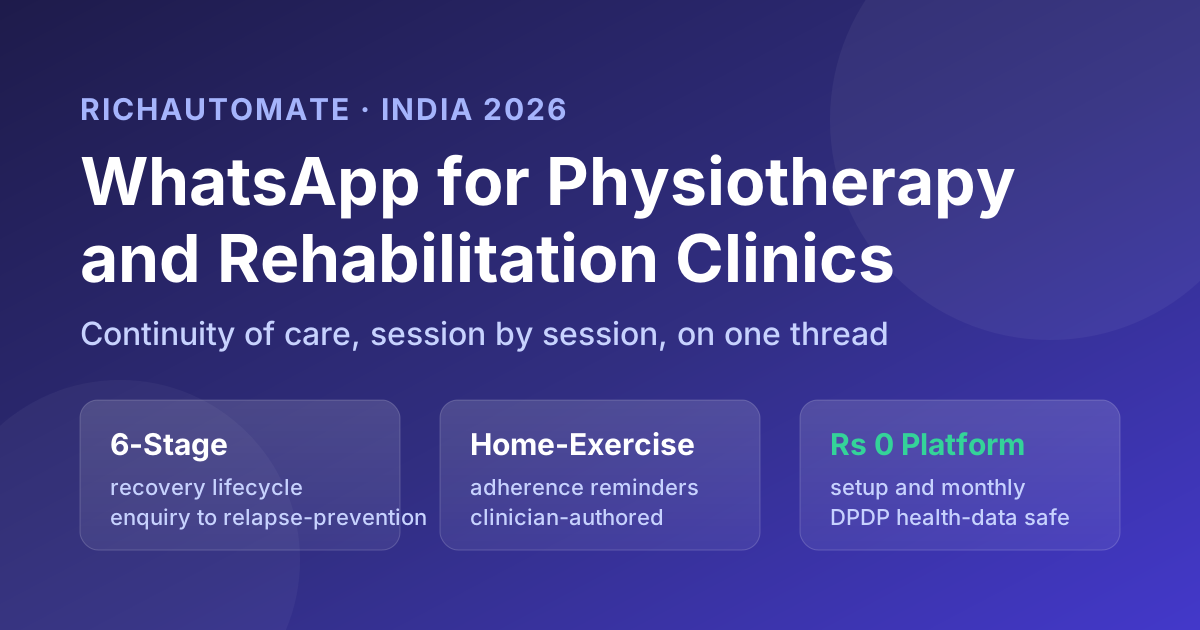
A physiotherapy or rehabilitation clinic does not sell a single product or a one-time procedure — it sells a recovery, and a recovery is a journey of repeated visits stretched across weeks. A patient walks in with back pain, a post-surgery knee, a sports injury or a stroke to rehabilitate, and the outcome depends almost entirely on one fragile thing: whether they keep coming back, session after session, and whether they do the prescribed home exercises in between. The single biggest leak in Indian physiotherapy practice is not clinical skill — it is the patient who feels a little better after three sessions, skips the fourth, never finishes the prescribed twelve, and relapses. For the physiotherapist, rehab-centre owner and sports-physio clinic in 2026, the entire continuity of care increasingly lives best where the patient already is — on WhatsApp. This is the deep-research playbook for running the physiotherapy and rehabilitation patient lifecycle over WhatsApp: the first enquiry, the assessment booking, the session-by-session reminders, the home-exercise programme, the progress check and the discharge-and-relapse-prevention follow-up. Every regulator, body and pricing specific below is hedged — Indian healthcare regulation and allied-health rules move quickly, so treat each as "verify as of 2026," treat every cohort figure as illustrative, and treat none of this as medical or legal advice.
Why physiotherapy recovery is a WhatsApp problem. Physiotherapy is the most reminder-dependent corner of healthcare. The same reminder-and-retention discipline drives our WhatsApp playbook for mental-health and counselling clinics, where cutting no-shows keeps a course of care on track. A course of treatment is rarely one visit — it is six, twelve or more sessions spread over weeks, plus a home-exercise programme the patient must actually do between visits. Drop-off is the enemy of outcomes: a patient who quits at session four because the acute pain eased gets a worse long-term result and a relapse that could have been prevented. Email is ignored, phone calls do not scale across a full appointment book, and a busy front desk cannot personally chase every patient's next session and every home-exercise reminder. WhatsApp — opened within minutes, read far more than email — is where a clinic keeps a patient engaged across the full course of care, sends the prescribed-exercise reminders, confirms the next slot, and follows up after discharge, provided every send is consent-based, clinically honest and respects the sensitivity of health data. Verify the operative rules as of 2026.
Why drop-off, not acquisition, is the real problem in physiotherapy
Most physiotherapy marketing obsesses over getting the first patient through the door. But the economics of a rehab clinic are decided after that — in whether the patient completes the prescribed course. A clinic that converts an enquiry into a first assessment but loses the patient at session four has done the hard, expensive acquisition work and thrown away the recovery and the revenue. The table below maps where physiotherapy patients leak out of the journey and the WhatsApp job that plugs each leak. It is directional — verify your own pattern as of 2026.
| Leak point in the recovery journey | Why patients drop off here | The WhatsApp job that plugs it |
|---|---|---|
| Enquiry to first assessment | Slow reply, unclear pricing, no easy booking | Instant reply, clear assessment info, one-tap slot booking |
| First session to mid-course | Forgotten appointments, busy life, no reminders | Session reminders the day before and an hour before |
| Mid-course "I feel better" drop-off | Acute pain eased; patient stops early and relapses | Progress framing, home-exercise nudges, why-finish messaging |
| Home-exercise non-adherence | Patient forgets or stops the prescribed programme | Scheduled exercise reminders with the clinician's instructions |
| Discharge to relapse | No follow-up; pain returns months later, patient goes elsewhere | Post-discharge check-in and a maintenance/re-assessment thread |
The reframe every clinic owner eventually makes: acquisition gets you a patient, but continuity of care gets you an outcome, a referral and a relationship that returns the next time something hurts. WhatsApp is the lowest-friction channel for continuity — it sits in the patient's pocket, it carries reminders and exercise instructions, and it keeps the clinic present across the whole course instead of going silent the moment the patient leaves the room.
The regulators and bodies a physiotherapy clinic must keep clean
Before you automate a single message, understand the compliance surface a physiotherapy or rehabilitation practice sits on. You do not need to be a lawyer, but you do need to know which rule each part of your operation leans on — and health data is among the most sensitive categories there is. The table below is directional — verify each line against the current position and your own state's rules as of 2026.
| Body / rule (verify 2026) | What it governs for a physio / rehab clinic | Where it touches your WhatsApp flow |
|---|---|---|
| NCAHP Act 2021 (allied & healthcare professions) | Recognition and conduct of physiotherapists as allied health professionals; state councils | Clinical claims and titles in messaging must reflect genuine qualification and scope |
| Clinical Establishments Act / state registration | Registration and standards of clinics and rehab establishments (where applicable) | Clinic identity and claims in messaging must match your registered, lawful status |
| State physiotherapy councils / professional conduct | Professional conduct, ethics and advertising norms for practitioners | No exaggerated cure claims; keep marketing copy honest and within conduct norms |
| DPDP (data protection) — health data | Patient personal and health data: consent, purpose limitation, retention, security | Health data is sensitive; every send needs lawful basis, minimisation and strong consent |
| Consumer Protection / ASCI advertising norms | Truthful advertising; no misleading health or outcome claims | Offer and outcome messaging must be honest; never guarantee a recovery |
| GST (on applicable services / products) | Tax treatment of services and any products supplied, per current rules | Invoice and payment messages must reference correct, GST-compliant documents |
The single discipline that keeps this clean: WhatsApp is a communication layer over a practice that must already be clinically and legally sound. The chatbot does not diagnose, does not promise a cure, and does not replace a clinician's judgement — it books, reminds, delivers prescribed instructions written by the clinician, and follows up. Health messaging is held to a higher honesty bar than retail: never let a template imply a guaranteed outcome, never let automation give clinical advice it is not qualified to give, and always route anything clinical to the physiotherapist. Keep the practice lawful and let WhatsApp narrate it accurately and humanely.
The six-stage WhatsApp physiotherapy lifecycle
Here is the end-to-end recovery lifecycle a physiotherapy or rehabilitation clinic can run over WhatsApp, mapped to the automation at each stage and the compliance guardrail that keeps it honest. Treat the automation column as a reference pattern and the guardrail column as principles to verify against current rules as of 2026.
| Lifecycle stage | WhatsApp automation | Compliance guardrail (verify 2026) |
|---|---|---|
| 1. Enquiry & triage | Click-to-WhatsApp captures the complaint type (back, knee, post-surgery, sports, neuro); bot shares assessment info and books a slot | Capture consent at first contact; no diagnosis by bot; route clinical questions to a human |
| 2. Assessment booking + reminder | Booking flow offers assessment slots; reminders the day before and an hour before to cut no-shows | Reminders are utility-style; factual, not promotional; honour opt-out |
| 3. Treatment-plan onboarding | After assessment, the clinic shares the session plan, schedule and what to expect, in-thread | Plan content authored by the clinician; no implied guaranteed outcome |
| 4. Session-by-session reminders | Automated reminder before each scheduled session across the full course; easy reschedule | Separate consent for treatment reminders vs marketing; minimise health detail in messages |
| 5. Home-exercise programme | Scheduled reminders to do the prescribed home exercises, with the clinician's instructions and video/PDF | Exercises prescribed by the clinician; not generic advice; respect sensitivity of data |
| 6. Progress, discharge & relapse prevention | Progress check-ins, a discharge summary, and a maintenance/re-assessment follow-up months later | Honest progress framing; consent for follow-up; lawful retention of records |
Notice the rhythm: WhatsApp narrates and nudges a recovery that the physiotherapist directs. The treatment plan is the clinician's; WhatsApp delivers it and reminds. The home-exercise programme is prescribed by the clinician; WhatsApp surfaces it at the scheduled times. That separation — WhatsApp as the conversation layer, the clinician as the source of clinical truth — is what lets a small practice keep patients engaged across a full course without the front desk drowning in manual calls. For the broader allied-health clinic pattern, our audiology and hearing-care clinic guide is a close companion.
The click-to-WhatsApp link generator produces the link and the QR code together if you need both.
The home-exercise programme: the thread that decides the outcome
The single highest-leverage conversation in physiotherapy is not the in-clinic session — it is the home-exercise programme between sessions. A patient typically spends an hour or less a week in the clinic and the rest of the week at home, where the prescribed exercises either get done or they do not. Adherence to the home programme is one of the strongest predictors of recovery, and it is exactly where patients fail — they forget, they get busy, the acute pain eases and motivation drops. WhatsApp is the highest-leverage channel to fix this: scheduled reminders to do the day's exercises, the clinician's own instructions delivered as a short video or PDF, and a simple in-thread way for the patient to flag pain or ask a question that routes to the physiotherapist. Done well, the home-exercise thread turns a passive patient into an engaged participant in their own recovery — which improves outcomes, which earns referrals, which is the real growth engine of a clinic.
The home-exercise discipline, in one principle. Treat the home programme as a clinician-authored, consent-based reminder sequence, not generic fitness content. The exercises, the frequency and the instructions come from the physiotherapist who assessed the patient — WhatsApp only schedules and delivers them. Keep each reminder short and supportive, attach the clinician's own video or PDF rather than random internet content, and make it trivially easy for the patient to reply if something hurts or they are unsure, with anything clinical routed to a human. Minimise the health detail you put in any message, secure the records, and take separate, specific consent for these reminders. The thread should feel like a caring clinic checking in, never like spam. Verify the operative professional-conduct and DPDP rules as of 2026; this is not medical advice.
For the relationship and record-keeping view across the whole patient base, the best WhatsApp API for healthcare in India guide covers the DPDP-aware, health-data-safe setup in depth.
Get a 1-minute BSP audit on WhatsApp
Drop your WhatsApp number — we line-item your current invoice against Meta India rates in under 60 seconds. India-hosted, DPDP-compliant.
The automation stack that runs it
The good news for a physiotherapy clinic is that none of this needs custom engineering. The building blocks map cleanly onto a standard WhatsApp Business API automation stack: a booking flow for assessment and session slots using buttons and date/time selection; a chatbot FAQ that answers the predictable non-clinical questions — location, timings, pricing, what to bring, parking — without a human; an appointment-reminder engine that fires the day-before and hour-before nudges for every session in the course; a home-exercise reminder sequence that delivers the clinician's prescribed instructions and media at scheduled times; payment links and UPI for session fees and packages with GST-compliant invoices; broadcast for opted-in clinic updates and seasonal health-awareness messaging; and a human handoff the moment a patient asks anything clinical, expresses pain or needs judgement. The patient never leaves WhatsApp, and your front desk gains a tireless coordinator. The discipline is to keep the chatbot scoped strictly to logistics and clinician-authored content, and to route every clinical question to the physiotherapist. For the relationship-management view, the best WhatsApp CRM for India guide is a useful companion.
Front-desk calls vs aggregator listings vs an owned WhatsApp line
Most physiotherapy clinics run patient communication through three channels, and they are not equal in cost, control or continuity. Aggregator and listing platforms drive first-time enquiries but are price-driven, shared and thin on the relationship; manual front-desk calls are personal but do not scale across a full appointment book and a course of many sessions; an owned WhatsApp line is the channel the clinic controls end to end and the only one where continuity of care — session reminders, home-exercise adherence, discharge follow-up — actually compounds. This comparison is directional — verify your own economics as of 2026.
| Dimension | Owned WhatsApp line | Aggregator / listing platform | Manual front-desk calls |
|---|---|---|---|
| Acquisition cost | Ad/listing cost to start the chat, then near-zero to nurture the course | Commission or lead fee, often recurring | Low marketing cost; high staff-time cost |
| Patient ownership | Yours alone — you own the thread across the full course and beyond | Frequently mediated by the platform | Yours, but only if captured with consent |
| Session-by-session continuity | Native — automated reminders for every session in the course | Hard to drive continuity outside the platform | Manual; breaks down across a busy book |
| Home-exercise adherence | Native — scheduled, clinician-authored exercise reminders | Not supported | Rarely done; staff have no time |
| Discharge to re-engagement | Native — post-discharge check-in and maintenance re-assessment thread | Hard to re-engage off-platform | Almost never happens manually |
The conclusion most clinic owners reach: use aggregators and listings to start patient relationships, but move every patient onto your owned WhatsApp line as fast as possible — because that is where the cheap, repeatable, outcome-defining work of session reminders, home-exercise adherence and discharge follow-up actually happens. The aggregator delivers a first visit; the owned thread carries the recovery, the referral and the next episode of care months or years later.
DPDP and the health-data carve-out
A physiotherapy clinic holds some of the most sensitive data there is: a patient's condition, injury, surgical history, pain levels and treatment plan, all tied to their identity. Under India's data-protection regime the principles are the familiar ones — lawful basis, purpose limitation, data minimisation, retention limits, security and the ability to honour deletion — but for health data the bar is higher and the consequences of a leak are more serious. A patient's musculoskeletal or neurological condition is not data to be casual with.
The health-data carve-out, in one principle. Practise aggressive data minimisation across the whole clinic. Take separate, specific, informed consent for transactional WhatsApp (booking, session reminders, home-exercise instructions, invoices) versus any marketing (clinic updates, offers); honour opt-out promptly. In the messages themselves, keep clinical detail to the minimum the patient needs — a reminder can say "your physiotherapy session" without restating the diagnosis. Store the actual clinical records in your secure practice system, not scattered in chat logs; retain only what you must, for as long as you must; and be able to answer, for any patient, what the lawful basis is and when their data will be deleted. Where a minor is the patient, take special care with parental consent. Verify the operative DPDP provisions and professional-conduct norms as of 2026; this is operational guidance, not medical or legal advice.
The mindset is "least data, clear purpose, finite retention, higher bar for health." A physiotherapy clinic that treats patient health data with this discipline is not only compliant — it is more trustworthy to the very patients whose continued attendance and referrals decide whether the clinic grows.
The economics: an illustrative physiotherapy cohort
Compliance and architecture are the floor; the reason to run WhatsApp across the recovery lifecycle is fewer missed sessions, higher course-completion, better home-exercise adherence, more discharge follow-ups recovered and more referrals. Consider an illustrative physiotherapy or rehab clinic running a mix of orthopaedic, post-surgical, sports and general musculoskeletal patients on multi-session courses. Every figure below is illustrative — model your own on the calculator — but it shows the shape of the case.
| Metric (illustrative) | Without WhatsApp lifecycle | With WhatsApp lifecycle |
|---|---|---|
| Session no-show rate | ~Higher (no reminders) | ~Lower (day-before + hour-before reminders) |
| Course-completion rate | Baseline; many quit when acute pain eases | Lifted by progress framing + reminders |
| Home-exercise adherence | Low; patients forget between visits | Higher (scheduled clinician-authored nudges) |
| Discharged patients re-engaged later | ~Few (no follow-up) | ~More (post-discharge check-in thread) |
| WhatsApp messaging cost | ₹0 | Utility reminders at the cheapest tier |
The asymmetry is the argument: session reminders, treatment-plan onboarding, home-exercise nudges, invoices and discharge follow-ups are utility-category conversations — the cheapest tier — and they directly reduce the most expensive failures in a physiotherapy clinic, namely empty appointment slots, abandoned courses, poor adherence and lost-to-follow-up patients who relapse and go elsewhere. A handful of completed courses and a few re-engaged discharged patients a month dwarf the messaging bill, which is a rounding error against the recovery outcomes and referral revenue it protects. Run your own figures on the WABA pricing and cost-optimisation guide and the calculator before committing.
Build the physiotherapy lifecycle on RichAutomate
You can stand up the entire recovery-lifecycle layer — click-to-WhatsApp enquiry and triage with human routing for anything clinical, assessment and session-slot booking with reminders, clinician-authored treatment-plan onboarding, session-by-session reminders across the full course, scheduled home-exercise reminders delivering the clinician's own video or PDF instructions, GST-compliant invoices with UPI links, opted-in clinic updates, and a discharge and maintenance re-assessment follow-up thread — without engineering lift, while your secure practice system stays the source of clinical truth. RichAutomate charges ₹0 platform fee, ₹0 setup, ₹0 monthly. On Client Pay you pay only ₹0.10 per message plus Meta's own per-conversation charge billed to you directly by Meta at Meta's rates; on SaaS Pay it is an all-in ₹1.20 per marketing conversation and ₹0.30 per utility conversation — and session reminders, treatment-plan onboarding, home-exercise nudges, invoices and discharge follow-ups are utility conversations, the cheaper category. There is a 14-day free trial with 100 credits, so you can measure the no-show, course-completion and adherence improvement before committing. Keep WhatsApp as the conversation layer, keep your practice system and the physiotherapist as the clinical source of truth, and verify the NCAHP Act, Clinical Establishments registration, state physiotherapy-council conduct norms, ASCI and consumer-protection advertising rules, GST and DPDP health-data rules as of 2026. See the full pricing page for details.
Keep every patient on the path to recovery
A physiotherapy or rehabilitation clinic does not have to let recoveries leak away because a patient forgot the next session, skipped the home exercises, or was never followed up after discharge. From the click-to-WhatsApp enquiry and triage, through the booked-and-reminded assessment, the clinician-authored treatment plan, the session-by-session reminders, the scheduled home-exercise programme with the physiotherapist's own instructions, the honest progress check, and the discharge and maintenance re-assessment follow-up — WhatsApp can be the one continuous patient thread, while your secure practice system and the clinician stay the source of clinical truth and you minimise sensitive health data at every step. On illustrative numbers that means fewer no-shows, higher course-completion, better home-exercise adherence and more re-engaged patients, for a messaging bill that is a rounding error. RichAutomate's pricing stays flat through all of it: ₹0 platform fee, ₹0 setup, ₹0 monthly — Client Pay at ₹0.10 per message with Meta conversation charges billed direct by Meta, or SaaS Pay at ₹1.20 marketing / ₹0.30 utility all-in. Start the 14-day free trial with 100 credits, WhatsApp us at 917434901027, or book a 30-minute walkthrough at https://calendly.com/inrichdaddy/30min. (All cohort, no-show, completion and adherence figures here are illustrative — model your own on the calculator — and the NCAHP Act, Clinical Establishments registration, state physiotherapy-council conduct norms, ASCI and consumer-protection rules, GST and DPDP health-data rules change; verify the current position as of 2026. This is operational guidance, not medical or legal advice.)
Start your 14-day free trial → · See full pricing · Read the healthcare WhatsApp guide
Related: WhatsApp for autism & child-therapy centres in India (2026) — warm screening intake, session reminders that crush no-shows, home-program sharing and DPDP-safe handling of a child's records.
Related: WhatsApp for medical-equipment rental & home care in India 2026 — enquiry capture, delivery proof, deposit and return-condition reconciliation on one thread.
Related: WhatsApp for de-addiction & rehabilitation centres in India (2026) — confidential admission enquiries, consent-gated family updates and relapse-prevention follow-up on one private thread.