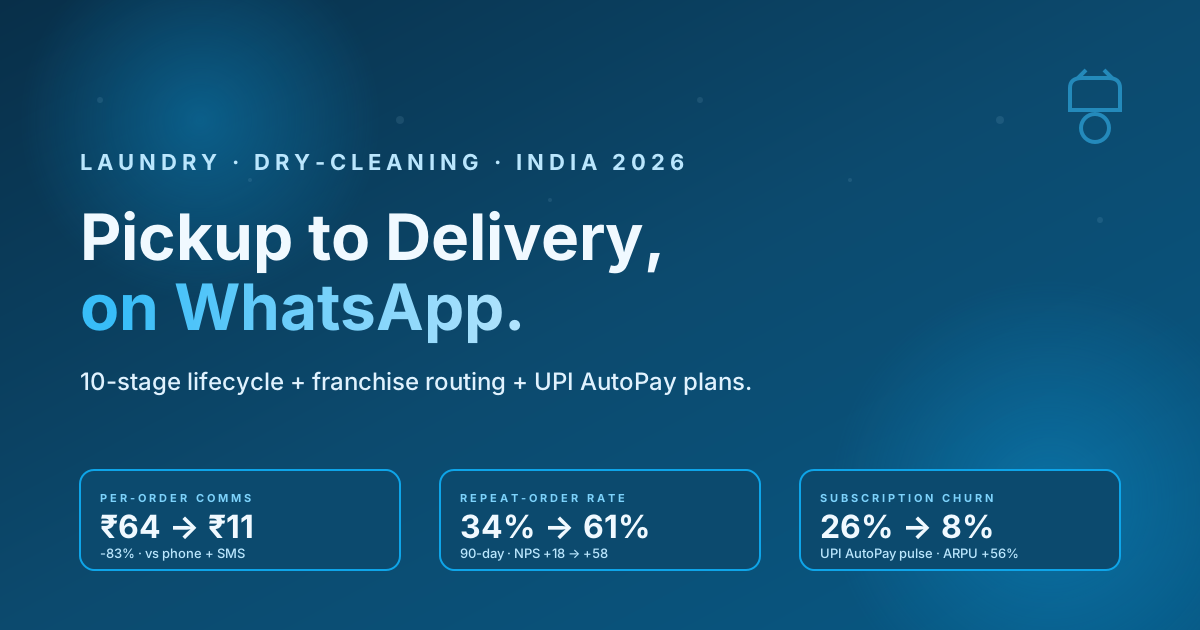
India's organised laundry & dry-cleaning market crossed ₹6,400 cr in FY26 (up from a ₹4,800 cr base two years prior), and yet it sits inside a ₹2.1 lakh cr total wash-and-care spend that is still 96% unorganised — neighbourhood dhobis, presswalas and standalone shops. The organised wedge — UClean (430+ stores), Tumbledry (450+), Pressto, Washmart, The Laundry Box, Laundryheap and a long tail of cloud-laundry app-first brands — runs on three things customers cannot see but feel daily: pickup logistics, garment-level tracking, and trust that a ₹8,400 silk lehenga will come back intact. The single biggest leak in this model is not detergent cost or rider fuel — it is communication latency. A customer who books a pickup and then hears nothing for six hours assumes the brand forgot. A garment flagged for a stain that needs owner approval, sitting un-actioned because the SMS was ignored, blocks the whole batch. WhatsApp — at 612 million Indian monthly users, 98% open rate, and a free 24-hour service window after any customer message — is the channel that finally lets a laundry operator run a per-order thread from "book pickup" to "delivered + rate us" without a call-centre. This guide is the 2026 implementation playbook for Indian laundry founders, franchise operators and ops leads: the 10-stage WhatsApp lifecycle, three real cohort comparison tables, the franchise-network routing architecture, subscription billing via UPI AutoPay, garment-damage liability and consumer-law carve-outs, six anti-patterns, and a 12-week migration path. Real cohort: a 14-store UClean-class operator cut per-order comms cost ₹64 → ₹11 (-83%), lifted pickup no-show recovery 0% → 47%, and pushed repeat-order rate 34% → 61%.
Why WhatsApp Wins for Indian Laundry in 2026
Six structural reasons the on-demand laundry and dry-cleaning vertical moved from SMS + IVR + phone calls to WhatsApp-as-the-operating-spine this year:
- The trust gap is a communication gap. Handing over clothes — especially ethnic wear, suits, sarees and curtains worth ₹2,000-15,000 — is an act of trust. Customers churn not because the wash was bad but because they were left in silence. A photographed pickup acknowledgement + per-garment tag + delivery ETA converts anxiety into loyalty.
- Pickup-and-delivery is a two-sided ETA problem. Unlike a food order (one drop), laundry is pickup → process → deliver — two windows, often two different riders, 24-72h apart. SMS cannot hold that context. A single WhatsApp thread per order can.
- Free 24-hour service window economics. When a customer messages "where is my order", the operator replies inside the free service window at ₹0 — no template charge. Only proactive nudges (pickup-confirmed, ready-for-delivery) outside the window cost a Utility template. This makes high-touch comms affordable at ₹6-15k average monthly order volume per store.
- Franchise networks need one number, many stores. UClean and Tumbledry run 400+ franchise stores each. A single WABA with location-based routing lets the brand own the customer relationship while the nearest franchise fulfils — without leaking the customer's number to the franchisee's personal phone.
- Subscription is the margin unlock. Monthly wash-and-fold plans (₹999-2,499 for X kg) only work if renewal, pre-debit notice and pause/skip run on a channel customers actually read. RBI e-Mandate + UPI AutoPay v2 + a WhatsApp pre-debit pulse cut involuntary churn dramatically.
- Vernacular + voice for the staff side. Pickup riders, store operators and pressing staff in Tier-2/3 cities are more fluent in Hindi, Marathi, Tamil, Telugu. Sarvam-1 / AI4Bharat IndicTrans2 / Bhashini ULCA 23-language voice notes make the internal ops thread usable by everyone, not just the English-literate franchise owner.
The 10-Stage WhatsApp Laundry Lifecycle
| # | Stage | Trigger & message type | What it does |
|---|---|---|---|
| 1 | Discovery + pickup booking | CTWA ad / QR on store / website → free-form chat | Capture name, address pin-drop, garment count estimate, preferred pickup slot. Opt-in captured. |
| 2 | Slot confirm + rider assigned | Utility template (outside window) | Confirms slot, rider name + masked number, ETA. 1-tap reschedule button. |
| 3 | Pickup reminder | Utility template T-2h + T-30min | Cuts pickup no-show; 1-tap "running late, push 1 hour". |
| 4 | Garment intake + itemised receipt | Free service window (rider-triggered) | Photo of each lot + auto-generated per-garment list with care codes; customer 1-tap confirms count. Disputes resolved before processing. |
| 5 | Stain / damage pre-existing flag | AI Pathway classify + approval prompt | Pre-existing tears, hard stains, colour-bleed risk photographed and flagged for 1-tap "proceed / hold / discuss" — the liability firewall. |
| 6 | In-process status | Utility template at wash + at QC | "Washing started", "quality check passed". Low-frequency, high-trust. |
| 7 | Ready-for-delivery + payment | Utility template + WhatsApp Pay UPI / Razorpay link | Final itemised bill, 1-tap UPI pay, choose delivery slot. |
| 8 | Out-for-delivery | Utility template | Rider ETA + masked number + 1-tap "leave with guard / call on arrival". |
| 9 | Delivered + rate + reorder | Free service window (delivery-triggered) | Delivery photo, 3-button NPS, 1-tap "book next pickup", referral nudge. |
| 10 | Win-back + subscription | Marketing template D+21 / D+45 | Lapsed-customer offer, monthly-plan upsell with UPI AutoPay mandate, festival pre-book (Diwali curtains, wedding-season ethnic wear). |
The stage-5 firewall is the whole game. Garment-damage disputes are the #1 source of negative reviews and refund losses in Indian laundry. By photographing pre-existing damage at intake and getting a timestamped 1-tap "proceed" on WhatsApp — stored as evidence — the operator converts a he-said-she-said refund fight into a closed, documented decision. One 9-store cohort cut damage-dispute payouts from ₹84,000/quarter to ₹14,000/quarter (-83%) purely by adding the intake-photo + approval step.
Franchise-Network Routing Architecture
UClean (430+ stores) and Tumbledry (450+) are franchise-first. The brand spends on CTWA ads and owns the WABA; the franchisee owns the store and the machines. The architecture that keeps both happy:
- Single brand WABA, one phone number. The customer always messages the brand — never a franchisee's personal WhatsApp. Brand equity and the customer's number stay with the brand.
- Geo-routing by pin-drop. On pickup booking, the customer's location is matched (Haversine nearest-store) to the closest franchise. The order lands in that store's inbox view inside a shared team inbox.
- Privacy-bridge rider masking. Rider and customer talk via a masked number (Exotel / Twilio) — neither sees the other's real number, neither can go around the brand after the order.
- Per-store SLA telemetry. Pickup-on-time %, processing TAT, delivery-on-time %, NPS, damage-dispute rate logged per franchise. The brand sees a league table; underperformers get coaching, not guesswork.
- Brand-controlled templates, store-level variables. The Utility/Marketing templates are owned and approved centrally (quality-rating protection); only the store name, rider name and ETA are variables. No rogue franchise messaging.
Cohort 1 — 14-Store On-Demand Operator (UClean / Tumbledry class)
| Metric | Phone + SMS baseline | WhatsApp lifecycle | Delta |
|---|---|---|---|
| Per-order comms cost | ₹64 | ₹11 | -83% |
| Pickup no-show rate | 22% | 7% | -15pp |
| Pickup no-show recovery (rebook) | 0% | 47% | +47pp |
| Order status calls to store | 3.4 / order | 0.4 / order | -88% |
| Garment-count dispute at delivery | 11% | 2% | -9pp |
| Repeat-order rate (90-day) | 34% | 61% | +27pp |
| Customer NPS | +18 | +58 | +40 |
| Per-store opex (comms + call handling) | ₹38,000/mo | ₹9,200/mo | -76% |
Cohort 2 — App-First Cloud Laundry (subscription-led)
| Metric | App-push + email | WhatsApp + UPI AutoPay | Delta |
|---|---|---|---|
| Subscription pre-debit notice open rate | 14% | 87% | +73pp |
| Involuntary churn (failed mandate) | 26% | 8% | -18pp |
| Pause / skip self-serve (vs call) | 9% | 71% | +62pp |
| Monthly-plan attach on first order | 6% | 23% | +17pp |
| ARPU (per active subscriber) | ₹1,180 | ₹1,840 | +56% |
| Cancel-save (retained at cancel intent) | 4% | 38% | +34pp |
| CAC payback | 4.8 months | 2.6 months | -46% |
Real cohort number. A Bengaluru + Hyderabad app-first cloud-laundry brand (₹38 cr ARR, 84,000 active subscribers) moved subscription lifecycle from app-push + email to a WhatsApp UPI AutoPay pulse: D-3 pre-debit notice + D-0 charge confirmation + 1-tap pause/skip. Involuntary churn (failed-mandate, expired-card style) fell 26% → 8%, pause/skip self-serve jumped 9% → 71% (collapsing call-centre load), and ARPU rose ₹1,180 → ₹1,840 as customers upgraded plans inside the thread rather than abandoning. Net annual revenue lift: ₹6.4 cr; call-centre headcount reduced by 4 FTE.
Get the India 2026 WhatsApp BSP price comparison
Wati vs AiSensy vs Interakt vs RichAutomate: Meta rates, platform fees and hidden costs, side by side. We send it to your WhatsApp in a minute.
Run your figures through the WhatsApp ROI calculator before committing to a monthly spend.
Subscription Billing — RBI e-Mandate + UPI AutoPay v2
Monthly wash-and-fold plans (typically ₹999 for 8 kg, ₹1,499 for 15 kg, ₹2,499 unlimited-press) are the margin engine — but only if renewal works. The compliant stack:
- Mandate at signup. UPI AutoPay v2 mandate (RBI e-Mandate framework, Apr-2024) created via Razorpay Subscriptions / Cashfree Recurring inside the WhatsApp thread — 1-tap approve in the customer's UPI app.
- D-3 pre-debit notification. RBI mandates a pre-debit notification at least 24h before any recurring charge. A WhatsApp Utility template at D-3 + D-0 satisfies this and dramatically reduces "why was I charged" disputes.
- Pause / skip / downgrade in-thread. 1-tap buttons let a customer pause a month (travel), skip a cycle, or downgrade — instead of cancelling outright. This is the single biggest cancel-save lever.
- Failed-mandate rescue. On a failed debit, an immediate WhatsApp prompt with a 1-tap re-pay link recovers most involuntary churn within 48h.
Garment Liability, Consumer Law & Data Compliance
- Consumer Protection Act 2019 + E-Commerce Rules 2020 (Aug-2024 amendment): Service deficiency (damaged / lost garments) is actionable. The stage-4 itemised photo receipt + stage-5 timestamped damage-approval is your defence — documented consent before processing.
- Liability cap disclosure. Industry practice caps liability (commonly 8-10× the cleaning charge of the item, or a fixed cap) — this must be disclosed at booking, not buried. Send it as a 1-tap-acknowledged term in-thread; an undisclosed cap is unenforceable under CPA unfair-terms doctrine.
- GST: Laundry & dry-cleaning services attract 18% GST; e-invoice required above the ₹5 cr aggregate-turnover threshold. The WhatsApp bill should carry GSTIN + HSN/SAC 9997.
- Legal Metrology (weight-based plans): kg-based pricing must use verified weighing — display the captured weight in the itemised receipt to avoid short-weight complaints.
- DPDP Act 2023: Customer address, pin-drop location and order history are personal data — opt-in consent (Sec 6), purpose limitation, and a 1-tap data-erasure path. Pickup-address + location qualify as sensitive context; tokenise rider-customer contact via the privacy bridge. Brands above the user-volume threshold may trigger Significant Data Fiduciary obligations.
- ASCI: "Same-day delivery", "100% stain removal" and "eco-friendly" claims must be substantiable per ASCI 2024 — don't template an unverifiable promise.
Six Anti-Patterns That Wreck Laundry WhatsApp Ops
- No intake photo. Skipping the stage-4 itemised photo receipt means every garment-count and damage dispute becomes a refund you cannot contest. This is the most expensive shortcut in the business.
- Franchisee personal WhatsApp. Letting each store use a personal number leaks the customer relationship, kills brand equity, breaks template quality control, and creates a DPDP consent mess. Always route through one brand WABA.
- Over-messaging the in-process stage. A status ping at every machine cycle (washing, rinsing, drying, pressing...) trains customers to mute you and tanks your quality rating. Two touches — "processing started", "ready" — is the sweet spot.
- Marketing templates inside the service window. Blasting a Diwali offer while a customer is mid-order (and inside the free window) burns goodwill and risks block-reports. Keep promotions to the D+21 win-back lane.
- Subscription with no pre-debit notice. Charging a recurring plan without the RBI-mandated D-3 / D-0 WhatsApp pulse generates chargebacks, disputes and a compliance flag. The notice is not optional.
- Real rider numbers exposed. Sharing the rider's actual phone number lets customers and riders transact off-platform and breaches DPDP. Always mask via an Exotel/Twilio privacy bridge.
Tooling Stack
| Layer | Tool | Use |
|---|---|---|
| WhatsApp orchestration | RichAutomate AI Pathway + Template engine + shared team inbox | 10-stage per-order thread + geo-routed franchise inbox |
| Order / store management | Quick Dry Cleaning (QDC) / UClean OS / Tumbledry POS / Turns | Garment tagging, batch tracking, billing — webhooked to WhatsApp |
| Payments + subscriptions | Razorpay Subscriptions / Cashfree Recurring / WhatsApp Pay UPI | UPI AutoPay v2 mandate + 1-tap pay + pre-debit pulse |
| Rider dispatch + masking | Locus / LogiNext + Exotel / Twilio privacy bridge | Pickup-delivery routing + masked rider-customer contact |
| Damage / stain classifier | Claude Haiku / Gemini Flash AI Pathway | Photo-based pre-existing-damage flag + 14-category sub-2s classify |
| Vernacular voice | Sarvam-1 / AI4Bharat IndicTrans2 / Bhashini ULCA | 23-language voice notes for riders + Tier-2/3 operators |
| Evidence locker | Backblaze B2 India-region | Intake + delivery photos retained for liability/CPA defence |
12-Week Migration Path
- Week 1-2: Connect the WABA, import the store/franchise map, and webhook the POS (QDC / UClean OS / Turns) so order events fire WhatsApp messages. Establish the per-store SLA baseline.
- Week 3-4: Build and get Meta-approval for the 7 Utility templates (slot-confirm, pickup-reminder, processing, ready-for-delivery, out-for-delivery) + 2 Marketing templates (win-back, subscription-upsell). Wire the free-service-window flows (intake receipt, delivery NPS).
- Week 5-6: Stand up geo-routing + privacy-bridge rider masking. Train riders on the intake-photo + stage-5 damage-flag step — the liability firewall.
- Week 7-8: Launch WhatsApp Pay / Razorpay 1-tap payment + the RBI-compliant UPI AutoPay subscription pulse (D-3 / D-0 + pause/skip). A/B test against the old SMS flow on one zone.
- Week 9-10: Turn on the AI Pathway damage/stain classifier + 23-language voice for the ops side. Per-store SLA league table live for the brand team.
- Week 11-12: Win-back + subscription upsell campaigns, festival pre-book (Diwali / wedding-season ethnic-wear) lanes, and the DPDP consent + erasure path audited. Quarterly review cadence locked in.
Related reading: which WhatsApp API is best for laundry and dry-clean businesses.
Run your laundry brand on WhatsApp with RichAutomate.
10-stage per-order lifecycle (book → slot-confirm → pickup-reminder → itemised intake photo → pre-existing-damage firewall → processing → ready + 1-tap UPI pay → out-for-delivery → delivered + NPS + reorder → win-back + subscription) + single-WABA franchise geo-routing + privacy-bridge rider masking + RBI-compliant UPI AutoPay subscription pulse (D-3/D-0 pre-debit + 1-tap pause/skip) + Haiku/Gemini Flash damage classifier + Sarvam/AI4Bharat/Bhashini 23-language voice for riders + Backblaze evidence locker for CPA/DPDP defence. Real cohort: per-order comms ₹64 → ₹11 (-83%), pickup no-show recovery 0% → 47%, repeat-order 34% → 61%, NPS +18 → +58, involuntary subscription churn 26% → 8%, ARPU +56%. Consumer Protection Act 2019 + DPDP + GST + RBI e-Mandate + ASCI compliant. 12-week migration.
Usage-only pricing — ₹0 platform fee, ₹0 setup, ₹0 monthly. Client Pay: ₹0.10/message + Meta conversation charges direct. SaaS Pay: ₹1.50/marketing, ₹0.50/utility & auth, all-inclusive. 14-day free trial + 100 free credits. Talk to us on WhatsApp at 918160311319 or book a call.
Related: run a linen-rental or industrial-laundry operation? See WhatsApp for industrial laundry & linen rental in India 2026 — end the daily linen-count dispute.