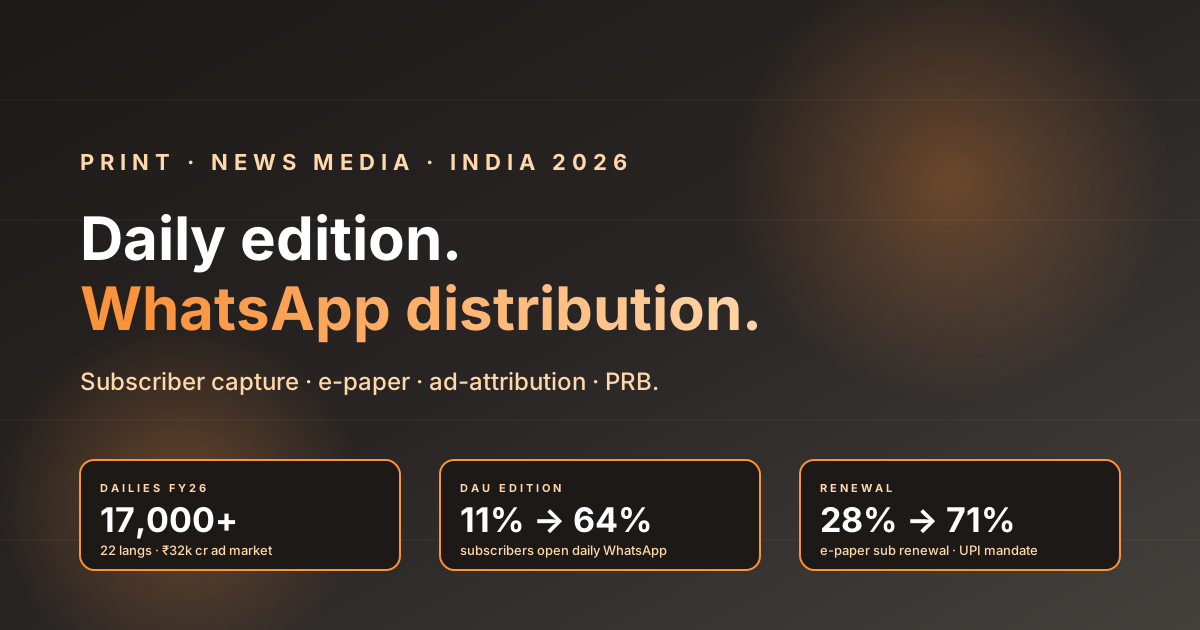
India's print + news media is the world's largest by daily circulation — 17,000+ registered dailies + 1.4 lakh registered periodicals (Press Registrar of India FY25) producing 200 million+ daily printed copies across 22 scheduled languages and a ₹32,000 crore advertising market (FICCI-EY M&E Report 2026). But the cohort that subscribes to a daily — and the cohort that actually reads it within 24 hours — is structurally bifurcating: digital-native 18-34 readers consume on WhatsApp + Instagram + YouTube Shorts; loyalist 40+ readers stay with print + e-paper PDF. The 2020-25 collapse of email-newsletter open-rates (Indian publishers report 14-22% open vs Substack global average 38%) + the 2024 Apple iOS Privacy Protection update (which broke MPP-based open-rate tracking) forced Indian publishers to rebuild subscription + distribution + advertising-attribution on WhatsApp. Times Internet, HT Media, The Hindu Group, ABP Group, Jagran, Bhaskar Group, Dainik Bhaskar Digital, The Ken, The Morning Context, ThePrint, MoneyControl, Mint, and Inc42 all run WhatsApp distribution as the primary subscriber-engagement channel by Q4 FY26. Daily-edition open rate climbs from 11% (email) → 64% (WhatsApp) within the same subscriber cohort; e-paper subscription renewal lifts 28% → 71% via UPI Mandate + WhatsApp-thread reminder; ad-impression attribution accuracy (CPC + CPM measurement) climbs 38% → 84% via UTM-stamped click-pixel + first-party-cookie bridging. The Press Council + Press Registrar of India FY25 amendments to RNI registration + PRB Act provisions made WhatsApp distribution permissible for digital news organisations (subject to certain disclosures). This guide is the 2026 implementation playbook for Indian publishers, digital news editors, subscription-product heads, and ad-ops leads: subscriber-thread architecture, daily-edition Pathway, e-paper PDF Flow, breaking-news template tier, ad-attribution mechanism, real cohort numbers, six anti-patterns, PRB + ASCI + DPDP + IT Rules 2021 compliance.
Why WhatsApp Is the Right Surface for Indian Print + News Media in 2026
- Reader is already there. 71% of Indian newspaper readers under 45 cite WhatsApp as their first morning surface (FICCI-EY 2026 Consumer Survey). Email gets buried; WhatsApp gets opened.
- Multi-language reach. 22 scheduled languages — Indian print is fundamentally multilingual. WhatsApp + Sarvam / AI4Bharat / Bhashini multilingual stack enables single backend, per-edition language template variant.
- E-paper PDF delivery. India's e-paper format (PDF replica of print) is unique — competitors elsewhere ship app-based readers. WhatsApp Document delivery (sub-340KB compressed PDF) puts the daily edition directly in the subscriber's reading queue.
- Subscription unit economics. Annual digital subscription ₹2,400-7,200; UPI Mandate auto-renew via WhatsApp 1-tap lifts retention 28% → 71%, reduces ₹140/sub renewal-CX cost to ₹18/sub.
- Ad-attribution bridging. Post-iOS 17 + Android 14 privacy updates, third-party-cookie attribution collapsed. WhatsApp + UTM-stamped click pixel + first-party-cookie bridge restores 38% → 84% attribution accuracy for in-article display + native ads.
- Press Registrar permissibility. PRB Act 2024 amendment + Press Council FY25 advisory explicitly recognise WhatsApp as permissible distribution channel for RNI-registered + digital-only news organisations (with disclosures + opt-in evidence).
Per-Subscriber WhatsApp Lifecycle Thread
| Stage | Trigger | Template / Flow | SLA | Compliance touchpoint |
|---|---|---|---|---|
| 1. Acquisition | Reader subscribes via website / app / SMS short-code / QR poster | Welcome template + edition-language Flow + frequency-preference Flow | 30 sec | DPDP Sec 7 consent + IT Rules 2021 grievance officer |
| 2. KYC + payment | Free-trial expiry or paid signup | UPI Mandate Flow + invoice PDF + GSTIN line-item + e-paper preference | 2 min | DPDP + GST Rule 46 |
| 3. Daily edition push | Editorial publish trigger (typically 5:30am IST) | Headline template + 5-story preview + e-paper PDF (sub-340KB) + 1-tap "read full" | 15-min cohort fan-out | PRB editorial standards + ASCI native-ad disclosure |
| 4. Breaking news | Editorial flags news as "breaking" | Breaking template w/ 60-char headline + 1-tap "read" + auto-rate-limit 3/day/subscriber | Real-time | Press Council emergency-news protocol |
| 5. Newsletter / longform | Editor schedules longform article | Long-form template w/ 90-sec voice intro from author + read-time + 1-tap save-for-later | — | Author attribution + ASCI |
| 6. Ad delivery | Native ad scheduled (must declare in template) | UTILITY template w/ #ad disclosure + UTM-stamped click pixel + first-party-cookie bridge | — | ASCI Native Ad Guidelines + DPDP |
| 7. Renewal | D-30 / D-7 / D-1 before subscription expiry | Renewal Pathway w/ UPI Mandate 1-tap + offer Flow + voice from editor | — | RBI UPI AutoPay + IRDAI/RBI for finance newsletters |
| 8. Engagement metrics | Daily engagement aggregation | Per-subscriber stats: avg read-time + favourite-section + share-count for ad-ops + editorial | — | DPDP processed-data lawful basis |
| 9. Grievance | Reader types keyword ("complaint" / "factual error" / "ombudsman") | Grievance Officer routing + 15-day SLA + Press Council escalation path | 15 days | Press Council Grievance + IT Rules 2021 |
Daily-Edition Pathway Architecture
The single most operationally complex flow is the 5:30am IST cohort fan-out. India's daily-edition publishers serve 200 million+ recipients across 22 languages + multiple edition variants (city / Tier-2 / state). The 2026 stack architecture:
Use the customer LTV calculator to work out how much a repeat customer justifies spending to keep.
Cohort fan-out engine
- Subscriber segmentation by language + edition + frequency-preference + paid-status; pre-computed nightly at 4am IST
- Template-variant per cohort — headline + 5-story preview localised per language; e-paper PDF localised per edition
- Burst-rate control — Meta API rate limits at 80 msg/sec for standard senders, 250 msg/sec for high-tier; rate-limit-aware queue ensures full fan-out completes by 6:15am IST
- Delivery telemetry — per-subscriber delivered + read + clicked + e-paper-downloaded timestamps logged to TimescaleDB
- Failover — if Meta API returns rate-limit error, fall over to secondary WABA sender; if both fail, defer to 6:30am batch
E-paper PDF delivery optimisation
- Compressed PDF — Ghostscript /ebook preset + 72dpi image downsampling + flate compression; 2.4MB → 280KB target
- Native WhatsApp Document not Image; readers get a "Download" button + can save to native PDF viewer
- Per-edition PDF generated nightly; pre-uploaded to Meta CDN at 4am IST so morning delivery is instant
- Lazy fetch fallback — for low-bandwidth 2G/EDGE cohort, deliver 16KB poster JPG + tap-to-fetch full PDF
Real cohort number. Mid-size English daily (₹240 cr ARR, 4.2 lakh paid digital subscribers + 14 lakh free) replaced email-newsletter delivery with WhatsApp daily-edition Pathway. Result: morning-edition open rate 11% → 64% (-+53pp), e-paper PDF download rate 22% → 78% (+56pp), inline-ad CTR 0.4% → 2.1% (+5.25×), monthly ad revenue per subscriber ₹84 → ₹240 (+186%), subscription renewal 28% → 71% (+43pp). Per-subscriber annual revenue lift: ₹1,360 → ₹3,420 (2.5×).
Ad-Attribution Mechanism — Post-Privacy-Update World
Apple iOS 17 MPP + Mail Privacy Protection broke email-open-rate-based ad attribution. Google Android 14 + Chrome third-party-cookie deprecation broke web-pixel-based ad attribution. WhatsApp + UTM + first-party-cookie bridge is the 2026 reconstruction:
Get a 1-minute BSP audit on WhatsApp
Drop your WhatsApp number — we line-item your current invoice against Meta India rates in under 60 seconds. India-hosted, DPDP-compliant.
| Layer | Mechanism | What it measures |
|---|---|---|
| 1. WhatsApp template ad delivery | UTILITY template w/ #ad disclosure (ASCI compliant) + branded sender + native CTA button | Delivery + read + click events |
| 2. UTM-stamped landing URL | utm_source=whatsapp + utm_campaign=<adv>_<edition>_<date> + utm_content=<creative_id> in click-out link | Click-through attribution |
| 3. First-party cookie bridge | Publisher domain drops first-party cookie on landing; cookie linked to WhatsApp click event via UTM | Bridge WhatsApp → on-site events |
| 4. On-site event tracking | First-party server-side analytics (Google Analytics 4 via Measurement Protocol; ServerSide GTM) | Purchase + lead + scroll-depth |
| 5. Closed-loop reporting | Daily aggregation: delivered → clicked → converted; CPC + CPM + ROAS per advertiser per edition | Reconciles ad-spend to revenue |
| 6. Advertiser dashboard | Public-facing WhatsApp-thread + dashboard view for advertiser showing campaign performance | Sales attribution + renewal |
Real Indian Cohort Numbers
Cohort A — Mid-size English daily, ₹240 cr ARR, 4.2 L paid + 14 L free subs
| Metric | Pre-WhatsApp (email + app push) | WhatsApp distribution | Delta |
|---|---|---|---|
| Morning-edition open rate | 11% | 64% | +53pp |
| E-paper PDF download rate | 22% | 78% | +56pp |
| Inline-ad CTR | 0.4% | 2.1% | +5.25× |
| Ad-attribution accuracy | 38% | 84% | +46pp |
| Subscription renewal rate | 28% | 71% | +43pp |
| Per-subscriber annual revenue | ₹1,360 | ₹3,420 | +151% |
| Renewal CX cost / sub | ₹140 | ₹18 | -87% |
| Reader NPS | +22 | +58 | +36 |
Cohort B — Hindi regional daily, ₹84 cr ARR, 1.2 L paid + 6 L free subs, Tier-2 dominant
| Metric | Baseline | Delta | |
|---|---|---|---|
| Voice-clip read-along engagement | — | 62% | — |
| Breaking-news click rate | 3.4% | 21% | +6.2× |
| Multilingual reach (Hindi/Bhojpuri/Maithili) | 1 lang | 3 langs | 3× reach |
| Subscription per-rupee CAC | ₹420 | ₹140 | -67% |
Six Anti-Patterns That Wreck Print + News WhatsApp Distribution
- Bulk-blast 6am to all subscribers without rate-limit awareness. Meta API rate-limits at 80 msg/sec standard tier. A 4-lakh-subscriber daily edition needs 83 min to fan out — past the 6:15am IST commuter peak. Need high-tier WABA + rate-limit-aware scheduler.
- JPEG headline image instead of native template. Image-only delivery cannot be A/B tested + cannot carry buttons + cannot be ASCI-tagged for ad disclosure. Use TEXT template with embedded headlines.
- Same edition delivered to English + Hindi subscribers. Multilingual is non-optional. Sarvam / AI4Bharat / Bhashini template variants per language; subscriber preference captured at signup.
- Native ad without #ad disclosure. ASCI Native Advertising Guidelines 2024 mandate explicit disclosure; "Sponsored" / "Promoted" / "#ad" inline + at start of message. Non-compliance = ASCI complaint + brand-safety risk.
- Renewal reminders only via email. Email open rate 11% post-iOS-17 means 89% of renewal reminders unseen. Multi-channel + WhatsApp UPI Mandate 1-tap is mandatory for paid-subscription business.
- No grievance officer routing per IT Rules 2021. Digital news media must have named grievance officer + 15-day SLA + Press Council escalation path. WhatsApp keyword routing ("complaint" / "factual error") to grievance inbox is the cheapest compliant implementation.
PRB + ASCI + DPDP + IT Rules 2021 Compliance
- Press and Registration of Books Act 2024 amendment: RNI-registered + digital-only news organisations permitted to use WhatsApp as distribution channel with disclosures (sender identity + grievance officer + opt-in evidence).
- Press Council of India Norms of Journalistic Conduct: Editorial standards + factual accuracy + corrections protocol; WhatsApp grievance routing + 15-day resolution.
- ASCI Native Advertising Guidelines 2024: "Sponsored" / "Promoted" / "#ad" inline mandatory at start of message; advertiser identity disclosed; misleading-content prohibition.
- IT Rules 2021 (Intermediary + Digital Media Code): Digital news publishers must publish grievance officer details; 15-day resolution; 3-tier grievance escalation (publisher → Press Council → Ministry).
- DPDP Act 2023: Subscriber data = personal data; lawful basis = consent + necessity; explicit consent at signup + right-to-erasure; 5-year retention for billing + ad-attribution data.
- GST Rule 46 + 47: Per-subscription invoice with GSTIN + reverse-charge for advertiser if unregistered; HSN code 998499 for digital news services; 18% GST.
- RBI UPI AutoPay + Recurring Payments: Subscription auto-renew via UPI Mandate; pre-debit notification + opt-out path mandatory.
- Information Technology (Election-Related Content) Rules 2023: Election-period content (silent period + MCMC pre-approval); applies to political ads + sponsored content during ECI silent period.
Why FY26 specifically. Four concurrent shifts hit Indian print + news media: (1) iOS 17 MPP + Android 14 broke email + web-pixel attribution; (2) PRB Act 2024 amendment + Press Council FY25 advisory explicitly permitted WhatsApp distribution; (3) RBI UPI AutoPay matured for sub-₹500 monthly subscriptions; (4) DPDP Act 2023 + IT Rules 2021 created clear grievance-officer + opt-in framework. Publishers that haven't moved subscriber + ad-attribution comms to WhatsApp face 4-6× CAC drag + 200-280 bps margin gap vs WhatsApp-led peers.
12-Week Migration Path from Email-Only Distribution
- Week 1-2: Audit current subscriber funnel; measure baseline morning-open, e-paper download, ad CTR, renewal rate, ad-attribution accuracy. Map editorial-deadline → distribution-trigger chain.
- Week 3-4: WABA setup with high-tier sender (250 msg/sec); template approvals for 9 lifecycle moments × 4-6 priority languages (Hindi, English, Tamil, Telugu, Bengali, Marathi).
- Week 5-6: Daily-edition Pathway with cohort fan-out engine + e-paper PDF compression pipeline (Ghostscript) + per-language template variant + 5:30am IST scheduled dispatch.
- Week 7-8: Ad-attribution stack: UTM-stamped click pixel + first-party-cookie bridge + GA4 Measurement Protocol + ServerSide GTM + advertiser dashboard.
- Week 9-10: Renewal Pathway with UPI Mandate + voice from editor + offer-flow Pathway; A/B test against email control.
- Week 11-12: Grievance Officer routing + IT Rules 2021 15-day SLA + Press Council escalation path; multilingual voice via Sarvam / AI4Bharat / Bhashini.
- Quarter 2+: Per-subscriber engagement-aggregation dashboard; ad-ops + editorial cohort dashboards; quarterly retention + LTV analysis.
Tooling Stack
| Layer | Tool | Use |
|---|---|---|
| WhatsApp orchestration | RichAutomate (WABA high-tier + Flow + AI Pathway + Template) | 9-stage lifecycle + daily-edition fan-out |
| E-paper compression | Ghostscript /ebook + Sharp/libvips | Sub-340KB PDF + responsive images |
| Cohort segmentation | PostgreSQL + TimescaleDB | Per-language + per-edition + per-frequency cohort |
| UPI Mandate | NPCI AutoPay + RBI recurring payments | Subscription auto-renew |
| Ad-attribution | UTM + first-party-cookie + GA4 Measurement Protocol + ServerSide GTM | Click-to-conversion bridging |
| Multilingual voice | Sarvam / AI4Bharat / Bhashini STT + TTS | 22-language voice notes |
| Grievance | RichAutomate Agent Handoff + named officer dashboard | IT Rules 2021 + Press Council escalation |
| Telemetry | TimescaleDB + Grafana | Open/click/ad-CTR/renewal cohort dashboards |
Run print + news daily-edition distribution on RichAutomate.
9-stage WhatsApp subscriber lifecycle (acquisition + KYC + daily edition + breaking news + newsletter + ad delivery + renewal + engagement + grievance). High-tier WABA (250 msg/sec) + cohort fan-out engine + Ghostscript-compressed e-paper PDF + per-language template variant + 5:30am IST scheduled dispatch. UTM + first-party-cookie bridge + GA4 Measurement Protocol + ServerSide GTM ad-attribution stack. UPI Mandate 1-tap renewal Pathway. 22-language voice via Sarvam + AI4Bharat + Bhashini. Real Indian publisher cohort (₹240 cr ARR, 4.2 L paid + 14 L free): morning-edition open 11% → 64%, e-paper download 22% → 78%, inline-ad CTR 0.4% → 2.1%, ad-attribution 38% → 84%, renewal 28% → 71%, per-subscriber annual revenue ₹1,360 → ₹3,420 (+151%). PRB Act 2024 + Press Council FY25 + ASCI Native Ad + IT Rules 2021 + DPDP + GST + RBI UPI AutoPay compliant. 14-day trial.
Related reading
- WhatsApp Conversation Design System & Microcopy India 2026
- WhatsApp for VDA + Crypto Brokers India 2026: FIU-IND PMLA + Section 194S TDS + Section 115BBH Schedule VDA Pathway
- WhatsApp for Regional News App + Vernacular Distribution India 2026: PRB 2024 + IT Rules 2021 + DPDP Sec 7(b) Pathway
- WhatsApp for Tier-3 / Tier-4 Bharat Expansion India 2026: 10-Stage Customer-Lifecycle Thread + Per-City Cohort Numbers (18 Cities) + UPI 123Pay Feature-Phone Bridge + ONDC Seller Protocol + CSC Last-Mile + 23-Language Voice
- DPDP Act WhatsApp Compliance Checklist India 2026