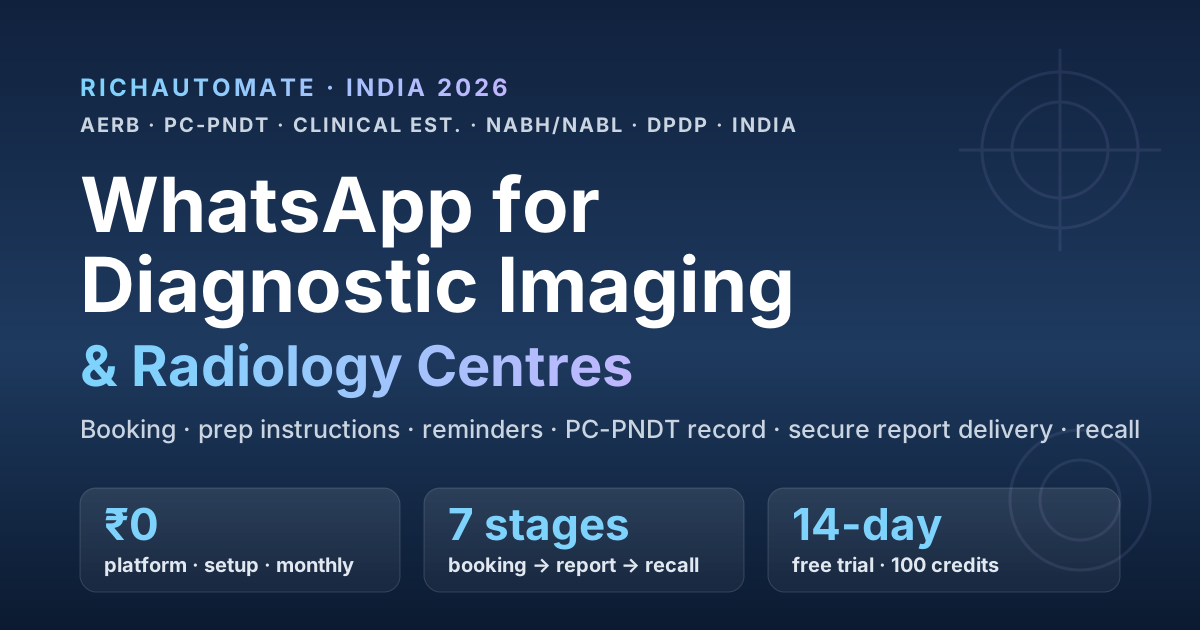
A diagnostic imaging and radiology centre in India 2026 — the standalone X-ray, ultrasound, CT and MRI centre, or the imaging wing of a hospital — runs a business that is far more operationally fragile than it looks from the reception desk. Unlike a pathology lab that draws a blood sample and runs chemistry, an imaging centre sells machine time and a radiologist's read: every scan needs the right patient prep (fasting for an abdominal ultrasound, contrast screening for a CT, the no-metal rule for an MRI), the right slot on an expensive machine that cannot sit idle, and a reported study delivered fast enough that the referring doctor and the anxious patient do not start phoning the front desk. Yet most centres still run this on a receptionist's personal phone: appointment requests on WhatsApp voice notes, prep instructions explained verbally and forgotten, patients arriving un-fasted (a wasted slot), reports "ready but not collected", and PC-PNDT paperwork for every ultrasound tracked in a register that an inspector could ask to see at any time. The centres that scale in 2026 move the whole patient journey onto the WhatsApp Business API — one auditable thread per patient carrying the booking, the modality-specific prep instructions, the appointment reminder, the arrival and contrast-screening checklist, the report-ready notification with secure delivery, and the recall for follow-up imaging. This guide maps that journey end-to-end, the regulatory spine that makes radiology unusually heavily licensed (AERB radiation safety, the PC-PNDT Act for ultrasound, clinical-establishment registration, NABH/NABL accreditation and DPDP for medical images), and the exact places where automation must stop and a qualified human must take over. Every regulatory specific below is as of 2026 — verify the current AERB licensing rules, PC-PNDT Act provisions and forms, Clinical Establishments Act applicability in your state, NABH/NABL norms, DPDP rules and the GST healthcare-exemption position before relying on it. General information, not legal, radiological or compliance advice.
The Licensing & Compliance Spine in Five Minutes (All Hedged)
Radiology sits at the intersection of ionising-radiation safety, a uniquely strict anti-sex-selection law, clinical-establishment regulation and sensitive-health-data protection — so the rule stack is denser than almost any other outpatient healthcare service. Do not run, market or report a scan without checking the current text of each:
- AERB radiation-safety licensing for X-ray/CT. X-ray and CT equipment emit ionising radiation, and the Atomic Energy Regulatory Board (through its eLORA registration/licensing regime) governs procurement, installation, room layout/shielding, the Radiation Safety Officer and periodic quality assurance for radiation-emitting equipment. Operating an unregistered or unlicensed radiation installation is a serious offence. Verify current AERB/eLORA registration and licensing obligations for every radiation-emitting machine you run.
- The PC-PNDT Act for ultrasound and prenatal imaging. This is radiology's defining carve-out. The Pre-Conception and Pre-Natal Diagnostic Techniques Act prohibits the use of ultrasound (and other techniques) for sex determination of a foetus, mandates registration of every ultrasound machine and centre, requires the prescribed declaration/record (commonly the "Form F") for every pregnant-woman scan, and imposes display, record-retention and reporting duties. Disclosing or even hinting at foetal sex is a criminal offence. Verify the current PC-PNDT registration, form and record-keeping requirements for your state.
- Clinical Establishments Act (state) / registration. Many states require diagnostic centres to register as clinical establishments and meet minimum standards. Verify whether your state has adopted the Clinical Establishments (Registration and Regulation) Act or has its own nursing-home/diagnostic-centre registration law, and what it requires.
- NABH/NABL accreditation (voluntary but commercially decisive). Accreditation of imaging facilities signals quality and is frequently required for empanelment by insurers, TPAs and government schemes. Verify current accreditation standards if you intend to empanel.
- DPDP Act 2023 — imaging is sensitive health data. Scan images, reports and a patient's clinical indication are personal data, and health data is especially sensitive. Consent, purpose limitation, access control, an access log, a retention schedule and secure delivery all apply. Verify current DPDP rules as of 2026.
- GST healthcare exemption nuance. Diagnostic services provided by a clinical establishment are generally treated as exempt healthcare services, but the boundary is fact-specific (and wellness/self-referred screening packages, rentals or non-clinical add-ons can be treated differently). Mark billing "GST as applicable, verify current position" and confirm your exact treatment with a qualified tax professional.
- Radiologist reporting and qualified-person duties. The read and the report are a registered radiologist's professional act; the centre carries medical-council and consumer-protection duties around competence, consent for contrast studies, and honest turnaround commitments.
Treat all market sizing as directional — the operational truth for an imaging centre is simpler: this is a slot-utilisation, prep-dependent, report-turnaround, referral-driven and heavily-licensed business, which makes machine-utilisation rate, no-show/wasted-slot rate, prep-compliance rate, report-turnaround time and PC-PNDT record completeness — not the number of machines you own — the real competitive variables. Every one of those is a WhatsApp problem.
Why a Radiology Centre Is a Near-Perfect WhatsApp Vertical
Few outpatient healthcare businesses fit WhatsApp as cleanly as diagnostic imaging. The patient is anxious and wants their report; the referring doctor wants it faster; the machine is expensive and idle time is pure loss; and the single biggest revenue leak — a patient arriving un-fasted or with metal for an MRI — is a pure communication failure that prep automation eliminates. Here is the contrast that makes the case:
| Operational reality | On a personal phone | On WhatsApp Business API |
|---|---|---|
| Appointment booking | Voice note "CT kab ho sakta hai?", line busy, lost | Slot-picker Flow captures modality, body part, referring doctor, prescription photo instantly |
| Prep instructions | Explained verbally, patient forgets, arrives un-fasted | Auto modality-specific prep checklist (fasting, contrast, no-metal) the day before + morning of |
| Reminders & no-shows | Slot held, patient never comes, machine idle | 24h + 2h reminder with one-tap confirm/reschedule; no-show rate drops |
| Arrival & safety screening | Metal/implant question asked in a rush at the door | Pre-arrival contrast/MRI-safety checklist in thread, flagged before the slot |
| Report delivery | "Report ready" call, patient travels back to collect | Secure report-ready notification + access-controlled delivery + audit log |
| PC-PNDT record (ultrasound) | Register entry, easy to miss, hard to audit | Structured pre-scan declaration capture in thread feeds your statutory record |
| Recall & follow-up | "Repeat scan in 6 months" forgotten by everyone | Auto recall nudge to opted-in patients at the clinical interval |
The 7-Stage Imaging Patient Journey on WhatsApp
An imaging visit is short but unforgiving — get the prep wrong and the slot is wasted; get the report-delivery wrong and the patient travels back for nothing. The table maps each stage to the WhatsApp capability that drives it, the data that rides along, and the compliance note that must never be skipped.
| Stage | Centre activity | WhatsApp capability | Key data / documents | Compliance note |
|---|---|---|---|---|
| 1. Booking & triage | Modality, body part, referring doctor, urgency, prescription | CTWA/QR entry + chatbot menu + slot-picker Flow with DPDP consent | Modality, indication, prescription photo, contact | Opt-in captured; clinical indication is sensitive data |
| 2. Prep instructions | Fasting, hydration, contrast screening, no-metal/implant check | Auto modality-specific prep template (day-before + morning-of) | Prep checklist, allergy/implant flags, fasting status | Safety screening informs, never replaces, the clinical check |
| 3. Reminder & confirm | Confirm or reschedule, reduce no-shows | 24h + 2h reminder + one-tap confirm/reschedule | Confirmation status, reschedule slot | Utility messages to opted-in patient only |
| 4. Arrival & consent | Check-in, contrast consent, MRI-safety final check, payment | Arrival checklist + consent capture + UPI payment link | Consent record, payment receipt, safety sign-off | Contrast/MRI safety verified by qualified staff in person |
| 5. Scan & PC-PNDT record | Acquire study; for ultrasound, statutory declaration/record | Pre-scan declaration capture feeding the statutory register | Study acquired, PC-PNDT declaration data (ultrasound) | PC-PNDT record mandatory; NEVER disclose foetal sex |
| 6. Report delivery | Radiologist reads, report finalised, delivered | Report-ready notification + secure access-controlled delivery + audit log | Final report PDF, delivery log, access record | Sensitive health data; secure delivery + access log |
| 7. Recall & follow-up | Repeat/follow-up imaging at clinical interval; referring-doctor loop | Auto recall nudge + referring-doctor report copy (with consent) | Recall schedule, follow-up booking | Marketing/recall to opted-in patients only; honour STOP |
Stage 1-2: Booking, Triage and the Prep Instructions That Save the Slot
The most expensive failure in an imaging centre is not the missed booking — it is the patient who arrives but cannot be scanned. An abdominal ultrasound patient who ate breakfast, a contrast-CT patient whose kidney-function screening was never done, an MRI patient who walked in with a pacemaker question unresolved — each is a wasted slot on a machine whose hourly cost is brutal. Route every enquiry — the click-to-WhatsApp ad, the QR on the prescription pad you give referring clinics, the Justdial/Practo lead, the hospital referral — into a structured intake. The chatbot asks the four things that define an imaging job: which modality (X-ray, ultrasound, CT, MRI, mammography), which body part or study, the referring doctor and the prescription (captured as a photo into the thread), and the urgency. It then offers a slot-picker WhatsApp Flow. The instant the slot is booked, the single highest-ROI automation in the whole journey fires: a modality-specific prep template — fasting hours for an abdominal scan, hydration and contrast-screening for a CT, the absolute no-metal/implant rules for an MRI — sent the day before and again the morning of, so the patient arrives correctly prepared and the slot is not wasted. For the high-volume qualification and FAQ-deflection mechanics behind this, see our WhatsApp chatbot for business guide.
Run your figures through the WhatsApp ROI calculator before committing to a monthly spend.
Get a 1-minute BSP audit on WhatsApp
Drop your WhatsApp number — we line-item your current invoice against Meta India rates in under 60 seconds. India-hosted, DPDP-compliant.
Stage 3-4: Reminders, Arrival Screening and the Contrast/MRI Safety Gate
A booked slot is only revenue if the patient shows up prepared. A 24-hour and 2-hour reminder with one-tap confirm or reschedule is the cheapest no-show reduction available — and rescheduling a slot a patient can no longer make lets you offer it to someone on the waitlist instead of running the machine empty. On arrival, the WhatsApp thread carries a check-in and a pre-arrival safety checklist — but here the line is bright and absolute: for a contrast study (CT/MRI with contrast) and for any MRI, the questionnaire that captures allergy history, kidney-function status, pregnancy, and implanted-device/metal information informs the qualified radiographer and radiologist; it never replaces the in-person safety verification before the patient enters the magnet room or receives contrast. Automation pre-flags risks so the qualified team can act early; the actual go/no-go is a clinical decision. Payment is collected with a one-tap UPI link (an exempt healthcare service is still a transaction that needs a clean receipt), and consent for contrast is captured and timestamped. Tie the patient record, modality history, consent and recall dates together with a proper WhatsApp CRM.
Stage 5: The Scan and the PC-PNDT Record — Radiology's Hard Line
For X-ray, CT and MRI, stage 5 is acquisition under AERB radiation-safety discipline. For ultrasound, it is acquisition plus the most legally serious obligation in the entire vertical: the PC-PNDT record. Every ultrasound of a pregnant woman requires the prescribed statutory declaration and record (commonly referred to as the "Form F"), the machine and centre must be registered, and the law's prohibition on communicating foetal sex is criminal and absolute. WhatsApp can help by capturing the pre-scan declaration data in a structured Flow that feeds — but does not become — your statutory register, and by keeping a clean administrative trail of who booked, who attended and when. But three things must be hard-coded into how you use it:
- The statutory PC-PNDT record is the legal artefact — the WhatsApp capture assists it, it does not replace it. Maintain the register exactly as the law and your state authority require.
- No part of any message, template, report or auto-reply may ever communicate, hint at, or enable inference of foetal sex. This is non-negotiable and a criminal matter; build it into your template approvals and staff training.
- Radiation justification, dose and the read stay with qualified professionals. The bot books and reminds; it never decides whether a scan is warranted.
Imaging centres share much of their administrative rhythm with other licensed diagnostic businesses — compare the sample-collection-and-report playbook for a pathology lab with home phlebotomy, which faces a parallel report-turnaround and consent problem on a different regulatory base.
Stage 6: Report Delivery — Fast, Secure, Audited
Report turnaround is the number that wins or loses referring doctors. A radiologist who reads and reports within the promised window, and a centre that delivers that report the moment it is signed, keeps the referral relationship alive. On a personal phone, "report ready" is a phone call and a wasted trip back to the centre. On the Business API, a report-ready notification fires automatically when the study is finalised, and the report PDF is delivered through an access-controlled channel with an audit log of who accessed it and when. Two compliance threads ride here. First, a radiology report is sensitive health data: deliver it to the verified patient (and, with consent, the referring doctor), restrict access, and keep the access record — do not broadcast a diagnosis into an unverified chat. Second, the report belongs to a medical record with its own retention norms; the WhatsApp delivery is a notification-and-access layer over your authoritative records system, not a replacement for it. For centres weighing platforms specifically for the regulatory load of healthcare messaging, see choosing a WhatsApp Business API for healthcare.
Stage 7: Recall, the Referring-Doctor Loop and the Annuity
Most imaging is one-and-done in the centre's mind — and that is the missed annuity. Clinical follow-up imaging (a six-month repeat scan, an annual screening mammogram, a post-treatment review CT) is a genuine, clinically-indicated reason to re-engage a patient, and a recall nudge at the right interval — to opted-in patients only, with opt-out honoured instantly — turns a forgotten follow-up into a booked slot and better patient care. The other flywheel is the referring doctor: an imaging centre lives on referrals, and the doctor who gets a clean, fast, securely-delivered report (with the patient's consent) refers again. A one-tap "refer a patient" pathway for partner clinics, plus a reliable report-back loop, makes the referring network your lowest-cost channel. Recall and referral messaging is marketing-adjacent — it goes only to contacts who opted in, capped in frequency, with STOP honoured immediately, and it must never edge into anything that could touch the PC-PNDT prohibition.
The Automation Tech Stack: Stage by Stage
Everything above assembles from five WhatsApp Business API primitives — Flows for structured intake (booking, prep-and-safety questionnaires, PC-PNDT pre-scan declaration), approved templates for business-initiated messages (prep instructions, appointment reminders, payment confirmations, report-ready notifications, recall nudges), a chatbot for FAQ deflection and booking triage, human handoff for clinical and safety judgement (contrast decisions, MRI-safety queries, abnormal-result conversations), and broadcast segments for clinically-indicated recall. Mapped to the journey with the KPI each stage owns:
| Stage | Automation | KPI to watch |
|---|---|---|
| Booking → prep | CTWA entry + triage chatbot + slot-picker Flow + modality-specific prep template | Booking-to-arrival rate; prep-compliance rate |
| Reminder → arrival | 24h + 2h reminder with one-tap confirm/reschedule | No-show / wasted-slot rate; reschedule recovery |
| Arrival → scan | Arrival checklist + contrast/MRI safety questionnaire (pre-flag only) + UPI payment | Machine-utilisation rate; on-time start % |
| Scan → record | PC-PNDT pre-scan declaration capture feeding the statutory register (ultrasound) | PC-PNDT record completeness; zero sex-disclosure (absolute) |
| Report delivery | Report-ready notification + access-controlled delivery + audit log | Report turnaround time; secure-delivery rate |
| Recall / referral | Clinically-timed recall nudge + referring-doctor report loop to opted-in base | Recall-conversion rate; referral-sourced volume |
Imaging centres operate inside a wider time-critical healthcare-logistics world — read the private ambulance and EMS dispatch playbook to see how the same reminder-and-status primitives flex when minutes, not turnaround days, are the unit of urgency.
The Compliance Carve-Out: Radiation, PC-PNDT and Health Data Make Radiology Different
A radiology centre carries obligations most outpatient services never face. Under the relevant regimes (all of which you must verify as of 2026):
- AERB radiation safety is licensed and inspected. X-ray and CT installations need AERB/eLORA registration/licensing, shielded rooms, a Radiation Safety Officer and periodic QA. Verify current obligations for every radiation-emitting machine; running an unlicensed installation is a serious offence.
- PC-PNDT is criminal and absolute. Register the centre and every ultrasound machine, maintain the prescribed declaration/record for prenatal scans, display the mandated notices, and never communicate or enable inference of foetal sex by any channel — including WhatsApp templates, auto-replies and report wording. Verify current PC-PNDT registration, forms and reporting requirements for your state.
- Clinical-establishment registration may apply. Verify whether your state requires diagnostic-centre/clinical-establishment registration and minimum standards.
- DPDP for images and reports. Scan images, reports and clinical indications are sensitive health data; apply consent, purpose limitation, access control, an access log, secure delivery and a retention schedule, and never reuse patient images as marketing.
- GST healthcare-exemption nuance. Diagnostic services by a clinical establishment are generally treated as exempt, but self-referred wellness screening, rentals and non-clinical add-ons can differ. Mark billing "GST as applicable, verify current position" and confirm with a tax professional.
- Consumer Protection Act 2019 and professional duties. The turnaround you promise and the consent for contrast are real commitments; the timestamped thread plus your clinical records are your evidence of diligence, while the read and safety decisions remain a qualified radiologist's responsibility.
Where individuals are identifiable in records, images or reports, DPDP applies; verify your exact radiation-safety, PC-PNDT, clinical-establishment and data obligations with qualified professional advice as of 2026.
Cost Model: A Radiology Centre on RichAutomate
With RichAutomate (₹0 platform fee · ₹0 setup · ₹0 monthly), the cost of the WhatsApp Business API for a diagnostic imaging centre is purely the Meta conversation charges — and only for conversations actually sent. Consider a mid-size centre running ~40 scans a day across X-ray, ultrasound, CT and MRI, each booking generating roughly 4-6 business-initiated conversations (prep instructions, reminder, payment confirmation, report-ready) plus clinically-timed recall:
- Booking + report utility conversations (prep instructions, appointment reminders, payment confirmations, report-ready notifications): comfortably a few thousand utility-tier conversations a month at this scale
- On Client Pay (₹0.10 per message, Meta conversation charges billed directly to you by Meta): the platform cost is a few hundred to low-four-figure rupees a month
- SaaS Pay is ₹1.20 per marketing message and ₹0.30 utility/authentication, all-inclusive — relevant when you run a clinically-indicated recall or a screening-camp reminder to your opted-in patient base
- A 14-day free trial with 100 credits lets you pilot a full booking-to-prep-to-report Flow on a single modality before paying anything
Set that against the value of a single saved slot — one un-wasted CT or MRI slot is worth thousands of rupees, and a centre that even halves its un-fasted-arrival and no-show rate recovers far more machine-time revenue than a year of conversation charges costs. For the deeper economics of who pays for each message and how the two billing models differ, read Client Pay vs SaaS Pay billing, model your own scan volume and message mix with the WABA cost calculator, and see the RichAutomate pricing page — the platform fee stays ₹0 regardless of scale.
Anti-Patterns: How Imaging Centres Get This Wrong
- Running it on a personal number. No templates, no shared inbox, no access control, no audit trail — and one ban away from losing every patient thread and every report-delivery record. Use the Business API — and never promise a patient or referrer their number "won't get banned"; promise consent discipline instead.
- Letting prep instructions stay verbal. A patient who arrives un-fasted or with metal for an MRI is a wasted, irrecoverable slot. Automate the modality-specific prep template day-before and morning-of; it is the single highest-ROI message in the journey.
- Anything that touches foetal sex. This is the absolute red line. No template, auto-reply, report phrasing or staff message may communicate or enable inference of foetal sex; bake the prohibition into template approvals and training.
- Treating safety screening as the safety check. A WhatsApp contrast/MRI questionnaire pre-flags risk; it never replaces the qualified in-person verification before the magnet room or contrast injection.
- Broadcasting reports into unverified chats. A radiology report is sensitive health data — deliver to the verified patient (and, with consent, the referring doctor), with access control and a log.
- Quoting GST and AERB/PC-PNDT status loosely. Exemption boundaries and licensing are fact-specific; hedge "verify current position" and keep your registrations, forms and records exactly as the law requires.
This article is general information, not legal, tax, radiological or compliance advice. AERB/eLORA radiation-safety licensing, PC-PNDT Act provisions and forms, Clinical Establishments Act applicability, NABH/NABL standards, DPDP rules, the GST healthcare-exemption position and consumer-protection provisions all change — verify every specific against current government publications and qualified professional advice before acting.
Run your diagnostic imaging & radiology centre on WhatsApp
RichAutomate gives diagnostic imaging and radiology centres a WhatsApp Business API platform — booking and slot-picker Flows, modality-specific prep instructions, 24h/2h reminders with one-tap reschedule, contrast/MRI safety pre-screening, one-tap UPI payments, secure access-controlled report delivery with an audit log, a PC-PNDT pre-scan declaration capture that feeds your statutory record, and clinically-timed recall nudges — at ₹0 platform fee, ₹0 setup, ₹0 monthly. Built with consent, access control and the radiology red lines in mind. Start with a 14-day free trial and 100 conversation credits, no card required. Questions? WhatsApp us on 918160311319.