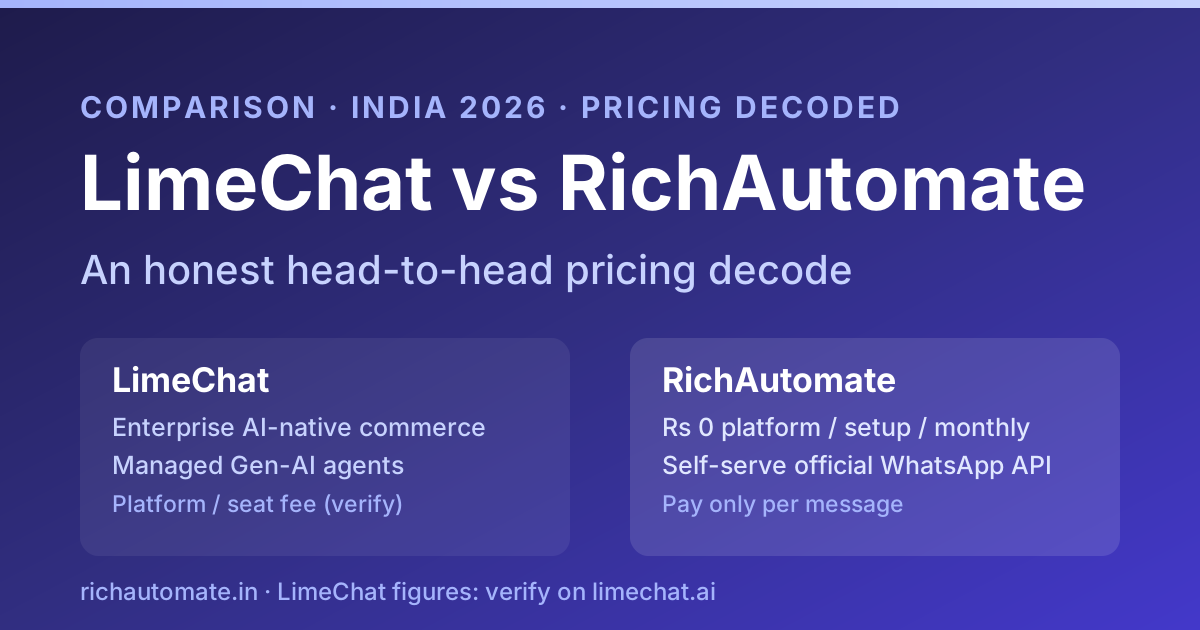
The short answer. LimeChat and RichAutomate solve different shapes of the same problem. LimeChat is an Indian AI-native, enterprise WhatsApp-commerce platform — Gen-AI agents that sell and support for large D2C brands, typically priced with a platform or seat element and a higher per-interaction cost (as of 2026, verify the current model on limechat.ai). RichAutomate is a ₹0-platform, ₹0-setup, ₹0-monthly self-serve WhatsApp Business API platform where you pay only per message. If you are a large D2C brand with a dedicated CX team that wants a done-for-you Gen-AI sales-and-support engine and can justify an enterprise contract, LimeChat may genuinely be the better fit — we say so plainly below. If you want the official WhatsApp Business API live this week with no platform fee and transparent per-message pricing, RichAutomate wins on cost and speed. Treat every LimeChat figure as “as of 2026, verify on limechat.ai” and every Meta specific as something to confirm against the live 2026 position; all rupee figures are illustrative.
If you are comparing LimeChat and RichAutomate, you are almost certainly weighing two genuinely different bets, and the honest framing matters more than a feature-checklist showdown. LimeChat built its name as an AI-native, enterprise-grade WhatsApp-commerce platform for Indian D2C brands — the kind of operation running large catalogues, high support volume and a team of agents, where a Gen-AI bot that can actually sell and resolve tickets at scale earns its keep. RichAutomate sits at the other end: a self-serve WhatsApp Business API platform built so a founder, a small team or a growing brand can be live on the official API this week, send templates and run flows, and pay nothing but the per-message cost — no platform fee, no setup, no monthly. This decode walks the real differences: a head-to-head comparison table across the lines that actually move a decision, an honest “who should pick which” that names the brand for which LimeChat is the better choice, illustrative rupee break-even math, the 24–48 hour steps to migrate if you decide to, and a five-question FAQ. Every LimeChat price and feature is hedged “as of 2026, verify on limechat.ai” because their packaging evolves; every RichAutomate number is real and current; and all cohort figures are illustrative, so model your own. This is general commercial information, not legal or pricing advice — confirm both vendors’ live terms before you commit.
The core difference in one paragraph
LimeChat is an enterprise AI-commerce suite; RichAutomate is a zero-platform-fee self-serve WhatsApp API. That single distinction explains almost every downstream difference in price, onboarding and fit. LimeChat’s value proposition is a done-for-you Gen-AI layer — bots that handle sales conversations, product discovery and support resolution for high-volume D2C brands — and that sophistication typically comes with an enterprise commercial model: a platform or seat fee, a higher per-interaction or per-conversation cost, and a guided onboarding (as of 2026, verify the exact structure on limechat.ai). RichAutomate’s value proposition is the opposite: strip out the platform fee entirely, run on the official Meta WhatsApp Cloud API, and let you pay only for the messages you actually send, with a no-code builder you operate yourself. Neither model is “better” in the abstract — a 200-agent CX operation and a 3-person founding team are buying different things. The rest of this page is about matching the model to your shape.
Head-to-head comparison
The table below lines up the two on the dimensions that genuinely change the decision. Every LimeChat cell is hedged because their packaging is enterprise and quote-based; verify the live position on limechat.ai. RichAutomate’s figures are current and flat.
| Dimension | LimeChat (as of 2026, verify on limechat.ai) | RichAutomate |
|---|---|---|
| Platform fee | Typically a platform / plan or seat element (enterprise, often quote-based) — verify | ₹0 platform fee |
| Setup fee | Guided enterprise onboarding; setup terms vary — verify | ₹0 setup |
| Per-message / per-interaction | Tends to a higher per-interaction or per-conversation cost reflecting the Gen-AI layer — verify | Client Pay ₹0.10/msg, or SaaS Pay ₹1.20 marketing / ₹0.30 utility-auth |
| Meta conversation cost | Confirm whether Meta’s charge is passed through or bundled — verify | Client Pay: Meta bills you direct. SaaS Pay: included in the all-in rate |
| Support model | Enterprise / managed, account-team led — verify | Self-serve + support; you operate the platform |
| DPDP / data handling | Enterprise data terms — request written DPDP terms — verify | Official Meta Cloud API; written data terms on request; no data resale |
| No-code builder | Yes, plus heavy managed Gen-AI agents — verify scope | Yes — visual flow builder you run yourself |
| Migration effort | Enterprise migration, account-managed — verify | Self-serve; typically 24–48h on the official API |
| Free trial | Demo / pilot, sales-led — verify | 14-day free trial + 100 free credits, self-serve |
The shape that emerges is consistent: LimeChat is an account-managed, Gen-AI-rich enterprise relationship; RichAutomate is a flat-priced, self-serve platform you stand up yourself. If your eyes went straight to the per-message and platform-fee rows, you are likely a fit for the RichAutomate model; if they went to the managed Gen-AI agent and account-team rows, LimeChat’s enterprise proposition may be what you actually need. For a clear breakdown of how RichAutomate’s two pricing modes work, see the Client Pay vs SaaS Pay billing guide.
Before you commit to a move, the BSP migration cost calculator gives you the all-in figure rather than the sticker price.
Honest — who should pick which
This is the section most comparison pages dodge, so here it is straight, both ways.
Pick LimeChat if you are a large or fast-scaling D2C brand with a dedicated customer-experience team, high daily conversation volume, a big catalogue, and a real appetite for a done-for-you Gen-AI agent that handles sales discovery and support resolution at scale. If you want an account team to own onboarding, build and tune the AI agents, and you can justify an enterprise contract against the revenue those conversations drive, an AI-native commerce suite like LimeChat is built for exactly that, and the platform/seat cost can be money well spent (verify the current model and pricing on limechat.ai). For that buyer, the per-interaction premium buys genuine leverage. Do not pick RichAutomate just because it is cheaper if what you actually need is a managed enterprise AI-commerce engine — that would be a false economy.
Pick RichAutomate if you want to be live on the official WhatsApp Business API this week without paying a platform fee, you would rather operate a no-code flow builder yourself than hand it to an account team, and you want pricing that tracks only the messages you send. This fits founders, SMBs, agencies running multiple client numbers, and growing brands that do not yet need a 200-agent managed AI operation. You still get automation, templates, flows and a CRM view — you just do not pay an enterprise platform fee to get there. The honest line: RichAutomate wins decisively on zero-platform-fee, transparent per-message pricing and self-serve speed; it is not pretending to be a fully-managed enterprise Gen-AI commerce suite, and if that is your requirement, weigh LimeChat seriously.
Get a 1-minute BSP audit on WhatsApp
Drop your WhatsApp number — we line-item your current invoice against Meta India rates in under 60 seconds. India-hosted, DPDP-compliant.
Illustrative break-even math
Numbers make the trade-off concrete, so here is illustrative math — model your own. Take a growing D2C brand running, say, 8,000 WhatsApp conversations a month: roughly 5,500 utility (order updates, shipping, COD confirmation, support) and 2,500 marketing (offers, cart recovery, re-engagement). Every figure is illustrative and every LimeChat figure must be verified on limechat.ai.
| Line item (illustrative) | Enterprise AI suite (verify) | RichAutomate SaaS Pay | RichAutomate Client Pay |
|---|---|---|---|
| Platform / seat fee | Platform or seat element, quote-based (verify) | ₹0 | ₹0 |
| 5,500 utility conversations | Higher per-interaction × 5,500 (verify) | ~₹1,650 (5,500 × ₹0.30) | Meta direct + ~₹550 markup (5,500 × ₹0.10) |
| 2,500 marketing conversations | Higher per-interaction × 2,500 (verify) | ~₹3,000 (2,500 × ₹1.20) | Meta direct + ~₹250 markup (2,500 × ₹0.10) |
| Setup (one-time) | Enterprise onboarding (verify) | ₹0 | ₹0 |
| Indicative monthly total | Platform + higher per-interaction + GST | ~₹4,650 + 18% GST, no platform fee | ~₹800 markup + Meta’s own charge |
The structural point is not that one is universally cheaper — it is that the cost models differ in kind. An enterprise AI suite bundles a platform/seat fee plus a richer per-interaction cost because you are buying managed Gen-AI leverage; RichAutomate strips the platform fee to zero and charges only per message, so the bill tracks your actual volume. For a low-to-moderate-volume brand, the ₹0-platform model is dramatically cheaper; for a brand where Gen-AI agents measurably lift conversion and deflect support cost, the enterprise premium may pay for itself. Run your real message mix through the WABA cost calculator, and verify Meta’s live conversation rates and the GST treatment as of 2026.
How to migrate in 24–48 hours
If you decide RichAutomate is the right fit, moving is a self-serve process rather than an enterprise project, and the official WhatsApp Business API makes it clean. The steps below are the typical path; timing depends on Meta’s own verification, which you should confirm for 2026. First, start the 14-day free trial and create your account — no card, no sales call required. Second, connect your WhatsApp Business number; if it currently sits with another provider, you initiate a migration of the number to the new platform on the official API, and Meta’s Business verification status carries with the WABA. Third, recreate or import your message templates — export the wording from your current tool and resubmit the templates for approval, which is usually quick for utility and authentication categories. Fourth, rebuild your core flows in the visual no-code builder — start with the one or two journeys that carry the most volume (order updates, support routing, cart recovery) rather than porting everything at once. Fifth, run both side by side during the trial: keep the old tool live, route a slice of traffic through RichAutomate, and compare cost and delivery before you fully cut over. Keep opt-in and opt-out handling intact throughout so consent is never broken in the move. Verify the current number-migration and template-approval rules against Meta’s live 2026 documentation, and treat the 24–48 hour window as typical rather than guaranteed.
What you keep either way. Both platforms run on the official WhatsApp Business API, so the fundamentals — your verified number, the green-tick path, approved templates, the 24-hour service window, and Meta’s conversation-pricing categories — are the same underneath. What changes between vendors is the commercial model on top (platform fee vs ₹0), the depth of managed Gen-AI, and whether you operate the platform yourself or an account team does. So the migration question is not “will WhatsApp still work” — it will — but “which commercial model and operating mode fits my brand.” For a wider view of how RichAutomate sits against managed WhatsApp CRM tools, see the best WhatsApp CRM for India 2026 guide, and for another head-to-head in the same series the Wati vs RichAutomate decode.
The honest bottom line
LimeChat and RichAutomate are not really competing for the same buyer on the same day. LimeChat is an enterprise, AI-native WhatsApp-commerce platform that earns its premium when a high-volume D2C brand with a CX team wants managed Gen-AI agents doing real sales and support work — if that is you, evaluate it seriously and verify its current pricing and AI capabilities on limechat.ai. RichAutomate is the platform-fee-free, self-serve alternative that wins when you want the official WhatsApp Business API live fast, pricing that tracks only what you send, and a builder you run yourself — ₹0 platform, ₹0 setup, ₹0 monthly, with Client Pay at a flat ₹0.10 per message (Meta billed direct to you) or SaaS Pay at an all-in ₹1.20 marketing / ₹0.30 utility-auth, plus a 14-day free trial with 100 free credits. Pick the model that matches your shape, not the louder logo. Verify every LimeChat specific on limechat.ai and every Meta and GST detail against the live 2026 position; all rupee figures here are illustrative. This is general commercial information, not legal or pricing advice; no vendor can guarantee against a WhatsApp number restriction, and what keeps a number healthy is relevant, consented, well-spaced messaging on the official API with prompt opt-out handling.
Get on the official WhatsApp Business API — ₹0 platform, ₹0 setup, pay only per message
If you want the speed and cost of a self-serve WhatsApp Business API platform — no platform fee, no setup, no monthly, transparent per-message pricing, and a no-code flow builder you operate yourself — RichAutomate gets you live on the official API, typically within 24–48 hours. Pricing is flat: ₹0 platform fee, ₹0 setup, ₹0 monthly, with Client Pay at a flat ₹0.10 per message on your own WhatsApp number (Meta’s conversation charge billed to you directly by Meta) or SaaS Pay at an all-in ₹1.20 marketing / ₹0.30 utility-auth. Start the 14-day free trial with 100 free credits, port one high-volume flow, run it side by side with your current tool, and compare the bill before you commit. If a managed enterprise Gen-AI commerce suite is genuinely what your brand needs, we will tell you so. WhatsApp us at 917434901027 or book a 30-minute walkthrough at https://calendly.com/inrichdaddy/30min. (This is general commercial information, not legal or pricing advice. Every LimeChat specific must be verified on limechat.ai and every Meta and GST detail against the live 2026 position; all rupee figures are illustrative; no vendor can guarantee against a ban.)
Start your 14-day free trial → · See full pricing · Run the WABA cost calculator
Related reading: Trengo alternatives in India 2026.