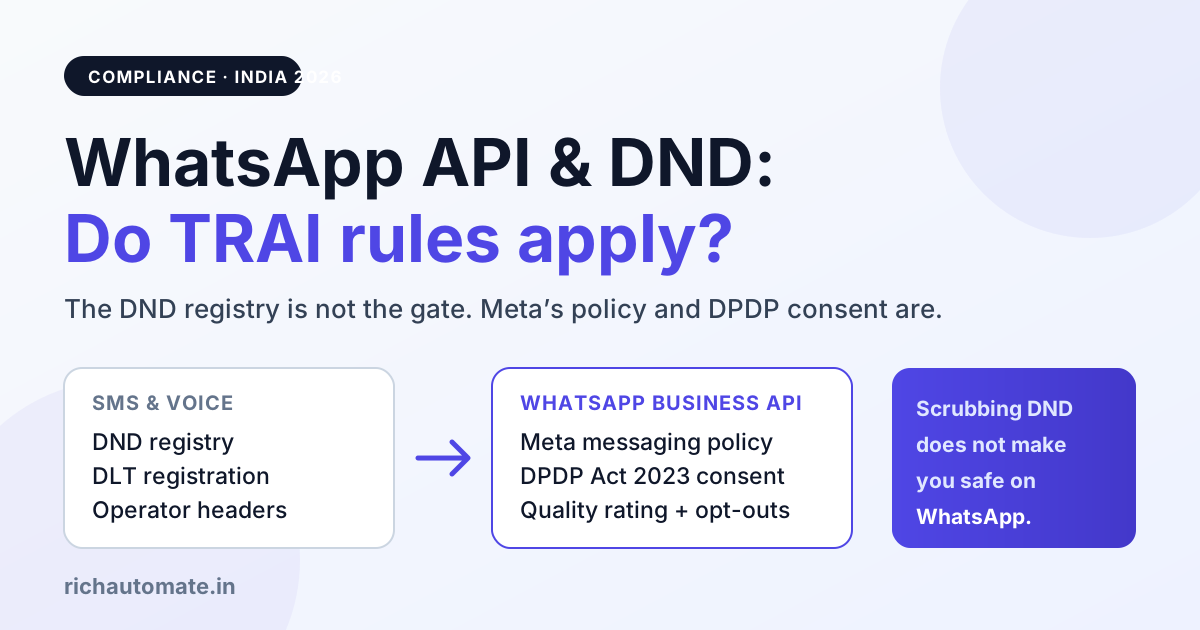
India's TRAI Do Not Disturb registry and the DLT registration regime govern commercial SMS and voice calls carried over licensed telecom operator networks, so they are not the gate on your WhatsApp Business API sends. WhatsApp is an over-the-top service, which means the binding rulebook for your business messages is Meta's WhatsApp Business Messaging Policy plus India's DPDP Act 2023 consent obligations, not a DND scrub list.
This is one of the most expensive misunderstandings in Indian business messaging. Teams arrive from SMS with a mental model built on DND scrubbing, DLT headers and operator-approved templates, and they try to port it wholesale onto WhatsApp. The vocabulary looks similar. The machinery underneath is completely different, and the controls that keep you safe on WhatsApp are controls the SMS world barely has.
Below is what the two regimes actually cover, why the distinction matters commercially, and the concrete practices that replace scrubbing when you move volume onto WhatsApp. Where a legal specific cannot be verified, it is written in plain hedged language rather than a confident-sounding clause number, because a wrong citation is worse than no citation.
The short answer, in plain language
Two separate systems are in play, and they do not overlap the way people expect.
India's unsolicited-commercial-communication framework sits with the telecom regulator and applies to the messages and calls that ride on operator networks. It is the machinery behind the DND registry, the preference categories consumers pick, the distributed-ledger registration that commercial SMS senders go through, and the header and content templates approved before a bulk SMS campaign runs. It exists because operators control those channels end to end and can be made accountable for what crosses them.
WhatsApp does not ride that pipe. Messages travel over the internet through Meta's infrastructure. The operator is carrying data, not a commercial SMS. Regulators have discussed how over-the-top communication services should be treated for years, but the DND registry as it works today was not extended to cover WhatsApp business messaging as of this writing, and you should confirm current TRAI and DoT guidance before you build policy on that statement.
What fills the gap is private rule-making with teeth. Meta sets commerce and messaging policies, approves every marketing template before it can send, scores the quality of each business phone number from user feedback, and throttles or restricts numbers that generate negative signals. In parallel, India's Digital Personal Data Protection Act 2023 governs the personal data you are processing, including the phone number itself and the consent you collected to use it. Neither of those is a DND list, and neither is optional.
What TRAI's DND and UCC framework actually covers
Strip it down and the telecom framework does four things. It gives consumers a central preference registry where they can block commercial calls and SMS, wholly or by category. It requires commercial senders to register as entities with operators and to register the sender headers they use. It requires message content templates to be registered before bulk sending. And it puts the obligation to enforce all of that on the access providers, with consequences that flow through them.
That design only works because the operator is the chokepoint. Every SMS has a header, every header traces to a registered entity, and the operator can refuse delivery at the network edge. The registry is enforceable precisely because there is a licensed intermediary who must consult it.
The commercial reality in India reflects that: bulk SMS is cheap per message, heavily regulated at the gateway, and increasingly ignored by recipients. Read-rate data published by messaging vendors consistently puts SMS engagement far below WhatsApp, which is a large part of why Indian businesses moved. India is widely reported as WhatsApp's largest market, with a user base in the hundreds of millions, which is exactly why the compliance question keeps coming up at scale rather than as a footnote.
Why WhatsApp sits outside the DND registry
There is no operator chokepoint on WhatsApp. There is no header to register, no per-operator scrub API to call before a send, and no consumer-facing preference registry that covers app-based messaging. A person who registered for full DND on their mobile number in 2019 has not, by that act, told your business anything about WhatsApp. Conversely, a person who never touched DND may still block you inside WhatsApp in one tap, and that tap carries far more weight against you than a registry entry ever would.
This is why "we scrubbed the list against DND" is not an answer to a WhatsApp compliance question. It is a control from a different channel. It does not reduce block rates, it does not improve template approval odds, and it will not help you if Meta reviews your account. What it can do is give a team false confidence to blast a purchased list, which is the fastest route to a restricted number.
The three rulebooks that actually bind a WhatsApp sender in India
Mapping the regimes side by side makes the substitution obvious.
| Dimension | Commercial SMS and voice | WhatsApp Business API |
|---|---|---|
| Who sets the rules | Telecom regulator, enforced through access providers | Meta's WhatsApp Business Messaging and Commerce policies |
| Consumer opt-out mechanism | Central DND preference registry, per category | In-app block and report, plus your own stop keywords |
| Sender registration | Entity and header registration with operators | Business verification and display-name review with Meta |
| Content pre-approval | Registered SMS content templates | Per-template approval with a category (marketing, utility, authentication) |
| Data-protection layer | DPDP Act 2023 applies to the personal data either way | DPDP Act 2023 applies to the personal data either way |
| Practical enforcement | Operator-side blocking and penalties via the regulator | Quality rating, messaging-limit throttling, number restriction |
Two things are worth pulling out of that table. First, the data-protection row is identical: DPDP obligations follow the personal data, not the channel, so moving from SMS to WhatsApp does not shed a single consent duty. Second, the enforcement row is where WhatsApp is genuinely harsher in practice. A regulator acts slowly and usually after complaints accumulate. Meta's quality signal reacts within days, and the consequence lands on the number your whole business runs on. Our breakdown of what happens when a WhatsApp Business number gets blocked or reported walks through that failure mode in detail.
Consent capture: what opt-in has to look like
Meta's position is straightforward even if the wording changes over time: you need opt-in that the person would recognise, given to your business by name, and specific enough that receiving a WhatsApp message from you is not a surprise. DPDP adds the Indian data-protection layer on top, with notice of purpose and the ability to withdraw.
Translated into something an engineering team can build, a defensible consent record has these fields, captured together and stored immutably:
- Phone number in full international format, as entered.
- Timestamp of the opt-in, with timezone.
- Source — the exact page URL, form, QR code, chat entry point, or checkout step.
- Exact wording shown at the moment of consent, versioned, so you can reproduce what the person actually agreed to.
- Mechanism — unticked checkbox, typed keyword, tapped button, verified OTP flow.
- Scope — which categories they agreed to, because order updates and promotional offers are not the same permission.
Two anti-patterns swallow most Indian teams. The first is the pre-ticked box bundled into terms of service; it is weak under data-protection principles and useless as evidence. The second is treating a transaction as blanket marketing consent. Someone who bought from you has given you a relationship, not a promotional subscription. Keep utility and marketing permissions in separate columns from day one — it is far cheaper than splitting them after a quality-rating drop. Our DPDP Act 2023 compliance checklist for WhatsApp Business covers the notice and withdrawal side in more depth.
Get the DPDP WhatsApp checklist
A founder-led WhatsApp reply with the DPDP consent + audit-log checklist for WhatsApp Business messaging. India-hosted. No spam.
Scrubbing versus the WhatsApp equivalent
Every SMS-era control has a WhatsApp counterpart. It is rarely the same mechanism, and it usually has to run earlier in the process.
| SMS-era control | WhatsApp equivalent | Where it runs |
|---|---|---|
| Scrub list against DND registry | Suppression list built from your own opt-outs, blocks and complaints | Before every send, on your side |
| Registered sender header | Verified business, approved display name, quality-rated number | Once at onboarding, then continuously |
| Registered content template | Meta-approved template with an explicit category | Per template, before first send |
| Operator-side throttling | Messaging limit tiers that scale with quality and volume | Continuously, automatically |
| Complaint counts via regulator | Block and report rate feeding quality rating | Continuously, visible in Manager |
| Time-of-day restrictions for promotions | Your own frequency caps and quiet hours policy | Self-imposed, enforced in your platform |
That last row deserves emphasis because nothing external enforces it. Nobody stops you from sending four marketing templates in a week to the same person. Your recipients stop you, by blocking, and the damage is already done by the time you see the metric move. Setting marketing frequency caps for WhatsApp compliance is a self-imposed control that behaves like a regulatory one, and mature senders treat it as non-negotiable.
Opt-out handling is the one place both regimes agree
Whatever the channel, an opt-out is a stop instruction and it has to be honoured promptly and completely. On WhatsApp the practical bar is higher than SMS in three ways.
It is not keyword-only. People reply in Hindi, in Hinglish, in Tamil, in free text. "Stop", "band karo", "please don't message", "not interested", "remove me" and a thumbs-down emoji all mean the same thing. If your opt-out handler only matches the literal word STOP, you are collecting blocks instead of unsubscribes.
It has to be fast. A person who opts out and then receives a queued campaign message an hour later blocks the number. Process opt-outs against the sending queue itself, not just the master list, so in-flight batches respect a suppression that landed mid-send.
It has to be global. A stop on one campaign is a stop on all marketing from your business, not that list alone. Keep a single suppression table scoped to your business, and check it at send time rather than at list-build time.
Keep the distinction between marketing and utility clean here. Someone who opts out of promotions has usually not asked you to stop sending their delivery updates, and suppressing genuine transactional notifications creates a different kind of customer problem. Record the scope of the opt-out and respect exactly that scope.
Enforcement is quality rating, blocks and reports
This is the part SMS veterans consistently underestimate. On WhatsApp there is no complaint backlog and no notice period. Every recipient holds an instant, one-tap sanction, and the aggregate of those taps sets your quality rating. Sustained poor quality reduces the number of unique recipients you can message in a rolling window, and a number can end up restricted.
The feedback loop is brutal in one specific way: the tier you can send at is a function of how well you sent yesterday. A team that blasts a cold list to hit a quarterly number can lose the messaging capacity it needs for the next quarter's legitimate transactional volume. The economics are not symmetric — one bad campaign can cost more capacity than several good ones earn. Our explainer on WhatsApp broadcast limits and messaging tiers covers how those tiers move.
Anyone promising that a particular platform or a particular sending pattern guarantees you will never be restricted is selling something they cannot deliver. The controls are yours: consent provenance, category discipline, frequency, and how quickly you honour a stop.
A working compliance checklist for Indian teams
This is the operational version of everything above, in the order a team should build it.
| Control | What good looks like | Review cadence |
|---|---|---|
| Consent provenance | Every number traceable to a timestamped source, wording and mechanism | Monthly sample audit |
| Purchased or scraped lists | Zero, with no exceptions for pilots | Every import |
| Template categories | Marketing, utility and authentication kept strictly separate | Every new template |
| Frequency cap | A documented per-contact marketing ceiling, enforced in code | Quarterly review |
| Opt-out handling | Multilingual and free-text detection, global suppression, minutes not days | Weekly spot check |
| Quality rating | Monitored per number with an alert on any drop | Daily |
| DPDP notice and withdrawal | Clear purpose notice at capture, working withdrawal path | On every consent-surface change |
| Data retention | Defined retention window for conversation and consent records | Annually |
If you can produce evidence for every row on request, you are in a defensible position under both Meta's policies and India's data-protection expectations. If you cannot, the gap is almost always row one — consent provenance — and everything downstream inherits that weakness.
Where to start
Stop looking for a WhatsApp DND list to scrub against; it is not the control that protects you. Start with provenance instead. Pull a random sample of a hundred numbers from your current audience and try to answer, for each one, when and where consent was given and in what words. Whatever percentage you cannot answer is your real compliance exposure, and it is usually higher than teams expect.
RichAutomate is built around that discipline: consent metadata stored with every contact, template categories enforced before send, frequency caps you configure yourself, multilingual opt-out detection, and quality-rating monitoring on every connected number. Pricing is usage-only — zero setup fee and zero monthly platform fee. On Client Pay you bring your own Meta billing and pay RichAutomate ₹0.10 per message; on SaaS Pay conversation costs are bundled at ₹1.20 per marketing message and ₹0.30 per utility message. The full breakdown is in our WhatsApp Business API pricing guide for India.
Create a free RichAutomate account and set your consent and opt-out rules before your next campaign, rather than after a quality-rating drop forces the conversation.
This article is general information about compliance practice, not legal advice. Regulatory positions on over-the-top messaging can change; confirm current TRAI and DoT guidance and Meta's published policies, and take professional advice for your specific situation.