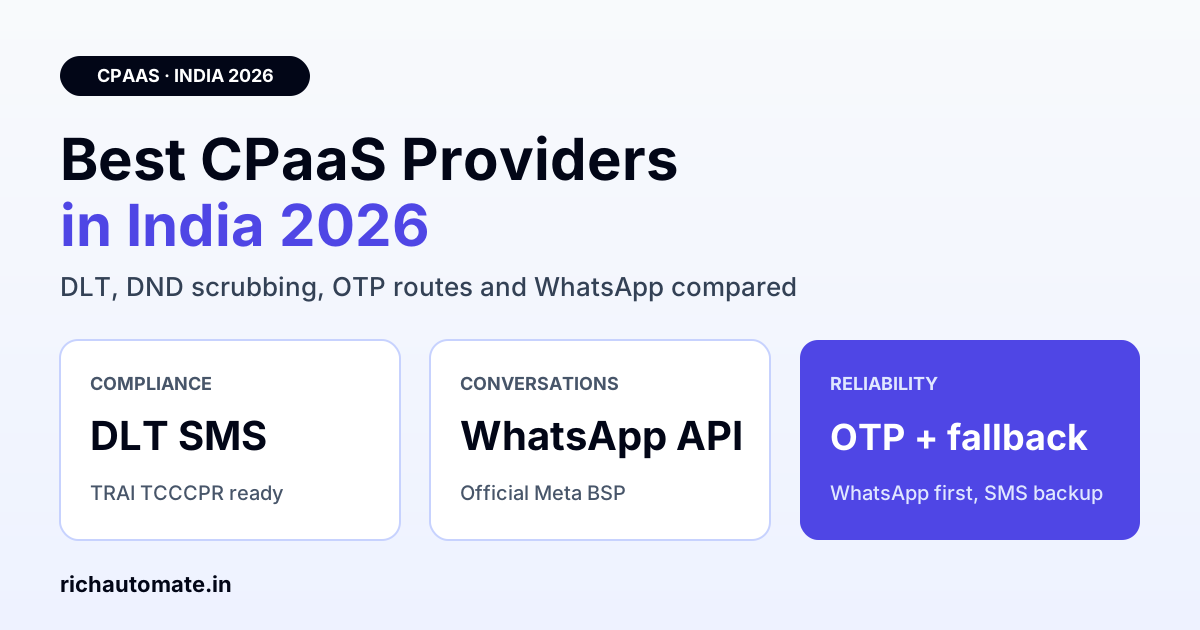
The best CPaaS provider in India for 2026 is one that is fully set up for TRAI's DLT system: it registers your entity, sender IDs and content templates, and it sends only through operator routes where DND scrubbing and consent checks happen on the DLT platform. Pick a vendor with a dedicated OTP route and SMS fallback, and run WhatsApp through an official Meta Business Solution Provider, because WhatsApp follows Meta's opt-in and template rules, not DLT.
This guide is for Indian teams in D2C, fintech, edtech, healthcare and SaaS who need to send OTPs, alerts, reminders and offers without getting blocked by operators. It explains how compliance actually works in India, compares the providers Indian businesses commonly shortlist, and gives you a checklist you can take into vendor calls. We do not quote any competitor's prices or performance numbers here. Rates and terms change often, so always get a written quote from each vendor.
What is a CPaaS, and why does India need a different lens?
CPaaS stands for Communications Platform as a Service. It is a cloud platform that lets your software send and receive messages and calls through APIs, without you building telecom connections yourself. A typical CPaaS covers some mix of SMS, WhatsApp, voice calls, RCS, email and verification (OTP) services, with dashboards, delivery reports and webhooks on top.
In most countries, choosing a CPaaS is mainly about API quality and price. In India, compliance comes first. Every commercial SMS sent to an Indian mobile number has to pass through the telecom operators' DLT (Distributed Ledger Technology) platforms. If your sender ID, template or consent records are not registered correctly, the message is simply dropped. So the real question is not "which API is nicest?" but "which provider will get my messages through TRAI's rules reliably, and help me stay compliant as those rules tighten?"
The India compliance spine: TRAI TCCCPR 2018 and DLT
The rulebook is the Telecom Commercial Communications Customer Preference Regulations, 2018, usually shortened to TCCCPR 2018. It moved spam control onto blockchain-style ledgers run by the operators (Jio, Airtel, Vi and BSNL each run a DLT portal). Registration on one portal is generally visible across operators. Here is what you register:
- Entity (Principal Entity) registration: your business registers once, with documents such as PAN, GST and authorisation details, and receives an entity ID.
- Header (sender ID) registration: the short alphabetic or numeric name that appears as the sender, for example a six-character brand header for transactional or service messages.
- Content template registration: every message format must be pre-approved, with variable fields marked. If the text you send does not match an approved template, operators reject it.
- Consent template registration: for service-explicit messages, you register how consent is taken, and consent records are tied to customers on the ledger.
- Telemarketer (TM) chain binding: your CPaaS provider is registered as a telemarketer, and the chain from your entity to the delivering operator has to be declared.
For a deeper walkthrough of how these rules interact with messaging apps, read our guide to TRAI TCCCPR and DLT for WhatsApp.
Who does DND scrubbing?
A common misunderstanding is that your CPaaS vendor "scrubs" your list against the DND registry before sending. Under DLT, the scrubbing is done on the operator side. When your message reaches the operator, the DLT system checks the recipient's preferences (the National Customer Preference Register, NCPR, also called DND) and any consent registered for that number, then decides whether the message can be delivered based on its category. Your provider's job is to route the message correctly with the right entity ID, header and template ID so this check can run. Your job is to choose the right category and keep honest consent records.
Message categories that decide delivery
| Category | Typical use | Reaches DND numbers? |
|---|---|---|
| Promotional | Offers, sales, marketing campaigns | No. Only to customers who have not blocked that type, and within permitted hours |
| Transactional | OTPs and alerts tied to a transaction, traditionally for banks and similar regulated entities | Yes |
| Service Implicit | Messages triggered by the customer's own action, such as order updates, delivery alerts, login OTPs | Yes |
| Service Explicit | Messages that need recorded consent, such as renewal reminders or follow-ups | Yes, if valid explicit consent is registered |
Exact definitions have shifted over time, so confirm the category for each template with your provider's compliance team before you register it.
URL and callback number whitelisting
TRAI also directed that links in SMS must be whitelisted. From late 2024, messages carrying URLs, APK links or OTT links that are not whitelisted against your templates can be blocked. TRAI has since pushed for callback numbers in messages to be whitelisted as well. Dates and scope have been updated more than once, so check the current direction with your provider. In practice, this means: register every domain you link to (including your link shortener), and keep a list of approved callback numbers.
Comparison: CPaaS providers commonly used in India
The table below lists providers that Indian businesses often evaluate. Channels shown are those the vendors broadly advertise; availability in India for a given channel, especially RCS and voice, can depend on your account and use case, so confirm with each vendor. This is not a ranking.
| Provider | Channels advertised | India DLT SMS | Typical fit |
|---|---|---|---|
| Gupshup | SMS, WhatsApp, RCS, chatbots | Yes | Brands wanting conversational messaging alongside A2P SMS |
| Route Mobile | SMS, WhatsApp, RCS, voice, email | Yes | Enterprises and high-volume A2P senders |
| Tanla (Karix) | SMS, WhatsApp, RCS, voice | Yes; Tanla has been closely involved with DLT infrastructure | Large enterprises, BFSI and regulated sectors |
| MSG91 | SMS, OTP, WhatsApp, voice, email | Yes | Startups and developer teams that want quick OTP and SMS setup |
| Exotel | Voice, SMS, WhatsApp, contact centre tools | Yes | Voice-first teams: call masking, IVR, support and sales calling |
| Kaleyra (part of Tata Communications) | SMS, WhatsApp, voice, RCS | Yes | Banks, insurers and enterprises wanting a large telecom group behind the vendor |
| Twilio | SMS, WhatsApp, voice, verification APIs | Supported; ask how India routes and DLT registration are handled | Global product teams already using its APIs in other countries |
| Infobip | SMS, WhatsApp, voice, RCS, email | Supported; confirm local connectivity setup | Multinationals wanting one omnichannel vendor across regions |
| Sinch | SMS, WhatsApp, voice, RCS, verification | Supported; confirm local connectivity setup | Global enterprises with multi-country messaging programmes |
All of these can generally send DLT-compliant SMS in India. The differences that matter are how much hands-on help you get with DLT registration, how OTP traffic is routed, what support looks like in Indian hours, and how billing works. For a breakdown of how SMS is usually priced in India, see our article on SMS API pricing in India.
Get a 1-minute BSP audit on WhatsApp
Drop your WhatsApp number — we line-item your current invoice against Meta India rates in under 60 seconds. India-hosted, DPDP-compliant.
Already have an SMS provider for DLT OTPs? Add WhatsApp next to it on RichAutomate: official WhatsApp Business API, ₹0 setup, ₹0 monthly fee and a 14-day free trial with 100 free credits. Start your free trial.
Selection checklist: what to ask every CPaaS vendor
Use this table in your vendor calls. Ask for answers in writing, and ask for a demo of the actual dashboard, not just slides.
| Criterion | What to ask | Why it matters |
|---|---|---|
| DLT template approval help | Will your team review my templates and headers before I submit them, and help fix rejections? | Template mismatches are the most common reason SMS silently fails in India. |
| DND scrubbing and consent records | How do you pass entity, header and template IDs, and how do I store and upload consent for service-explicit messages? | Operator-side scrubbing only works if routing data is correct and consent is registered. |
| OTP latency and fallback | Is OTP on a dedicated route? Can I fall back automatically from WhatsApp to SMS, or SMS to voice? | Slow OTPs cost logins, sign-ups and payments. Fallback protects conversion. |
| WhatsApp official Meta BSP status | Are you an official Meta Business Solution Provider, or reselling another provider's access? | Official access means direct template approval flow, clearer pricing and faster issue resolution. |
| India data residency | Where are message logs and contact data stored, and for how long? | Fintech and healthcare teams often have regulator or customer contract requirements on data location. |
| Billing (INR, GST invoice) | Do you bill in rupees with a GST invoice? Prepaid wallet or postpaid? Any monthly minimum? | Foreign-currency billing adds exchange swings and makes input tax credit harder. |
| Support hours | What are support hours in IST, and what is the escalation path when OTPs stop delivering? | An OTP outage at night is a revenue outage. You need a human who answers. |
WhatsApp vs SMS: how to split the work
SMS works on every phone and is the default for OTPs, but it is plain text and every template needs DLT approval. WhatsApp supports rich messages, buttons, media and two-way chat, and many Indian customers read WhatsApp faster than SMS. The two are complementary, not competitors.
OTP on WhatsApp with SMS fallback
Meta offers authentication templates built specifically for one-time passwords, including copy-code buttons. A common setup in India is to send the OTP on WhatsApp first and fall back to DLT SMS if the user is not on WhatsApp or the message is not delivered within a short window. This keeps a compliant SMS route ready while letting WhatsApp handle the majority of verifications where it works.
WhatsApp is not under DLT
WhatsApp Business API messages do not go through the telecom DLT platforms. Instead, they are governed by Meta's rules: you need the customer's opt-in, business-initiated messages must use approved templates, and each template is categorised as marketing, utility or authentication. Your quality rating and messaging limits depend on how customers respond. We cover the details in does WhatsApp API need DLT registration and do DND rules apply to WhatsApp. Regulations can change, so treat these as guidance and confirm with your legal or compliance team for your sector.
On cost, the comparison depends on message type and volume. Our breakdown of WhatsApp vs SMS cost in India walks through realistic scenarios.
Where RichAutomate fits (honestly)
RichAutomate is a WhatsApp-first platform built on the official WhatsApp Business API from Meta. It is not an SMS CPaaS. We do not send SMS, voice calls or RCS, and we do not handle DLT registration. If you need DLT SMS or SMS OTP, keep a CPaaS from the list above for that.
What we recommend for most Indian businesses is a simple pairing:
- Your SMS CPaaS: DLT-registered SMS, SMS OTP and SMS fallback.
- RichAutomate: everything on WhatsApp, including broadcasts to opted-in customers, a shared team inbox for support and sales, a no-code flow builder, chatbots and WhatsApp authentication templates for OTP.
This split keeps each channel with a tool designed for it. Your developers keep the SMS integration they already trust, and your marketing and support teams get a WhatsApp workspace they can run without code.
RichAutomate pricing
There is no setup fee and no monthly fee. You choose one of two ways to pay per message:
- Client Pay: Meta's rate plus ₹0.10 per message. Meta's India rates are ₹0.8631 for marketing and ₹0.13 for utility and authentication messages.
- SaaS Pay: one all-inclusive price, ₹1.50 per marketing message and ₹0.50 per utility message.
Every new account gets a 14-day free trial with 100 free credits. Full details are on our pricing page. If you are comparing WhatsApp providers specifically, our WhatsApp BSP scorecard lays out what to check.
How to choose: a short decision guide
- You mainly need OTPs and transactional SMS: pick an India-focused SMS CPaaS with strong DLT support and a dedicated OTP route. Add WhatsApp authentication templates later to reduce SMS volume.
- You are voice-heavy (support, sales calls, call masking): shortlist voice-first vendors, then add WhatsApp for follow-ups and reminders.
- You are a global team with India as one market: a global CPaaS can work, but ask specifically how DLT registration and Indian routes are handled.
- You want customer conversations, campaigns and automation: run WhatsApp on a dedicated platform like RichAutomate, and keep SMS as a compliant fallback.
Whatever you choose, run a two-week pilot with real traffic. Measure OTP delivery time, template approval turnaround, and how quickly support responds when something breaks. Those three numbers tell you more than any sales deck.
Bottom line
For compliant SMS in India, choose a CPaaS that handles DLT registration well, routes OTPs on a dedicated path, bills in INR with GST invoices and answers support calls in Indian hours. DND scrubbing happens on the operator's DLT side, so your focus should be correct templates, correct categories and clean consent records. Then put WhatsApp on an official Meta platform for richer, faster customer conversations. RichAutomate gives you that WhatsApp layer with ₹0 setup and ₹0 monthly fees. Start your 14-day free trial with 100 free credits and run WhatsApp alongside the SMS provider you already use.