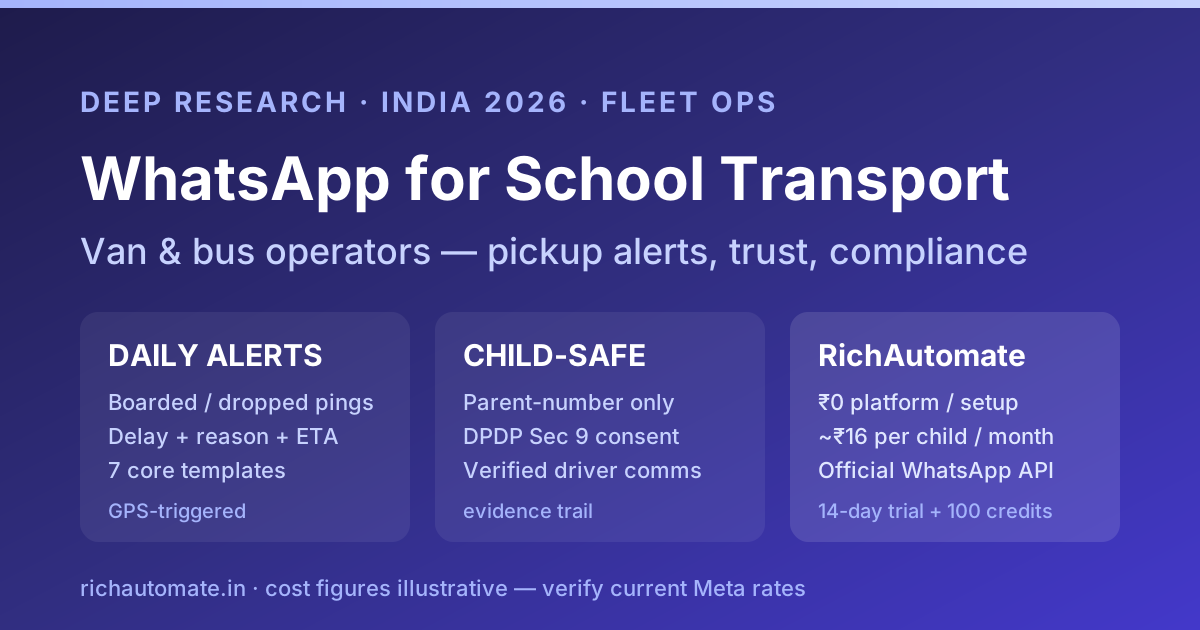
The short answer. A school-transport operator — whether you run 4 vans for one school or a 60-bus fleet across a city — lives and dies by one thing: parent trust. That trust is built or destroyed in the daily gap between "the van left" and "my child is home". WhatsApp is where every Indian parent already is, and wiring your fleet into it — pickup/drop alerts, delay notices, driver-change intimations, fee reminders, renewal flows — converts that anxiety gap into a professional, timestamped communication trail. RichAutomate runs this on the official Meta Cloud API with ₹0 platform fee — you pay only per message, and most of a transport operator's traffic is cheap utility messaging.
India moves crores of children to school every day in private vans, buses and cabs. The operators behind them run one of the most scrutinised small businesses in the country — parents, schools, RTOs and courts all watch. Yet most operators still coordinate on personal phone calls and an unstructured group chat. This guide lays out the full WhatsApp operating system for a school-transport business in 2026.
Why school transport is a perfect WhatsApp fit
Three structural reasons. First, the daily cadence: every child generates at least two events a day (pickup, drop) — that is 40+ touchpoints per child per month, far too many for phone calls and exactly what templated utility messages exist for. Second, the anxiety asymmetry: a 10-minute delay is trivial operationally but terrifying for a waiting parent; a proactive "van running 10 min late — reason: traffic at the flyover" message costs under a rupee and saves a panicked call to the driver (who should not be answering while driving). Third, the evidence trail: when a dispute arises — a missed pickup, an attendant complaint, a fee disagreement — a timestamped WhatsApp thread is your professional record.
The regulator spine (verify each for your state, as of 2026)
| Regulator / rulebook | What it governs | Where WhatsApp touches it |
|---|---|---|
| Supreme Court school-bus guidelines + state Motor Vehicle rules | Bus colour/markings, speed governors, attendant presence, first-aid, window grills | Compliance-evidence photo log per vehicle; renewal reminders for fitness certificates |
| State school-cab/van schemes (state-wise, verify yours) | Permits, seating caps, driver eligibility (age/experience), police verification | Driver-document collection Flow; expiry reminders (badge, permit, PUC, insurance) |
| AIS-140 GPS/VLT + panic-button mandates (state notification dependent) | Vehicle tracking devices on notified categories | Live-location sharing etiquette; "van approaching stop" alerts fed by your GPS system |
| POCSO + school child-safety policies | Verified staff around children, incident reporting | Driver/attendant photo + verification-status intimation to parents; incident-comms discipline |
| DPDP Act 2023 — Section 9 (children's data) | Verifiable parental consent, no tracking/targeted ads at children | All comms go to the PARENT's number; minimise child identifiers in message bodies |
| GST + contract terms | Transport-service billing (school-contracted vs parent-direct differs — verify with your CA) | Invoice + fee-reminder templates with UPI links |
Every row above is state- and contract-dependent — treat this as an operational map, not legal advice. Verify current rules with your RTO and counsel.
Before you submit, run the copy through the WhatsApp template approval checker to catch the rejection triggers Meta flags most often.
The 6-stage parent lifecycle on WhatsApp
| Stage | What has to happen | WhatsApp job | Message category |
|---|---|---|---|
| 1. Enquiry + route check | Parent asks "do you cover my area, what's the fee?" | Route/stop lookup Flow → instant fee quote + seat availability | Service (24h window) |
| 2. Onboarding | Child details, stop assignment, emergency contacts, consent | Structured intake Flow — parent's number verified as the comms channel; consent recorded | Utility |
| 3. Daily operations | Pickup/drop confirmations, delay alerts, route changes | Templated alerts fired from your GPS/attendance trigger; "van approaching" nudges | Utility |
| 4. Exceptions | Driver change, breakdown, weather closure, early dispersal | Broadcast to affected route only — with driver photo + verification status on changes | Utility |
| 5. Fees + renewal | Monthly/term fee, annual seat renewal before session start | Invoice + UPI link, 3-step reminder ladder; March renewal Flow locks next-year seats | Utility |
| 6. Feedback + referral | Term-end feedback, sibling/neighbour referrals | 1-tap rating Flow; referral nudge in renewal confirmation | Marketing (opt-in) |
The daily alert engine — the product parents pay for
The operational core is a trigger→template pipeline: your GPS platform (or even the attendant's one-tap check-in on a stop list) fires an event; RichAutomate matches it to a pre-approved utility template; the parent gets "Aarav boarded at 7:42 AM, Stop 4" seconds later. Build these five templates first: boarded, dropped at school, boarded for return, dropped at home stop, delay + reason + revised ETA. Add two exception templates: driver/attendant change (with name, photo, verification status) and route disruption. That is 90% of your parent-facing value in seven templates.
Get a 1-minute BSP audit on WhatsApp
Drop your WhatsApp number — we line-item your current invoice against Meta India rates in under 60 seconds. India-hosted, DPDP-compliant.
The one-rule that builds trust: never let a parent discover a delay by standing at the stop. If your ETA slips more than 7-8 minutes, the delay template fires — automatically, with a reason. Operators who do this report the daily "where is the van?" call volume collapsing to near zero (illustrative — measure your own baseline first).
Driver & attendant verification — communicate it, don't just do it
You already police-verify drivers and attendants because the rules demand it. The missed opportunity is telling parents. A start-of-session message per route — "Your route team this year: Driver Ramesh (badge no., police verification completed), Attendant Sunita (verified)" — with photos, converts a compliance cost into a trust asset. On any substitution, the change template fires before the substitute arrives at the first stop. For incidents (minor accident, medical event, behaviour complaint), keep the discipline: facts, action taken, next update time — never speculation, and serious matters move to a phone call with the transport-in-charge, with WhatsApp as the follow-up record.
What it costs (illustrative)
| Item | Assumption | Monthly cost |
|---|---|---|
| Daily alerts | 400 children × 2 alerts × 22 days = 17,600 utility msgs | ~₹8,800 at ₹0.50 (SaaS Pay) |
| Exceptions + fee reminders | ~1,800 utility msgs | ~₹900 |
| Renewal/referral campaigns | ~500 marketing msgs | ~₹750 at ₹1.50 |
| Platform fee | RichAutomate | ₹0 |
| Total | 400-child operator | ~₹10,450/month — ~₹26/child |
₹26 per child per month for a parent experience no phone-call operation can match — most operators fold it into the fee without a murmur. On Client Pay you instead pay ~₹0.10/msg platform charge with Meta's rates billed to you directly — run your own numbers on the WABA cost calculator. (Figures illustrative; Meta rates change — verify current pricing.)
DPDP Section 9 — the children's-data carve-out
Non-negotiables for child data on WhatsApp: all messaging goes to the parent's verified number, never the child's; collect verifiable parental consent at onboarding (your intake Flow is the natural place, keep the record); minimise child identifiers in message bodies — first name and stop number, not school ID + class + full name in one message; no marketing targeted at children, ever; set a retention window — when a family leaves, their thread data goes on a deletion schedule. All DPDP obligations are evolving — verify current rules with your compliance advisor.
What the software cannot do
Honesty section. WhatsApp automation does not make your fleet compliant — fitness certificates, speed governors, verified staff and permits are physical, legal obligations that no message can substitute. It does not replace your GPS/VLT obligations where AIS-140 applies. And no provider can promise your number is immune from Meta enforcement — quality comes from opt-in discipline and template hygiene, and anyone selling a "no ban guarantee" should be shown the door. What the software does do: turn the compliance and care you already deliver into something parents can see, twice a day, every day.
How RichAutomate fits
Official Meta Cloud API (v24), template management, route-wise broadcast lists, WhatsApp Flows for intake/renewal, webhook triggers for your GPS events, team inbox for the transport-in-charge — with ₹0 platform, setup and monthly fee, 14-day trial and 100 free credits. Related reading: WhatsApp for K-12 schools, school fees & parent comms, best WhatsApp API for schools, and the full API cost guide.
Run a school-transport fleet? Get the seven core templates live in a week. Start the 14-day free trial (100 credits, no card), see pricing, or talk to us on WhatsApp at +91 81603 11319 / book a free 30-min setup call.