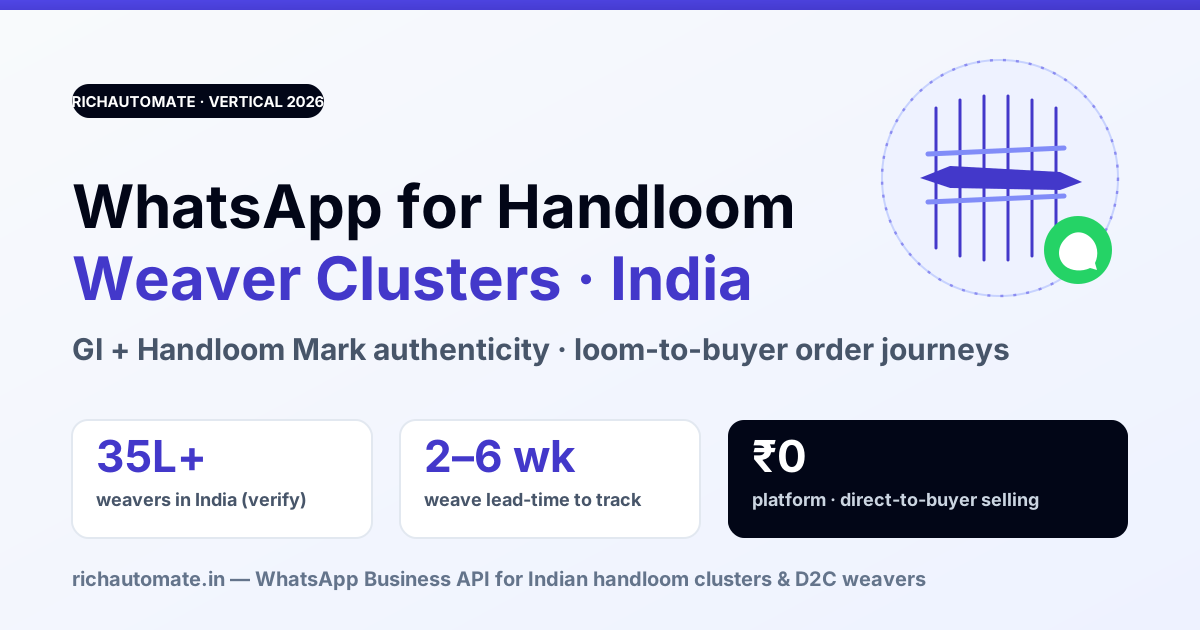
WhatsApp is the single most effective channel for a handloom weaver cluster or a direct-to-buyer weaving brand in India in 2026 because it carries the two things that actually close a handloom sale — a live authenticity story (GI tag, Handloom Mark) and honest loom-to-buyer progress on a 2-to-6-week weave — inside the one app the buyer already checks. The WhatsApp Business API lets a cluster, co-operative or D2C label run enquiries, custom orders, weaving-progress photo updates, dispatch with authenticity proof and festival re-marketing from one number, without a website or a call centre. This guide maps the regulators a handloom business touches, a five-stage WhatsApp order journey built for the reality of hand-weaving lead times, the automation stack, and the data-protection carve-outs that matter for artisan and buyer information. Market figures are directional and as of 2026 — verify current scheme rules, GI and Handloom Mark criteria on the official Development Commissioner (Handlooms) and GI Registry sources. General information, not legal advice.
Why handloom is a natural WhatsApp business
Handloom does not sell like a stocked product. Most pieces are made to order or made in tiny batches, the lead time is weeks not hours, the buyer is paying a premium specifically for authenticity, and the maker is often a weaver household or a cluster with no website and no shopfront reach beyond the local mandi. Every one of those frictions is a WhatsApp strength: a chat thread can hold the design conversation, the advance, the weekly loom photo, the authenticity certificate and the reorder, all against one phone number the buyer trusts.
India's handloom sector supports roughly 35 lakh weavers and allied workers (directional — verify against the latest Handloom Census and Development Commissioner data), overwhelmingly rural, overwhelmingly women. The commercial shift of 2025-26 is direct-to-buyer: clusters and weaver-entrepreneurs selling past the middleman to city buyers, NRIs and boutiques. That shift lives or dies on communication, and WhatsApp is where it happens. If you are weighing whether you even need a site first, see our guide to running a WhatsApp Business API without a website — most weaver businesses should start exactly there.
The regulators and schemes a handloom business touches
Handloom sits at an unusual intersection of craft-protection law, authenticity marks and ordinary business compliance. You do not need to master all of it, but your customer messaging should reflect it — authenticity is your product.
The WhatsApp compliance self-audit is a quick way to find which of these you are actually missing.
| Area | Body / scheme (verify current rules 2026) | Why it touches your WhatsApp |
|---|---|---|
| Sector oversight | Office of the Development Commissioner (Handlooms), Ministry of Textiles + state Handloom Development Corporations | Scheme benefits, cluster (NHDP) support, weaver ID data |
| Authenticity mark | Handloom Mark / India Handloom Brand (IHB) scheme | The badge you send buyers to prove genuine handloom vs power-loom |
| Geographical Indication | GI Registry (e.g. Banarasi, Kanjeevaram, Pochampally, Chanderi — verify each product's GI) | GI proof is a core sales message and an anti-counterfeit claim |
| Craft protection | Handlooms (Reservation of Articles for Production) Act, 1985 | Certain articles reserved for handloom — informs honest claims |
| Tax | GST (several handloom items attract concessional or nil rates — verify HSN-wise) + e-invoicing thresholds | Invoicing and price transparency in chat |
| Data protection | Digital Personal Data Protection (DPDP) Act, 2023 | Buyer contact data and weaver roster data are personal data |
The five-stage WhatsApp order journey for handloom
A stocked-retail funnel does not fit a 2-to-6-week weave. This journey is built for the real rhythm of the loom, where the waiting period is not dead time but the most trust-building part of the sale.
Stage 1 — Enquiry and catalogue with authenticity up front
Buyer messages the cluster number after seeing a reel, a boutique referral or an exhibition. An automated welcome shares the catalogue (weave, region, GI status, price band) and immediately foregrounds authenticity — Handloom Mark, GI, weaver name. Capturing occasion (wedding, gifting, personal) and budget here routes the buyer to the right weave.
Get a 1-minute BSP audit on WhatsApp
Drop your WhatsApp number — we line-item your current invoice against Meta India rates in under 60 seconds. India-hosted, DPDP-compliant.
Stage 2 — Custom order, design lock and advance
Handloom buyers customise — colour, border, motif, blouse-piece. A structured order form (via WhatsApp Flows) captures the spec, a design reference photo is exchanged, the lead time is set honestly (say 3-5 weeks), and an advance is collected against a clear invoice. Setting the timeline in writing here prevents the number-one complaint in the craft: silent delays.
Stage 3 — Weaving progress updates (the trust engine)
This is where WhatsApp beats every other channel. A weekly loom-to-buyer photo — warp set, weaving underway, motif emerging — turns the wait into anticipation and pre-empts the anxious "is my order happening?" message. It also quietly proves the piece is genuinely hand-woven. Scheduled update nudges keep it consistent across dozens of live orders without the founder chasing each loom.
Stage 4 — Dispatch with authenticity proof
On completion: a finished-piece photo, the invoice, the GI / Handloom Mark image or certificate, and a courier tracking link, all in the thread. The authenticity document travelling with the dispatch is both a compliance-friendly habit and a re-sale asset the buyer keeps. Delivery-status templates close the loop.
Stage 5 — Post-sale care, story and festival re-marketing
Care instructions (handloom needs gentle washing) reduce returns and complaints. Then the long game: opt-in festival and wedding-season broadcasts (Pongal, Durga Puja, wedding months), new-weave drops, and the weaver's own story — the human behind the loom is the marketing. Reorders and referrals from satisfied premium buyers are the cluster's cheapest growth. For cost-sensitive clusters comparing running costs, our cheapest WhatsApp Business API in India guide lays out the total-cost math.
The automation stack behind it
- Shared team inbox so a cluster co-ordinator and helpers answer from one number without stepping on each other.
- WhatsApp Flows / order forms to capture custom specs, occasion and measurements as structured data, not scattered messages.
- Broadcast campaigns (opt-in) for festival drops and new collections, respecting Meta's marketing-category rules.
- Scheduled update templates for weekly weaving progress and dispatch status.
- Catalogue to show the range in-chat with GI and authenticity noted per item.
Related maker-and-export playbooks worth borrowing patterns from: our guides for leather goods and footwear exporters and for art, collectibles and luxury resale use the same authenticity-first, made-to-order journey.
DPDP and the data carve-outs that matter
Two kinds of personal data flow through a handloom operation, and both fall under the DPDP Act, 2023. First, buyer data — phone number, address, occasion, purchase history — used only for the order and, with clear opt-in, for festival marketing; give an easy opt-out and do not over-retain. Second, and easy to forget, weaver and artisan roster data — names, IDs, bank details for payments — which is equally personal data and must be minimised and protected, not casually forwarded in group chats. Collect only what the order and the payment need, keep it purpose-limited, and get consent before adding anyone to a broadcast list. Verify the current DPDP rules and any consent-notice requirements as of 2026.
Where RichAutomate fits for a weaver cluster
Margins in handloom are thin and the maker is often the seller, so platform cost matters. RichAutomate runs a flat model — Rs 0 platform fee, Rs 0 setup and Rs 0 monthly, with no per-seat platform charge, so a co-ordinator plus a couple of helpers on the shared inbox costs Rs 0 on the platform side. Two billing modes fit different clusters:
- Client Pay: Rs 0.10 per message, and Meta's conversation charges billed to you directly by Meta at Meta's own rates — no markup on top.
- SaaS Pay: an all-in Rs 1.50 per marketing conversation and Rs 0.50 per utility conversation.
A 14-day free trial with 100 credits lets a cluster run a real festival broadcast and a few live custom orders before committing. Meta's conversation-category pricing changes, so verify current rates as of 2026.
Get started
Message us on WhatsApp at +91 81603 11319 or book a 15-minute walkthrough at richautomate.in/book/demo to map your cluster's order journey. Or start a free 14-day RichAutomate trial and run your next festival drop from one number.
Related: exporting from India on WhatsApp? Read WhatsApp for spice exporters in India 2026.
Related: making jewellery for retailers? Read WhatsApp for jewellery manufacturers in India 2026.
Related: in the silk supply chain? Read WhatsApp for sericulture & silk reeling in India 2026.