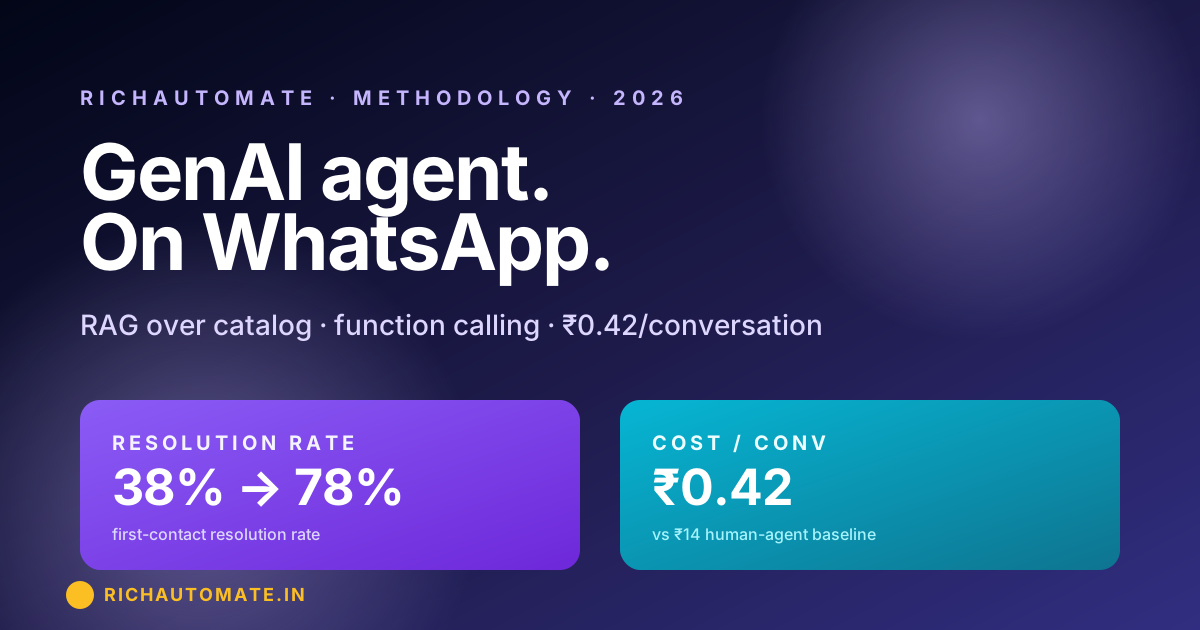
Decision-tree chatbots dominated Indian WhatsApp Business through 2024 — "press 1 for orders, 2 for refund, 3 for talk-to-human". Customer satisfaction was 4.1/10. Resolution rate 38%. Most flows ended in "please contact support" on user intent the bot couldn't parse. The 2026 stack is different: a small LLM (GPT-4o-mini, Claude Haiku 4.5, Gemini 2.5 Flash, Llama-3-8B-Instruct fine-tuned, or Sarvam-1 for Indian languages) handles intent classification + entity extraction + response generation with retrieval-augmented generation (RAG) over the brand's catalog + FAQ + order data. Function calling lets the LLM trigger backend actions (place order, check status, request return). Resolution rate climbs from 38% to 78%; cost per resolved conversation drops from ₹14 (human agent) to ₹0.42 (LLM-driven). This guide is the 2026 implementation playbook for Indian D2C + SaaS + B2C WhatsApp brands.
Why Decision-Tree Bots Fail Indian Customers
Three structural problems:
- Indian customers code-switch mid-message — "Where is my order bhai, last week order kiya tha for ₹890". Decision-tree bots match keyword fragments, fail context. LLMs handle code-switched Hindi-English-Tamil-Bengali natively.
- Intent space is too large for menus — a typical D2C support handles 80-200 distinct intents. Decision trees max out at 4-7 levels deep before customers abandon.
- Catalog + FAQ + policy knowledge changes weekly — decision trees require manual rebuilding. RAG-powered LLMs auto-update by re-indexing the knowledge base.
The result: decision-tree resolution rate plateaus around 38% after months of tuning. LLM-with-RAG starts at 65% out-of-the-box and climbs to 75-82% with 6-8 weeks of feedback-loop fine-tuning.
The Reference Architecture for Indian D2C in 2026
| Layer | Choice for Indian D2C 2026 | Why |
|---|---|---|
| LLM | GPT-4o-mini / Claude Haiku 4.5 / Gemini 2.5 Flash / Sarvam-1 (regional) | Small model, fast, cheap (~₹0.30-0.60 per conversation), multilingual |
| Embeddings | OpenAI text-embedding-3-small / Cohere embed-multilingual / Sarvam embeddings | Affordable, supports Indian regional languages |
| Vector DB | pgvector (Postgres) / Qdrant / Pinecone | pgvector if already on Postgres; otherwise Qdrant self-hosted |
| Knowledge base | Catalog SKUs, FAQs, policies, recent orders for the user | Structured + unstructured indexed nightly |
| Function-calling tools | get_order_status, place_order, request_return, escalate_to_human | 5-12 tools cover 90%+ of intents |
| Guardrails | Output filter for hallucination, policy violations, off-topic | Block responses outside brand voice / make commitments brand can't honour |
| Eval harness | 200-500 sample conversations re-graded weekly | Catches regressions when model / prompt updates |
Real Indian D2C Numbers
Skincare D2C, 80,000 active customers, 6,400 support conversations/month
| Metric | Decision-tree bot | LLM + RAG agent |
|---|---|---|
| First-contact resolution | 38% | 78% |
| Median time-to-resolution | 11 min (multi-turn) | 2 min |
| Customer satisfaction (CSAT) | 6.2/10 | 8.4/10 |
| Cost per conversation | ₹14 (escalates 62% to humans) | ₹0.42 (escalates 22%) |
| Monthly support cost | ₹89,600 | ₹26,880 |
| Languages handled | 2 (English, Hindi) | 11 (incl. regional) |
SaaS B2B, 12,000 ARR customers, 1,800 support conversations/month
| Metric | Without LLM | With |
|---|---|---|
| Conversations resolved without human | 32% | 71% |
| Average response time | 4.2 hours | 14 seconds |
| NPS impact (90-day) | baseline | +18 points |
| Senior CSM time freed up | — | 62 hours/month for strategic accounts |
Function-Calling Tool Catalog (Cover 90%+ of Indian D2C Intents)
| Tool | Trigger intent | Action |
|---|---|---|
| get_order_status | "where is my order" / "order kab aayega" | Lookup order_id from customer phone, return courier + ETA |
| list_recent_orders | "mere orders" / "past purchases" | Last 5 orders with status |
| request_return | "return karna hai" / "wrong size" | Initiate return, schedule reverse pickup |
| request_refund_status | "refund kab milega" | Lookup refund timeline |
| place_reorder | "same as last time" / "repeat order" | Pre-fill cart with last successful order |
| recommend_product | "skincare for oily skin" | RAG over catalog → top 3 SKUs |
| apply_coupon | "discount code" | Validate + apply if valid |
| update_address | "wrong address" / "change delivery" | Update if order not yet shipped |
| cancel_order | "cancel my order" | Cancel if cancellation window open |
| escalate_to_human | Sentiment negative + LLM low-confidence | Route to live agent with conversation context |
Operating Rule
The single highest-leverage move for any Indian D2C above 5,000 monthly support conversations is replacing decision-tree bots with a small-model LLM (GPT-4o-mini / Haiku 4.5 / Gemini 2.5 Flash) backed by RAG over catalog + FAQ + recent orders, plus 8-12 function-calling tools. Resolution rate doubles, cost per conversation drops 30×, regional language support arrives free. The technology is mature in 2026 — integration takes 4-6 weeks for a competent backend team, not 6 months.
Get a 1-minute BSP audit on WhatsApp
Drop your WhatsApp number — we line-item your current invoice against Meta India rates in under 60 seconds. India-hosted, DPDP-compliant.
The Six Anti-Patterns That Wreck LLM Agents
- No guardrails on output. LLM commits brand to refunds it can't honour or shares competitor info. Build output filter + policy-violation classifier; block before send.
- RAG over too-large knowledge base. Retrieving 50 chunks per query dilutes context. Index only top FAQs, recent orders for that customer, top 200 SKUs by recent volume. Fewer, better-ranked chunks.
- No conversation memory across turns. Each LLM call sees only the latest message. Pass last 6-10 messages as context; clip history beyond that to keep tokens low.
- Hallucination on inventory / pricing. LLM confidently states "in stock for ₹890" when it's out-of-stock. Always validate via function call before committing in the response.
- Skipping the eval harness. Model upgrade or prompt change silently breaks 5-15% of intents. 200-500 sample conversations re-graded weekly catches regressions.
- Marketing template for free-form LLM responses. Free-form replies inside the 24h customer-initiated session don't need templates — they're free. Templates only for outbound business-initiated. Mixing up the two doubles cost.
Cost Economics: LLM vs Human vs Decision-Tree
| Component | Cost per conversation | Notes |
|---|---|---|
| WhatsApp session (24h customer-initiated) | ₹0 (free) | No template fee inside the session |
| LLM inference (GPT-4o-mini, ~3 turns) | ₹0.18-0.32 | ~3,000 input + 500 output tokens at India 2026 rates |
| Embedding + vector lookup | ₹0.04-0.08 | Per-query embedding + top-K retrieval |
| Function-call backend ops | ₹0.05 | DB lookup, courier API, etc. |
| Total per conversation | ₹0.30-0.50 | Comfortably below ₹0.50 ceiling |
| Human agent equivalent | ₹12-18 | 4-7 min agent time at ₹180/hr fully-loaded |
Compliance + Operational Notes
- DPDP Act 2023 — automated decision-making + LLM-generated responses require disclosure in Privacy Policy. Customer should be told they're interacting with an AI assistant; offer easy escalation to human.
- Hallucination accountability — brand is liable for commitments the LLM makes. Output filter + policy guardrails + escalation path are mandatory before scaling beyond pilot.
- Indian-region inference — for sensitive verticals (BFSI, healthcare), use Indian-region LLM endpoints (Sarvam, Anthropic India region, OpenAI Azure India region). DPDP-aligned data residency.
- Logging + audit — log all LLM inputs + outputs + function calls per conversation for 90-180 days. Required for compliance + eval harness training data.
- Free-form vs template — inside 24h customer-initiated session, LLM free-form replies are free + unrestricted. Outside session, must use templates — LLM cannot compose ad-hoc outbound business-initiated messages.
Run GenAI WhatsApp agent on RichAutomate.
GPT-4o-mini / Haiku 4.5 / Gemini 2.5 Flash with RAG over your catalog + FAQ + orders. 12 function-calling tools pre-built. Output guardrails + eval harness included. Hindi + English + 9 Indian regional languages. ₹0.42 per conversation in production. 14-day trial.
If you still need the paperwork, the DPDP privacy policy generator produces a policy covering your WhatsApp data flows.
New to WhatsApp automation? Start with the complete WhatsApp chatbot for business guide for the full picture, then come back to apply it here.
\nRelated reading
- WhatsApp Business API cost in India 2026 — the conversation charges underneath your ₹0.42-per-resolution math
- best WhatsApp Business API for 2026 — AI-capable platforms compared for RAG and agent workloads
- RichAutomate pricing — AI automation plans priced against build-it-yourself LLM stacks