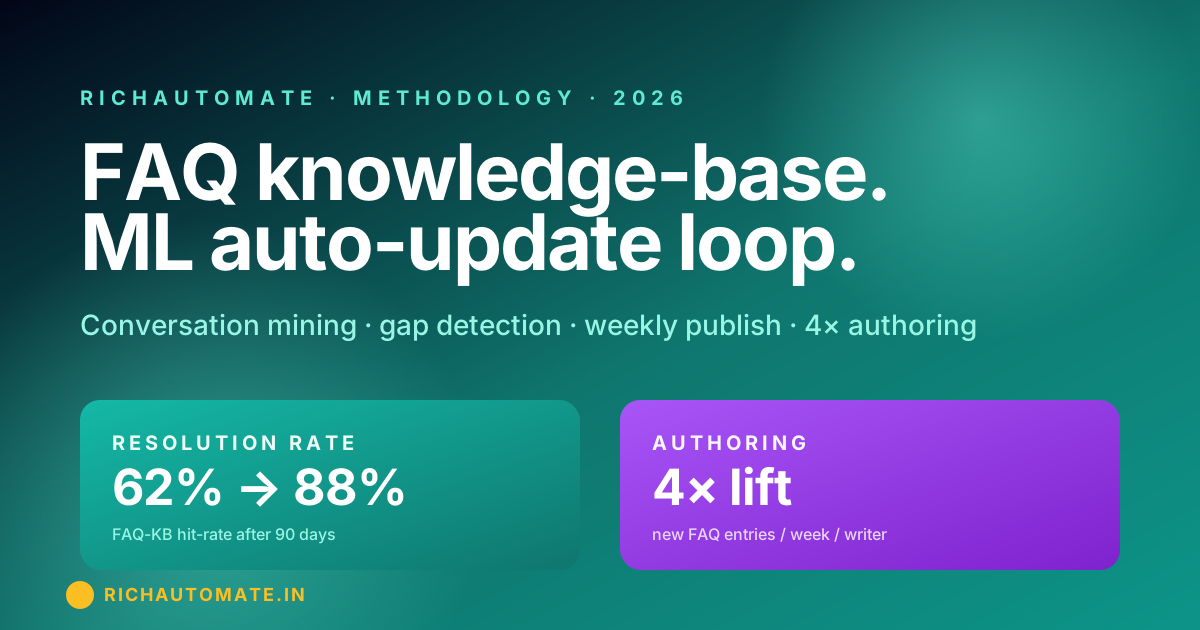
The hidden bottleneck in every Indian WhatsApp LLM-bot deployment is not the model — it's the FAQ knowledge base it retrieves over. Brands ship a polished v1 KB with 80-200 articles, the bot resolves 62% of customer queries on launch, and then the KB calcifies. Customer questions evolve (new product launches, policy changes, regional concerns), but the KB doesn't. By month 3, the bot is answering yesterday's questions while a growing tail of new queries fall through to expensive human escalation. The brands compounding fastest in 2026 closed this loop with an ML auto-update feedback pipeline — mine bot conversations weekly, detect FAQ gaps where the bot hedged or escalated, auto-draft new KB entries with LLM, route through a human-review queue, and publish back into RAG within 5-7 days. Resolution rate climbs from 62% to 88% over 90 days; content-team authoring throughput rises 4× per writer. This guide is the 2026 implementation playbook for Indian D2C, SaaS, BFSI, and B2C operators running LLM bots: the gap-detection signals, ML mining pipeline, human-in-the-loop review architecture, real cohort numbers, and the compliance pattern.
Why Static KBs Decay
Three structural forces:
- Product velocity outpaces content team. D2C launches new SKU monthly; SaaS ships features quarterly. Bot KB lags 4-12 weeks behind reality.
- Customer language drifts. "Where is my order" in Q1 becomes "ETA kya hai" / "status update bhejo" / "tracking pe nahi dikha raha" in Q3. Same intent, different surface forms; static KB matching breaks.
- Long-tail intents emerge. Top 50 intents covered at launch; intents 51-200 surface organically over months. Without mining, bot escalates them all.
The Six FAQ-Gap Detection Signals
| Signal | What it captures | Action |
|---|---|---|
| Bot escalation cluster | Multiple users escalated with similar phrasing | Cluster + draft new FAQ |
| Low LLM-confidence cluster | Bot answered but confidence below 0.6 — likely wrong | Re-author existing FAQ with better grounding |
| Negative-CSAT cluster | Customer rated bot response 1-2 stars | Audit + revise FAQ |
| Repeat-query rate | Same intent asked 3+ times in same conversation | Existing FAQ is unclear; rewrite |
| Code-switch / regional-language gap | Hindi / Tamil / Telugu queries failing English-only KB | Translate / regenerate per language |
| New-product / policy event | Trigger from product launch / policy update | Pre-emptive FAQ authoring |
The ML Auto-Update Pipeline
Weekly cron Sunday 2 AM IST:

Step 1: Mine last 7 days of conversations
  Filter: bot-resolved + escalated + low-confidence + negative-CSAT
  Strip PII (phone, email, name, address, payment) before any further processing

Step 2: Cluster by intent
  Embedding-based clustering (K-means / HDBSCAN over OpenAI text-embedding-3-small)
  Min cluster size: 5 conversations
  Output: clusters with representative examples

Step 3: Auto-draft FAQ entries
  Per cluster: LLM (Claude Haiku 4.5 / GPT-4o-mini) generates draft FAQ
    Question: paraphrased + canonical
    Answer: grounded in product docs, policy, prior FAQ
    Tags: product, region, language
  Confidence score: how well-supported by existing context

Step 4: Human review queue
  Reviewer dashboard with cluster, draft, source examples
  Reviewer: approve / edit / reject / merge with existing
  Median review time: 4-7 minutes per draft

Step 5: Publish to RAG
  Approved entries indexed in vector DB (pgvector / Qdrant)
  Versioned: each entry tagged with version + author + approval date
  A/B routing: 10% of relevant queries answered with new entry; measure CSAT

Step 6: Outcome tracking
  Per entry: hit count, resolution rate, CSAT
  Underperforming entries flagged for re-review at 30/60/90 days

Step 7: Stale-entry detection
  Entries with hit count near zero for 60+ days → archive
  Entries answering outdated info → flag for refresh

Step 8: Weekly delta report
  New entries added, updated, archived
  Resolution-rate trend per intent cluster
  Top language-coverage gaps
  Reviewer queue health metrics
Real Indian Operator Numbers
D2C beauty brand, 240 FAQ KB at launch, 6,400 monthly bot conversations
| Metric | Static KB (no ML loop) | ML auto-update loop |
|---|---|---|
| Resolution rate at launch | 62% | 62% (same baseline) |
| Resolution rate after 30 days | 56% (decay) | 74% |
| Resolution rate after 90 days | 48% (continued decay) | 88% |
| FAQ entries / week / writer (manual) | 2-4 | 10-16 (with auto-draft) |
| Human escalation cost / month | ₹2.4L | ₹64k |
| Time to add new-product FAQ post-launch | 4-8 weeks | 5-7 days |
SaaS B2B, 1,200 FAQ KB, 1,800 monthly bot conversations
| Metric | Without ML loop | With |
|---|---|---|
| Long-tail intent coverage | top 50 only | top 200+ |
| Regional-language coverage | English only | 11 Indian languages |
| CSAT on bot responses | 6.4/10 | 8.1/10 |
| Content-team capacity (KB articles / quarter) | 120 | 480 |
Human-in-the-Loop Review Architecture
Auto-drafting is fast; auto-publishing is risky. Human review is the safety net. Review architecture:
Get a 1-minute BSP audit on WhatsApp
Drop your WhatsApp number — we line-item your current invoice against Meta India rates in under 60 seconds. India-hosted, DPDP-compliant.
- Reviewer dashboard: pending drafts ranked by cluster size + frequency.
- Per-draft view: cluster examples (5-10 representative conversations with PII stripped), LLM-generated draft, confidence score, related existing FAQs.
- Action buttons: Approve / Edit (in-place markdown editor) / Reject (with reason) / Merge with existing FAQ.
- SLA: drafts > 7 days old auto-promoted to high priority. Reviewer queue should clear weekly.
- Quality control: 10% sample of approved entries audited monthly by senior reviewer; tracking accuracy over time.
Operating Rule
The single highest-leverage move for any Indian operator running LLM bots at 1,000+ monthly conversations is the weekly conversation-mining + auto-draft + human-review + publish loop. This single pipeline lifts resolution rate from 62% (decaying static KB) to 88% (compounding KB) over 90 days. Content-team authoring throughput climbs 4× per writer because LLM does the boilerplate; humans do the judgment. Human escalation cost drops 70%+. Build the pipeline before scaling KB volume; KB without feedback loop is a depreciating asset.
The Six Anti-Patterns That Wreck FAQ ML Loops
- Auto-publish without human review. LLM hallucinates pricing / policy / commitment; brand liable. Always human-in-the-loop.
- Mining conversations with PII intact. Phone / email / address inside cluster examples = DPDPA violation + data breach risk. Strip PII at mining boundary.
- Cluster size threshold too high. Min 5 cluster size catches early-emerging intents; threshold of 50 misses long-tail until weeks later. Tune per volume.
- No stale-entry archival. KB grows unbounded; vector retrieval degrades; bot retrieves outdated answers. Archive entries with near-zero hits over 60 days.
- Skipping multi-language regeneration. Drafting only in English misses 60-70% of Tier-2/3 queries that arrive in regional language. Generate per-language variants.
- Marketing template for KB-update notifications. Internal team notifications stay internal. Customer-facing "new help available" (rare) = utility (₹0.115/msg) since transactional.
Cost Economics: ML Loop vs Manual KB Maintenance
| Component | Cost / month (240 FAQ KB) |
|---|---|
| Conversation mining + clustering | ₹4-8k (compute + embedding API) |
| LLM auto-draft (Haiku 4.5 / GPT-4o-mini, ~80 drafts / week) | ₹3-6k |
| Human reviewer time (1 reviewer × 8 hrs / week) | ₹14-22k |
| RAG re-indexing | ₹2-4k |
| Total ML-loop monthly cost | ₹23-40k |
| Avoided human escalation cost (D2C beauty pilot) | ~₹1.7L / month |
| Net saving | 4-7× ROI |
Compliance + Operational Notes
- DPDPA Act 2023 — conversation mining + clustering processes personal data; lawful basis (legitimate interest) + PII stripping at mining boundary mandatory. Indian-region storage.
- Audit trail — every approved FAQ entry logged with author + reviewer + approval date + LLM model + version. Reproducibility for compliance + AI accountability.
- Hallucination accountability — brand liable for commitments LLM-generated entries make. Human review + output guardrails (no pricing without source citation, no policy commitments outside approved list).
- Eval harness — 200-500 sample conversations re-graded weekly catches regressions when model / KB updates. Without eval, silent quality degradation.
- Children's data + sensitive categories — clusters involving children or sensitive personal data (health, financial) require elevated review by senior reviewer + compliance officer.
Run FAQ KB ML loop on RichAutomate.
Weekly conversation mining with PII stripping. Embedding-based clustering. LLM auto-draft (Haiku 4.5 / GPT-4o-mini). Human-in-the-loop reviewer dashboard. Multi-language regeneration. Stale-entry archival. Pre-built eval harness. Lifts resolution rate 62% → 88% over 90 days and authoring throughput 4× per writer on real Indian D2C + SaaS pilots. 14-day trial.
Run your figures through the WhatsApp ROI calculator before committing to a monthly spend.
Related reading
- WhatsApp + GenAI / LLM Agent India 2026: 78% Resolution, ₹0.42 per Conversation, RAG Over Catalog
- WhatsApp Bot-to-Human Handoff India 2026: 8.6 CSAT, 6-Minute Resolution, Context Handover Schema
- WhatsApp Chatbot for Business in India 2026: Build, Cost, Examples and Best Builder
- WhatsApp + AI Voice Agent India 2026: 68% Autonomous Resolution, ₹4.20/min, 11 Regional Languages
- WhatsApp Business API Cost India 2026: ₹0.11–₹0.99/msg