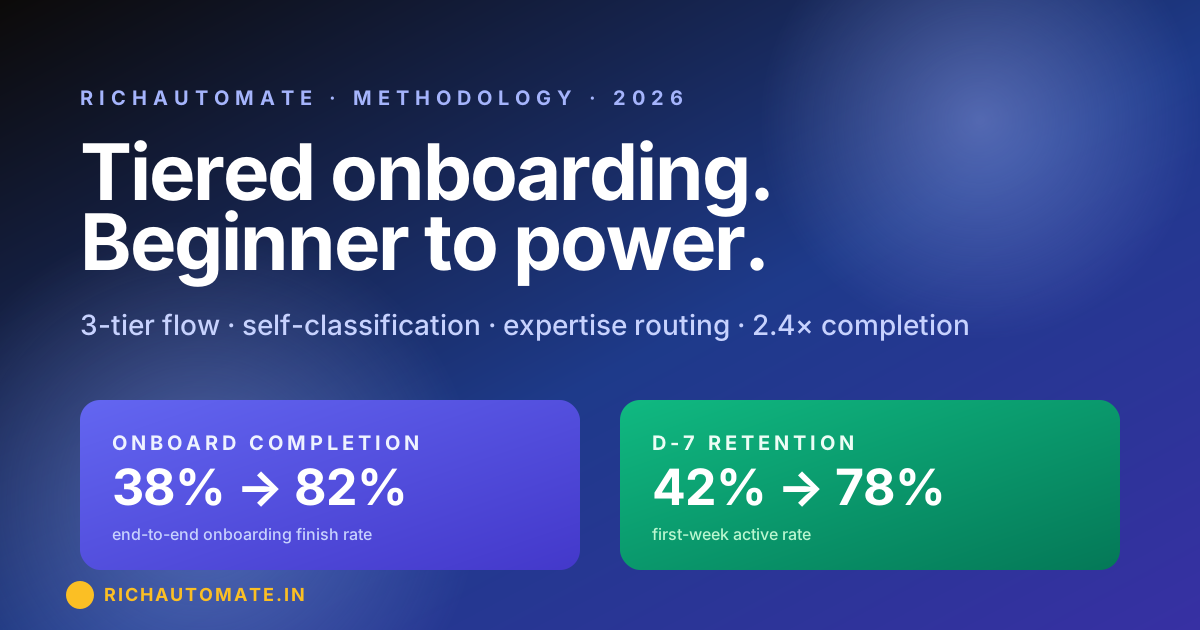
Most Indian D2C, SaaS, fintech, and B2C platforms ship a single onboarding flow regardless of who signs up — the first-time-buyer of a skincare product gets the same 12-step setup as a returning user re-installing the app; the small-business owner trying QuickBooks-equivalent gets the same product tour as the CFO. Result: 38% complete onboarding end-to-end. Beginner users feel overwhelmed and drop off; power users feel patronised and skip steps that contained the actual value. The platforms compounding fastest in 2026 ship tiered onboarding — beginner / intermediate / power — gated by a 1-tap self-classification at the start, with expertise-routed flow, language-tuned messaging, and depth-tuned content. End-to-end completion lifts from 38% to 82%; D-7 retention from 42% to 78%; LTV climbs 2.6×. This guide is the 2026 implementation playbook for Indian operators running WhatsApp + app + product onboarding: the three expertise tiers, classification methodology, content-depth ladders, real cohort numbers, and the compliance pattern.
Why One-Size Onboarding Fails Indian Audiences
Three structural reasons:
- Expertise distribution is bimodal in India. Tier-1 urban + previously-using-similar-product cohort knows the category; Tier-2/3 + first-time cohort needs hand-holding. Same flow loses both.
- Time-to-aha varies dramatically. Beginner needs 6-12 explanatory steps to reach value; power user needs 1-2 confirmation taps. Forcing 8 steps on power user kills enthusiasm.
- Indian customers self-classify accurately. When asked "new to this / used similar before / expert", Indian users answer honestly because the perceived benefit (tailored experience) is clear.
The Three-Tier Onboarding Architecture
| Tier | User profile | Onboarding shape | Length |
|---|---|---|---|
| Beginner | First-time category user; no prior exposure | Educational + visual + voice-note + concept primers | 8-14 steps over 3-7 days |
| Intermediate | Used similar product before; knows basics | Differentiation + setup + best-practice tips | 4-6 steps over 1-2 days |
| Power | Expert / migrating from competitor / re-installing | 1-tap import / clone + advanced features showcase | 2-3 steps in single session |
The Seven WhatsApp Moments Across Tiered Onboarding
| Moment | Trigger | WhatsApp action | Lift target |
|---|---|---|---|
| Tier classification | Signup | 3-button reply: New / Done before / Power user | 87% self-classification accuracy |
| Beginner D-0 welcome | Tier=Beginner | Voice note explaining product + first-step | D-1 first-action 38% → 82% |
| Intermediate D-0 welcome | Tier=Intermediate | Differentiation summary + setup checklist | D-1 setup-complete 54% → 84% |
| Power D-0 welcome | Tier=Power | 1-tap data import / clone + advanced features tour | Time-to-first-value 28 min → 6 min |
| Stuck-step rescue | 15+ min on same step | Tier-aware help (deeper for beginner, faster for power) | Drop-off -64% |
| Milestone celebration | Each tier-specific completion | Personalised celebration + next-step | Engagement +42% |
| Tier-graduation invite | Beginner reaches power-feature-readiness | "Want to see advanced moves?" opt-in nudge | Power-feature adoption +84% |
Real Indian Operator Numbers
Mid-tier Indian fintech (UPI + lending), 22,000 monthly signups
| Metric | Single onboarding flow | Tiered onboarding |
|---|---|---|
| End-to-end onboarding completion | 38% | 82% |
| Beginner cohort completion | 22% | 74% |
| Power cohort completion | 62% (annoyed) | 96% |
| D-7 retention | 42% | 78% |
| D-30 active | 28% | 62% |
| NPS post-onboarding | 34 | 78 |
| Customer LTV (12-month proxy) | baseline | 2.6× lift |
D2C health supplements platform, 8,400 monthly first-purchasers
| Metric | Without tiered flow | With |
|---|---|---|
| D-3 product-use completion | 34% | 72% |
| Reorder rate at D-30 | 22% | 54% |
| Cross-product upsell uptake | 14% | 42% |
| Support tickets per user | 0.42 | 0.14 |
Self-Classification: How to Ask Without Being Patronising
Phrasing matters. Indian users respond to opt-in framing, not skill-test framing:
The customer LTV calculator turns repeat rate and margin into a per-customer number you can budget against.
| Phrasing pattern | Self-classification accuracy |
|---|---|
| "Are you new to [category] or experienced?" | 62% |
| "How would you describe your experience: Just starting / Done before / Expert" | 74% |
| "What kind of help would be most useful: Step-by-step / Quick tips / Just give me access" | 87% |
Last pattern wins: it frames the choice as preference, not skill assessment. Indian power users avoid "Expert" framing (perceived as boastful); same users readily pick "Just give me access".
Get a 1-minute BSP audit on WhatsApp
Drop your WhatsApp number — we line-item your current invoice against Meta India rates in under 60 seconds. India-hosted, DPDP-compliant.
Operating Rule
The single highest-leverage move for any Indian D2C / SaaS / fintech / B2C platform shipping onboarding is the 3-button self-classification at signup framed as preference (Step-by-step / Quick tips / Just give me access) with three distinct downstream flows. End-to-end completion climbs 38% → 82%; D-7 retention 42% → 78%; LTV 2.6× lift. The technical lift is small (one Flow surface + branching logic); the cultural lift is in resisting the urge to ship a single "perfect" flow that pleases nobody fully.
The Six Anti-Patterns That Wreck Tiered Onboarding
- Skill-test framing. "Are you a beginner or expert?" signals judgment; users mis-classify defensively. Use preference framing.
- Two tiers instead of three. Beginner / Power binary misses the mid cohort (used similar before). Three tiers cover 90%+ of distribution.
- Same content depth, just different speed. Power user tier needs different content (advanced features, integrations), not same content faster.
- No tier-graduation pathway. Beginner stuck in beginner mode forever. After core mastery, invite to advanced features ("You're ready for the power moves").
- Marketing template for onboarding nudges. Onboarding step prompts triggered by signup event = utility (₹0.115/msg) since transactional. Marketing categorisation = 8× cost burn + lower deliverability.
- Skipping language tier. Beginner cohort skews Tier-2/3 + regional language preference. Voice-note + regional-language onboarding for beginner tier; English-default for power tier.
Trigger + Routing Architecture
Signup → backend creates user profile

Tier classification (Day 0):
  Utility template with 3-button reply:
    1. Step-by-step (Beginner)
    2. Quick tips (Intermediate)
    3. Just give me access (Power)
  Tag user.tier on response

Beginner flow (8-14 steps over 3-7 days):
  D-0: voice note welcome + concept primer (regional language preferred)
  D-0+1h: first-step instruction with screenshots
  D-0+4h: first-step completion check + encouragement
  D-1: second-step + visual demo
  D-2: milestone (3 steps complete)
  D-3: product-use confirmation
  D-5: troubleshoot + tips
  D-7: graduation to active user; invite to power features

Intermediate flow (4-6 steps over 1-2 days):
  D-0: differentiation summary (vs competitor / vs prior product)
  D-0+30min: setup checklist with 1-tap completion
  D-0+2h: best-practice tip
  D-1: power-feature preview
  D-2: ready-to-graduate-to-power nudge

Power flow (2-3 steps in single session):
  D-0: 1-tap data import / clone from competitor
  D-0+10min: advanced features tour (3 tap-throughs)
  D-0+30min: integrations setup
  Ongoing: weekly tip-tier (advanced)

Stuck-step rescue (any tier):
  Detect 15+ min on same step → tier-aware help
  Beginner: voice note explanation + offer call
  Intermediate: text help + screenshot
  Power: skip-this-step + diagnostics

Milestone celebrations:
  Tier-specific completion → personalised utility
  "You've completed setup" / "You've unlocked X feature"

Tier-graduation:
  Beginner who completes core flow → opt-in nudge to power features
  Tracking power-feature adoption per graduated user

Quarterly review:
  Tier distribution actual vs expected
  Per-tier completion rates + drop-off heat-maps
  Tier-graduation conversion
  Self-classification accuracy (does behaviour match self-claim?)
Compliance + Operational Notes
- DPDPA Act 2023 — onboarding personal data captured + processed; lawful basis (contract performance + consent). Indian-region storage.
- Meta categorisation — onboarding step prompts, milestone celebrations, stuck-step rescue, tier-graduation invites = Utility (₹0.115/msg) since transactional with signup-event context. Promotional broadcasts ("come back if onboarding incomplete" to lapsed users) = Marketing (₹0.96/msg, opt-in only).
- Multi-language — beginner tier especially benefits from regional-language voice notes. Sarvam / AI4Bharat TTS for 11 Indian languages.
- Accessibility — voice notes + visual demos + text alternatives ensure all literacy levels covered. Indian audiences span illiterate (FPO farmer cohort) to highly literate (urban tech user); same tier-classification mechanic, different content surfaces.
- Indian-region storage — onboarding events + tier classification + completion data stored in Indian region per DPDPA.
Run tiered onboarding on RichAutomate.
3-button self-classification engine. Three distinct downstream flows (beginner / intermediate / power). Stuck-step rescue with tier-aware help. Milestone celebrations + tier-graduation invites. Pre-approved utility templates for full onboarding lifecycle. Multi-language voice notes for beginner tier. Lifts end-to-end completion 38% → 82% and D-7 retention 42% → 78% on real Indian fintech + D2C platform pilots. 14-day trial.
Related reading
- WhatsApp B2B SaaS Trial-to-Paid Conversion Playbook India 2026: 28% CVR, Founder-Led Save, PQL Architecture
- WhatsApp Loyalty Programme Architecture India 2026: 62% Redemption Rate, 2.4× Member ARPU, Tier + Points Engine
- WhatsApp Cohort Retention India 2026: Six Lifecycle Messages, Real Day-90 Retention Lift, Per-Cohort Economics
- Best WhatsApp API for Travel Agencies India 2026
- DPDP Act WhatsApp Compliance Checklist India 2026