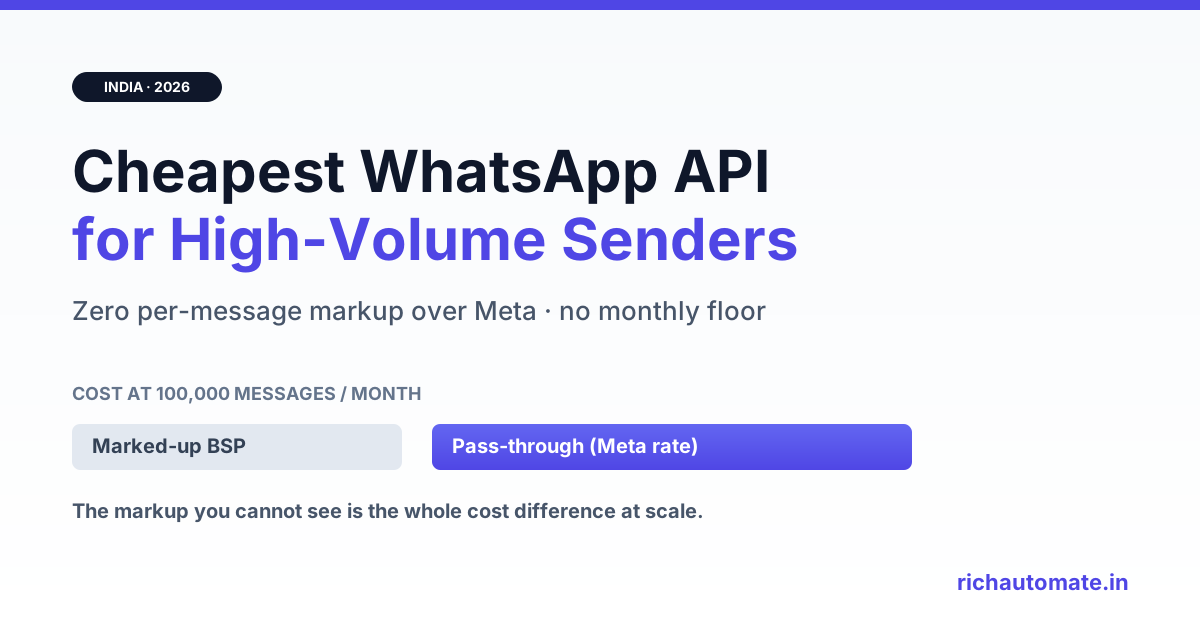
For high-volume WhatsApp senders in India, the cheapest Business API is the one that charges you Meta's exact per-message rate with zero markup and no monthly platform floor. At scale, the platform fee stops mattering and one number decides everything: the spread your provider adds on every single message.
If you send 100,000 messages a month, a ₹149/month "starter" plan is a rounding error. What actually drains your budget is a ₹0.10–₹0.30 markup layered on top of Meta's published rate, multiplied across every message, every month. This page shows you how to find the genuinely cheapest option for volume — using arithmetic on your own numbers, not marketing claims.
The short answer for high-volume senders
Rank providers by marginal cost per message, not by headline plan price. A "free" or ₹0 monthly plan that adds ₹0.15 per message is far more expensive at 100k/month than a ₹2,000/month plan that passes Meta's rate through at cost. The break-even is simple: once your monthly volume × the per-message markup exceeds the cheaper provider's platform fee, the pass-through provider wins — and for most senders above ~20,000 messages/month, it already has.
Cost at 100,000 messages/month: the stack that matters
Here is the same volume priced two ways. Numbers are illustrative Indian utility-conversation rates for 2026; plug in your own invoice.
| Cost line | Marked-up BSP | Pass-through (Meta rate) |
|---|---|---|
| Monthly platform fee | ₹0 (free tier) | ₹2,000 |
| Meta per-message (utility, illustrative) | ₹0.32 | ₹0.32 |
| BSP markup per message | +₹0.15 | +₹0.00 |
| Effective per-message | ₹0.47 | ₹0.32 |
| 100,000 messages | ₹47,000 | ₹34,000 |
| Total / month | ₹47,000 | ₹36,000 |
The "free" plan costs ₹11,000/month more at this volume. The gap widens every month you grow. This is why the cheapest starter plan is almost never the cheapest API at scale — see our breakdown of BSP markup over Meta rates for how to read the spread off your invoice.
Why per-message markup dominates at volume
At low volume the monthly fee is your biggest line. At high volume it inverts: fees are fixed, messages are linear, so the per-message spread compounds without limit. A provider that looks cheap at 2,000 messages/month can be the most expensive option you could pick at 200,000. Always model your projected 6–12 month volume, not today's. The WhatsApp Business API cost calculator lets you run both plans against your real send volume.
Get the India 2026 WhatsApp BSP price comparison
Wati vs AiSensy vs Interakt vs RichAutomate: Meta rates, platform fees and hidden costs, side by side. We send it to your WhatsApp in a minute.
The monthly floor trap
Some providers advertise "pay only for what you send" but enforce a minimum monthly spend or a per-agent seat fee that behaves like a floor. For a high-volume sender routing through the API (not human agents), per-seat pricing is dead weight. Check for: minimum monthly commitment, mandatory add-on modules, and per-agent licensing you don't use. These are covered in full in our list of hidden costs in WhatsApp BSP pricing.
Template category is your biggest single lever
Meta bills conversations by category, and marketing templates cost materially more than utility templates. At high volume, misclassifying a message that could be utility (order updates, OTPs, alerts) as marketing quietly inflates your bill on every send. Audit your top 10 templates first — moving high-frequency sends to the correct utility category often saves more than switching providers. The full pricing model is explained in Meta's WhatsApp per-message pricing for India 2026.
What "cheapest at scale" actually looks like — checklist
- Per-message pass-through: provider charges Meta's published rate with the markup shown separately (or zero), not folded in.
- No monthly floor and no per-agent seat fee for API-only sending.
- Correct template categorisation with utility/marketing split visible on the invoice.
- Transparent invoice: you can reconcile every rupee against Meta's rate card.
- Volume that doesn't buy lock-in: no annual prepay required to unlock the good rate.
If a provider can't show you the per-message spread separately from Meta's rate, assume the markup is high and grows with your volume. For a like-for-like ranking, start from our cheapest WhatsApp Business API in India guide.
Where RichAutomate lands for high-volume senders
RichAutomate prices on Meta's per-message rate with the markup disclosed on your invoice, no per-agent seat fees for API sending, and no annual prepay to unlock the rate. That means your cost curve stays linear as you scale — the number you model at 100,000 messages is the number you pay. Going live in India requires a GST number on the business; the trial does not. Start a free onboarding and we'll audit your current invoice against Meta's rate card before you migrate.