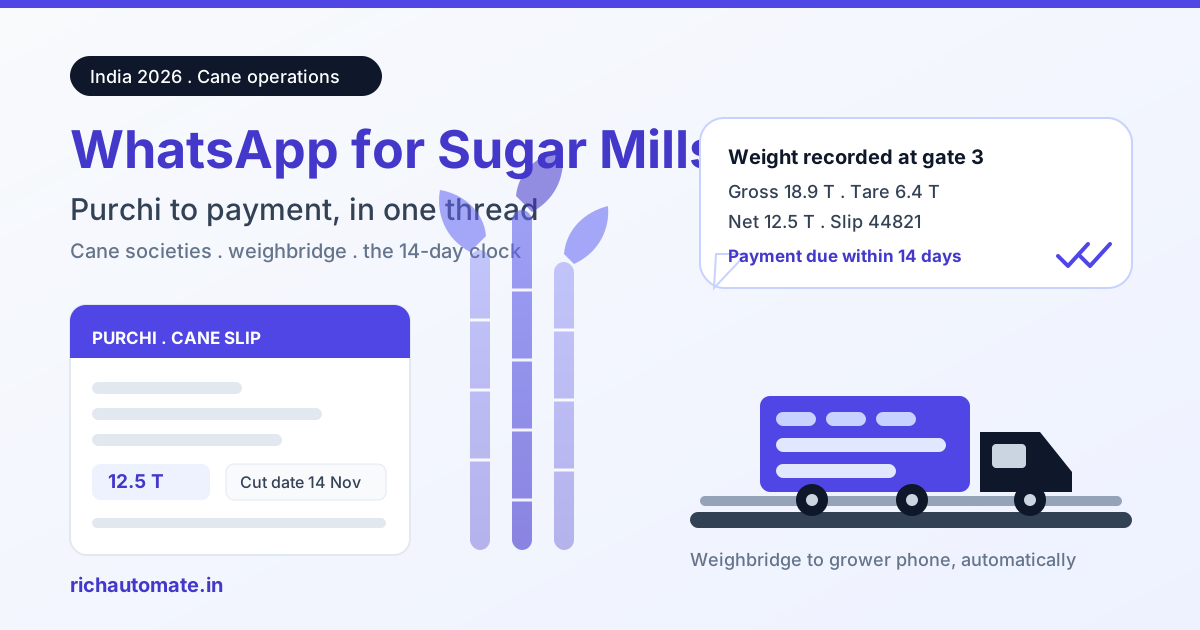
WhatsApp Business API lets a sugar mill push the purchi (cane supply slip), the cut order, the weighbridge weight and the cane payment confirmation straight to a grower's phone in Hindi, Marathi or Kannada, and lets a cane-supply co-operative society answer supply-calendar questions without a queue building outside the society office. For a mill crushing from October to April against the 14-day payment clock in the Sugarcane (Control) Order, 1966, that is not a marketing channel — it is cane-department infrastructure.
This guide is for the people who carry the risk: the cane department head at the mill and the secretary of a cane growers' co-operative society. It maps the cane year to specific message types, says which are utility and which are marketing, and puts real rupee figures against a 10,000-grower run. Where a statutory number moves season to season — FRP, SAP, the release quota — it says so rather than faking precision.
Why the cane department owns this channel, not marketing
A sugar mill is one of the few industrial buyers in India whose supplier base is tens of thousands of smallholders, whose purchase price is fixed by statute, and whose payment deadline is legally enforceable. Roughly 500-plus mills operate in a given crushing season, and cane supports a very large share of rural households in Uttar Pradesh, Maharashtra and Karnataka. Every grower has the same four questions: when do I cut, what did the weighbridge record, what was deducted, and when do I get paid.
Today those questions arrive as footfall — at the society office, at the supervisor's mobile at 10 pm, at the gate during peak crushing, eventually as a complaint through the Cane Commissioner's machinery. That workload has a supply-chain consequence: a grower who cannot get a straight answer on his calendar slot cuts late, or diverts cane to a gur (jaggery) unit, and your crush rate and recovery suffer.
The same pattern appears wherever a processor buys from many small producers at a regulated price, which is why WhatsApp for rice mills and custom milled rice compliance and WhatsApp automation for dairy and livestock co-operatives land on almost the same message architecture. Cane is the hardest version: political price, statutory clock.
The rule book you are automating around
FRP, SAP and the one number you must never get wrong
The Fair and Remunerative Price is fixed by the Centre on the recommendation of the Commission for Agricultural Costs and Prices, in rupees per quintal at a basic recovery rate, with a premium for each percentage point of recovery above that base. Uttar Pradesh, Punjab and Haryana additionally declare a State Advised Price above the FRP, usually differentiated by variety group. The FRP for the 2025-26 season and the current SAP band are both notified figures that move — pull the live value from the CACP or state notification before you put a rupee amount into a template.
Rather than writing from scratch, pull a close match out of the WhatsApp template library and edit it.
The practical rule: never hardcode a rate in a template. Pass it as a variable from your cane accounting software, and where the payable rate awaits a state announcement, say so in the body rather than implying finality.
The 14-day clock
The Sugarcane (Control) Order, 1966 requires the cane price to be paid within 14 days of the date of delivery, and makes the mill liable for interest on the outstanding amount for the period of delay. Cane arrears are therefore not an accounting matter but a legal and political one, tracked publicly in every cane state. Automation will not create liquidity. What it does is convert an opaque arrear into a communicated position: every grower knowing which supply dates are cleared, which are pending, and what reference to quote.
Essential Commodities Act, releases, MSP and ethanol
Sugar remains a regulated commodity under the Essential Commodities Act, 1955, with a monthly release mechanism capping how much each mill may sell, a minimum selling price at the mill gate, and centrally allocated export and ethanol-diversion quotas. The Ethanol Blended Petrol programme has pulled a growing share of B-heavy molasses and cane juice into ethanol, on a supply year running November to October. None of this is grower-facing, but all of it drives cash timing — so never automate a payment-date commitment your release quota cannot fund.
GST and DPDP
Cane bought from a farmer is a purchase from an agriculturist generally not required to register under GST, so grower-facing messaging carries no invoicing obligation. GST bites on the sale side — sugar, molasses, bagasse and ethanol — where molasses moved to a sharply lower slab after the GST Council's 2023 revision. Grower phone numbers are personal data under the Digital Personal Data Protection Act, 2023: notice, purpose limitation and a genuine withdrawal mechanism all apply. A society holding 8,000 mobile numbers is a data fiduciary whether or not it thinks of itself as one.
The purchi problem, in one page
The purchi — also parchi, the supply slip, or the cut order — is the most valuable message a mill sends all year. It tells one grower that a specific quantity from a specific plot is to be cut on a given date and delivered to a given centre. Late, and the cane is cut late: staleness costs recovery and the transport indent falls out of sequence. Wrong recipient, and you have a complaint.
Historically the purchi was pinned on a society noticeboard or hand-delivered by a supervisor. Then came SMS and the state cane portals and grower apps — a real improvement, and in Uttar Pradesh the cane department's grower app made supply data individually visible. The residual gaps are the ones WhatsApp closes: SMS in Devanagari is Unicode and fragments into multiple billed parts, carries no slip image or PDF, gives no read receipt, and is one-way — a grower who does not understand it still walks to the society office.
The six-stage cane lifecycle, mapped to automation
Stage 1 — Survey and grower registration
What breaks today: survey area disputes surface months later at bonding time, when correction is expensive and the calendar is already drawn. Growers cannot see what area and variety were recorded against their code.
Fix: a utility template at survey close confirming grower code, village, plot, variety and surveyed area, with a quick-reply button for correction needed that opens a 24-hour window and routes to that circle's supervisor. Consent is captured here, in the local language, against the grower code. Category: utility.
Stage 2 — Bonding, basic quota and the supply calendar
What breaks today: the satta or bonding position and the calendar allotment are known precisely to the mill, roughly to the society, and hardly at all to the grower. Perceived unfairness in calendar order is the top source of cane-office friction.
Fix: a season-open utility message stating bonded quantity, basic quota and indicative calendar slot, then an automatic push on every calendar revision. Revisions are where trust is won or lost, so send them when they are made. Category: utility.
Stage 3 — Purchi and cut order issuance
What breaks today: delivery uncertainty. Paper is slow, SMS is fragile and truncated, and the grower has no artefact to present at the gate.
Fix: issue the purchi as a media template — a generated slip image or PDF carrying grower code, purchi number, quantity, cut date, delivery centre and whatever code your gate already scans — with the same detail repeated in body text so it reads on a low-end handset. Add a cannot supply button so a genuine non-supply is captured before the calendar slot is wasted. Category: utility.
Stage 4 — Harvest, harvester gang and transport indent
What breaks today: in Maharashtra and Karnataka especially, the harvesting gang and the transport contractor are the real choke point. Growers wait, cut cane sits in the field, and staleness eats recovery by the hour.
Fix: a utility notification carrying the assigned gang or vehicle reference and an expected arrival window, plus a location share on the transporter side so the mill has a rough position on loaded trolleys. Grower replies ride the free window. Category: utility, with free-window replies.
Stage 5 — Weighbridge, gate pass and tare
What breaks today: the most common grower grievance in the industry is the weight. Gross, tare and net are printed on a slip that gets lost in a shirt pocket, and the grower's only later recourse is memory.
Fix: fire a utility template on weighbridge commit carrying gate pass number, vehicle, gross, tare, net, any trash or binding deduction, and the timestamp. It costs a fraction of a rupee and ends the argument, because both sides hold the same record. On grievances avoided per rupee spent, this is the highest-return integration here.
Stage 6 — Payment, deductions and arrears
What breaks today: growers cannot map a bank credit back to a supply. Society commission, seed and fertiliser advances, harvesting and transport charges all net off, so the credit never equals quantity times rate and the gap reads as a shortfall rather than a deduction.
Fix: a payment utility template on every credit — supply dates covered, total weight, rate basis, itemised deductions, net credited, bank reference — plus a payment-status keyword returning cleared and pending supplies inside the free window. Where the 14-day position has slipped, an honest status beats silence. Mills routing grower advances through a co-operative bank should read WhatsApp for co-operative banks and rural BFSI for the lending-side message set.
Paper purchi vs SMS vs WhatsApp: capability and cost
| Capability | Paper purchi via society | SMS (DLT-registered) | WhatsApp Business API |
|---|---|---|---|
| Time to reach the grower | Hours to days, and it depends on a person | Seconds | Seconds |
| Hindi or regional script | Yes | Yes, but Unicode splits into roughly 70-character parts, each billed | Yes, full length, one message |
| Slip image, PDF or scannable code | Physical only | No | Yes, media template |
| Proof of delivery and read | None | Carrier level only | Delivered and read status per grower |
| Grower can reply and get an answer | Only in person | No | Yes, free for 24 hours after the grower writes |
| Audit trail for a weight or payment dispute | Receipt book | Weak | Per-grower timestamped log |
| Works after office hours | No | Send only | Send plus automated self-service |
What 10,000 grower notifications actually cost
The next table is an illustrative model, not a quotation. The WhatsApp figures are RichAutomate's published rates; the SMS line assumes a mid-market Indian transactional rate and the structural fact that a Devanagari purchi occupies about three Unicode parts. Substitute your own SMS contract rate before this reaches a board note.
Get the India 2026 WhatsApp BSP price comparison
Wati vs AiSensy vs Interakt vs RichAutomate: Meta rates, platform fees and hidden costs, side by side. We send it to your WhatsApp in a minute.
| Channel | Unit basis | 10,000 notifications | What you also get |
|---|---|---|---|
| SMS in Hindi (illustrative) | About 3 Unicode parts at an assumed Rs 0.18 per part | About Rs 5,400 | Text only, no reply path, DLT template upkeep |
| WhatsApp utility, SaaS Pay | Rs 0.50 per message, all in | Rs 3,000 | Media slip, read receipts, free 24-hour replies |
| WhatsApp utility, Client Pay | Rs 0.10 per message platform fee; Meta bills conversation charges to your own account | Rs 1,000 platform fee | Same capability, with direct Meta billing visibility |
| WhatsApp marketing, SaaS Pay | Rs 1.50 per message | Rs 12,000 | Promotional sends only — never route purchis here |
| Grower-initiated replies, either model | Free inside the 24-hour service window | Rs 0 | Payment-status and calendar self-service |
Setup is Rs 0 and there is no monthly platform fee on either model, so a mill can pilot one circle for a fortnight and pay only for what it sent. Choosing between the models is mostly about who holds the Meta billing relationship; the trade-offs are in Client Pay vs SaaS Pay WhatsApp billing, and the channel economics against SMS in WhatsApp Business API vs SMS cost in India.
Template routing: utility, marketing, or free window
Category routing is where mills leak money. A message is utility when it relates to a transaction the grower already has with you, and marketing when it promotes, recruits or upsells. Meta re-categorises templates it disagrees with, so write body copy matching the category you claim.
| Cane message | Category | Cost basis | Note |
|---|---|---|---|
| Purchi or cut order issued | Utility | Rs 0.50 SaaS Pay / Rs 0.10 Client Pay | Send as a media template with the slip attached |
| Supply calendar revision | Utility | Same | Trigger on change, never batch it weekly |
| Weighbridge gross, tare and net | Utility | Same | Fire on weighbridge commit, not on the end-of-day batch |
| Payment credited with deductions | Utility | Same | Always name the supply dates the credit covers |
| New-season bonding drive to lapsed growers | Marketing | Rs 1.50 SaaS Pay | Needs opt-in; keep the list small and targeted |
| Seed cane, drip or trash-free cane incentive scheme | Marketing | Rs 1.50 SaaS Pay | Off-season use; honour opt-outs immediately |
| Grower asks a question and you answer within 24 hours | Service window | Rs 0 SaaS Pay / ~Rs 0.115 Meta + Rs 0.10 Client Pay | Where payment-status and calendar lookups belong |
What the society secretary gets out of it
The society sits between the mill and several thousand growers and absorbs most of the friction with almost no tooling. Three things change on day one. The noticeboard becomes a broadcast: meetings, share and commission notices and calendar changes go out as one utility send instead of a phone tree. The office queue shrinks, because status lookups are answered by keyword inside the free window. And the secretary holds an evidence trail — a delivered-and-read timestamp against the grower code when someone says he was never informed.
Run one WhatsApp Business Account for the mill with societies as a routing layer inside it, not a separate number per society. Circle-wise inboxes let each supervisor see only his own growers while the cane department keeps the full log.
The off-season is not dead time
Crushing runs roughly October or November through April or May depending on the state. The four to five off-season months carry survey, ratoon management, seed-cane distribution and the next bonding cycle — this is when a grower relationship is quietly kept or lost to a competing mill or a gur unit. Weather and pest advisories, sett treatment reminders and variety-replacement nudges are the highest-value off-season messages. Route them carefully: an advisory tied to the bonded crop is normally acceptable as utility, a scheme push is marketing and must be priced and consented as such.
Keeping DPDP clean and the WABA healthy
Two failure modes end programmes like this. The first is consent hygiene: importing a purchased or inherited number list with no notice trail, then sending promotional content to it. Capture consent at survey or bonding with the purpose stated in the local language, timestamp it against the grower code, and give every message a working opt-out. The second is quality collapse: high-volume marketing to cold numbers drives blocks and negative feedback, degrading your quality rating and shrinking your messaging limit. No provider can guarantee that unsolicited or bulk sending stays unrestricted, and anyone who says otherwise is selling you a risk you alone carry.
The safe shape is boring: heavy utility volume tied to real cane transactions, small consented marketing volume, and send-rate limits so a weighbridge outage cannot fire ten thousand duplicate slips at midnight.
Where to start this season
Do not attempt the whole lifecycle in one season. Take one circle and two messages — the purchi and the weighbridge slip — and instrument them against your cane software. Those two remove most of the cane office's inbound queries. Add payment confirmations next, because that message touches the 14-day clock.
RichAutomate is usage-only: Rs 0 setup, Rs 0 monthly, Rs 0.10 per message on Client Pay, or Rs 1.50 marketing and Rs 0.50 utility on SaaS Pay, with the 24-hour service window free on both. If you run a mill's cane department or a cane-supply society and want purchi-to-payment live before the next crushing season, create a free RichAutomate account and start with one circle.