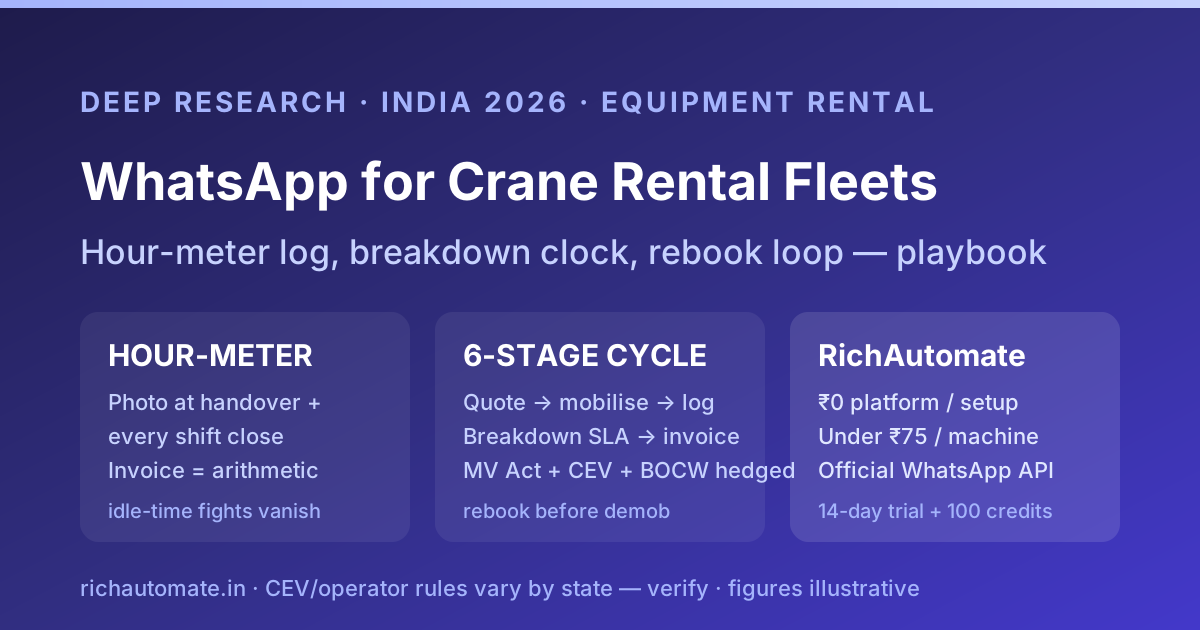
The short answer. Crane, excavator and earthmover rental is an hour-meter business — revenue is metered in machine-hours, and every dispute is about hours claimed vs hours worked, idle time, and who pays for the breakdown day. WhatsApp on the official Business API turns that into an evidence trail: an availability auto-reply that answers "20-tonne crane milega?" at night, a mobilisation thread with transport and site details, a daily hour-meter photo log that makes the invoice self-proving, a breakdown SLA thread with timestamps, and a demob-to-rebook loop that keeps machines earning between sites. A 12-machine fleet runs this for roughly ₹700-1,000/month in messages on RichAutomate's ₹0-platform model (illustrative math below). Compliance note first: mobile cranes and construction-equipment vehicles sit under MV Act/CMVR registration, CEV emission norms, state operator-licensing and BOCW site rules — all state/machine dependent, verify current position.
From single-JCB owners in Tier-3 towns to multi-city crane fleets serving infra contractors, the economics repeat: utilisation is everything, disputes eat margin, and the next booking goes to whoever confirms availability first.
The 6-stage rental cycle on WhatsApp
| Stage | What happens | WhatsApp job | Category |
|---|---|---|---|
| 1. Enquiry | "50T crane chahiye, 15 din" | Auto-reply: machine list + capacity + shift/monthly rate card + availability capture via Flow | Service |
| 2. Booking + mobilisation | Machine assigned, transported | Booking confirmation + transport/e-Way details + operator name + hour-meter photo at handover | Utility |
| 3. Daily log | Shifts run | End-of-shift hour-meter photo + operator log in the site thread — the invoice writes itself | Utility |
| 4. Breakdown SLA | Machine down | Timestamped breakdown report → mechanic dispatch → back-up-running confirmation; idle-time clock visible to both sides | Utility |
| 5. Billing | Weekly/monthly invoice | Invoice summarising logged hours + UPI/credit terms; disputes shrink because the log is shared | Utility |
| 6. Demob + rebook | Job ends | Demob checklist + condition photos; next-requirement nudge to contractors (opt-in) — machines earn between sites | Utility/Marketing |
The hour-meter thread — where rental disputes go to die
The classic month-end fight — "machine idle thi 4 din" vs "aapki site ready nahi thi" — survives only where the record lives in someone's private diary. Put it in the shared thread instead: hour-meter photo at handover, photo at every shift close, timestamped breakdown and back-up messages. The invoice becomes arithmetic on photos the contractor's own site engineer watched arrive. Fleets running this discipline report billing cycles compressing and idle-time arguments nearly vanishing — and the same thread protects the operator when site-readiness, not the machine, caused the idle day.
The WhatsApp pricing calculator by country is the fastest check on what each destination market actually costs.
The utilisation loop — rebook before demob
A machine's most expensive days are the ones between jobs. The demob checklist message doubles as a sales trigger: the moment a job-end date firms up, an availability broadcast to the opt-in contractor list ("50T crane free from 20th, NCR region") fills the gap before the trailer arrives. The ready-mix concrete suppliers feeding the same sites run a comparable time-critical dispatch thread in our WhatsApp playbook for ready-mix concrete (RMC) suppliers. Rate-card auto-replies do the first round of negotiation while your team sleeps.
Get a 1-minute BSP audit on WhatsApp
Drop your WhatsApp number — we line-item your current invoice against Meta India rates in under 60 seconds. India-hosted, DPDP-compliant.
Compliance spine (verify each for your state/machine)
Registration — mobile cranes, tippers and many construction-equipment vehicles need MV Act/CMVR registration; CEV emission-stage norms apply to new equipment (stage applicability shifts — verify current CPCB/MoRTH position). Operators — crane-operator competency/licensing rules vary by state and machine class; certified-operator proof in the thread is a trust asset with corporate clients. Site law — BOCW Act and client EHS rules govern lifting plans, load charts and inspections; never let messaging language imply safety shortcuts. Insurance — equipment + third-party cover status shared at mobilisation prevents later blame games. GST — right-to-use rental treatment and e-Way Bill for machine movement; confirm with your CA. Meta rules — job threads are utility; availability broadcasts are marketing → opt-in only, STOP honoured instantly. No platform can promise a "ban-proof" number — consent discipline does that. DPDP — operator IDs and site contacts are personal data: minimise, restrict, delete on schedule.
Cost math (illustrative — verify Meta rates)
| Item | 12-machine fleet | Monthly |
|---|---|---|
| Site threads (logs, breakdowns, invoices) | most rides in free 24h windows; ~1,900 paid utility × ₹0.50 | ~₹950 |
| Availability broadcasts (opt-in contractors) | ~250 × ₹1.50 | ~₹375 |
| Platform fee (RichAutomate) | — | ₹0 |
| Total | ~₹1,325 — under ₹115/machine |
Run your own fleet numbers on the WABA cost calculator.
5-point fleet checklist: (1) hour-meter photo at handover + every shift close — no photo, no billable hour; (2) breakdown clock timestamped both ways; (3) certified-operator + insurance proof pinned at mobilisation; (4) opt-in recorded before availability broadcasts; (5) registration/emission-stage paperwork verified each renewal — norms move.
What the software cannot do
It cannot lift a girder, cannot certify an operator, and cannot make a hydraulic seal last longer — it makes every machine-hour provable, every breakdown accountable, and every idle week shorter. Related reading: DG genset rental & AMC (same rental-evidence pattern) · construction-material dealers (your site counterpart) · DPDP compliance checklist · full cost guide.
Run a crane or equipment-rental fleet? Rate-card auto-replies + hour-meter threads + rebook broadcasts live in a week. Start the 14-day free trial (100 credits, no card), see pricing, or WhatsApp us at +91 81603 11319 / book a free 30-min call.
When a hired machine goes down, the spares desk is the next call. The part-number and despatch-proof loop is set out in the guide to mining equipment spares and service on WhatsApp.