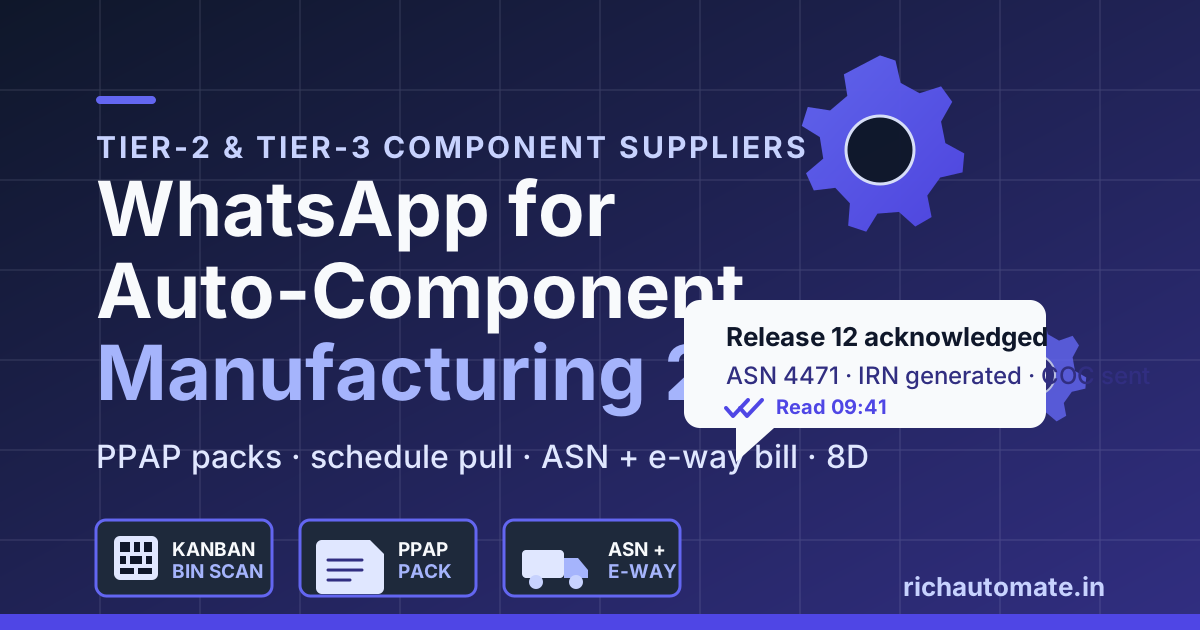
WhatsApp works for Indian auto-component Tier-2 and Tier-3 suppliers because the four things that actually decide whether you keep a part number — PPAP pack turnaround, schedule-pull acknowledgement, ASN/e-way bill confirmation at gate-out, and 8D response time on a rejection — are all deadline-bound messages that today sit unread in email or behind a customer portal login. Moving them to a WhatsApp Business API workflow with template messages, timestamped acknowledgements and document delivery typically cuts each of those loops from hours to minutes while leaving a clean, exportable audit trail for IATF 16949.
This guide is written for Tier-2 and Tier-3 component manufacturers supplying Tier-1s and OEMs — machining, stamping, forging, moulding, rubber, fasteners, wiring and sub-assembly units in Chakan-Pune, Manesar-Gurugram, Hosur, Chennai-Oragadam, Sanand and Pithampur. It is not about dealerships, aftermarket retail counters or spare-parts distribution. If you sell into the aftermarket or run a parts distribution business, read our WhatsApp playbook for auto-parts aftermarket distributors in India instead — the trigger points, the compliance spine and the ROI maths there are completely different.
Why Tier-2 supply chains leak time in the gaps between systems
A Tier-2 supplier of any scale already has systems. There is an ERP for the BOM and the invoice. There is a customer portal — Ariba, SAP SNC, a Tier-1's own vendor portal, or three different ones for three different customers. There is a quality department with a controlled-document server. None of that is the problem.
The problem is the gap. A weekly release lands in the portal at 06:00; the planner who has to react to it sees it at 10:30 when he next logs in. A PPAP Level 3 pack goes out by email as a 40 MB zip; the SQA engineer's mailbox rejects it and nobody finds out for two days. A truck leaves the gate and the ASN is keyed in that evening, so the Tier-1's inbound gate sees an unannounced vehicle. A rejection is raised on Friday and the 8D clock — usually 24 hours for containment, 10 days for root cause — starts running before anyone on the shop floor has read the email.
Across the Tier-2 supplier accounts we run on RichAutomate, the pattern is consistent: nothing is missing from the process, but the handoffs between people are slow because they depend on someone choosing to open a channel. WhatsApp inverts that. The message arrives where the planner, the QA head, the dispatch supervisor and the customer's buyer already are, and — critically for the API version — every send, delivery and read is logged with a timestamp you can export.
What WhatsApp is not for
It does not replace the portal, the EDI link or the ERP. Treat WhatsApp as the notification and acknowledgement layer over those systems: it tells the right human that something changed, carries the document, captures a structured reply, and writes the reply back. Anyone selling it to you as an EDI replacement has never sat through an IATF audit.
The six-stage RFQ-to-serial lifecycle on WhatsApp
Every new part number a Tier-2 wins travels the same road. Mapping it to six automated stages is how you stop treating each customer's demands as a fresh emergency.
| Stage | Trigger | WhatsApp automation | Who is on the thread |
|---|---|---|---|
| 1. RFQ received | Drawing + volume enquiry from Tier-1 SQA/purchase | Auto-acknowledge with RFQ number, feasibility-review owner and committed quote date; internal alert to costing | Sales, costing, tool room |
| 2. Sampling & tooling | Tool PO / amendment released | Milestone updates at tool design freeze, T0 trial, T1 samples; PO-amendment confirmation captured as a reply | Tool room, project engineer, buyer |
| 3. PPAP submission | Sample lot cleared internally | Document pack delivered as PDFs, submission-level stated, interim/full approval status tracked with a reminder cadence | QA head, customer SQA |
| 4. Schedule pull / JIT | Weekly release, daily call-off, kanban bin signal | Parsed release pushed to planner with delta vs last release; acknowledgement button; short-supply flag back to the buyer | PPC, stores, buyer |
| 5. Dispatch + ASN | Gate-out at your plant | ASN summary, invoice, e-way bill number, LR/vehicle number and PDIR/COC pushed at the moment the vehicle leaves | Dispatch, logistics, inbound gate |
| 6. Rejection / 8D + payment | Line rejection, incoming NCR, or invoice ageing | Containment acknowledgement within the SLA, 8D milestone reminders (D3/D5/D8), CAPA closure note; separate payment-follow-up track | QA, production, accounts |
Stages 4, 5 and 6 are where the money is. Stages 1-3 win you the business; 4-6 are what stop you losing it.
PPAP and APQP packs: kill the email chase
A Level 3 PPAP submission is eighteen elements — PSW, design record, process flow, PFMEA, control plan, MSA, dimensional results, material and performance test results, initial process studies, appearance approval where relevant, and the rest. The engineering work is hard. The administration of it should not be.
The pattern that works: keep the controlled documents wherever they live today, and use WhatsApp to deliver a submission summary plus the individual PDFs, with the submission level and the part/change reference stated in the message body. When the customer's SQA replies "interim approval, dimensional re-submission needed on features 12-18", that reply lands in the same thread as the pack. Six months later, when an auditor asks why an interim ran past its expiry, the whole exchange is one export.
Two APQP habits that pay for themselves:
- Phase-gate reminders instead of phase-gate meetings. An automated nudge three working days before each gate, sent to the owner of the open deliverable, removes most of the status-meeting load.
- Re-submission triggers on change. Any tooling change, sub-supplier change, process relocation or material change should fire a checklist message to QA asking whether a PPAP re-submission is required. The expensive failures are the ones where nobody asked.
If you run tooling or moulding as job work for other suppliers, the same document discipline applies one tier down — we cover that in the WhatsApp guide for injection moulding and job-work units in India.
Schedule pull: choosing the channel that actually gets read
Release-to-reaction time is the single most measurable improvement. Here is how the four channels compare for a typical weekly release plus daily JIS call-offs.
| Channel | Typical time to planner reaction | Proof of receipt | Weakness |
|---|---|---|---|
| Customer portal | Hours — depends on login discipline | Portal log only, not on your side | Pull-based; one missed login loses a day |
| 1-4 hours, worse on shift changeover | Weak — read receipts routinely disabled | Attachments bounce, threads fork, mailbox rules bury it | |
| Phone call | Minutes, when it connects | None | No record, no attachment, does not scale past a handful of parts |
| WhatsApp Business API | Minutes — push, on the device already in hand | Sent / delivered / read timestamps, exportable | Needs opt-in and approved templates; not an EDI substitute |
Kanban bin signals
For customers running two-bin or e-kanban replenishment, the bin scan itself becomes the trigger. A QR or barcode scan at the customer's line, or at your own finished-goods rack, posts a call-off message to your PPC group with part number, bin quantity, and the by-when. Suppliers who wire this up stop discovering short-supply at the 4 PM dispatch review and start discovering it at 9 AM.
Get a 1-minute BSP audit on WhatsApp
Drop your WhatsApp number — we line-item your current invoice against Meta India rates in under 60 seconds. India-hosted, DPDP-compliant.
If you would rather start from something proven, the WhatsApp template library has formats you can adapt.
Dispatch, ASN, e-way bill and GST e-invoice
Gate-out is the highest-value single automation in the whole list, because one message closes four open questions at once. When the vehicle leaves, a single template push carries: ASN reference and line quantities, invoice number with IRN once the GST e-invoice is generated, the e-way bill number and validity, the LR and vehicle number, and the PDIR/COC PDF for the lot.
Three failure modes this removes:
- Unannounced vehicles at the inbound gate. The Tier-1's stores team gets the ASN before the truck gets there, so unloading is scheduled instead of queued.
- E-way bill expiry disputes. The validity window is in the thread with a timestamp; nobody argues about when it was generated.
- Missing COC at incoming inspection. The certificate of conformance and PDIR travel with the notification, not in a separate email that arrives after the material is already in the quarantine bay.
One thing to get right early: the GST treatment of your own WhatsApp messaging spend, particularly where Meta bills you directly from outside India. We break down the reverse-charge and input-tax-credit mechanics in GST on WhatsApp Business API charges — RCM and ITC explained. Note also that a 14-day trial can run without GST registration, but going live on WhatsApp Business API in India effectively requires a GST registration — plan for it, do not treat it as optional.
Rejections, 8D and CAPA: winning back the response clock
Most 8D failures are not technical. They are clock failures — containment reported late, D3 slipping because the person who could authorise sorting was on the floor and not on email, D5 root cause pushed because the trial slot was booked after the deadline.
Wire the rejection intake as its own flow: the customer's NCR or line-rejection message drops into a dedicated thread, an acknowledgement with a containment plan goes back inside the agreed SLA window, and the 8D milestones fire as scheduled reminders to named owners. When D8 closes, the closure note and revised control-plan reference go back on the same thread. Your CAPA effectiveness review 90 days later then has a complete, dated record rather than four people's recollections.
What this does to the numbers
Across the Tier-2 supplier accounts we run, the ranges below are what we observe once the six stages are live for a full quarter. Treat them as a planning band for your own business case, not as a guarantee — mix, customer count and part-number spread all move them.
| Process | Before (manual email / portal) | After (WhatsApp workflow) | Observed range |
|---|---|---|---|
| Weekly release to planner reaction | 3-8 working hours | 10-30 minutes | 85-95% reduction |
| PPAP pack acknowledged by customer SQA | 2-5 working days | Same or next working day | 50-70% reduction |
| ASN available before vehicle arrival | ~55-70% of dispatches | Above 95% of dispatches | +25-40 points |
| 8D containment acknowledged within SLA | Roughly 6 in 10 | Roughly 9 in 10 | +30 points |
| Invoice follow-up cycles per overdue bill | 4-6 touches | 2-3 touches | ~50% reduction |
IATF 16949 audit-trail discipline and consent
Auditors do not object to WhatsApp. They object to undocumented communication that affects product quality. Four rules keep you clean:
- Use the Business API, not personal WhatsApp. Personal accounts have no exportable log, no role-based access and no continuity when the person leaves. Every quality-relevant message must survive the employee.
- Name the record in your quality manual. Add WhatsApp threads to your controlled-records list with a defined retention period, and state which processes use them — PPAP submission, deviation approval, 8D, dispatch notification.
- Approvals still need approvals. A WhatsApp "OK ship it" from a customer engineer is a useful record, not a deviation authorisation. Keep the formal deviation note; let the message carry and timestamp it.
- Opt-in is a real requirement. Every customer contact, transporter and sub-supplier on your list must have consented, and the record of that consent must be retrievable. Our guide to WhatsApp opt-in and list hygiene for Indian businesses covers re-permissioning and cleanup. And to be plain about it: nobody can promise you immunity from restrictions if you send unsolicited or bulk messages — quality and consent of the list is what keeps a sender healthy.
What it costs to run
Tier-2 messaging volume is modest and almost entirely utility-category — schedule alerts, dispatch notifications, document delivery, 8D reminders. That matters, because utility messages are the cheap ones.
RichAutomate is usage-only: ₹0 setup, ₹0 monthly floor. On Client Pay you bring your own Meta billing and pay us ₹0.10 per message on top of what Meta bills you directly. On SaaS Pay we handle Meta billing and you pay ₹1.20 per marketing message and ₹0.30 per utility or authentication message, all-in. A supplier running six stages across four Tier-1 customers usually lands in the low thousands of rupees a month — less than one expedited freight run caused by a missed release. There is a 14-day trial with 100 free credits to test the flows against a live part number before you commit. Full detail is on the RichAutomate pricing page.
A 30-day rollout that does not disturb production
Week 1 — one customer, one flow
Pick your most schedule-volatile Tier-1 and automate stage 4 only: release parsed, pushed to the planner, acknowledged. Nothing else. Measure release-to-reaction time before and after.
Week 2 — gate-out
Add the dispatch message: ASN, invoice/IRN, e-way bill, LR, PDIR/COC. Wire it to your dispatch entry so it fires automatically rather than depending on the supervisor remembering.
Week 3 — quality
Add PPAP submission delivery and the 8D reminder ladder. Get your QA head to own the templates; the wording is a quality record, not marketing copy.
Week 4 — widen
Roll the same three flows to your remaining customers, then add the payment-follow-up track. Only after all of that should you consider outbound anything.
If you want implementation help choosing a provider and getting the WABA and templates approved, our guide to choosing a WhatsApp Business API provider in Mumbai and western India walks through verification, template approval and the questions to ask before you sign.
Start with one part number
You do not need a transformation programme. Take one part number with a volatile schedule, run stages 4 and 5 on it for two weeks, and compare the release-to-reaction and ASN-before-arrival numbers against the month before. If they do not move, you have lost two weeks and nothing else. If they do move — and in our deployments they do — you have a template you can copy across every customer you supply.
Ready to try it on a live part number? Start your 14-day RichAutomate trial with 100 free credits — ₹0 setup, ₹0 monthly floor, and no card needed to build your first schedule-pull and dispatch flow.