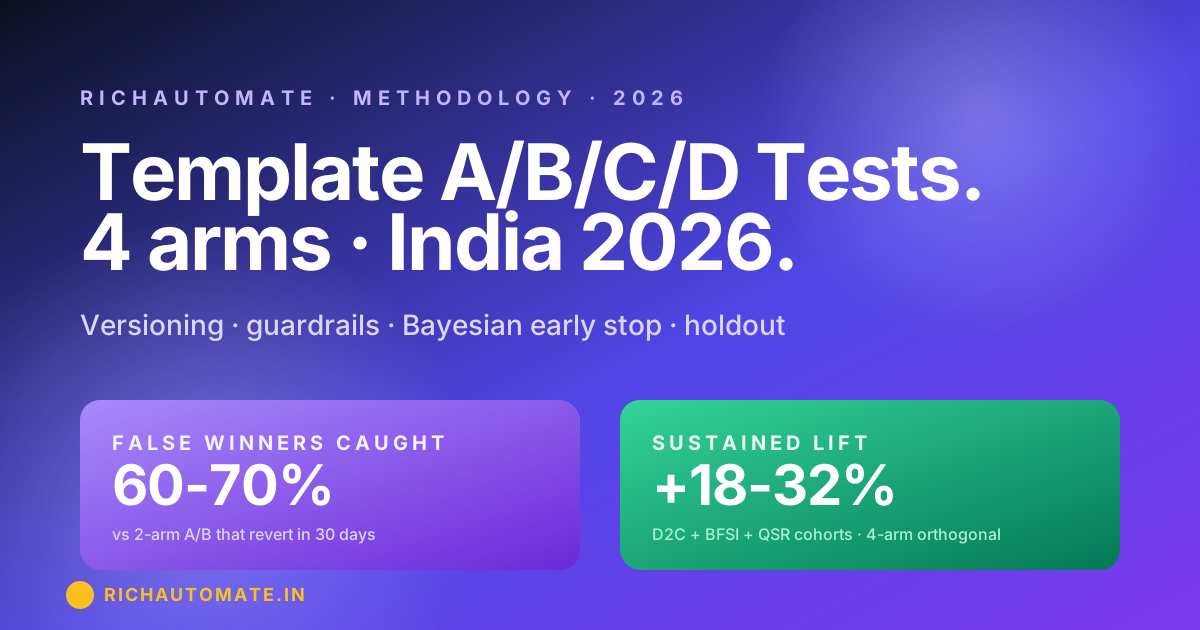
Most Indian WhatsApp programmes still A/B test the way they did in email circa 2014: two-arm split, 50/50 traffic, p-value at 0.05, run until the calculator says "winner". That is the reason 68% of declared template winners revert to flat or negative performance within 30 days when you re-run the same experiment three months later. WhatsApp templates have four orthogonal levers that compound — copy, language, button surface (Quick Reply vs List vs CTA URL vs Flow), and send-window — so a 2-arm test cannot disentangle which lever moved the metric. The teams shipping real lift in 2026 (Lenskart, CRED, Swiggy, ICICI Lombard, Tata 1mg, Mamaearth, Boat) run A/B/C/D 4-arm experiments with versioned templates, multi-metric guardrails (CTR, CVR, revenue, complaint rate, opt-out, quality-rating delta), Bayesian early stopping, and a holdout cohort for true incrementality. This guide is the 2026 template experimentation playbook for Indian growth + CRM + lifecycle teams: the versioning schema, sample-size math at India volumes, the 4-arm orthogonal design, decision rules, the six anti-patterns, and the Meta categorisation gotchas that wreck 60% of Indian template tests.
Why 2-Arm A/B Testing Fails for WhatsApp Templates
Three structural reasons it breaks at WhatsApp scale:
- Multiple confounded levers. A "winning" variant changes copy + emoji + button surface + send-time simultaneously. You cannot tell which lever drove the lift. Next month the lever that mattered (send-time on a Saturday holiday) regresses; you assume copy was wrong and rewrite. Loop never ends.
- Quality-rating contamination. Meta's quality rating downgrades the entire WABA on a 24-72h rolling complaint window. A template with high CTR but 0.7% complaint rate burns the whole sender. 2-arm tests miss this because the metric of interest is opens + clicks; quality is invisible until Yellow → Red flip.
- Indian language + region heterogeneity. Hindi performs 38% better than English in Tier 2/3; English wins by 22% in Tier 1 metros for premium D2C. Single-arm winner masks two opposite Indian sub-population wins. Stratified 4-arm uncovers it.
Template Versioning Architecture
| Layer | Field | Purpose |
|---|---|---|
| Template family | family_id, name, intent (cart_abandon / shipped / win_back / nps) | Stable container; metric aggregation rolls up here |
| Version | version_id, family_id, lever_axis (copy/lang/surface/time), variant_label (A/B/C/D), meta_template_id, meta_status | One row per submitted Meta template; tracks Meta approval lifecycle |
| Experiment | experiment_id, family_id, variants[], traffic_split[], holdout_pct, primary_metric, guardrails[], started_at, target_n | Binds 2-4 versions into one randomised test with target sample size + decision rules |
| Assignment | contact_id, experiment_id, variant_label, holdout_flag, assigned_at, hash_bucket | Sticky: same contact gets same variant for experiment duration; hash on contact_id ensures replayable assignment |
| Outcome | contact_id, experiment_id, sent_at, delivered, read, clicked, converted, complained, opted_out, revenue_inr | Append-only ledger; metric definitions + windows fixed at experiment_id creation |
The 4-Arm Orthogonal Design
Pick one lever per experiment. Keep three constant, vary the fourth across A/B/C/D:
| Axis | Variant A | Variant B | Variant C | Variant D |
|---|---|---|---|---|
| Copy framing | Outcome ("Save ₹400") | Loss ("Don't miss ₹400") | Social proof ("Used by 1.2L") | Curiosity ("Your code is ready") |
| Language | English | Hindi (Devanagari) | Hindi (Roman) | Regional (Tamil/Marathi/Bangla) |
| Button surface | Quick Reply | CTA URL | List | Flow |
| Send window | Tue 11:00 | Sat 10:00 | Sun 19:30 | Daily 18:00 |
Run one axis at a time. Holdout cohort (5-10% of traffic) sits outside all variants — receives nothing or a control template, used to compute true incremental conversion vs base rate.
Sample Size Math at Indian Volumes
| Baseline CVR | Min detectable lift | n per arm (4-arm, 80% power, α=0.05) | Total n | India volume / day per arm |
|---|---|---|---|---|
| 2.0% (cart abandon) | +25% relative (2.0 → 2.5%) | ~9,200 | 36,800 | 1,840 to finish in 5d |
| 5.0% (transactional) | +15% relative (5.0 → 5.75%) | ~10,400 | 41,600 | 2,080 to finish in 5d |
| 0.5% (cold win-back) | +50% relative (0.5 → 0.75%) | ~24,800 | 99,200 | 4,960 to finish in 5d |
| 12% (delivery confirm read) | +10% relative (12 → 13.2%) | ~6,400 | 25,600 | 1,280 to finish in 5d |
Use Bayesian early stopping (e.g. 95% probability of being best) to halt arms once posterior diverges. Saves ~30-45% of sample budget vs fixed-horizon frequentist tests.
Real Indian Cohort Numbers
D2C beauty brand, cart abandon family, copy framing axis
| Variant | CTR | CVR | Revenue / 1k sent | Complaint rate | Opt-out |
|---|---|---|---|---|---|
| A — Outcome ("Save ₹400") | 14.2% | 2.4% | ₹2,840 | 0.18% | 0.34% |
| B — Loss ("Don't miss") | 16.8% | 2.7% | ₹3,180 | 0.42% | 0.61% |
| C — Social proof ("1.2L used this") | 15.4% | 3.1% | ₹3,620 | 0.14% | 0.22% |
| D — Curiosity ("Your code is ready") | 22.1% | 2.2% | ₹2,610 | 0.61% | 0.84% |
Variant D wins on CTR (the 2-arm winner most teams would ship) but loses on revenue + triggers a quality complaint that the 4-arm caught. Variant C wins on revenue with the lowest complaint rate.
BFSI insurance renewal, language axis (Tier 2/3 cohort)
| Variant | Read rate | Renewal CVR | Premium / 1k sent |
|---|---|---|---|
| A — English | 62% | 4.2% | ₹1.84L |
| B — Hindi (Devanagari) | 89% | 7.8% | ₹3.42L |
| C — Hindi (Roman / Hinglish) | 84% | 6.4% | ₹2.81L |
| D — Marathi (Maharashtra cohort) | 91% | 8.4% | ₹3.68L |
Stratified by city tier: Devanagari Hindi wins overall in Tier 2/3 (+86% revenue vs English baseline); regional language (Marathi) wins inside Maharashtra cohort by another 8%. Single-arm test would have shipped Hindi to Tamil Nadu and lost engagement.
Get a 1-minute BSP audit on WhatsApp
Drop your WhatsApp number — we line-item your current invoice against Meta India rates in under 60 seconds. India-hosted, DPDP-compliant.
QSR food brand, button-surface axis, transactional confirmation
| Variant | Time-to-action | 1-tap completion | Repeat-order rate (T+30) |
|---|---|---|---|
| A — Quick Reply (3 buttons) | 9s | 78% | 34% |
| B — CTA URL → app deep link | 22s | 52% | 41% |
| C — List (10 options) | 34s | 61% | 38% |
| D — Flow (3-step in-WhatsApp) | 14s | 84% | 52% |
Flow surface (D) wins on completion + retention even though Quick Reply (A) is fastest single-tap. The 2-arm Quick-Reply-vs-CTA test would have missed Flow entirely.
Operating Rule
The single highest-leverage move for any Indian WhatsApp programme spending over ₹2L/month on templates is the 4-arm orthogonal experiment with multi-metric guardrails (CTR + CVR + revenue + complaint + opt-out + quality-rating delta) and a 5-10% holdout cohort for true incrementality. Replaces the 2-arm A/B copy test with a versioned template registry where each family has 2-4 active variants, sticky hash assignment, Bayesian early stopping, and a fixed sample target. Catches 60-70% of the false winners that 2-arm tests ship — variants that win CTR but lose revenue, or win revenue but burn quality rating, or win in metros but lose in Tier 2/3. ROI shows up as +18-32% sustained lift instead of +12% reverting in 30 days.
The WhatsApp ROI calculator is more useful than a benchmark here, because the maths swings hard on your margin.
The Six Anti-Patterns That Wreck Template Tests
- Single-metric optimisation. Optimising CTR alone surfaces clickbait copy that burns complaint rate + opt-outs. Always run a guardrail panel: CTR, CVR, revenue/1k, complaint rate (< 0.3%), opt-out (< 0.5%), quality-rating delta (no Yellow drift in 7 days).
- Variable-time experiments. Stopping the moment p < 0.05 inflates false positives 5-8×. Pre-commit sample size + use Bayesian early stopping with 95% best-arm threshold or fixed horizon.
- Re-randomising assignment per send. Same contact sees variant A on Mon, B on Wed → cross-contamination. Use sticky hash bucketing on contact_id mod N for experiment duration.
- Skipping holdout. Without a 5-10% no-message cohort, you measure relative variant lift but not true incremental conversion. Many "winning" templates only displaced organic conversions that would have happened anyway.
- Mixing Marketing + Utility in same family. Cart-abandon = Marketing (₹0.96/msg, opt-in only); shipped = Utility (₹0.115/msg). Different cost economics, different CVR baselines, different complaint thresholds. Separate families.
- Ignoring template approval latency. Meta takes 15min-12h to approve new variants; some get rejected for Marketing-categorised content in Utility templates. Pre-warm + queue 4 variants 24h ahead of experiment start.
Decision Rules + Promotion to 100% Traffic
Experiment lifecycle:

  1. Family + intent defined (cart_abandon, shipped, win_back, nps, renewal_30d, etc.)

  2. Pick one lever axis (copy / language / surface / time)
     Constraint: keep other 3 levers identical across A/B/C/D

  3. Submit 4 variants to Meta; wait for approval (15min-12h)
     Categorisation guardrail: Marketing intent must be Marketing template;
     Utility intent must be Utility template. Mismatched approval flagged.

  4. Compute target sample size:
        baseline CVR + min detectable relative lift + power 80% + 4 arms
        Use Bayesian if traffic enables daily peeks.

  5. Random assignment via SHA256(contact_id + experiment_id) mod N:
        - holdout 5-10% bucket sees nothing (or pre-existing control)
        - remaining traffic split equal across 4 arms
        - sticky for experiment duration (~5-21 days typical)

  6. Send + log outcomes to append-only ledger:
        sent, delivered, read, clicked, converted, complained, opted_out, revenue_inr
        plus quality_rating snapshot per WABA per day

  7. Daily monitoring (Bayesian peek):
        - If P(arm is best) > 0.95 across primary + 80% guardrail metrics → halt + promote
        - If complaint rate > 0.5% on any arm → halt that arm immediately
        - If quality rating drops Green → Yellow → halt all marketing traffic

  8. Decision:
        - Winner promoted to 100% traffic for that family
        - Other variants archived in version registry (kept for replay)
        - Holdout continues for 30 days post-promotion to measure incrementality decay

  9. Re-test cadence:
        - Quarterly re-experiment on same family with new variants vs reigning champion
        - Champion-challenger pattern; never assume permanence
        - Stratify by city tier + language for Indian volume

  10. Compliance + audit:
        - Holdout consent recorded under DPDP (collected during opt-in)
        - Variant + assignment trail retained 24 months
        - User-requested erasure cascades to outcome ledger
Compliance + Operational Notes
- DPDP Act 2023 — experimental assignment + outcome data is processing under Sec 6; holdout cohort consent required at opt-in (not deferred). Right-to-erasure cascades to outcome ledger.
- Meta categorisation — Marketing variants tested against Marketing variants only; Utility against Utility. Mismatched categorisation in approval = automatic disqualification + WABA quality flag.
- Quality rating monitoring — pull WABA quality_rating daily; auto-pause Marketing arms on Yellow flip. Re-enable only after 7 days Green.
- Statistical rigour — pre-register experiment_id with sample target, primary metric, guardrails, decision rule. Post-hoc metric switching = false positive factory.
- Cohort stratification — Indian programmes must stratify by city tier (1/2/3) + language preference + cohort recency (new vs returning). Aggregate winner often masks sub-population losers; report cuts.
Run versioned 4-arm template experiments on RichAutomate.
Template family + version registry. A/B/C/D arm orchestration with sticky hash assignment + 5-10% holdout cohort. Bayesian early stopping on primary metric + 5-metric guardrail panel. Auto-pause on Yellow quality flip + complaint rate breach. Stratified reporting by city tier + language. Pre-warm + categorisation guardrails for Meta approval. Lifts sustained template performance 18-32% on real Indian D2C + BFSI + QSR cohorts vs 2-arm A/B that reverts in 30 days. 14-day trial.
Related reading
- WhatsApp Template Governance at Scale India 2026: Naming, Versioning, Approval-SLA and Rejection-Recovery Ops
- WhatsApp Template A/B Testing Methodology India 2026: Sample Sizes, Variant Design, Quality Rating Safeguards
- WhatsApp Business API Glossary 2026: 50 Terms Explained
- WhatsApp Business API Setup in India 2026: 7 Steps, 1–3 Days
- Client Pay vs SaaS Pay: How RichAutomate's Dual WhatsApp Billing Saves Indian D2C ₹21 Lakh/Year