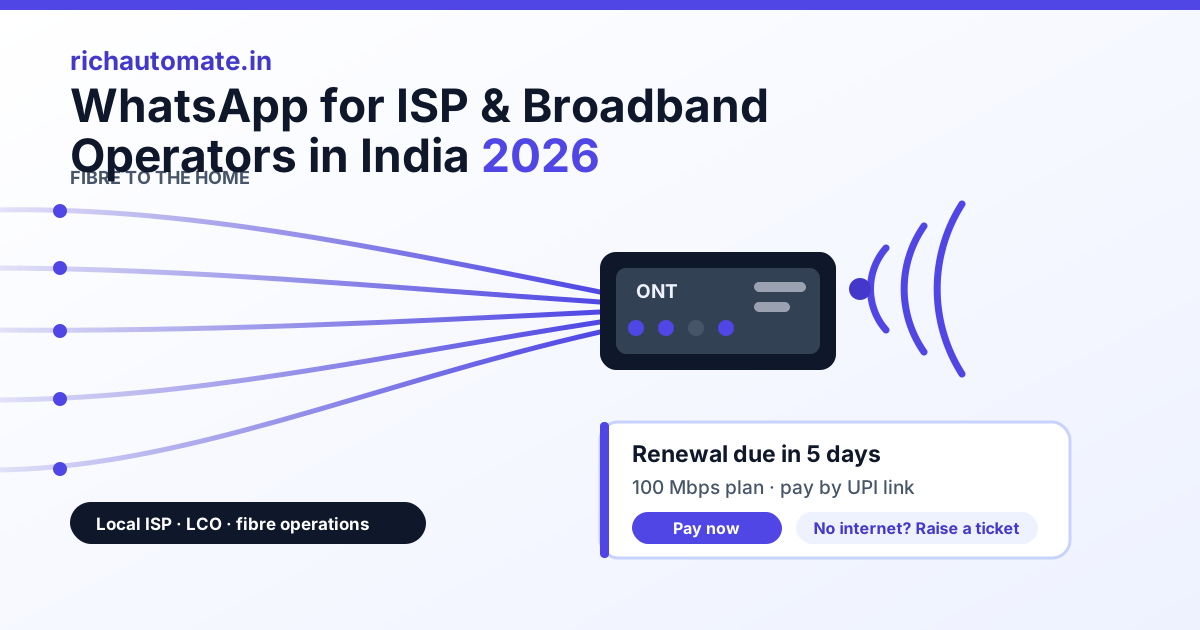
Local ISPs and LCO-turned-fibre operators in India run their subscriber desk on WhatsApp because the two events that decide the P&L — the plan renewal collected before the disconnect date, and how fast a "no internet" complaint reaches a technician — are both single-message events. A WhatsApp Business API setup turns them into automated, logged, template-driven flows: renewal reminders carrying a UPI payment link, and one-tap downtime tickets with an SLA timer and technician dispatch.
If you run 800 to 5,000 connections across three or four localities, you already know the shape of the problem. Your collection window is the last five days of the month. Your support load spikes at 8pm when every household starts streaming. And your churn happens quietly — a subscriber gets disconnected on the 6th, waits, and by the 9th a competitor's drop cable has reached his balcony. That is a messaging cadence problem, not a technology problem, and it is the one thing a broadband operator can fix in a fortnight.
Why WhatsApp, and not SMS or the 8pm phone call
Most operators started on SMS. Then TRAI's TCCCPA framework and DLT registration arrived, header and template scrubbing tightened, and the transactional SMS that used to land in two seconds started arriving late, getting filtered, or being rejected outright for a template mismatch. A renewal SMS that lands on the 3rd instead of the 27th is worthless — the disconnect has already happened. The phone route does not scale either: one desk person manages maybe 60 useful calls a day.
The WhatsApp template library covers the common message types here if you want a starting point.
WhatsApp sits in a different lane. It is an opt-in, template-approved channel with delivery and read receipts you can actually see, media support for the payment receipt and the ONT handover photo, and — the part that matters operationally — a threaded history per subscriber, so the next agent can see what the last one promised. Verify the current DLT and TCCCPA position with your compliance advisor before retiring SMS entirely.
| Channel | Renewal reminder reality | Downtime ticket reality | Practical ceiling |
|---|---|---|---|
| Voice call from the office | Works, but only for your top accounts | Fine for an angry subscriber, hopeless at volume | ~60 calls per person per day |
| Transactional SMS (DLT) | Template-scrubbed, latency unpredictable, no receipt image | No two-way thread, no media, no status | Delivery you cannot verify |
| Field boy knocking on doors | Collects cash, costs a visit each | Only if he is already in that lane | Dies past one locality |
| WhatsApp Business API | Reminder + UPI link + receipt, delivery and read visible | One-tap ticket, SLA timer, technician ETA, closure proof | Opt-in and template discipline |
The compliance spine you build the flows on top of
An ISP is a licensed entity, and the bot lives inside that licence — it never replaces any part of it. Treat this section as a prompt to check with your own licensor and compliance team, not as legal advice, and verify the current text of every obligation before changing a process.
You operate under a DoT Unified Licence with an ISP authorisation, scoped to a service area category — commonly described as Category A for national scope, B for a telecom circle, C for a smaller secondary switching area. That scope decides where you may serve, and therefore what your serviceability bot is allowed to say yes to. Never let an automated feasibility reply promise coverage outside your licensed area; verify current licence conditions with your licensor.
TRAI's broadband quality-of-service and tariff-reporting obligations shape what you can safely automate. Tariff transparency means the price quoted in your renewal template must match what you have published and reported; QoS reporting means your complaint-resolution timelines are already measured, so an SLA timer inside WhatsApp should mirror your reported process rather than invent a friendlier one. Verify current TRAI regulations and reporting formats — they are revised periodically.
The Customer Application Form and its KYC annexures remain a licence obligation with retention requirements. WhatsApp is an excellent collection channel — the subscriber photographs the ID page, the signed CAF, the address proof — but verification and retention stay with your KYC-trained staff and your record system. CERT-In directions on log retention and incident reporting apply to you as a service provider; those logs live in your NOC, never in a chat platform. Lawful interception is entirely your compliance team's domain — the bot never touches it.
On subscriber personal data, the DPDP Act 2023 changes how you should think about a chat archive full of identity photographs. Collect the minimum, retain it only as long as your licence requires, name someone accountable, and be able to answer an erasure request without a week of manual searching — our DPDP Act 2023 compliance checklist covers the practical version for a small operator. Two mundane items complete the picture: GST applies to your subscription billing, so the receipt the bot sends should be the GST-compliant document your accounting system generates; and right-of-way permission for fibre laying comes from the local body, so a new-connection flow must not quote an installation date assuming a permission you do not hold.
Stage 1 and 2: the enquiry, the serviceability check, and the CAF
A broadband enquiry is almost always "is your line available at my address". That question is where operators lose the most cheap demand, because it arrives at 10pm to a number nobody is watching. Automate the intake, not the answer: capture building, locality, landmark and pin code, then match against your served-buildings list.
There are three honest outcomes and the bot should give all three plainly. Serviceable now, in which case offer installation slots. Feasible with a drop from an existing junction, in which case it goes to a survey queue with a realistic window. Not serviceable, in which case say so and offer to notify when the area is lit. Log every not-serviceable pin code — six months of them is the best expansion map you will ever get, and it costs nothing to collect.
Once the subscriber says yes, CAF and KYC collection runs as a checklist inside the thread: signed CAF, ID proof, address proof, photograph, and the advance plus installation charge. The bot chases what is missing — "we have your ID, still need signed CAF page 2" — which is exactly the boring follow-up your desk person forgets on a busy day. Book the installation slot only after the documents are in, or your technician makes a wasted trip.
Stage 3: installation and the ONT handover proof
The most under-rated message in this lifecycle is the handover photo. When the technician finishes, he sends a photo of the installed ONT with its serial visible, the router, and the speed-test result into that subscriber's thread. Three months later, when the subscriber insists the router was never handed over or the ONT was faulty from day one, you have a timestamped image against the account.
Attach the ONT and router serials, the plan, the activation date and the next due date to the subscriber record in the same step. That next due date drives everything after this point. If you are still deciding where subscriber records should live, our comparison of the best WhatsApp CRM options for Indian businesses covers chat-native records versus a separate billing system.
Stage 4: the renewal clock — the money message
This is the flow that pays for the platform, so build it first and build it carefully. Your billing system already knows every subscriber's due date, and the renewal sequence hangs off that date rather than a calendar day — quarterly and half-yearly subscribers renew on their own cycle, and a month-end blast reaches half of them at the wrong time.
A cadence that works: a reminder five days before the due date carrying the plan, amount, due date and a UPI or gateway payment link; a second at two days; one on the due date; and, only if still unpaid, a grace-period notice stating the disconnect date exactly as your terms define it. The instant payment lands, the receipt goes back into the thread automatically — that matters more than it sounds, because half your "but I already paid" support load is a subscriber holding no proof.
Get the India 2026 WhatsApp BSP price comparison
Wati vs AiSensy vs Interakt vs RichAutomate: Meta rates, platform fees and hidden costs, side by side. We send it to your WhatsApp in a minute.
Two rules from operators who have run this for a year. Never let the reminder be the first message of the month — a subscriber who has heard nothing since installation reads a payment reminder as a dunning notice, and a short uptime note earlier in the cycle changes the tone completely. And the payment link must point at your own gateway with the subscriber ID pre-filled; every manual step left in the payment path costs you collections on the 1st.
| Stage | Trigger | Message type | What it is worth |
|---|---|---|---|
| 1. Enquiry and serviceability | Inbound "is it available at my address" | Service reply / utility | Captures after-hours demand |
| 2. CAF and KYC collection | Subscriber accepts a plan | Utility, checklist chase | Kills the wasted installation trip |
| 3. Installation and handover | Technician closes the job | Utility with media | Timestamped ONT proof per account |
| 4. Renewal and payment | Due date minus 5, minus 2, due date, grace | Utility, payment link, receipt | The collection curve — the money message |
| 5. Downtime ticket | Subscriber reports no internet | Utility, SLA-timed | Retention — a fast fix is why nobody leaves |
| 6. Upgrade, OTT, referral, win-back | Opted-in segments and the churn list | Marketing, opt-in only | ARPU plus cheap new connections |
Stage 5: the downtime ticket and the SLA timer
At 8:40pm a subscriber types "net not working". Today that message either sits unread or lands in a personal WhatsApp on someone's second handset. Structure it instead: an immediate acknowledgement with a ticket number, two or three questions a subscriber can genuinely answer (are the ONT lights on, one device or all, did it stop suddenly), then routing.
Routing is where the real win sits. If your NOC already shows an OLT-level or area-level outage, the bot should say so — "known outage in your area, fibre cut near the main road, restoration expected by 10:30pm" — and stop that ticket from becoming a technician visit. During an outage that single branch removes most of your dispatch load. A single-subscriber fault goes to the technician covering that lane with address, ONT serial and symptom attached, and the subscriber gets a name and a window. On closure the technician confirms in the thread and the subscriber confirms the line is up.
The bot asks questions and routes. It does not diagnose, and it never tells a subscriber the fault is in his router or that the fibre is cut unless a human or your monitoring system established that. It also never quotes a two-hour response SLA if you have two technicians covering four localities — promise the window you can staff, because a missed automated promise damages you more than a slower honest one. The same discipline governs any field-service business; the pattern is nearly identical to our guide on WhatsApp for CCTV installers and AMC businesses.
Stage 6: upgrades, OTT bundles, referrals and win-back
Everything up to here is utility traffic tied to an existing service relationship. Stage 6 is marketing, and it is where operators get into trouble. Send plan-upgrade offers, OTT bundle additions and referral schemes only to subscribers who have opted in, keep frequency low, and always give a clean way to stop. Nobody can promise you immunity from restrictions for bulk or unsolicited sending — that risk sits with you, and the only genuine mitigation is real opt-in and real relevance.
Done properly this segment stays small and works well. Subscribers repeatedly hitting their FUP limit are your natural upgrade list. And referrals from a satisfied subscriber in a building where your fibre already terminates are the cheapest new connections in the business — a referral message a day after a well-handled downtime fix converts better than any hoarding. For churned subscribers, one win-back message with a concrete reason to return is worth trying. Once, not monthly.
What the bot must never do
Write these down and hand them to whoever configures your flows. The bot does not perform KYC verification — it collects documents, and your trained staff verify and retain them under your licence obligations. It does not diagnose a line fault; it triages and routes. It never promises a response or restoration SLA you cannot staff. It never exposes one subscriber's data inside another's thread, which means no shared thread for a whole building and no copy-pasted account details. It has no role in lawful interception or log retention — those belong to your compliance team and your NOC. It does not send marketing to anyone who has not opted in. And it never quotes a tariff differing from what you have published and reported.
What this actually costs a 2,000-subscriber operator
RichAutomate charges no platform fee, no setup fee and no monthly minimum — you pay only for messages. For a broadband operator the arithmetic is simple, because the traffic is overwhelmingly utility, which is the cheap category. Take an operator with 2,000 connections on a monthly cycle, roughly 40 new connections a month, about 8 percent of subscribers raising a downtime ticket, and 1,200 subscribers opted in to offers.
| Flow | Messages per month | Category | SaaS Pay cost |
|---|---|---|---|
| Renewal reminders (T-5, T-2, due date) | 6,000 | Utility | ₹1,800 |
| Payment receipts | 2,000 | Utility | ₹600 |
| Downtime tickets (160 tickets x 4 messages) | 640 | Utility | ₹192 |
| New-connection onboarding (40 x 6 messages) | 240 | Utility | ₹72 |
| Upgrade / OTT / referral broadcast | 1,200 | Marketing | ₹1,440 |
| Total | 10,080 | — | ₹4,104 + GST |
That is roughly ₹2.05 per subscriber per month on SaaS Pay, where utility and authentication messages are ₹0.50 each and marketing messages are ₹1.50 each, inclusive of the Meta pass-through and billed as one INR invoice with GST. On Client Pay you attach your own Meta billing and pay RichAutomate ₹0.10 per message — the same 10,080 messages cost ₹1,008, with Meta invoicing you directly for its conversation charges. Larger operators usually land on Client Pay; those wanting a single Indian invoice stay on SaaS Pay. The trade-off is laid out in Client Pay vs SaaS Pay, and the full breakdown of what a WhatsApp Business API deployment costs in India is in our WhatsApp Business API pricing guide.
Set that against reality. At a typical fibre ARPU of a few hundred rupees a month, recovering even a handful of renewals that would otherwise have lapsed past the disconnect date pays the entire messaging bill several times over. The downtime flow is harder to quantify, but the complaint acknowledged in ten seconds does not become the complaint that ends in a disconnection request.
Roll it out in two weeks, starting with the renewal flow
Do not build all six stages at once. Week one: get the number live, import subscribers with their due dates, and ship the renewal sequence only — that one flow moves collections within the first cycle. Week two: add the downtime ticket with real routing to your technicians, then the installation handover photo. Leave marketing broadcasts for month two, once you have a clean opt-in list rather than an imported contact dump.
Two warnings. Submit utility templates for approval early, because approval time delays go-live, not the integration. And clean your due-date data before importing — a reminder sent on the wrong date to 2,000 people is a loud mistake.
RichAutomate comes with a 14-day trial and 100 free message credits, no platform fee, no setup fee, no monthly minimum — enough to run one renewal cycle for a pilot group and watch the collection curve move before committing. Create your free RichAutomate account and build the renewal reminder first, then check transparent INR pricing for the full Client Pay and SaaS Pay comparison.